
How Much Water Does Softener Regeneration Use?
How much water does a softener use to regenerate? Usually between about 40 and 100 gallons per cycle. A 1.5 cubic foot softener in a 10-inch tank, worked through one manufacturer's published cycle times, uses about 56 gallons at an economy salt setting, 85 at a standard setting and 105 at a high setting. On a metered softener that regenerates every week or so, that adds up to roughly 3 to 4 percent of what the household uses in a year.
The objection to buying a softener is usually based on a bigger impression than that: a picture of hundreds of gallons flushed every night. That happens only with an old-style timer set to regenerate daily. This page works out the real number stage by stage, puts it against a year of household use, and then goes through the levers that reduce it, with what each one saves.
How Much Water a Softener Uses to Regenerate, Stage by Stage
Regeneration is not one flush. It is four or five separate stages, each with its own flow rate and length. The water use is simply flow × minutes for each stage, added up. The stages themselves are explained in how water softener regeneration works. Here the only question is how many gallons each one sends to the drain.
Two published sources give the numbers needed:
- Flow rate. Pentair's whole-house softener spec sheet lists a backwash of 2.5 gpm for its 1.0 and 1.5 cubic foot units in 10-inch tanks, and 3.5 gpm for the 2.0 cubic foot unit in a 12-inch tank. The drain line flow control holds that rate for backwash and fast rinse.
- Minutes. Clack's WS1 control valve manual publishes the cycle times its valve runs as a downflow softener. They get longer as the salt dose goes up, which is the detail most estimates miss.
| Clack WS1 downflow stage | Under 7.5 lb salt per cu ft | 7.5 to 12 lb | Over 12 lb |
|---|---|---|---|
| Backwash | 6 min | 8 min | 8 min |
| Regenerate (brine draw + slow rinse) | 45 min | 60 min | 75 min |
| Second backwash | 3 min | 8 min | 10 min |
| Rinse | 3 min | 4 min | 6 min |
| Total, not counting refill | 57 min | 80 min | 99 min |
The brine draw and slow rinse stage moves water through the injector, not the drain restrictor, so it runs much slower than backwash. Injector flow depends on the injector size and your pressure. For the worked example below I assume 0.5 gpm, which is an illustrative figure, not a published one. The refill is set by the salt dose: Fleck's brine line flow controls are labelled at 3 lb of salt per gallon of refill water, so 13.5 lb of salt needs about 4.5 gallons.
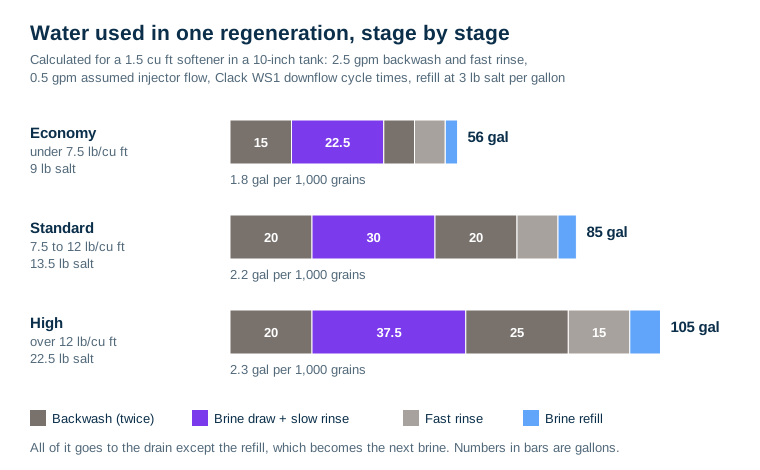
Put together for a 1.5 cubic foot unit:
| Salt setting | Salt per cycle | Water per cycle | Capacity per cycle | Water per 1,000 grains removed |
|---|---|---|---|---|
| Economy (6 lb/cu ft) | 9 lb | ~56 gal | ~31,500 grains | ~1.8 gal |
| Standard (9 lb/cu ft) | 13.5 lb | ~85 gal | ~39,000 grains | ~2.2 gal |
| High (15 lb/cu ft) | 22.5 lb | ~105 gal | ~46,500 grains | ~2.3 gal |
Calculated. Capacities are the published design figures for standard resin, scaled to 1.5 cubic feet. Your valve's cycle times and flow controls will differ.
For comparison, the efficiency criteria summarised by the U.S. Department of Energy's Building America Solution Center ask a softener to "not generate more than 5.0 gallons of water per 1,000 grains of hardness removed", alongside a salt efficiency of at least 3,350 grains per pound and demand-initiated control. All three settings in the example clear that water limit easily. Only the economy setting clears the salt one.
Why the range quoted online is so wide
Figures from 25 to 150 gallons all circulate, and most of them are right for some softener. Three things move the number:
- Tank diameter. Backwash flow scales with the bed's cross-section. A 9-inch tank might backwash at about 2 gpm, a 12-inch at 3.5 gpm, a 14-inch at 5 gpm. Same minutes, very different gallons.
- One backwash or two. Clack's downflow sequence backwashes twice. Many other valves backwash once and then fast-rinse.
- Salt setting. On valves that scale cycle times to the dose, a heavier salt setting also means a longer, wetter cycle.
To get your own number, find the drain line flow control rating (it is stamped on the fitting or listed in the manual) and the programmed stage minutes, and multiply.
The Number in Context: A Year of Household Water
A single cycle is the wrong unit for judging waste. What matters is how often it runs. The EPA's WaterSense programme says the average American family uses more than 300 gallons of water per day at home, about 109,500 gallons a year. Its page on cation exchange water softeners warns that regeneration "can use 25 gallons of water or more per day, or up to 10,000 gallons per year". That warning describes a softener regenerating frequently. A metered one does far better.
Take that 300-gallon household on 15 gpg water. It removes 4,500 grains of hardness a day, and the 1.5 cubic foot softener holds back a day of that as reserve.
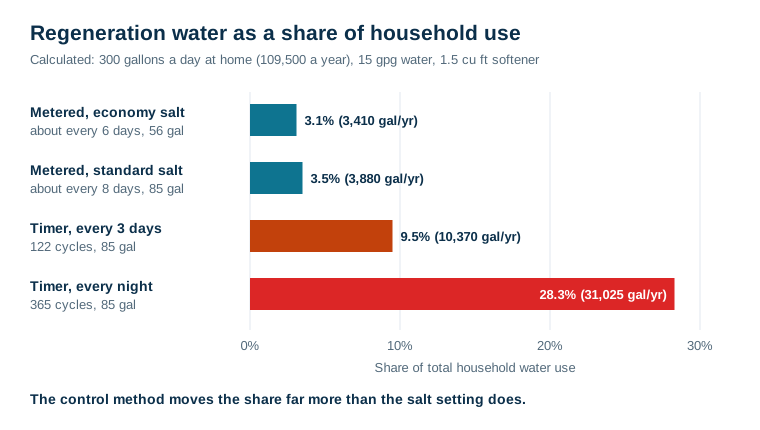
| Control and setting | How often | Gallons a year | Share of household use |
|---|---|---|---|
| Metered, economy salt | about every 6 days | ~3,410 | ~3.1% |
| Metered, standard salt | about every 8 days | ~3,880 | ~3.5% |
| Timer, every 3 days | 122 times | ~10,370 | ~9.5% |
| Timer, every night | 365 times | ~31,025 | ~28% |
Calculated from the per-cycle figures above.
Three percent is roughly 65 gallons a week, in the range of a couple of extra loads of laundry. Twenty-eight percent is a genuine problem. The same softener can land at either end, and the difference is almost entirely in the control settings, not the hardware. The yearly picture across household sizes is worked through in how much water a softener uses per year.
Five Levers That Cut Regeneration Water, Ranked
These are in order of how much they save for the least risk.
1. Metered, demand-initiated control
Savings: the largest by far. A timer has to be set for the heaviest week the house ever has, so in a normal week it regenerates with capacity left over. A meter waits until the capacity is actually used. In the table above, moving from a three-day timer to metered control cuts regeneration water by about two-thirds.
If your valve has a meter, check that it is being used. Clack's valve can run as a time clock, a meter, or both, depending on how the Day Override and Volume Capacity are set. A metered valve with a short day override is effectively a timer again. The full comparison is in metered vs timer-based water softeners.
2. A lower salt setting
Savings: about 20 percent per grain of hardness removed in the example, from 2.2 gallons per 1,000 grains down to 1.8. A lower dose regenerates more often, but each cycle is shorter on valves that scale their times to the dose, and the salt saving comes with it. This is the one lever that cuts salt and water together. If you change the dose, re-enter the capacity for the new dose at the same time, or the meter keeps counting for the old one.
3. Upflow (counter-current) brining
Savings: roughly one backwash per cycle. In Clack's tables the upflow sequence skips the first backwash: 54, 74 or 93 minutes against 57, 80 or 99 for downflow, and only one backwash in each. On the example's standard setting that is about 70 gallons instead of 85. Upflow is a valve and piston configuration, not a menu setting, so this lever applies when you buy, not after.
4. Right-sizing and the day override
Savings: avoiding cycles that should not run. A softener far bigger than the household needs does not regenerate less in practice, because a sensible day override forces a cycle every week or two anyway to keep the bed from going stagnant. An oversized bed then uses big-tank backwash flow on a bed that was barely used. Match the resin to the load and the override rarely triggers.
5. Trimming the backwash
Savings: a few gallons, with real risk. This is where owners usually start, and it should be last. Backwash lifts the bed, breaks up channels and flushes out silt and iron fines. Pentair's whole-house softener manual allows 5 to 99 minutes but says it does not recommend a backwash of less than 10 minutes. On clean city water, trimming a long custom backwash back to the manufacturer's default is reasonable. Cutting below it on well water with sediment or iron saves perhaps 5 to 10 gallons a cycle and shortens resin life.
The full tuning sequence, including where further cuts start costing you soft water, is in how to optimize regeneration for salt and water efficiency.
What Does Not Reduce It
- Pre-fill. Some valves make the brine two hours before regeneration instead of after it. That changes when the refill happens, not how much water is used.
- Lowering the hardness setting. Entering a lower hardness than you have makes the valve regenerate less often, but the resin runs out first and hard water gets through. The water saved is paid for with scale.
- Blocking the drain line flow control. A restricted drain slows backwash below what the bed needs. It saves water and damages the softener.
- Softer water from the softener. Nothing about the softening itself uses extra water. All the water use is in regeneration.
Where the Water Goes, and What a Softener Cannot Do About It
Everything except the refill leaves through the drain line, carrying the hardness minerals the resin removed and the unused salt. On a sewer, the treatment plant receives it. On a septic system, the tank does. Volume on a metered softener is modest, but it arrives as one slug of salty water, which is why a septic system deserves its own check before you install. If you are on one and still choosing a unit, comparing softeners for a septic system by the gallons each sends to the drain in a year puts the metered and upflow designs side by side.
A softener cannot regenerate with zero water, and it cannot recycle its own brine on residential equipment. The practical floor is a metered valve at an efficient salt setting, sized for the household. For most homes that is around 3 percent of household water. The water saved by efficient settings is real, but it is often smaller than what a running toilet or an overwatering irrigation zone wastes. Check those too if you are trying to cut the water bill.
Frequently Asked Questions
How many gallons does a water softener use per regeneration?
Most residential softeners use somewhere between about 40 and 100 gallons per regeneration. Worked from one manufacturer's cycle times, a 1.5 cubic foot unit in a 10-inch tank uses about 56 gallons at an economy salt setting, 85 at a standard setting and 105 at a high setting. Smaller tanks with slower backwash flows sit toward the low end, and larger tanks toward the high end.
Does a water softener waste a lot of water?
On a demand-initiated, metered softener it is usually a small share of household use. For a household using 300 gallons a day on 15 gpg water, regeneration works out to roughly 3,400 to 3,900 gallons a year, about 3 to 4 percent. A timer that regenerates every night on a fixed schedule can use more than 30,000 gallons a year, which is where the reputation for waste comes from.
Which regeneration stage uses the most water?
Backwash and the brine draw with slow rinse. Backwash runs at the drain line flow control's rate, about 2 to 3.5 gpm on residential tanks, for 6 to 12 minutes, sometimes twice. The brine draw and slow rinse runs much slower but lasts 45 to 75 minutes. The brine refill is the smallest part, only a few gallons, and it stays in the brine tank for the next cycle.
Can I shorten the backwash to save water?
Only a little, and only on clean water. The backwash lifts and loosens the resin bed and flushes out sediment. One manufacturer's manual says it does not recommend a backwash shorter than 10 minutes. Cutting it on water with iron or sediment saves a few gallons and costs resin life. Metered control and the right salt setting save far more with no risk to the bed.
Does a twin-tank softener use less water to regenerate?
Not per cycle in any meaningful way. Each tank still backwashes, brines and rinses. A twin-tank unit can save water only because it regenerates exactly when a tank is used up and wastes no reserve capacity. Some designs rinse with soft water from the other tank, which uses that tank's capacity instead of fresh supply.
Is softener regeneration water bad for a septic system?
The volume is modest on a metered softener, often similar to a few extra loads of laundry a week, but it arrives all at once and carries salt. The fewer and more efficient the regenerations, the less goes to the tank. The septic question is covered in its own article, along with where the discharge is allowed to go.
