
Can a Water Softener Be Too Large?

Yes, a water softener can be too large. Oversized water softener problems all come from one fact: a bed sized far beyond the household's daily hardness load regenerates too rarely. The resin then sits in still water for weeks, the wider tank needs more backwash flow than the plumbing may supply, and salt gets wasted when a timer forces the cycle early. Bigger is not automatically safer.
The standard sales advice runs the other way. Buy more capacity than you need, the thinking goes, and you will never run out. That is true as far as it goes. It ignores what happens to a resin bed that is almost never asked to regenerate, and it ignores a setting built into nearly every modern control valve for exactly this situation.
Oversized Water Softener Problems Start With the Calendar
A softener does not regenerate on a schedule it chooses. A metered valve regenerates when the gallons it has softened use up the bed's capacity. Put a big bed in a small household and those gallons take a long time to add up.
Penn State Extension's guide to water softening works through the basic arithmetic: four people using 75 gallons each per day on 10 gpg water load the softener with 3,000 grains a day. A bed that delivers 20,000 grains regenerates about every six to seven days.
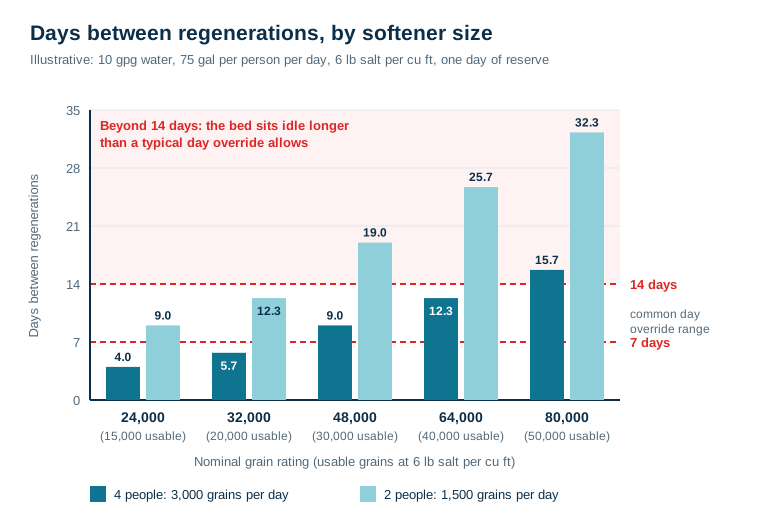
Run the same household through a range of common sizes and the calendar stretches quickly. The chart assumes a moderate salt dose of 6 lb per cubic foot, which gets roughly 20,000 grains from each cubic foot of standard resin, and one day of reserve. That is the conservative figure from Penn State's worked example; some manufacturer tables rate a cubic foot nearer 23,000 grains at 6 lb, which would stretch each calendar further still.
| Nominal rating | Usable at 6 lb/cu ft | 4 people (3,000 grains/day) | 2 people (1,500 grains/day) |
|---|---|---|---|
| 24,000 | 15,000 | 4.0 days | 9.0 days |
| 32,000 | 20,000 | 5.7 days | 12.3 days |
| 48,000 | 30,000 | 9.0 days | 19.0 days |
| 64,000 | 40,000 | 12.3 days | 25.7 days |
| 80,000 | 50,000 | 15.7 days | 32.3 days |
The two-person column is the one that matters. Houses are sized for the family that bought the softener, then the children leave. A 64,000-grain unit that suited five people on 20 gpg water can end up serving a retired couple, and on gallons alone it would regenerate about once a month.
Nothing is visibly wrong while that happens. The water tests soft, the salt level barely moves, and the owner assumes the softener is being efficient.
Why a Bed Needs a Minimum Regeneration Frequency
Regeneration does more than restore capacity. Each cycle backwashes the bed, lifting and loosening the resin, then rinses it with strong brine and fresh water. A bed that goes weeks between cycles misses all of that.
Stagnation is the main problem. A resin bed is a very large wet surface area sitting at room temperature. When no water moves through it for days, the bed and the water standing in it become a place for microbes to grow. Research reviewed in a 2023 Environmental Science and Technology paper on residential water softeners reports that softeners can raise heterotrophic plate counts by up to three orders of magnitude, and that pathogenic bacteria can remain in a softener even after regeneration. The same paper notes resins can consume free chlorine, which strips out the disinfectant a city supply relies on.
Be careful with what that does and does not mean. A heterotrophic plate count is a general measure of bacteria, not a diagnosis of anything harmful, and the research does not show that an oversized softener makes people ill. What it does show is that the resin bed is not sterile, that still water makes it worse, and that regular regeneration is part of how the bed stays in check.
The bed also settles. Resin packs down under its own weight when nothing moves it. A regular backwash re-fluffs it. A bed that is backwashed once a month has longer to compact between fluffings, which is one of the conditions behind resin channeling.
The first draw after a long idle period is the worst. The water in the tank and the plumbing after it has been standing the whole time. Musty or stale-tasting water first thing after a holiday is a common report from owners of large, lightly used softeners.
The practical conclusion is simple. A healthy bed regenerates every few days to about two weeks. Past 14 days, most valves offer a way to force the issue.
The Setting Built for This: Day Override
Almost every metered control valve has a setting that caps the number of days between regenerations, whatever the meter says. Manufacturers call it different things: day override, regeneration day override, calendar override, or maximum days between regenerations.
Clack's WS1 control valve manual lets the installer set day override anywhere from 1 to 28 days, or turn it off. It also warns that day override and gallon capacity cannot both be off, because then the valve would have no reason to regenerate at all. Fleck and other valve makers have the equivalent in their installer menus.
How to check yours:
- Find the installer or "master" programming menu in the manual. It is usually a button combination held for a few seconds.
- Step through until you reach the day override or calendar setting.
- If it reads OFF, or a number above 14, write down the current value before you change anything.
- Set it to 7 to 14 days. Seven is the cautious choice for a lightly used unit or a well with a trace of iron. Fourteen suits a unit that normally regenerates on gallons every week or so.
- Leave gallon capacity on AUTO or at its calculated figure, so the meter still triggers regeneration during busy weeks.
Day override on its own creates a new waste. On the 64,000-grain unit serving two people, a 14-day override triggers regeneration when only about 21,000 of the 40,000 usable grains have been used. Roughly half the salt in each regeneration recharges resin that was never exhausted. That is why the setting only fixes stagnation. It needs a second change to stop the waste.
Lower the Salt Dose So Capacity Matches the Calendar
The second change is to shrink the bed's usable capacity until it runs out at about the same time the day override would trigger. You do that with the salt dose.
Resin capacity rises and falls with salt. A lower dose per cubic foot regenerates the bed less completely, which gives less capacity per cycle but more grains per pound of salt. That trade-off, which is covered in whether a higher grain rating is always better, is the one genuine argument for a slightly bigger softener: it lets you run a low, efficient dose and still have enough capacity.
On an oversized unit, the goal is to take that trade-off as far as the manufacturer allows:
- Read the capacity chart in the manual. It lists usable grains at each salt setting. Pick the lowest dose the chart lists that still gives at least a week of capacity at your daily load.
- Recalculate the reserve at the new capacity. It should be about one day's use, not a fixed percentage left over from a bigger family.
- Watch the gallons-remaining figure for two cycles. If the unit still reaches the day override with most of its capacity left, it is too big even at the lowest dose.
There is a floor. Resin capacity charts stop at a minimum dose, and a softener two or three sizes too big can still reach day override with capacity to spare at that minimum. The remaining waste is the price of the oversizing. How often a correctly sized unit should cycle is set out in how often a water softener should regenerate.
The Second Chain: Backwash Flow Grows With Tank Diameter
The stagnation problem can be fixed with settings. The backwash problem cannot, because it is built into the tank.
A softener's backwash must lift the bed by a set percentage to loosen it and wash out fines. The flow needed to do that depends on the area of the bed, which depends on the tank diameter. Going from a 10-inch to a 14-inch tank roughly doubles the bed area, so it roughly doubles the backwash flow the supply has to deliver.
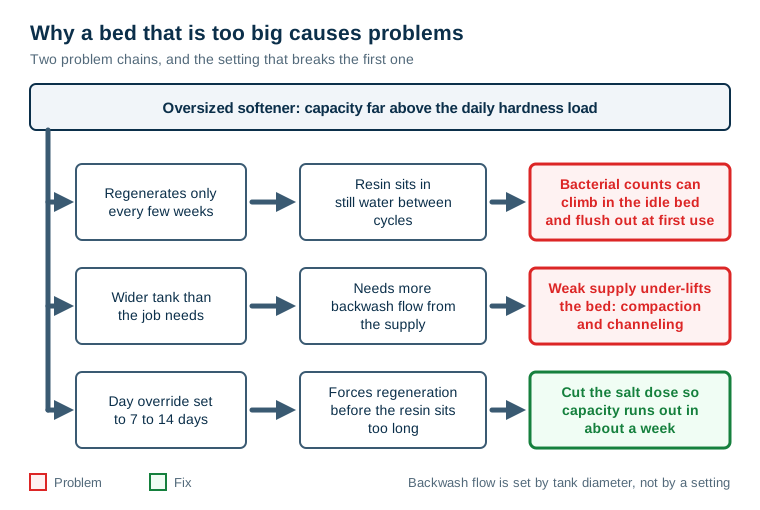
On city water that is rarely a problem. On a private well it can decide whether the softener works at all. A pump that holds 3 gpm will backwash a 10-inch tank properly and under-lift a 14-inch one every single cycle. The under-lifted bed compacts, fines stay in, and water starts carving channels through it. The published backwash figures by tank diameter, and how to measure what a well actually delivers, are in well pump flow and backwashing.
This is the oversizing mistake that costs the most. Stagnation can be tuned away in five minutes. A tank too wide for the well needs a different softener.
When Bigger Really Is the Right Call
This page is not an argument for the smallest unit that will do. Undersizing is the more common fault and the more annoying one, because it lets hard water into the house before the bed regenerates. There are households where the larger unit is correct:
| Situation | Why a bigger bed makes sense |
|---|---|
| Hardness above 20 gpg with 4 or more people | Daily load is high enough to keep a big bed cycling every few days |
| Iron in the supply | Iron adds to the effective hardness and fouls resin faster, so extra capacity is used |
| Salt efficiency matters more than upfront cost | A larger bed at a low dose uses fewer pounds of salt per grain removed |
| Household is growing | A unit for the family you will have in two years, not the one you have now |
| High peak flow | A wider tank passes more gallons per minute with less pressure drop |
The test in every row is the same. Will the household's real daily load exhaust the bed within about a week at an efficient salt dose? If yes, the bigger unit is sized correctly. If the answer depends on the day override doing the work, it is too big. Above 20 gpg, choosing a large-capacity softener for very hard water comes down to this same test, and an 80,000-grain unit passes it only at a daily load of roughly 5,600 grains or more.
A Worksheet for Checking Whether Yours Is Too Large
You need four numbers, all of which you can get without a technician.
| Step | What to find | Example (two people, 64,000-grain unit) |
|---|---|---|
| 1 | Compensated hardness in gpg (add 3 to 4 gpg per ppm of iron) | 10 gpg |
| 2 | Daily use: people × 75 gallons, or read the meter over a week | 2 × 75 = 150 gallons |
| 3 | Daily load: step 1 × step 2 | 1,500 grains |
| 4 | Usable capacity at your current salt dose, from the manual's chart | 40,000 grains |
| 5 | Days between regenerations: (step 4 − one day's load) ÷ step 3 | 25.7 days |
How to read the answer:
- 4 to 8 days: well sized. Leave it.
- 8 to 14 days: a little large. Set day override to 14 and consider a lower salt dose.
- Over 14 days: oversized at this setting. Set day override to 7 to 14 days and lower the salt dose to the manual's minimum that still gives a week of capacity.
- Over 14 days even at the minimum dose: the bed is too big for the household. Live with some salt waste, or plan a smaller unit when this one needs a new valve or resin.
If you are buying rather than checking an existing unit, the same worksheet run in reverse gives the target size. Work out the daily load, multiply by seven, and choose the smallest standard size that delivers that capacity at an efficient salt dose. For two or three people on moderate water, that is often about 1 cubic foot of resin, and comparing 32,000-grain softeners at the same efficient salt dose shows what one really delivers per cycle.
What Right-Sizing Will Not Fix
A correctly sized, regularly regenerating softener still has limits worth stating plainly:
- It does not disinfect. Regular regeneration keeps the bed in better condition, but a softener is not a treatment for bacteria. If a well tests positive for coliform, that is a separate problem needing its own treatment.
- It does not replace chlorine it consumes. On chlorinated city water, the resin can use up some of the residual disinfectant.
- It does not fix a weak well. Sizing down to a narrower tank reduces the backwash demand, but it does not add flow the pump cannot supply.
- It does not remove contaminants other than hardness. Lead, arsenic, nitrate and most other health-related contaminants need their own treatment, as Penn State's guide notes.
What to Do Next
- Check the day override. If it is off or above 14 days, set it to 7 to 14.
- Run the worksheet above with your own hardness and water use.
- If the unit would go longer than two weeks on gallons alone, lower the salt dose to the smallest setting that still gives about a week of capacity.
- On a well, compare the valve's backwash flow with what the pump actually delivers before you blame the resin for anything.
- If you are about to buy, size for a regeneration every four to eight days. Bigger than that pays for capacity the house will never use.
Frequently Asked Questions
Can a water softener be too big for a house?
Yes. A softener whose capacity is far above the household's daily hardness load goes a long time between regenerations, sometimes several weeks. The resin sits in still water for that whole time, and a larger tank diameter also needs more backwash flow than a smaller one. Moderate oversizing is fine and can even save salt, but a unit that would naturally regenerate less than every 14 days needs its day override set and its salt dose lowered.
What happens if a water softener is oversized?
Three things. The bed regenerates rarely, so resin stands in stagnant water where bacterial counts can climb. The tank is wider, so it needs more backwash flow, and a supply that cannot deliver it leaves the bed compacted and prone to channeling. And if the day override then forces regeneration before the capacity is used, salt is wasted unless the dose is reduced.
How often should a water softener regenerate at minimum?
Most control valves let you force a regeneration after a set number of days whatever the meter says. Common settings run from 7 to 14 days, and many installers treat 14 days as the longest a bed should sit. If your softener would go longer than that on gallons alone, it is larger than the household needs at its current salt setting.
Is it better to oversize or undersize a water softener?
Slightly oversized is better than undersized, because an undersized unit lets hard water through before it regenerates. The mistake is jumping two or three sizes. Aim for a unit that regenerates roughly every 4 to 8 days at an efficient salt dose, with the day override as a backstop rather than the main trigger.
Does a bigger water softener use less salt?
It can, because a bigger bed lets you run a lower salt dose per cubic foot, and resin uses salt more efficiently at low doses. That advantage disappears if the unit regenerates on a day override with much of its capacity unused, or if the salt dose is left at a high factory setting.
What is day override on a water softener?
Day override is the maximum number of days the valve will wait between regenerations, even if the meter has not counted enough gallons to trigger one. On a Clack WS1 valve it can be set from 1 to 28 days or turned off. On an oversized softener it is the setting that stops the resin sitting idle for weeks.
