
Signs a Water Softener Is Undersized
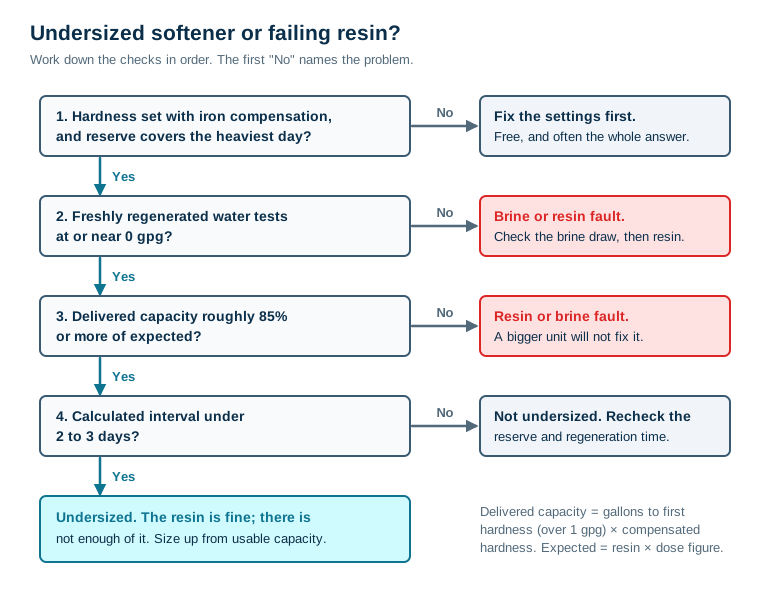
The clearest signs a water softener is undersized are regenerating every one to two days with the hardness set correctly, hard water appearing on the same predictable day of each cycle, and salt use that matches the household's hardness load. Failing resin can produce the same early hardness, so confirm with one test: measure how many grains the softener actually delivers per cycle and compare it with what it should deliver.
If it delivers close to its expected capacity and still runs out, it is too small. If it delivers far less, the resin or the brining is the problem, and a bigger softener would not fix it.
Why Undersizing and Resin Failure Look Alike
Both problems end the same way: the resin bed runs out of exchange capacity before the valve regenerates, and hard water reaches the taps. From the kitchen tap, there is no difference.
The difference is in why it runs out:
- Undersized: the bed delivers everything it should. There just is not enough of it for the household's daily load.
- Resin or brine fault: the bed delivers much less than it should, because it is fouled, degraded, channelling, or not being properly recharged with brine.
The fixes are nothing alike. One means a larger softener. The other means cleaning the resin, repairing the brine draw, or rebedding the tank. Buying the wrong one wastes the money and leaves the problem in place. Undersizing is also a sizing issue, so it has a flow side: a unit can have enough grains and still be too small hydraulically. That shows up as pressure, not hardness, and is covered below.
Five Signs a Water Softener Is Undersized
1. It regenerates every one to two days with correct settings. Check the regeneration interval against the log, not your memory. A metered valve regenerating this often, with the hardness correctly entered, is removing the household's full daily load from too little resin.
2. Hardness appears on the same day of every cycle. Undersizing is predictable. The bed runs out at the same point each cycle because the load is steady. Erratic breakthrough, soft for six days one cycle and two the next, points instead to channelling or fouling. The timing patterns are laid out in why hardness returns before the next regeneration.
3. Water right after a regeneration tests at or near zero. A bed that is recharged properly produces fully softened water for the first part of the cycle. If freshly regenerated water already shows hardness, the problem is in the resin or the brining, not the size.
4. The problem started when the household changed, not when the unit aged. Two more people, a new bathroom, a home office, a teenager's showers. A softener that was right for the old household can be too small for the new one. Resin decline is gradual and follows age and water quality instead.
5. Salt use is high but matches the arithmetic. An undersized softener regenerates often, so it goes through a lot of salt. Work out what your load should consume (below). If the salt use is close to that figure, the unit is doing what the load demands. If it is well above, look for a fault such as a brine tank that overfills.
Signs That Point to the Resin Instead
- Capacity has fallen month over month with no change in water use or hardness.
- Freshly regenerated water is not fully soft. Hardness at the start of a cycle means the resin is not being fully recharged or cannot be.
- Brown or orange water after regeneration, or iron in the supply. Iron coats the beads and blocks exchange sites. What is water softener resin fouling covers the signs and the cleaning options.
- Pressure through the softener has been rising over months. Fouled or broken-down resin packs the bed.
- Amber beads in faucet aerators, which means a distributor or screen has failed.
- An older unit on chlorinated water. Chlorine slowly oxidises resin, so beds on city water wear out with age.
None of these is caused by undersizing. If any is present, deal with it before deciding the unit is too small.
The Delivered-Capacity Worksheet
This is the test that separates the two. You need a drop-count hardness test kit, the softener's meter or display, and a week of readings.
Step 1: Compensated hardness (H). Test the raw water. Add about 4 gpg for every 1 ppm of dissolved iron, because iron uses up exchange sites without showing on a hardness test.
Step 2: Daily water use (D). Record the softener's meter at the same time each day for a week and take the average. Without a meter, 75 gallons per person per day is the planning figure Penn State Extension uses in its water softening guide.
Step 3: Daily load (L). L = D × H, in grains per day.
Step 4: Expected capacity (C). Find the resin volume in cubic feet and the salt dose in pounds per regeneration. Divide the salt by the resin volume to get pounds per cubic foot. Standard resin gives about 21,000 grains per cubic foot at 6 lb, 26,000 at 9 lb, 29,000 at 12 lb and 31,000 at 15 lb. C = resin volume × the figure for your dose.
Step 5: Calculated interval. Days between regenerations = (C − L) ÷ L. The subtraction is one day of reserve.
Step 6: Delivered capacity. After a regeneration, test the softened water every day at the same cold tap and note the meter each time. When hardness first rises above about 1 gpg, record the gallons since the regeneration (G). Delivered capacity = G × H. If the valve regenerates before any hardness appears, the bed delivered at least as much as the valve allowed, which already rules out a serious resin problem.
Reading the result:
| Result | What it means |
|---|---|
| Delivered is close to C (roughly 85% or more) and the calculated interval is under 2 to 3 days | Undersized. The resin is fine. There is not enough of it |
| Delivered is close to C, the interval is reasonable, but hardness still appears before regeneration | Settings. Hardness setting or reserve. See the reserve and settings checks |
| Delivered is well below C (roughly 70% or less) | Resin or brine fault. Check the brine draw first, then the resin |
| Delivered is somewhere in between | Check the settings and the brine draw, then run the test again |
The percentage bands are working thresholds, not a standard. Hardness test kits and meter readings both carry some error, so do not read too much into a few percent either way.
Two Houses, Same Symptom
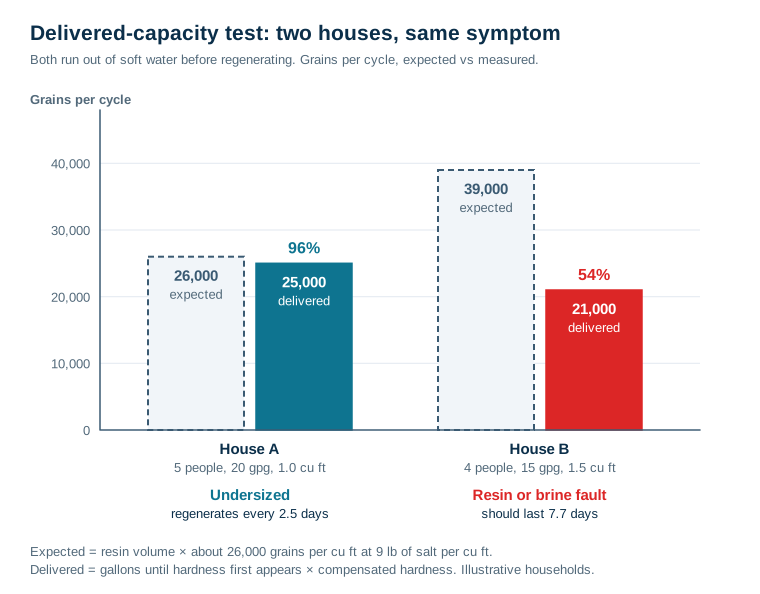
House A: five people, 20 gpg, a 1.0 cu ft softener at 9 lb/cu ft.
- Daily load: 5 × 75 gal × 20 gpg = 7,500 grains
- Expected capacity: 26,000 grains
- Calculated interval: (26,000 − 7,500) ÷ 7,500 = 2.5 days
- Delivered: hardness appeared at 1,250 gallons, so 1,250 × 20 = 25,000 grains, 96% of expected
The resin is healthy. The softener is simply too small for five people on 20 gpg water.
House B: four people, 15 gpg, a 1.5 cu ft softener at 9 lb/cu ft, nine years old on city water.
- Daily load: 4 × 75 gal × 15 gpg = 4,500 grains
- Expected capacity: 39,000 grains
- Calculated interval: (39,000 − 4,500) ÷ 4,500 = 7.7 days
- Delivered: hardness appeared at 1,400 gallons, so 1,400 × 15 = 21,000 grains, 54% of expected
This unit is the right size for the house. It is delivering only half its capacity, so the brine draw and then the resin need checking. A bigger softener would have hidden the problem for a while and cost far more.
Checking the Salt Arithmetic
Expected yearly salt = daily load × 365 ÷ salt efficiency. At 9 lb per cubic foot, standard resin yields about 2,890 grains per pound of salt (26,000 ÷ 9).
- House A: 7,500 × 365 ÷ 2,890 ≈ 950 lb of salt a year. That is about 24 bags of 40 lb, and it is what the load requires. High, but not a fault.
- House B: 4,500 × 365 ÷ 2,890 ≈ 570 lb a year. If house B were using 950 lb, something other than the load would be consuming the salt.
Actual use runs somewhat above these figures because regenerations happen with some capacity unused, but a result far above them is worth investigating.
Flow Undersizing Is a Separate Sign
A softener can have enough grains and still be too small for the flow:
- Pressure is fine at one fixture but falls sharply when two showers and the washing machine run together.
- The drop across the unit rises steeply beyond one or two fixtures, while softening is fine.
- It started when a large shower or extra bathroom was added.
That is a flow problem. It is fixed by a larger valve or a wider tank, not by more resin in the same tank. Confirm it with a gauge before and after the softener: a drop that is small at one fixture and climbs steeply at two or three is the signature.
What to Do Once You Know
If it is undersized:
- Correct the hardness setting (with iron compensation) and the reserve first. Both are free.
- Consider raising the salt dose to buy capacity in the short term. It costs salt, but it may cover the gap until you replace the unit.
- Take outdoor taps off the softened line if they are on it. That removes load without buying anything.
- Size the replacement from the usable capacity at an efficient salt dose, not the box rating. For house A, a one-week interval needs about 7,500 × 7 + 7,500 = 60,000 grains, which is 2.3 cu ft at 9 lb per cubic foot or 2.9 cu ft at 6 lb. That points to a 2.5 or 3.0 cu ft unit. How to calculate the right water softener size covers the full method, and resizing a softener after adding a bathroom covers the common case where the household has grown. If your own answer lands near two cubic feet, choosing a 64,000 grain softener sets out the smallest household that justifies one at each hardness, and the backwash flow it needs.
If it is a resin or brine fault: fix the brine draw, clean fouled resin, or replace degraded resin. The same tank then goes back to its original capacity.
What This Test Cannot Tell You
- It cannot see inside the tank. It tells you the bed is underperforming, not whether that is iron fouling, chlorine damage, channelling or a cracked distributor. That needs an inspection.
- It depends on an accurate hardness figure. A wrong raw hardness makes every number in the worksheet wrong.
- It says nothing about other contaminants. A bigger softener removes more hardness, and that is all. As University of Nebraska–Lincoln Extension's guide to water softening notes, softening does not remove bacteria, hydrogen sulfide, silt or sand, lead, nitrate, pesticides and many other contaminants. If your water has those, a larger softener is not the answer.
Measure what the softener delivers before deciding what to buy. The test takes about a week and a test kit, and it tells you whether the problem is the size of the softener or the condition of its resin.
Frequently Asked Questions
How do I know if my water softener is too small?
Three signs together point to an undersized softener. It regenerates every one to two days even with the hardness set correctly. Hardness appears on the same predictable day of each cycle rather than at random. And the resin still delivers close to its expected capacity when you measure it. A healthy but undersized softener simply runs out because the household's daily hardness load is too large for the amount of resin in the tank.
How often should a correctly sized water softener regenerate?
A correctly sized metered softener on a typical household usually regenerates every few days to about once a week. Regenerating every day or every other day with correct settings means the unit is working hard for the load. Going much longer than a week is the opposite problem, which is common with oversized units in small households.
Can a water softener be undersized for water pressure but fine for capacity?
Yes. Capacity and flow are separate. A softener can have plenty of grains for the daily load and still be too small hydraulically, so pressure falls noticeably when several fixtures run together. That is flow undersizing, and it shows as a pressure drop at busy times rather than as early hardness. It is fixed by a larger valve or wider tank, not by more resin alone.
Does an undersized water softener use more salt?
It uses more salt per year only because it has more hardness to remove per regeneration cycle than it can hold, so it regenerates more often. The salt used per grain removed depends mainly on the salt dose setting, not the unit size. High salt use that matches the arithmetic of your load is a capacity sign. High salt use that is well above what the load explains is a fault sign, such as a brine tank overfilling.
Is it cheaper to replace the resin or buy a bigger softener?
It depends on which problem you actually have, which is the point of testing first. New resin in the same tank restores the original capacity and nothing more, so it does not help an undersized unit. A bigger softener does not fix a brine draw fault or iron fouling, which would follow it to the new unit. Measure delivered capacity before spending money on either.
Why did my softener start running out after we added a bathroom?
Because more fixtures and more people raise the daily hardness load, and possibly the peak flow, while the resin volume stays the same. A unit that lasted six days for three people may last three days for five. Recalculate the load with the new household numbers. If the correctly programmed unit would regenerate every one to two days, it is now undersized.
