
iSpring RCC7AK Review: Alkaline Tank RO vs Going Tankless
This iSpring RCC7AK review comes down to a format decision more than a brand one. The RCC7AK is a six-stage tank RO with an alkaline remineralization filter. It is certified to NSF/ANSI 58 by NSF International and needs no electricity. Over five years it costs less to own than a popular tankless system. In return, you wait 1 to 3 hours for the tank to refill after it runs dry, and iSpring publishes no waste-water ratio. If those trade-offs suit your kitchen, it is one of the best-value RO systems you can buy.
Disclosure: Hard Water Solved may earn a commission if you buy through links on this page, at no extra cost to you. It does not change which products we include or how we rank them. Read our disclaimer.
The iSpring RCC7AK in One Table
| Item | Figure | Source |
|---|---|---|
| Amazon | Check price on Amazon | Listing opened, live |
| Stages | 6: sediment, GAC, CTO carbon block, RO membrane, post carbon, alkaline | RCC series manual |
| Rated output | 75 GPD | Product page |
| Certified daily production | 25.41 GPD (RCC7AK-BN) | NSF listing |
| Tank | 3.2 gallon capacity, pressurized | Manual and product FAQ |
| Inlet pressure | 45 to 70 psi | Manual |
| Feed limits | 40 to 100°F, TDS up to 750 ppm, chlorine up to 2 ppm | Manual |
| Power | None (the UV version needs an outlet) | Product page |
| Warranty | 1 year on registration, plus lifetime phone support | Product page |
How This Review Was Put Together
Method. No unit was physically tested for this review. It draws on iSpring's RCC series manual, its product page and replacement-filter range, the NSF International listing for the RCC7AK family, and EPA's WaterSense figures for RO waste water. The five-year comparison assumes 3 gallons of RO water a day and counts the filters in the box as year one. The Amazon listing was opened to confirm it is live.
Prices are not listed here because they change often. Use the buttons to see the current price on Amazon.
Six Stages, and What the Alkaline One Actually Adds
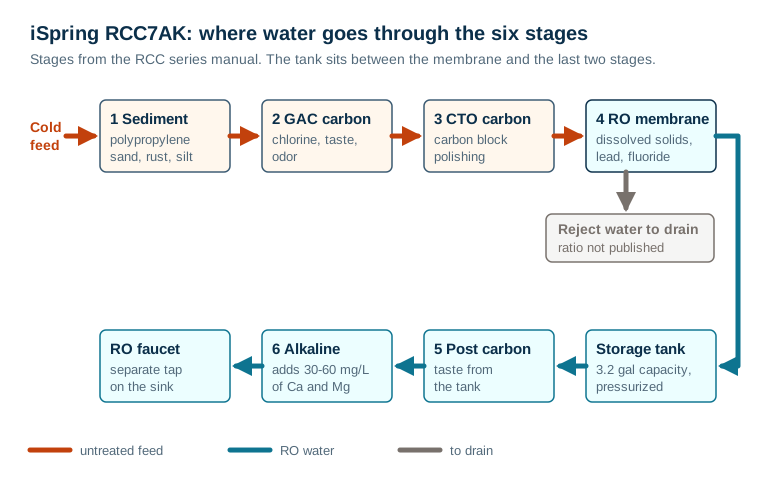
The first three stages protect the membrane. The sediment filter catches sand and rust. The GAC and CTO carbon filters remove chlorine, which damages RO membranes. The manual puts the ceiling at 2.0 ppm of chlorine in the feed. The membrane at stage 4 does the real work. Water then waits in the tank, and passes a post-carbon filter on its way to the faucet to remove any taste picked up in storage.
Stage 6 is the "AK" in the name. According to iSpring, the alkaline filter contains calcite (calcium carbonate), mineral balls and Corosex (magnesium oxide), and adds back about 30 to 60 mg/L of calcium and magnesium. Three things follow:
- It raises pH. RO water usually comes out slightly acidic, because dissolved carbon dioxide passes the membrane while most of the bicarbonate buffer does not. The alkaline stage counters that. This is a different effect from softening, which leaves pH where it was. The difference is explained in does a water softener change pH.
- It changes taste. Many people find plain RO water flat. A little calcium and magnesium is the main reason to choose the AK model over the plain five-stage RCC7.
- It adds a little hardness back. At 30 to 60 mg/L, that is roughly 2 to 3.5 grains per gallon. That is nowhere near enough to scale a kettle quickly, but your RO water will not test as completely soft.
The alkaline filter is not a safety stage. It changes taste and pH, not what the membrane has already removed.
75 GPD on the Box, 25 GPD on the NSF Listing
The RCC7AK is sold as a 75 GPD system. NSF's listing for the RCC7AK-BN, the version on Amazon, gives a daily production rate of 25.41 GPD. The RCC7AK listed from iSpring's Taiwan facility shows 21.04 GPD.
These are not contradictory. The 75 GPD figure is the membrane's rating under ideal conditions. NSF's figure is the whole system's production under the test conditions of NSF/ANSI 58, with real prefilters, a tank pushing back, and test water. Your output will sit somewhere around or between them, depending on your pressure, water temperature and TDS.
What it means in practice:
- 25 GPD is still plenty for drinking and cooking, which for most families is a few gallons a day.
- The tank is what you actually live with. At 3 gallons a day, you draw roughly one tank a day. If you fill a big pot and two water bottles in a row, the tank runs dry and the flow drops to a trickle.
- Refill takes about 1 to 3 hours. At 75 GPD, 3.2 gallons takes about an hour. At 25.41 GPD, about 3 hours. iSpring's manual says the first fill takes 1 to 2 hours, and that warmer, lower-TDS water fills faster.
The listing also confirms the certified claims: asbestos, barium, cadmium, trivalent chromium, copper, fluoride, lead, selenium and TDS reduction, plus NSF/ANSI 372 for lead-free materials. iSpring's product page gives the reductions as 97.9% for TDS, 97.4% for fluoride and 98.9% for lead.
iSpring RCC7AK Review: Tank or Tankless Before Brand
Most people comparing the RCC7AK are also looking at tankless systems such as the Waterdrop G3P600. Brand matters less than format here. The two formats differ on four points that affect daily life more than any single spec.
1. Waiting
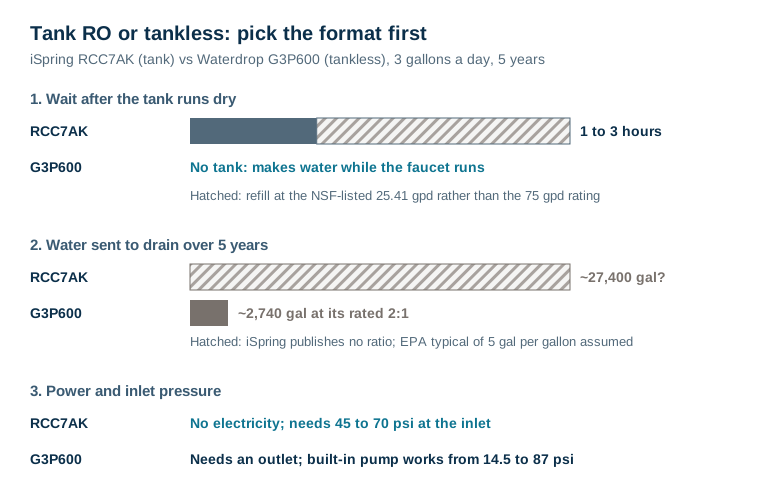
- RCC7AK: about 1 to 3 hours to refill a dry tank. You rarely notice if the household draws a gallon or two at a time.
- Tankless: no stored water and no refill. The trade is slower flow from the faucet, because the water is made as it runs.
2. Waste water
- RCC7AK: iSpring does not publish a pure-to-drain ratio in the manual or on the product page we checked. EPA's WaterSense page on point-of-use RO says typical systems send five gallons or more to drain per gallon made. If the RCC7AK is typical, that is about 27,400 gallons over five years at 3 gallons a day. It may be better than that. iSpring simply does not say.
- G3P600: rated 2:1, about 2,740 gallons over the same five years.
Where water is metered and expensive, or on a septic system or a low-yield well, the difference is worth weighing. On cheap city water, the dollar cost is small.
3. Five-year cost
| Five years, 3 gal/day | iSpring RCC7AK | Waterdrop G3P600 |
|---|---|---|
| Filters to buy, years 2 to 5 | 4 yearly F9K sets + 2 MC7 membranes | 4 years of replacement filters |
| Cost when we checked each maker's store | Lower to buy and lower in yearly filters | Higher to buy and higher in yearly filters |
The membrane is assumed to be replaced every two years, the short end of iSpring's 2 to 3 year range. Check the current price of each system and its filters before you compare.
4. Power and pressure
- RCC7AK: no electricity. It needs 45 to 70 psi at the inlet. Below 45 psi, iSpring says to add a booster pump. Above 70 psi, it says to fit a pressure regulator. Many private wells cycle between 40 and 60 psi, which puts them at or under the minimum for part of every cycle.
- G3P600: needs an outlet under the sink, but its built-in pump works from 14.5 to 87 psi.
The format decision in one line: choose the tank system if you want the lowest cost and no wiring, and you can live with a refill wait. Choose tankless if cabinet space, waste water or low pressure matter more than the extra cost.
Yearly Filters and What They Cost
iSpring's own schedule for the RCC7AK:
| Filter | Replace every |
|---|---|
| FP15 sediment | 6 to 12 months |
| FG15 GAC | 6 to 12 months |
| FC15 CTO carbon block | 6 to 12 months |
| FT15 post carbon | 6 to 12 months |
| FA15 alkaline | 6 to 12 months |
| MC7 RO membrane | 2 to 3 years |
| F9K 1-year set (9 pieces) | yearly |
Buying the yearly set is cheaper than buying single cartridges. Budget for one set a year plus a membrane every two to three years. iSpring's own daily running-cost claim only holds at the long end of every interval.
Change the prefilters at six months if your water carries sediment or more chlorine. They are cheap, and they are what keeps the membrane alive.
Hard Water, Softened Water and the Membrane
The current RCC series manual lists a "maximum hardness at pH 6.9" of 2,000 ppm, far looser than the 7 grain-per-gallon ceilings other RO makers set. iSpring's own FAQ is more cautious: without a softener, "you can simply install the RO machine directly to your raw water source. Although it may reduce the life of the membrane, it will still work."
That is the honest version. Hard water does not stop an RO system working, but calcium concentrates at the membrane surface and scales it. Production drops, and TDS creeps up. The evidence on membrane life with and without softening, and why nobody publishes exact figures, is set out in reverse osmosis and water softener together.
Two practical points for the RCC7AK:
- The cheap membrane changes the maths. The MC7 is inexpensive, so replacing it every year on hard water instead of every two to three years adds relatively little. That is a smaller penalty than on systems with far pricier RO cartridges.
- Test TDS, as the manual asks. Measure tap water and RO water with a TDS pen when the system is new, then every few months. When the RO reading rises well above where it started, change the membrane.
If hard water is a problem across the house, not just in the drinking glass, the RO unit is not the fix. See salt-based vs salt-free water treatment for the whole-house choice.
RCC7AK or RCC7AK-UV?
The RCC7AK-UV adds a seventh stage, an ultraviolet light after the alkaline filter. It costs more than the standard model, its 1-year filter pack costs more too, and it needs an outlet for the lamp.
The RCC series manual warns not to use any of these systems on water that is microbiologically unsafe or of unknown quality without adequate disinfection. The UV stage helps on a private well or an uncertain supply. On chlorinated city water it adds cost and wiring for little benefit.
Pros and Cons
Pros
- Low five-year cost, among the lowest for a certified RO
- Certified by NSF International to NSF/ANSI 58 for nine claims, including lead and fluoride
- No electricity needed
- Cheap standard 10-inch filters and an inexpensive membrane
- Alkaline stage improves taste for people who find RO water flat
Cons
- NSF-listed production of 25.41 GPD, a third of the 75 GPD on the box
- 1 to 3 hours to refill a dry 3.2 gallon tank
- No published waste-water ratio
- Needs 45 psi or a booster pump, which rules out many low-pressure wells as installed
- Tank and filter housings take more cabinet space than a tankless unit
Who Should Not Buy the iSpring RCC7AK
- Homes under 45 psi that are not willing to add a booster pump.
- Households that draw several gallons at once, for big-batch cooking or filling jugs, and do not want to wait for refills.
- Anyone who wants a known waste-water ratio, for example on metered water or a low-yield well.
- Small cabinets that will not take a tank beside the filter housings.
- People who want completely mineral-free water for an aquarium, steam iron or lab use. Buy the plain RCC7 instead. The alkaline stage adds minerals back by design.
Verdict
The iSpring RCC7AK earns its reputation on value. It has real third-party certification for lead, fluoride and TDS, and a low five-year cost. It needs no outlet, and its parts are cheap and standard. Its weak points are the ones every tank RO shares: a refill wait, a tank in your cabinet, and an output that falls well short of the headline 75 GPD. Decide on the format first. If tank RO suits your kitchen, the RCC7AK is an easy recommendation. If it does not, no tank system will.
Frequently Asked Questions
How long does the iSpring RCC7AK tank take to refill?
iSpring's manual says the first fill takes 1 to 2 hours, depending on water temperature and TDS. Working from the numbers, the 3.2 gallon tank refills in about an hour at the 75 GPD rating, and in about 3 hours at the 25.41 GPD daily production rate on the RCC7AK-BN's NSF listing. Cold or high-TDS water, and pressure near the 45 psi minimum, push it toward the slower end.
How often do you change the iSpring RCC7AK filters?
iSpring recommends changing the sediment, GAC, carbon block, post-carbon and alkaline filters every 6 to 12 months, and the RO membrane every 2 to 3 years. Buying the 1-year replacement set (F9K) works out cheaper than buying the cartridges singly. Check the current price of the set and of the MC7 membrane before you budget.
Does the iSpring RCC7AK need electricity?
No. The standard RCC7AK runs on your water pressure alone, which is one of its advantages over tankless systems that need an outlet under the sink. It does need at least 45 psi, according to its manual. Below that, iSpring says a booster pump is needed. Only the RCC7AK-UV version needs power, for its UV lamp.
What does the alkaline filter in the RCC7AK do?
The sixth-stage filter contains calcite (calcium carbonate), mineral balls and Corosex (magnesium oxide). According to iSpring, it adds back about 30 to 60 mg/L of calcium and magnesium after the RO membrane has removed almost everything. That raises the pH and changes the taste. It does not make the water any safer, and it adds a filter to replace each year.
Is the iSpring RCC7AK NSF certified?
Yes. NSF International lists the RCC7AK-BN and RCC7AK-BLK under NSF/ANSI 58 for asbestos, barium, cadmium, trivalent chromium, copper, fluoride, lead, selenium and TDS reduction, and they are certified to NSF/ANSI 372 for lead-free materials. Check the listing for the exact model you buy, because the plain RCC7AK listing from iSpring's Taiwan facility covers TDS reduction only.
