
Kinetico vs EcoWater: Water-Powered Twin Tank or App-Connected Smart Softener
Kinetico vs EcoWater is a choice between two design philosophies. Kinetico's softeners run on water pressure alone: a turbine meter counts the gallons, and the flow itself switches to a fresh tank. There is no electricity, no circuit board and no app. EcoWater's softeners are built around an electronic controller that learns how your household uses water, predicts tomorrow's demand and, on the Compact and 3700 Series, reports to your phone through HydroLink Plus. For the same family, the makers' own data puts their annual salt and water costs within about $25 of each other. So the decision rests on power, soft water during regeneration, alerts and the dealer's quote.
Disclosure: Hard Water Solved may earn a commission if you buy through links on this page, at no extra cost to you. It does not change which products we include or how we rank them. Read our disclaimer.
Kinetico vs EcoWater at a Glance
Method. Kinetico figures come from its softener page, its Premier Series product sheet and the Kinetico 2030s data sheet. EcoWater figures come from its current spec sheets, and its regeneration behaviour from an EcoWater EEC1502 owner's manual. No unit was physically tested. The annual use model uses the makers' published numbers and a stated household. Neither brand is sold on Amazon under its own name; the alternatives below were checked against their Amazon listings and brand stores. Prices are not listed here because they change often. Use the buttons to see the current price on Amazon.
| Kinetico (2030s shown) | EcoWater (ECR3702R40 shown) | |
|---|---|---|
| Power | None; "pressure shall be used to drive all valve functions" | 120 V, with a 24 V DC power supply |
| Tanks | Two, alternating | One |
| Regeneration trigger | Water-driven meter reaches a set volume | Controller predicts reserve will run short |
| Soft water during regeneration | Yes; valve prevents hard-water bypass | No; hard water bypassed to faucets |
| Resin | 0.47 cu ft per tank | 63 lb stratified bed |
| Capacity range | 7,867 to 10,500 grains (1.8 to 3.0 lb salt) | 11,330 to 40,100 grains (2.2 to 14.8 lb salt) |
| Water per regeneration | 29 gal | About 51 gal at 35 psi |
| Maximum hardness | 45 gpg | 75 gpg |
| Phone alerts | None | HydroLink Plus on Compact and 3700 |
| Warranty | 10 years Premier XP; 5 years Signature | 10 years valve body, 7 years faceplate (Compact, 3700) |
Two Ways to Decide When to Regenerate
Both brands regenerate on use rather than on a calendar. They get there in opposite ways.
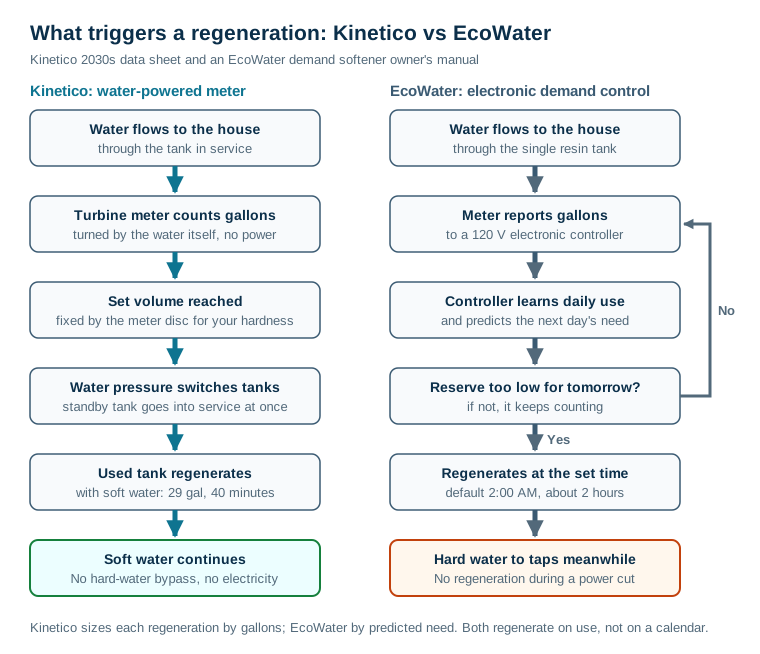
Kinetico counts and switches. The 2030s data sheet specifies a polypropylene turbine meter covering 0.30 to 25 gpm. It also specifies a meter disc chosen for your compensated hardness, which sets the gallons between regenerations, from 1,253 down to 157 depending on the disc. When that volume has passed, water pressure moves the valve. The standby tank goes into service, and the used tank regenerates with soft water supplied by the other tank. The data sheet states that the valve "will prevent the by-pass of hard water to service during the regeneration cycle." Each regeneration takes 40 minutes and 29 gallons, and nothing waits for a clock.
EcoWater learns and schedules. EcoWater's spec sheets describe "patented electronics" that "capture historical usage patterns to predict future needs for precise regenerations." When that prediction says the remaining capacity will not cover the coming day, a regeneration is due. In the EcoWater owner's manual we read, it then starts at a set time, 2:00 AM by default, and a regeneration takes about two hours. The manual is direct about the trade-off: "During regeneration hard water is bypassed to house faucets." It also notes that if power is lost, "the display will be blank and the softener will not recharge," and the clock may need resetting.
Neither approach is wrong. Kinetico avoids electronics and never runs short, because it does not need a reserve. EcoWater regenerates less often per grain of capacity, picks a time when you are asleep, and can tell your phone when something is off. The engineering background is in electric vs non-electric water softeners, and how demand control counts water is in metered vs timer-based water softeners.
Kinetico vs EcoWater: Salt and Water in a Year
Here is the same household on both systems: a family of four on 15 gpg water using about 300 gallons a day. That is 4,500 grains of hardness a day, or about 1.64 million grains a year. Salt is priced at $0.20 per lb and water and sewer at $0.01 per gallon.
The Kinetico 2030s is shown at three of its settings. EcoWater's spec sheet gives the ECR3702R40 only at its minimum and maximum salt doses, so it is shown at both ends. A dealer will usually program somewhere between them.
| Per year | Kinetico 1.8 lb | Kinetico 2.7 lb | Kinetico 3.0 lb | EcoWater min, 2.2 lb | EcoWater max, 14.8 lb |
|---|---|---|---|---|---|
| Capacity per regeneration | 7,867 grains | 9,802 grains | 10,500 grains | about 11,330 grains | 40,100 grains |
| Regenerations | about 209 | about 168 | about 156 | about 145 | about 41 |
| Days between regenerations | about 1.7 | about 2.2 | about 2.3 | about 2.5 | about 8.9 |
| Salt | about 376 lb ($75) | about 452 lb ($90) | about 469 lb ($94) | about 319 lb ($64) | about 606 lb ($121) |
| Regeneration water | about 6,060 gal ($61) | about 4,860 gal ($49) | about 4,540 gal ($45) | about 7,390 gal ($74) | about 2,090 gal ($21) |
| Electricity | $0 | $0 | $0 | up to about $18 | up to about $18 |
| Salt, water and power | about $136 | about $139 | about $139 | up to about $156 | up to about $160 |
Worked example, ignoring reserve. The EcoWater water figure uses its sheet's single "approximate water used each regeneration" of 51 gallons at both doses. The electricity line is a ceiling: its 24 V, 500 mA supply drawing full rating all year would use about 105 kWh, about $18 at $0.17 per kWh. Real draw is lower.
Three findings come out of the table:
- The running costs are close. Across every setting, the two brands land within about $25 a year. Over ten years that is a few hundred dollars, far less than the usual gap between two dealer quotes.
- They spend differently. The Kinetico uses more salt than the EcoWater at its minimum dose, but less water. The EcoWater at its maximum dose uses the least water and the most salt. Where your water and sewer are expensive, Kinetico's small 29-gallon regenerations look better. Where salt is the bigger cost, a low EcoWater dose does.
- The EcoWater at minimum dose regenerates almost as often as the Kinetico, about every two and a half days. Unlike the Kinetico, each of those regenerations sends hard water to the taps for about two hours overnight. That rarely matters at 2 AM, but it does in a house with shift workers or night-time laundry.
Ask any EcoWater dealer which dose they will program and what capacity it gives. Ask the Kinetico dealer which model, disc and salt setting you are getting. Without those figures, neither quote's efficiency claim can be checked.
What the Smart Side Actually Adds

EcoWater's HydroLink Plus, listed on the Compact and 3700 Series sheets, "sends continuous and excessive water use, system error, low salt and service reminder alerts." It also sends "a water-to-drain sensing alert notifying you when an excessive amount of water is going to drain." The 3700 sheets add that "HydroLink, patented two-way remote monitoring" is available, so a dealer can see the unit's status.
These alerts are useful in practice. A low-salt reminder prevents the most common cause of hard water returning. A drain alert catches a valve stuck mid-regeneration, which a Kinetico owner would only notice from a higher water bill. An excessive-use alert can flag a running toilet. None of these alerts can shut off water, though, and the lower EcoWater tiers (1100, 1500 and 2800) do not list Wi-Fi at all.
Kinetico's answer is to have fewer things to monitor. There is no board, display or clock, so there is nothing to reset after an outage. Salt still runs out, though, and nothing tells you. A monthly look in the brine tank does the job of the low-salt alert.
Warranty and Service
- Kinetico: 10 years on the Premier XP series and 5 years on the Signature Series, per its water softener page. Its Premier literature calls the 10-year term a Platinum Limited Warranty. Parts and service run through Kinetico dealers.
- EcoWater: on the Compact and 3700 Series sheets, lifetime cover on the salt and mineral tanks, 10 years on the valve body, 7 years on the electronic faceplate and 5 years on all other parts. The 1100 and 2800 Series give 3 years on the valve body, electronics and other parts. The 1500 Series sheet gives 1 year. The warranty in EcoWater's manual is extended "to the original owner," and you pay "normal shipping, installation or service charges."
If you compare a Kinetico against an EcoWater below the Compact and 3700 tier, the EcoWater warranty is much shorter. Both brands are dealer channels, so after the warranty, repairs cost what your local dealer charges. Get the labor rate and trip charge in writing from both.
Which Suits Your Home
Kinetico fits better if:
- Power cuts are common, or there is no outlet near where the softener will go.
- Soft water at any hour matters: a large household, night-time water use, or a home where hard water reaching the water heater during a 2 AM regeneration is a concern.
- Water and sewer charges are high, which favours its small 29-gallon regenerations.
- You want no electronics in the system at all.
- Your hardness is within the model's limit: 45 gpg for the 2030s; larger Kinetico models cover more.
EcoWater fits better if:
- You want phone alerts for low salt, excessive use and a stuck valve.
- Your water is very hard. The ECR3702R40 is rated to 75 gpg.
- Dynamic water pressure is low. The Kinetico 2030s needs at least 15 psi with water flowing.
- You are on chlorinated city water and want carbon in the same unit. The 3700 refiner adds it.
- The EcoWater dealer quotes a Compact or 3700 Series unit for less than the Kinetico.
Kinetico and EcoWater Alternatives on Amazon
Neither brand sells whole-house softeners on Amazon under its own name. These are the nearest online equivalents to each design:
| Alternative | Which design it mirrors | Amazon |
|---|---|---|
| AFWFilters Fleck 9100SXT twin tank, 48k | Kinetico's metered twin tank and soft water during regeneration, but electric | Check price on Amazon |
| GE Smart Water Softener GXSH35W | EcoWater's app-connected approach: built-in Wi-Fi, low-salt reminders and water-flow alerts in the SmartHQ app; shutoff needs a separate GE valve | Check price on Amazon |
GE's older Wi-Fi model, the GXSHC40N, showed as unavailable on Amazon and is not included; the GXSH35W is its successor.
The online equivalent of a Kinetico has no non-electric option on Amazon at this size. The Fleck twin matches its continuous soft water and metering, not its independence from power. Both alternatives are self-installed or plumber-installed and come with no dealer service.
Who Should Choose Neither
- Homes with iron, sulfur or acidic water that has not been treated. Softening is the last stage. Kinetico's 2030s sheet also caps free chlorine at 2.0 mg/L, so check any model's inlet limits against your water test.
- Anyone whose main goal is leak protection. An automatic shutoff valve does that job; neither softener does.
- Price-first buyers. Both are dealer brands. An online softener on a standard valve costs a fraction of either.
- Homes that may not need a salt softener. Salt-based vs salt-free water treatment covers whether softening is the right treatment before you choose between brands.
For the full specifications behind the table, see the Kinetico 2030s data sheet and EcoWater's 3700 conditioner spec sheet.
Frequently Asked Questions
Is Kinetico better than EcoWater?
It depends on what you value. Kinetico softeners need no electricity, use two tanks so soft water continues during regeneration, and carry a 10-year warranty on the Premier XP line. EcoWater's Compact and 3700 Series add Wi-Fi alerts, learn your water use, and carry 10 years on the valve body. Running costs for the same household come out within about $25 a year of each other on the makers' data, so the dealer's price and service usually decide it.
Does Kinetico use less salt than EcoWater?
Not always. For a family of four on 15 gpg water, a Kinetico 2030s at its 2.7 lb setting uses about 450 lb of salt a year. An EcoWater ECR3702R40 uses about 320 lb at its 2.2 lb minimum dose and about 610 lb at its 14.8 lb maximum. Where an EcoWater dealer programs it between those points decides which brand uses less.
Does an EcoWater softener work during a power outage?
No. An EcoWater owner's manual for a demand softener says that during a power outage the display goes blank and the softener will not regenerate. Water still flows through it and stays soft until the resin is used up, and the clock may need resetting afterwards. A Kinetico softener has no electrical connection, so outages do not affect it.
Why does a Kinetico regenerate so often?
Its tanks are small. The compact 2030s holds 0.47 cubic feet of resin per tank and restores about 7,900 to 10,500 grains per regeneration, so a typical family triggers one every two days or so. Because the second tank takes over at once, you never notice it. Each regeneration uses 29 gallons and takes 40 minutes, per its data sheet.
Does an EcoWater softener give hard water during regeneration?
Yes, on its single-tank models. EcoWater's owner's manual says that during regeneration hard water is bypassed to house faucets, which is why the default start time is 2:00 AM and a regeneration takes about two hours. A Kinetico twin-tank valve is specified to prevent hard water bypassing to service during regeneration.
