
Metered vs Timer-Based Water Softeners

In the metered vs timer water softener comparison, a timer regenerates on a fixed schedule whether or not the resin is used up, while a metered softener counts the gallons it softens and regenerates only when capacity is nearly exhausted. Because a timer must be set for the household's heaviest week, it regenerates too often in every other week. Metering usually cuts salt and regeneration water by roughly a fifth to two-fifths.
That range is wide because the saving depends on how the timer was set. The rest of this page works through the same household on both controls, prices the difference, and explains why demand-initiated regeneration is the basis of efficiency ratings and some state rules.
Metered vs Timer Water Softener: How Each Decides to Regenerate
A timer (time-clock) softener has a clock and a schedule. The installer sets it to regenerate every so many days, or on chosen days of the week, at a set hour. The valve does not know how much water has passed through it.
A metered (demand-initiated) softener has a flow meter in the valve, usually a small turbine. The installer enters the bed's capacity and the water's hardness, and the valve works out how many gallons it can soften before the resin is exhausted. It counts down as water is used and regenerates when the remaining capacity drops below a reserve, usually about one day's use.
Penn State Extension's guide to water softening puts the difference plainly: timed models "will waste more water and salt because they regenerate whether the resin needs it or not," while demand-control models regenerate "after so many gallons of water have been softened."
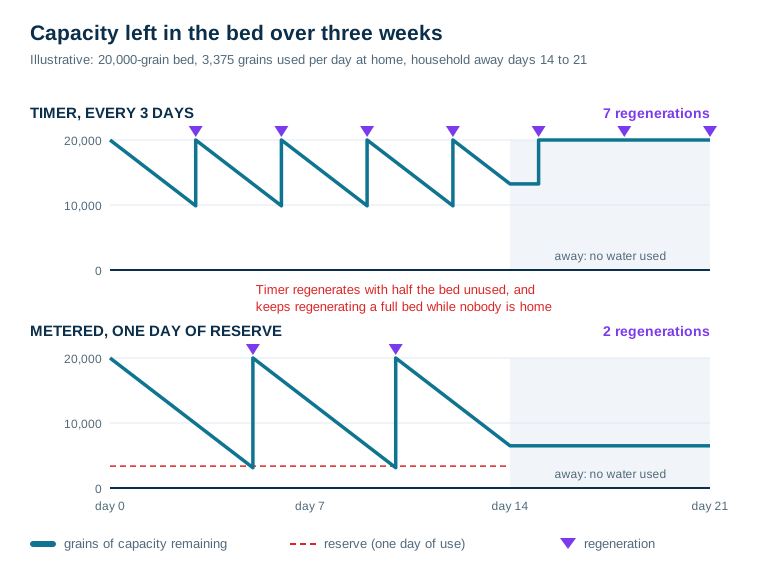
The chart shows what that means over three weeks. The timer regenerates with about half the bed still unused, then keeps regenerating a full bed while the house is empty. The meter regenerates only when the bed is nearly spent, and not at all while nobody is using water.
Why a Timer Has to Be Set Wastefully
The timer's problem is not just that it ignores the water. It is that it has to be set for the worst case.
- Water use varies. Laundry days, guests, a child home from college, a hot week with long showers. A timer set for an average day lets hard water through in a heavy week, so installers set it for the heavy week. Every average week then regenerates early.
- Days come in whole numbers. If the bed lasts 5.9 days, the timer can be set to 5 or 6, not 5.9. A cautious installer picks the lower number, and many round further down.
- Absences cost the same as occupancy. A timer regenerates on schedule during holidays, business trips and empty weeks.
- The household changes, the setting does not. When a child leaves home, a metered valve simply regenerates less often. A timer keeps the schedule set for the bigger household until someone reprograms it.
None of those are faults in the timer. They are the unavoidable result of controlling a variable process with a fixed schedule.
The Same House on Both Controls
Here is a worked example. It is illustrative, but every number comes from the stated assumptions, so you can rerun it with your own.
Assumptions:
| Item | Value |
|---|---|
| Household | 3 people, 75 gallons each per day |
| Hardness | 15 gpg |
| Daily load | 225 gallons × 15 gpg = 3,375 grains |
| Softener | 1 cu ft of resin, 6 lb salt per regeneration, about 20,000 usable grains |
| Water per regeneration | 50 gallons |
| Time away | 2 weeks a year |
The 20,000-grain figure is the conservative round number from Penn State Extension's worked example. Some manufacturer tables rate 1 cu ft a little higher at this dose (Hellenbrand's lists about 22,930 grains at 6 lb), which would lengthen every cycle slightly but not change the comparison.
Regenerations per year:
- Timer every 3 days (a cautious setting that covers heavy weeks): 365 ÷ 3 = 122.
- Timer every 4 days (a tighter setting that risks hardness in heavy weeks): 365 ÷ 4 = 91.
- Metered, one day of reserve: it uses about 16,625 grains per cycle before the reserve triggers regeneration. 351 days at home × 3,375 grains ÷ 16,625 = 71.
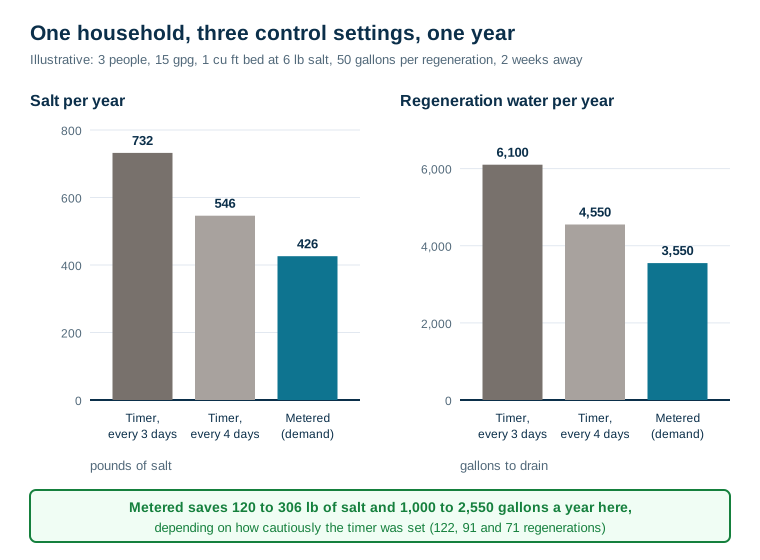
| Control | Regenerations a year | Salt a year | Regeneration water a year |
|---|---|---|---|
| Timer, every 3 days | 122 | 732 lb | 6,100 gallons |
| Timer, every 4 days | 91 | 546 lb | 4,550 gallons |
| Metered | 71 | 426 lb | 3,550 gallons |
| Saving with metering | 20 to 51 | 120 to 306 lb | 1,000 to 2,550 gallons |
That is a 22 percent saving against the tight timer setting and a 42 percent saving against the cautious one. The "about a third" often quoted for metering sits between the two.
Households that save more: those with irregular use, frequent travel, seasonal occupancy or a shrinking household. Households that save less: very steady use, where a timer can be set close to the real cycle length.
Payback on the Price Difference
The saving is only half the calculation. A metered valve costs more than a timer valve, and the question is how long the difference takes to recover.
Annual running-cost saving, using illustrative prices:
| Item | Price assumed | Saving vs 4-day timer | Saving vs 3-day timer |
|---|---|---|---|
| Salt | $0.20 per lb | $24 | $61 |
| Water and sewer | $12 per 1,000 gallons combined | $12 | $31 |
| Total | $36 a year | $92 a year |
Check both prices on your own bills. Water and sewer charges vary widely between utilities, and salt prices vary by type and region.
Payback formula:
Payback in years = price difference between metered and timer valve ÷ annual saving
As an example, if the metered version of a valve costs $150 more, payback is about 1.6 years against the cautious timer and about 4.2 years against the tight one. On a softener expected to last well over a decade, either is a good return. Dealer brands bundle the step with a higher series rather than pricing the valve on its own, and EcoWater's typical prices by tier show what that step costs in practice.
Replacing a working timer unit is a different calculation. The cost is then a whole new valve head, not a price difference. That usually makes sense when the old valve needs major service anyway, or when water and sewer are expensive. The broader efficiency picture, including salt dose and reserve settings, is covered in how to optimize a softener for salt and water efficiency.
There are also savings the table does not count: less brine going to a septic system, which matters for the reasons set out in water softeners and septic systems, and fewer regeneration cycles wearing the valve's seals.
Demand-Initiated Regeneration and Efficiency Ratings
Demand-initiated regeneration (DIR) is not just a feature. It is the dividing line in the efficiency standards.
The Department of Energy's Building America guide to water softeners sets out the NSF/ANSI 44 efficiency rating. An efficiency-rated softener must remove at least 3,350 grains of hardness per pound of salt and use no more than 5.0 gallons of water per 1,000 grains removed. The guide also states that devices using time-clock regeneration do not qualify for the rating.
What that means in practice:
- A timer softener cannot be efficiency rated, however it is set.
- A metered softener can be, if it meets the salt and water figures at a stated salt setting. Efficiency is always tied to the salt dose, so a unit rated at a low dose may not be efficient at a high one.
- Where rules or programs refer to efficiency rating, timers are out. California's Health and Safety Code section 116785 sets conditions for residential softeners that discharge to a community sewer. One condition is that the appliance "activates regeneration by demand control." Another is a certified salt efficiency rating, which for appliances from 2002 onward is at least 4,000 grains per pound.
Rebate programs, where they exist, are set locally and change often, so check the current rules for your utility. Where a program is built around efficiency, a timer unit will not qualify. How to find and check programs is covered in water softener rebates and incentives.
Getting the Most From a Metered Valve
A meter only saves what its settings allow. Four settings decide the result:
- Hardness. Enter the compensated hardness, including iron where relevant. Too low and hardness slips through; too high and the valve regenerates early.
- Capacity and salt dose. The capacity entered must match the salt dose, from the manufacturer's chart. A high dose gives more capacity but fewer grains per pound of salt.
- Reserve. About one day's use. A large fixed percentage reserve, left from a factory default, gives away part of the metering saving.
- Day override. Set to 7 to 14 days, so the bed never sits idle for weeks. It is a backstop, not the main trigger.
Delayed or immediate regeneration. Most home units use delayed regeneration: the meter decides during the day and regeneration happens at 2 am. Immediate regeneration starts as soon as capacity runs out, which suits twin-tank units and homes with no quiet hours. Delayed is the right default for a single tank.
Salt efficiency in grains per pound is the number that ties these settings together, and it is explained in water softener salt efficiency.
When a Timer Is Still Acceptable
It is hard to recommend buying a new timer softener, but an existing one does not always need replacing:
- Very steady water use, where the timer can be set close to the real cycle length and the household rarely travels.
- Cheap salt and cheap water, where the saving takes many years to pay for a new valve head.
- A softener near the end of its life, where the money is better saved toward a metered replacement.
If you keep a timer unit, check its setting against the household's real use. Many were set years ago for a bigger family or a different hardness, and a simple reprogram recovers part of the metering saving.
What Metering Will Not Fix
- A salt dose set too high. A meter decides when to regenerate, not how much salt each regeneration uses.
- A wrong hardness setting. The meter's countdown is only as good as the hardness it was given.
- An undersized softener. A metered unit that is too small regenerates every day or two and still runs out.
- Leaks and running toilets. The meter counts leaked water as softened water, and regenerates for it.
- Anything other than hardness. A softener does not remove lead, nitrate, bacteria or most other health-related contaminants, whatever controls it.
The Decision in Short
- If you are buying, choose metered. The saving pays back the price difference within a few years, and only metered units can be efficiency rated. Some dealer ranges still start with a timer model, and the EcoWater review maps which of its series use a timer, which use demand control, and how the valve warranty changes between them. If two dealers are quoting, comparing Culligan and EcoWater on warranty and which features need a higher tier does the same for both.
- If you own a timer unit, work out your real days between regenerations and reprogram it to match.
- Replace a working timer valve with a metered one when it needs major service, when water and sewer are expensive, or when a local rule or rebate requires demand control.
- On any metered unit, check the hardness, capacity, reserve and day override. Those four settings decide how much the meter actually saves.
Frequently Asked Questions
What is the difference between a metered and a timer water softener?
A timer softener regenerates on a fixed schedule, such as every three days, whether or not the resin is exhausted. A metered softener counts the gallons it softens and regenerates only when the capacity is nearly used. The metered unit regenerates less often in most homes, so it uses less salt and sends less water to the drain.
Is a metered water softener worth it?
For almost every household, yes. In a worked example for three people on 15 gpg water, metering cut salt use by 120 to 306 lb a year and regeneration water by 1,000 to 2,550 gallons, depending on how cautiously the timer had been set. The saving pays back a modest price difference within a few years, and much faster where water and sewer are expensive.
How much salt does a metered water softener save?
It depends on how the timer was set and how much water use varies. In the example on this page, the metered unit used about 22 percent less salt than a timer set every four days and about 42 percent less than one set every three days. Households with irregular use, frequent travel or changing occupancy save the most.
What does demand-initiated regeneration mean?
It means regeneration is triggered by actual demand, measured by a flow meter or a hardness sensor, rather than by a clock. Under NSF/ANSI 44, only demand-initiated softeners can be efficiency rated. California law also requires demand control for residential softeners that discharge to a community sewer, along with a minimum salt efficiency.
Can I convert a timer water softener to metered?
Often, by replacing the control valve head with the metered version from the same valve family, which usually fits the existing tank. Some valves accept a meter as an add-on. If the resin is old or the tank is failing, replacing the whole unit may make more sense than upgrading the valve.
Does a metered softener still need a day setting?
Yes. A metered valve should also have a day override, a maximum number of days between regenerations, typically set to 7 to 14 days. It stops the resin sitting idle for weeks if the household is away or water use falls. The meter handles normal weeks; the day override is the backstop.
