
Types of Hardness: Temporary, Permanent, Calcium and Magnesium
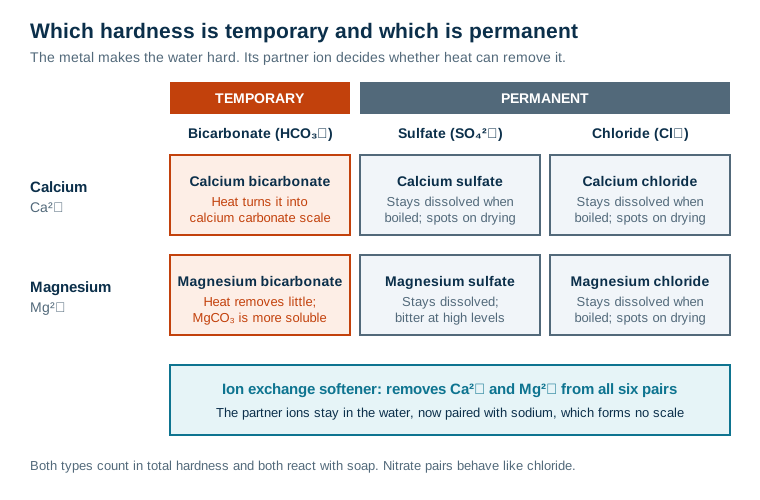
The difference between temporary vs permanent hardness is what the calcium and magnesium in your water are paired with. Temporary hardness is paired with bicarbonate, so heat turns it into scale and boiling removes part of it. Permanent hardness is paired with sulfate or chloride, stays dissolved when heated, and leaves spots as water evaporates. A softener removes both.
The other way hardness gets split, calcium versus magnesium, gets a lot of attention in sales material and changes very little about what you should buy. This article explains both splits and ties each one to something you can see at home: the kettle that furs up in three weeks, the cold faucet that keeps spotting, and the softener quote that claims your "high magnesium" needs a bigger unit.
The Two Ways Hardness Is Split
Total hardness is one number on a test report, but it can be divided in two independent ways. It helps to keep them apart, because they answer different questions.
| Split | The two parts | What decides the split | What it predicts |
|---|---|---|---|
| By partner ion | Temporary (carbonate) and permanent (noncarbonate) | Your water's alkalinity, meaning how much bicarbonate is present | Where scale forms: on hot surfaces, or only where water evaporates |
| By metal | Calcium hardness and magnesium hardness | The rock the water passed through: limestone gives mostly calcium, dolomite adds magnesium | Scale type and taste at high levels. Almost nothing about softener size |
Both splits describe the same calcium and magnesium. A single water can be, say, 70% calcium and 30% magnesium and 60% temporary and 40% permanent at the same time. The diagram below shows why: hardness comes from the positive ions, and the type comes from the negative ions they are balanced by.
Temporary Hardness: The Part Heat Can Remove
Rain picks up carbon dioxide from the air and, far more, from the soil. That makes it weakly acidic, and as it moves through limestone (calcium carbonate) or dolomite (calcium magnesium carbonate) it dissolves the rock. The calcium comes out paired with bicarbonate, a form that stays dissolved only while enough carbon dioxide is present.
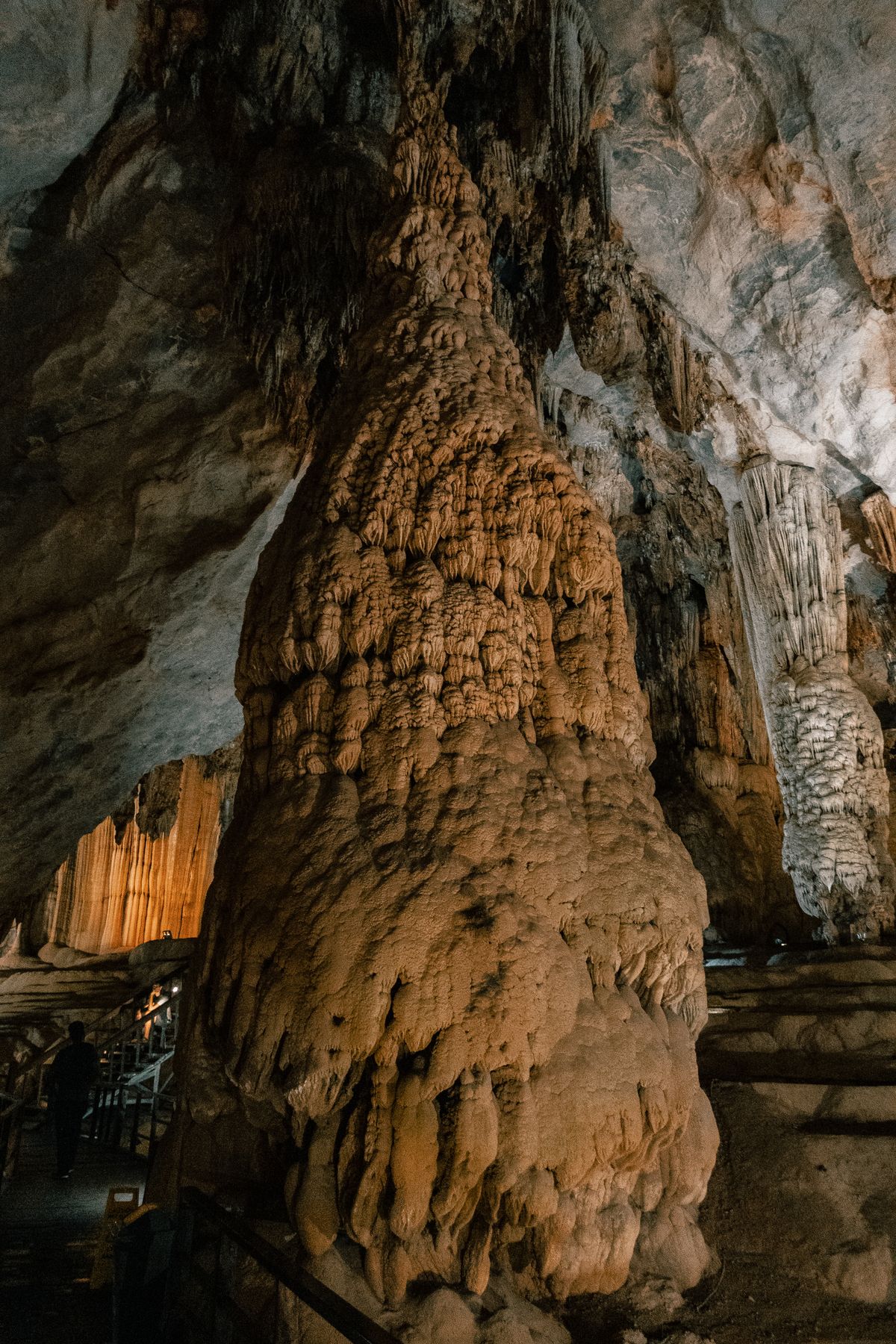
Heat drives that carbon dioxide out. Once it leaves, the bicarbonate turns back into carbonate and the calcium drops out as solid calcium carbonate. That is the white fur in a kettle, the crust on a water heater element, and the flakes in a hot-side aerator. The same reaction builds cave formations when groundwater loses carbon dioxide to the cave air, which is why stalactites and kettle scale are chemically the same mineral. The full reaction, and why the hottest surface scales first, is covered in why hot water causes more scale.
The name "temporary" is a lab term. It means the hardness can be taken out by boiling. In a house it is the opposite of temporary. Once it leaves the water it stays on your equipment.
Three practical things follow:
- Temporary hardness scales the heating appliances. The kettle, coffee maker, dishwasher element, tank water heater and tankless heat exchanger all run the reaction.
- It forms on the heated surface, not in the pipe. Cold supply lines carrying the same water stay mostly clean inside.
- Boiling only removes some of it. A little calcium carbonate stays dissolved even at boiling point, and magnesium carbonate is far more soluble than calcium carbonate, so most magnesium comes through. Boiling is a demonstration, not a treatment.
Permanent Hardness: The Part Heat Leaves Behind
Where water passes through gypsum (calcium sulfate) or salt-bearing rock, calcium and magnesium dissolve alongside sulfate or chloride rather than bicarbonate. No gas holds that pair in solution, so heating has nothing to drive off, and the minerals stay dissolved through ordinary household heating.
That is why it is called permanent. In a house it shows up where water evaporates rather than where it is heated:
- Spots and rings on cold-only fixtures, shower glass and car paint, because a drying drop leaves every dissolved mineral behind.
- Soap curd and dull laundry, because soap reacts with calcium and magnesium whatever they are paired with.
- A harder, more stubborn deposit in equipment that concentrates water, such as humidifiers and evaporative coolers, where calcium sulfate builds up as water evaporates away.
Permanent hardness does not usually dominate a household's scale problem. It explains the complaint that surprises people after they have dealt with the kettle: cold-line spotting that carries on even though nothing is being heated.
Calculating Temporary vs Permanent Hardness From a Test Report
You do not need a special test. Total hardness and total alkalinity, both reported as mg/L of calcium carbonate, give you the split:
- Carbonate (temporary) hardness = the smaller of total hardness and total alkalinity.
- Noncarbonate (permanent) hardness = total hardness minus alkalinity, if the result is above zero. If alkalinity is equal to or higher than hardness, there is no permanent hardness at all.
This is the standard method taught in water operator courses. A water softening calculations lesson from Mesa Community College's water program works through it the same way. Both numbers have to be in the same units. If your report gives grains per gallon, multiply by 17.1 to get mg/L. The guide to water hardness units covers the conversions.
Two worked examples, both at the same total hardness:
| Water A: limestone well | Water B: gypsum-influenced supply | |
|---|---|---|
| Total hardness | 300 mg/L (17.5 gpg) | 300 mg/L (17.5 gpg) |
| Total alkalinity | 250 mg/L | 80 mg/L |
| Temporary hardness | 250 mg/L (83%) | 80 mg/L (27%) |
| Permanent hardness | 50 mg/L (17%) | 220 mg/L (73%) |
| What the owner notices | Kettle furs in weeks, water heater rumbles, hot aerators clog | Kettle scales slowly. Glass, fixtures and cold taps spot heavily |
| Softener sizing uses | 17.5 gpg | 17.5 gpg |
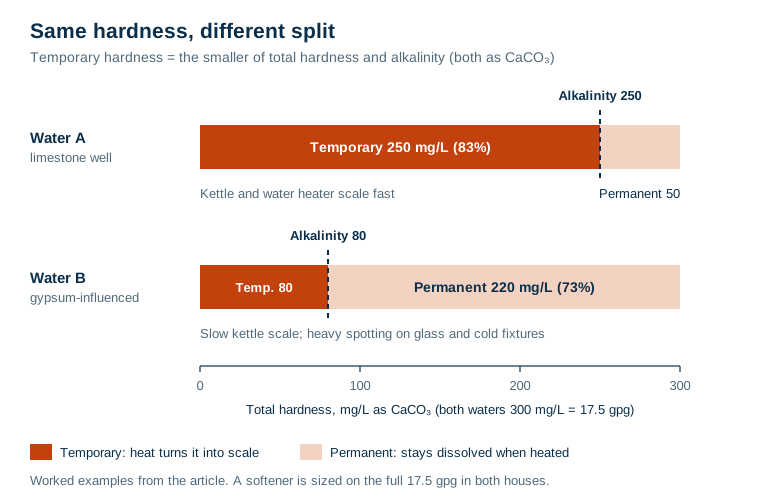
The last row is the point. The split changes where the damage appears, but a softener has to remove all 17.5 grains in both houses.
How Each Type Shows Up in Your House
Use this as a quick diagnostic before you test:
| What you see | Mostly caused by | Why |
|---|---|---|
| Kettle or coffee maker furs up within a month | Temporary hardness | Boiling runs the bicarbonate reaction on every refill |
| Rumbling or popping storage water heater | Temporary hardness | Scale flakes settle on the tank bottom and trap water that flashes to steam |
| Hot-side aerators clog, cold ones don't | Temporary hardness | Heater scale travels downstream and degassing happens at the spout |
| White spots on cold-only fixtures and glass | Both | Evaporation leaves all dissolved minerals, whatever their pairing |
| Soap won't lather, laundry feels stiff | Both | Soap reacts with calcium and magnesium regardless of partner ion |
| Chalky ring in a humidifier or evaporative cooler | Both, with sulfate deposits the hardest to remove | Water is evaporated away and everything left concentrates |
The table also shows the practical limit of the split. For soap, laundry, skin and spotting, the type makes no difference. It matters mainly for heating appliances, which is the most expensive place to get scale.
Calcium vs Magnesium Hardness
Most US groundwater carries more calcium than magnesium, because limestone is the commonest source rock. Dolomite and some sedimentary formations add a large magnesium share, and a few supplies run close to half and half. A lab report may list them separately, as "calcium hardness" and "magnesium hardness" or as calcium and magnesium in plain mg/L.
To combine them into total hardness as calcium carbonate:
- Calcium (mg/L as Ca) × 2.50 = calcium hardness as CaCO₃
- Magnesium (mg/L as Mg) × 4.12 = magnesium hardness as CaCO₃
The larger multiplier for magnesium is not a penalty. A magnesium atom weighs less than a calcium atom, so each milligram of magnesium carries more ions. The conversion puts both on the same scale of "how many hardness ions are there".
What the split actually changes:
- Scale character. Calcium carbonate forms most household scale. Magnesium tends to stay dissolved longer on heating and can form magnesium hydroxide or magnesium silicate deposits at the higher temperatures found in boilers.
- Taste. Magnesium sulfate is bitter. It is noticeable only in unusually mineralized supplies.
- Salt-free conditioners. Some template-assisted media are rated on calcium carbonate behavior, so check the manufacturer's limits if your water is high in magnesium.
Why the Calcium-to-Magnesium Ratio Barely Changes Softener Sizing
This claim comes up a lot: "your water is high in magnesium, so you need more capacity." It is mostly wrong, for three reasons.
- Sizing already uses the combined number. A softener's capacity is rated in grains of hardness as calcium carbonate. Total hardness in gpg converts magnesium into its calcium carbonate equivalent before any sizing math is done. A water at 17.5 gpg needs the same grain capacity per gallon whether that is 80% calcium or 50% calcium.
- The resin exchanges both. A cation exchange resin prefers calcium slightly over magnesium, but it takes up both and holds both until the bed is regenerated. The EPA WaterSense page on cation exchange softeners describes the process as removing "the calcium and magnesium ions" together, with no separate rating for each.
- Where the ratio shows up, it is small. Because magnesium is held a little less tightly, it can be the first ion to slip through as a bed nears exhaustion. That is one reason to keep a sensible reserve. It is not a reason to jump up a tank size.
What does change sizing is the total hardness figure itself, iron and manganese (each ppm adds to the compensated hardness), and your daily water use. If a quote leans on the magnesium share to justify a larger unit, ask to see the capacity math. How the resin exchange works inside the tank is covered in how a whole-house water softener works.
What This Changes About Treatment
Knowing your split lets you choose treatment for the reason that actually applies:
- Ion exchange softening removes every type. It swaps the calcium and magnesium ions themselves, so temporary, permanent, calcium and magnesium hardness all go at once. The bicarbonate, sulfate and chloride stay in the water, now paired with sodium.
- Heat-based "treatment" removes only part of the temporary share, and it moves that part onto your equipment instead of taking it out of the house.
- Lime softening, the method some city plants use, mainly removes carbonate hardness. Utilities add soda ash to deal with noncarbonate hardness. That is one reason two cities with similar source water deliver quite different hardness.
- Scale control that works by changing crystal shape (salt-free conditioners) is aimed at calcium carbonate from temporary hardness. It does not stop evaporation spots or soap curd, which come from both types.
And what a softener cannot do, whichever type you have: it does not dissolve scale already on your equipment, it does not lower alkalinity or change the bicarbonate, and it adds sodium in proportion to the hardness removed. Penn State Extension puts that at 7.5 milligrams of sodium per quart for each grain per gallon removed. Water that is very high in permanent hardness therefore gains more sodium from softening than a moderately hard supply.
What to Do With This
- Find your total hardness and your alkalinity on the same report. If you only have hardness, a lab test or a multi-parameter strip adds alkalinity cheaply. The steps for reading a lab or utility sheet are in how to read a water hardness report.
- Work out your temporary vs permanent hardness split with the two-line method above.
- If most of it is temporary, expect heating appliances to scale first and put them at the top of your list.
- If most of it is permanent, expect spotting and soap problems more than kettle scale, and do not expect a salt-free conditioner to fix them.
- Size any softener on total hardness in gpg, plus iron compensation, regardless of the calcium-to-magnesium ratio.
Frequently Asked Questions
What is the difference between temporary and permanent hardness?
Temporary hardness is calcium and magnesium that is balanced by bicarbonate. Heating drives carbon dioxide out of the water and turns it into calcium carbonate scale, so boiling removes part of it. Permanent hardness is calcium and magnesium balanced by sulfate, chloride or nitrate. It stays dissolved when the water is boiled. Both kinds count toward total hardness, both react with soap, and an ion exchange softener removes both.
How do I find out how much of my hardness is temporary?
Compare two numbers on the same test: total hardness and total alkalinity, both expressed as mg/L of calcium carbonate. The temporary (carbonate) hardness is whichever of the two is smaller. Anything left of the total hardness after you subtract the alkalinity is permanent (noncarbonate) hardness. Most lab reports and many multi-parameter test strips give both numbers.
Is calcium or magnesium hardness worse?
For a household neither is clearly worse. Calcium is usually the larger share and forms most kettle and water heater scale. Magnesium adds to soap scum and spotting in the same way, and at high levels magnesium sulfate can give water a bitter taste. For softener sizing the split hardly matters, because total hardness already expresses both as calcium carbonate equivalents and the resin exchanges both.
Does boiling water remove permanent hardness?
No. Boiling works only on the bicarbonate part, the temporary hardness, and even then only partly, because some calcium carbonate stays dissolved and magnesium carbonate is much more soluble. Calcium sulfate and calcium chloride stay in solution through boiling, and boiling off some water actually concentrates them.
Which type of hardness does a water softener remove?
All of it. A cation exchange softener swaps the calcium and magnesium ions themselves for sodium or potassium, and it does not care which negative ion they were paired with. The bicarbonate, sulfate and chloride stay in the water, now paired with sodium, which does not form scale or soap curd.
Why does my kettle scale but my cold tap does not?
Heat converts temporary hardness into calcium carbonate inside the kettle, so a kettle is a direct gauge of your bicarbonate hardness. A cold tap never gets that reaction inside the pipe. Its spots form outside, where drips evaporate and leave every dissolved mineral behind, including the permanent hardness that heat does not touch.
