
Why Hot Water Shows More Scale Than Cold Water
The reason why hot water causes more scale is not that it contains more minerals — it is that hot water cannot hold them. Heating drives dissolved carbon dioxide out of the water, which converts soluble calcium bicarbonate into insoluble calcium carbonate, and calcium carbonate is itself less soluble when hot. So the hottest surface in your plumbing gets the scale first.
That single mechanism explains a dozen separate complaints: the crust in the kettle, the rumbling tank, the tankless unit that throws codes, the hot-side aerator that clogs while the cold one stays clear. This article explains the chemistry properly, shows the curve, and maps it onto the seven places in a house where scale turns up first.
Why Hot Water Causes More Scale: The Reaction Behind It
Most explanations stop at "calcium carbonate is less soluble in hot water." That is true, but it is the smaller half of the story. The bigger half is a gas.
Hard water rarely carries its calcium as calcium carbonate. Rainwater absorbs carbon dioxide from the air and from the soil, becomes weakly acidic, and dissolves limestone and dolomite as it moves through the ground. The result is calcium held in solution alongside bicarbonate — a form that is far more soluble than carbonate. That dissolved pair is kept stable by the carbon dioxide still in the water.
The balance looks like this:
Ca²⁺ + 2 HCO₃⁻ ⇌ CaCO₃ (solid scale) + CO₂ (gas) + H₂O
Read left to right, it is scale forming. Read right to left, it is limestone dissolving in the ground. Which way it runs depends on how much carbon dioxide the water is holding.
Heat tips it to the right in two ways at once:
- Carbon dioxide leaves. Gases are less soluble in warm water — the same reason a warm soda goes flat faster. As CO₂ escapes, the reaction replaces it by converting more bicarbonate into carbonate and CO₂, and the carbonate pairs with calcium and drops out as a solid. Removing a product pulls the reaction forward; chemists call this Le Chatelier's principle, and it is the main driver of household scale. A general chemistry text from LibreTexts puts the mechanism plainly: heating decreases the solubility of CO₂, which escapes, and the carbonate ions precipitate as calcium carbonate, "the major component of boiler scale".
- Calcium carbonate itself gets less soluble. Most salts — table salt, sugar — dissolve better in hot water. Calcite does the opposite. Its dissolution releases heat, so adding heat pushes it back toward the solid. This is called inverse or retrograde solubility, and calcium carbonate is one of the few common compounds that behaves this way.
There is a third, quieter effect. As CO₂ leaves, the water's pH rises, and at higher pH a greater share of the remaining bicarbonate exists as carbonate. So the loss of gas both removes the stabiliser and raises the concentration of the ion that forms scale. The effects compound rather than add.
The Solubility Curve: What Heat Does to Dissolved CO₂ and Calcium Carbonate
The chart below plots two things against temperature. The solid line is how much carbon dioxide water can hold at a given CO₂ pressure, relative to 50°F groundwater. It is calculated from the Henry's law constant for CO₂ published in the NIST Chemistry WebBook — 0.034 mol/kg·bar at 77°F with a temperature coefficient of 2,400 K — so those percentages are real. The dashed line shows the direction in which calcium carbonate solubility falls. It is an illustrative trend, not measured values, because the real figure depends on your water's alkalinity, pH and pressure.
Three things in that curve matter for your house.
Most of the gas is gone well before boiling. At 120°F — a typical tank setpoint — water can hold only about 36% of the CO₂ it held coming out of the ground. The bicarbonate balance was set in cold water, so by the time the water reaches the tank it is carrying far more calcium bicarbonate than the hot water can keep stable.
Open vessels lose gas faster than sealed ones. Inside a pressurised tank, carbon dioxide has nowhere obvious to go, which slows the reaction. In an open kettle, at a shower spray, or at a faucet aerator where water hits the air and the pressure drops, it escapes immediately. That is why the fixtures at the end of the hot line scale so aggressively.
Speed rises even where the curve flattens. The solubility curve levels off at high temperature, but the precipitation reaction itself runs faster the hotter it gets. Combine that with open-air degassing and daily refills, and you get the familiar contrast: a kettle furs up in weeks while a 120°F tank takes years to build the same layer.
The Hottest Surface Scales First, Not the Hottest Water
Here is the part that turns the chemistry into a practical diagnostic: scale does not form evenly throughout the hot water. It forms at the metal surface that is doing the heating, because that surface is hotter than the water around it.
Water flowing past a heating surface has a thin boundary layer right against the metal. That layer is far hotter than the tank average or the outlet temperature on the thermostat, and it is where CO₂ comes out of solution first — the tiny bubbles you see forming on a heating element before water boils are dissolved gas leaving. Calcium carbonate crystallises in that layer and bonds to the metal.
This is why:
- An electric tank scales on the element sheath, not on the tank walls.
- A gas tank scales on the bottom head above the burner, where the flame meets the steel.
- A tankless unit set to 120°F still scales badly, because the inside wall of its heat exchanger runs much hotter than the water leaving it.
- A kettle's element or base plate crusts before its sides do.
It also explains why scale is self-reinforcing. Calcium carbonate is a poor conductor of heat, so a scaled element has to run hotter to deliver the same energy, and a hotter surface precipitates scale faster. The deposit builds its own accelerator.
Where Scale Appears First in Your House
Put the curve and the hot-surface rule together and you can predict the order in which fixtures scale. The temperatures below are typical operating ranges, not specifications; your equipment's manual has the exact figure.
| Location | Typical water or surface temperature | Why it scales first |
|---|---|---|
| Tankless water heater heat exchanger | Outlet 120–140°F; exchanger wall much hotter | Narrow passages, intense heat flux and a hot wall mean even a thin layer restricts flow and insulates the exchanger. This is the most expensive place in the house for scale to form — see the early signs of scale in a tankless water heater |
| Storage tank bottom and electric element | Setpoint 120–140°F; element sheath and burner-side bottom hotter | The heating surface is the hot spot, and loose flakes that break off settle onto the bottom as sediment, where they trap water and cause popping and rumbling. The mechanics are covered in hard water sediment in a storage water heater |
| Kettle and coffee maker boiler | 195–212°F, open to the air | The far right of the curve: near-total CO₂ loss, the fastest reaction, and evaporation concentrating what remains. Refilled every day, so it scales in weeks |
| Dishwasher heating element | Roughly 120–155°F in heated wash and sanitise cycles | A bare element heating a small volume of water, often mineral-rich, with a heated dry cycle that evaporates the last film onto glassware and the tub |
| Hydronic or combi boiler | 140–180°F | A closed heating loop uses up its scale potential on the first fill, so it scales mainly when the loop is topped up after leaks. A combi boiler's domestic hot water heat exchanger, fed fresh water every time a tap opens, scales continuously |
| Showerhead (hot supply) | Mixed, usually 100–110°F at the head | Water depressurises through small nozzles and sprays into air, so CO₂ escapes instantly; the droplets left in the nozzles after each shower then evaporate |
| Hot-side faucet aerators | 110–140°F at the spout | The same degassing at the point of discharge, plus scale flakes shed from the water heater upstream arriving at the first fine screen |
The cold side makes the useful contrast. Groundwater usually enters the house at 50–60°F, well to the left of the curve, so cold pipes and cold-only fittings build very little scale internally. Cold faucets still get white spots on their outside surfaces, but that is evaporation leaving minerals behind, not the reaction running in the pipe.
Why Hot-Side Aerators and Showerheads Scale Faster
The fixtures at the end of the hot line pick up scale from two separate sources, and it is worth knowing which one you have.
Deposit that forms at the outlet. When pressurised water leaves a spout or nozzle, the pressure drops to atmospheric and the water meets air. For hot water already short of CO₂, that is the final push: the remaining gas escapes, and a crust of calcium carbonate forms on the mesh or around the nozzle holes. This deposit is thin, chalky, and grows outward from the openings.
Scale that arrives from upstream. A water heater sheds its deposit. Tank walls flex slightly with each heating cycle, element scale cracks off as the element expands and cools, and the first flush of a tankless unit after descaling can release loose fragments. Those pieces travel down the hot lines until they meet the first fine screen, which is almost always an aerator or a showerhead's inlet filter.
You can tell them apart in about a minute. Unscrew the aerator and tip the debris onto a paper towel:
- A thin, even crust on the mesh — outlet deposit. Soak in white vinegar and refit.
- Hard, white, curved chips — flakes from the heater. Cleaning the aerator treats the symptom; the heater needs flushing.
- Fine sand or grit, often darker — sediment from the supply, frequently from a well, and not a heating problem at all.
If the hot-side aerators across the whole house clog at the same time, especially after work on the water heater, the flakes are the likelier answer.
Why Two Homes With the Same Hardness Scale Differently
This is the question the curve answers that a hardness number cannot. Two houses can both test at 15 grains per gallon and have very different scale problems, because what the heat acts on is bicarbonate, not calcium alone.
Hardness is split into two types that behave differently under heat:
- Carbonate (temporary) hardness — calcium and magnesium balanced by bicarbonate. This is the part heat converts into scale. It is called temporary because boiling removes it, which is what the fur in a kettle is.
- Non-carbonate (permanent) hardness — calcium and magnesium balanced by sulfate or chloride. This stays dissolved through ordinary heating, though it still leaves residue when water evaporates and forms harder calcium sulfate scale in equipment running hotter than household appliances.
In practice, the carbonate share is set by your water's alkalinity. Groundwater drawn from limestone is typically high in both hardness and alkalinity and scales heavily. Water with the same hardness but low alkalinity — for example, from gypsum-bearing rock — scales noticeably less inside water heaters, though it still spots glass and fixtures. Penn State Extension's guide to water softening notes simply that hard water "causes gray or white deposits when water is heated" and that scale shortens a water heater's useful life, and grades water above 10.5 grains per gallon (180 mg/L) as very hard.
Two practical consequences:
- Test hardness on the cold side. A sample from the hot tap can read lower, because some of the calcium was deposited in the heater before it reached you. That lower reading is not good news — it is scale sitting in your equipment.
- Look at the alkalinity figure if your test gives one. Many multi-parameter strips and every lab report include total alkalinity. High hardness with high alkalinity is the combination that coats a water heater fastest.
Kettles: The Far End of the Curve
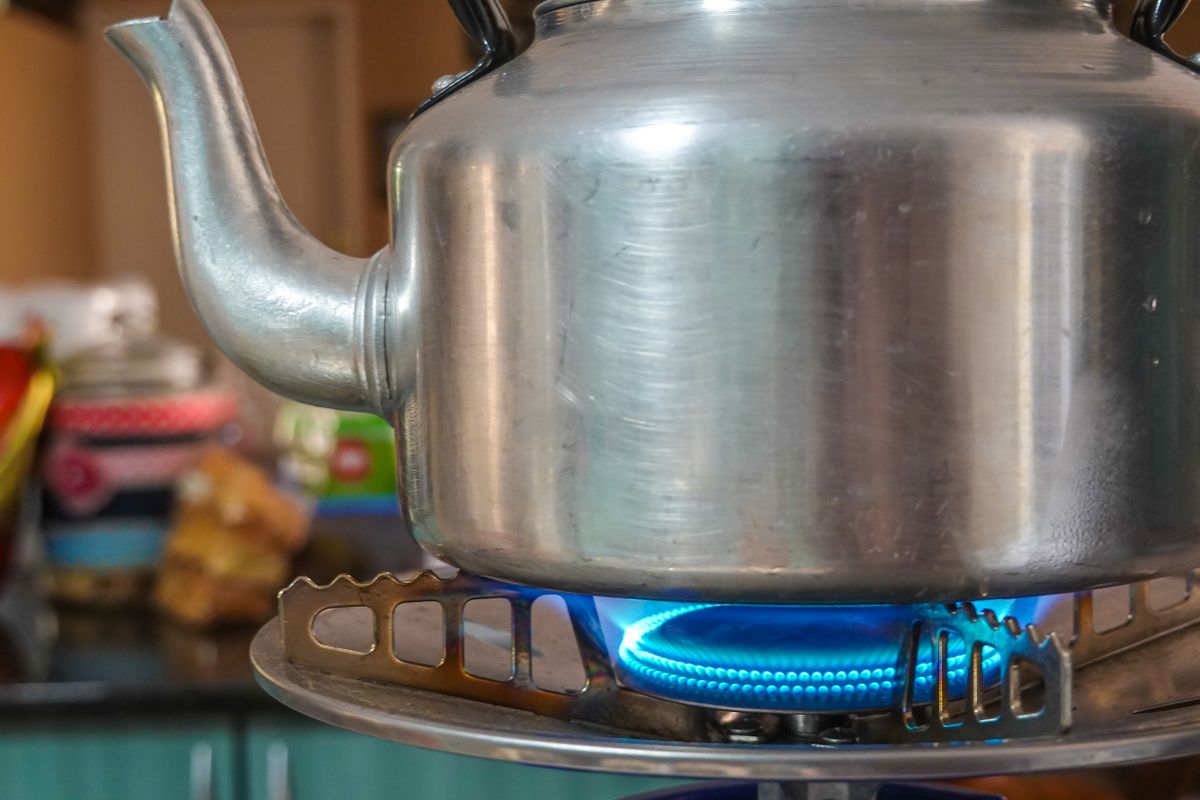
A kettle is the whole mechanism running at full speed. It takes cold, gas-rich tap water to 212°F, open to the air, so almost all of the carbon dioxide leaves, the reaction runs at its fastest, and the carbonate hardness drops out on the element. Then a little water boils off, concentrating what is left, and it is refilled with fresh hard water the next morning.
That makes the kettle the most honest scale gauge in the house. If it furs up within two or three weeks, your water carries a lot of carbonate hardness, and the same reaction is happening more slowly inside your water heater. The scale in a kettle is also the calcium that would otherwise have gone into your cup — it is why tea brewed on hard water sometimes forms a thin film on the surface. The practical routines for the kettle, coffee maker and steam iron are in the guide to limescale in kettles, coffee makers and irons.
What Slows Hot-Side Scale — and What a Softener Cannot Do
Because the problem is set by temperature and by the calcium and bicarbonate in the water, the options reduce to three: run cooler, clean more often, or take the calcium out.
Turn the tank down. Dropping a storage tank from 140°F to 120°F moves it left on the curve and slows the reaction. It costs nothing and cuts energy use as well. It does not help the appliances that heat water themselves — the dishwasher, kettle and coffee maker still run at their own temperatures.
Flush and descale on a schedule. Draining sediment from a tank, descaling a tankless exchanger, and soaking aerators and showerheads in vinegar all remove deposit after it forms. None of them change the rate at which it forms, so the interval is set by your hardness and alkalinity.
Soften the water. An ion exchange softener removes calcium and magnesium and replaces them with sodium, which forms no scale when heated. With no calcium left, heat has nothing to precipitate, so the reaction in the chart simply has no fuel. This is the only option of the three that works everywhere at once, including inside appliances that run hotter than the tank.
What a softener cannot do:
- It does not remove scale already formed. Existing deposit in the tank, the tankless exchanger or the kettle stays until you flush or descale it. Do that once after the softener goes in.
- It does not change the physics. Softened water still loses CO₂ when heated. The difference is that there is no calcium left for it to act on.
- It does not stop every deposit. Silica, which is common in some western and well water supplies, forms its own glassy scale that ion exchange does not remove. Iron and manganese need their own treatment.
- It does not stop evaporation residue entirely. Softened water still contains dissolved solids, mostly sodium, so drops left to dry still leave a faint film — just one that wipes off instead of etching into a crust.
What to Do Next
- Accept that the hot side will always scale first. Why hot water causes more scale is a question of chemistry, not of faulty equipment — the reaction runs wherever cold, bicarbonate-rich water meets a hot surface.
- Test hardness on the cold tap, and note the alkalinity if your kit or lab report gives it. Those two numbers together predict how fast your heater will coat.
- Use the kettle as a gauge. Note how many weeks it takes to fur up. If it is under a month, assume your water heater is building deposit at the same pace.
- Check the hot-side aerators and read the debris. Flakes mean the heater needs flushing; an even crust means the aerator just needs a vinegar soak.
- Set the tank to 120°F unless you have a specific reason to run hotter, and put the heater's flush or descale on the calendar.
- If you are above about 10 grains with high alkalinity, look at softening. It is the only step that stops the reaction instead of cleaning up after it.
Frequently Asked Questions
Does hot water have more limescale than cold water?
It carries the same dissolved minerals — a water heater does not add calcium. What changes is how much of that calcium can stay dissolved. Heating drives carbon dioxide out of the water and lowers the solubility of calcium carbonate, so part of the calcium leaves solution as solid scale on the heater, the hot pipes and the hot-side fixtures. Water from the hot tap can even test slightly softer than the cold, because some of its hardness has already been deposited upstream. Always test hardness on the cold side.
Does lowering the water heater temperature reduce scale?
Yes, measurably, though it does not stop it. Less carbon dioxide is driven off at 120°F than at 140°F, calcium carbonate stays slightly more soluble, and the precipitation reaction itself runs more slowly at lower temperature. Turning a tank down to 120°F is a free, sensible step on hard water. It does nothing for the appliances that heat water themselves — the dishwasher, the kettle and the coffee maker still run at their own temperatures.
Does boiling water remove hardness?
It removes part of it. Boiling drives out carbon dioxide and precipitates the calcium that was held as bicarbonate — the so-called temporary hardness — which is exactly the white fur inside a kettle. It does not remove permanent hardness, the calcium and magnesium balanced by sulfate or chloride, which stays dissolved through boiling. It also concentrates whatever is left as water evaporates. It is a lab demonstration of the chemistry, not a practical way to treat a household supply.
Why do my hot water faucet aerators clog but the cold ones don't?
Two reasons stack up. Hot water degasses and evaporates faster as it leaves the spout, so deposit forms on the screen itself. And the water heater upstream sheds flakes of scale from its walls or heat exchanger, which travel through the hot lines until they meet the first fine mesh — the aerator. Unscrew one and look at the debris: hard, white, curved chips are heater scale, while fine sand or grit usually points to the supply line or a well.
Does a water softener stop scale in a water heater?
It stops new calcium and magnesium scale, because it removes the calcium that the reaction needs — no amount of heat can precipitate calcium carbonate from water that has no calcium left in it. It does not dissolve scale already inside the tank or heat exchanger, so flush or descale once after installing one. It does not remove silica, which forms its own glassy deposit in some regions, and it does not change the physics: softened water still loses carbon dioxide when heated, there is just nothing left for it to precipitate.