
Upflow vs Downflow Regeneration: Which Uses Less Salt?

An upflow vs downflow water softener comparison comes down to which way the brine travels during regeneration. Upflow (counter-current) brining pushes brine up from the bottom, against the service flow, so the resin that polishes water last gets the strongest brine. It leaks less hardness and saves roughly 5 to 25 percent of the salt, provided the bed stays still.
Downflow (co-current) brining sends brine the same way as the water, top to bottom. It wastes some salt, but it tolerates dirty water better.
Upflow vs Downflow Water Softener: One Choice, Two Sets of Names
Search results treat "upflow vs downflow" and "counter-current vs co-current" as separate topics. They are the same topic. Both pairs describe the direction brine moves relative to the water being softened.
| Name you will see | What it means in a home softener | Same thing as |
|---|---|---|
| Downflow brining | Brine enters at the top and leaves at the bottom | Co-current regeneration |
| Upflow brining | Brine enters at the bottom and leaves at the top | Counter-current regeneration |
| Counter-flow, reverse-flow | Brine moves opposite to service water | Upflow brining |
| "Upflow softener" | Almost always upflow brining, not upflow service | Counter-current |
That last row is where buyers get confused. In nearly every residential softener, service water flows down through the resin and leaves up the centre riser tube. "Upflow" describes only the brine step. Kinetico's own specification for its 2030s model states it plainly: "Service flow shall be downflow and regeneration flow shall be upflow."
So you are not choosing between two kinds of softener. You are choosing between two brine paths through the same kind of resin bed. How the rest of the cycle works — backwash, brine draw, rinse, refill — is covered in how water softener regeneration works.
What the Brine Meets First Decides How Well the Bed Recharges
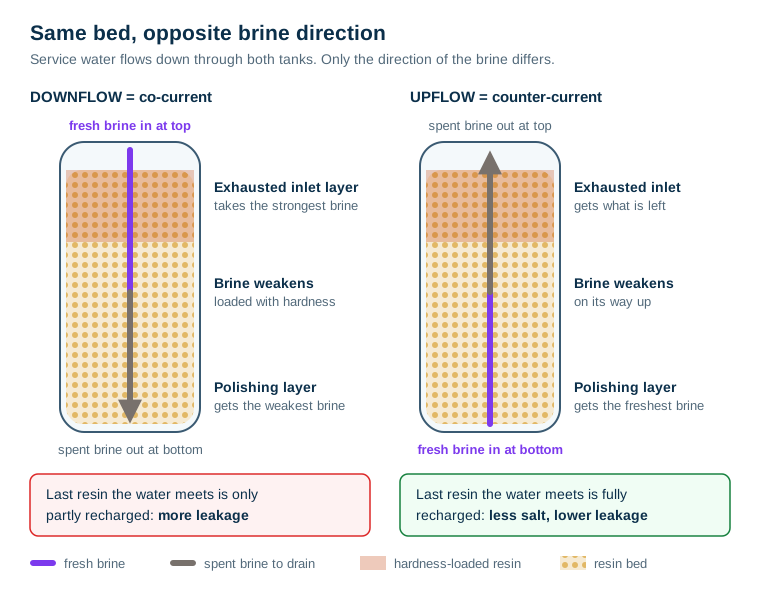
During service, hard water enters at the top. The top layer of resin exhausts first, and a band of exhausted resin creeps downward as the days go by. At regeneration time the bed is layered. The top is heavily loaded with calcium and magnesium, and the bottom, the polishing layer, is still mostly in sodium form. That bottom layer is the last resin every gallon touches before it reaches your taps.
Downflow (co-current) brining. Fresh brine hits the heavily loaded top layer first and does most of its work there. By the time it reaches the bottom it is weaker and carries the hardness it has just stripped off. The polishing layer is regenerated with the weakest, dirtiest brine in the cycle. Some hardness can even be pushed down into it. When service resumes, that partly loaded layer releases a little hardness into the first water through. This is called leakage.
Upflow (counter-current) brining. Fresh brine enters at the bottom and meets the polishing layer first, at full strength. That layer ends up almost completely in sodium form. The brine then climbs through the more exhausted resin above and leaves at the top carrying the hardness. The water's last contact in service is with the best-regenerated resin in the tank.
The principle is the same one used in large industrial softening plants: put the freshest chemical where the cleanest water leaves.
Why leakage matters to you. A downflow softener running a generous salt dose can still produce water that tests near zero. The leakage becomes noticeable when the salt dose is cut to save money. On a downflow bed, lowering the dose is what drives leakage up. On a counter-current bed you can cut the dose further before that happens. That is the real mechanism behind the salt savings.
How Much Salt Counter-Current Actually Saves
This is where marketing and the technical literature part company. The most useful single source is a review in Water Conditioning and Purification magazine, countercurrent regeneration of softeners: weighing the pros and cons. It reports:
- About 5 to 10 percent better efficiency at standard salt doses of 6 to 7 lb per cubic foot of resin.
- About 15 to 25 percent better when counter-current is combined with low salt doses, where a reduction of up to a third in salt use becomes possible.
- Low leakage even below 4 lb per cubic foot, which a co-current bed cannot match.
Put simply, counter-current does not make salt work harder at the same dose. It makes a low dose usable. Low doses are where every softener gets its best grains per pound, whichever way the brine flows.
A manufacturer's spec sheet shows the pattern. These figures come from Kinetico's 2030s counter-current softener data sheet, which lists capacity and efficiency at each salt setting:
| Salt setting | Dose per cu ft | Capacity | Efficiency |
|---|---|---|---|
| 1.8 lb (certified setting) | 3.8 lb | 7,867 grains | 4,371 grains per lb |
| 2.4 lb | 5.1 lb | 8,900 grains | 3,708 grains per lb |
| 2.7 lb (certified setting) | 5.7 lb | 9,802 grains | 3,630 grains per lb |
| 3.0 lb | 6.4 lb | 10,500 grains | 3,500 grains per lb |
The same data sheet specifies resin with at least 30,000 grains per cubic foot "when regenerated with 15.0 lbs/ft³". That works out to 2,000 grains per pound. So on one data sheet the lowest dose gets more than twice the softening from each pound of salt as the highest. Every extra pound of salt buys less capacity than the one before.
The benchmark to compare against. The EPA WaterSense fact sheet on water-efficient softeners tells buyers to look for more than 3,350 grains of hardness exchanged per pound of salt and no more than 4 gallons of water per 1,000 grains removed. It also recommends demand-initiated regeneration. A counter-current softener at a low dose clears the salt figure comfortably. A co-current one can clear it too, but only at doses low enough that leakage starts to show.
How salt efficiency is rated, and how to read the figure on a spec sheet, is covered in what water softener salt efficiency means.
Treat big percentage claims with care. Figures like "75 percent less salt" usually compare a well-tuned counter-current unit at a low dose with a badly tuned old co-current unit on a high dose and a timer. Most of that gap comes from the dose and the regeneration trigger, not the brine direction.
The Tradeoff: Upflow Brine Must Not Move the Bed
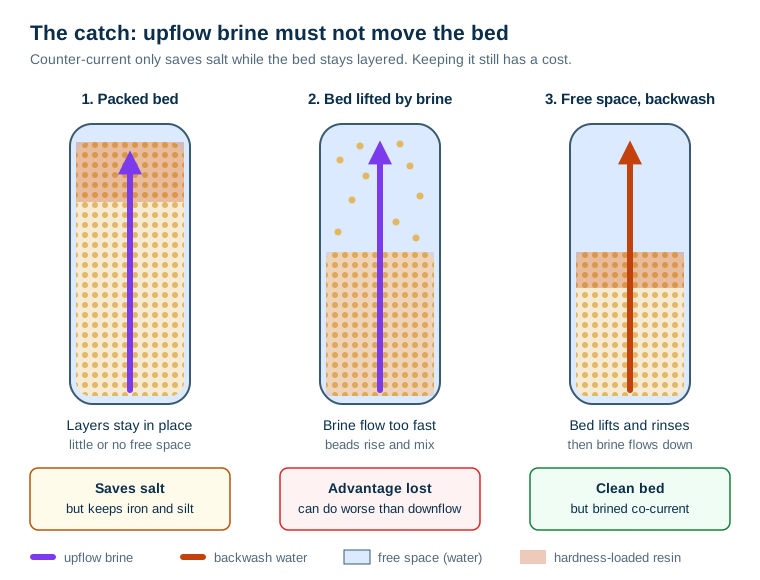
Counter-current brining depends on the bed keeping its layers. If the upward brine flow lifts the resin, the exhausted top and the fresh bottom mix, and the advantage disappears. The WC&P review is blunt about it. Dilute brine "tends to fluidize the resin at much lower flow rates than are required for backwash." It adds that a poorly controlled counter-current softener can perform worse than a co-current one.
There are three ways a softener can deal with this, and each has a cost.
1. A packed bed. Fill the tank so there is little or no free space above the resin, so the bed has nowhere to move. The WC&P review calls this "the only really practical method that has yet been devised" for homes. The cost is that a packed bed cannot be backwashed properly. Backwashing needs room for the bed to expand and let trapped particles float out. Without it, iron, manganese, silt and resin fines stay in the bed.
2. A bed that lifts. Free space, upflow brine, and a brine flow too fast for the bed. The layers mix every cycle. You pay for an upflow valve and get co-current results, or worse.
3. Free space and a regular backwash. The conventional design. The bed lifts and rinses clean, reclassifies, then gets brined downflow. This keeps the bed healthy on dirty water, at the cost of co-current efficiency.
This is why the same review calls counter-current "far less attractive for well waters than for municipal waters." Clean, filtered city water loads almost nothing a backwash needs to remove. A well carrying iron or sediment loads plenty.
Where Each Direction Makes Sense
| Your situation | Better fit | Why |
|---|---|---|
| City water, low sediment, moderate hardness | Upflow (counter-current) | Clean feed, so a packed or lightly backwashed bed stays healthy and the salt saving is real |
| City water with chlorine or chloramine | Upflow, with carbon ahead of it | The direction does nothing about oxidation, so protect the resin separately |
| Well water with dissolved iron or manganese | Downflow with full backwash, or iron removal first | The bed needs room to shed what it traps |
| Well water with silt or sand | Sediment filtration first, then either | Silt fouls any bed, and a packed bed holds on to it |
| Very high hardness with a low salt budget | Upflow at a low dose | This is where the 15 to 25 percent gain lives |
| Local limits on brine discharge | Upflow at a low dose, demand-initiated | Less salt in means less chloride out |
Direction is one of several efficiency features, and it is not the biggest. The regeneration trigger usually matters more. A timer that regenerates on schedule wastes more salt than any brining direction saves. Next comes how the salt dose is set. Proportional brining vs fixed salt dosing covers the refill side. A counter-current softener on a timer is still a timer softener.
How to Tell Which Direction a Softener Uses
Sales pages often do not say. These four checks work.
- Read the spec sheet for "regeneration type" or "brining". Kinetico's 2030s data sheet states "Countercurrent" outright. If a sheet says nothing, assume co-current and ask.
- Check the valve model and its manual. Several common valves are made in both configurations. Pentair publishes separate downflow and upflow service manuals for the Fleck 5600SXT, and the upflow version's parts list includes its own valve body, piston rod and drive gear. The model name alone does not tell you which one is on the tank.
- Look at the cycle order in the programming. Upflow valves commonly draw brine before the backwash step, or refill the brine tank before regeneration (prefill) rather than after. The manual lists the order. Counting the cycle steps on the display shows it too.
- Ask for the NSF/ANSI 44 efficiency figure at a stated salt setting. A seller who can quote grains per pound at a named dose, as Kinetico's sheet does, has something to show. "High efficiency" without a number is marketing.
How the valve moves between those positions mechanically is covered in how a water softener control valve works.
What Upflow Brining Cannot Do
- It does not remove more kinds of contaminant. The resin is the same, so the list of what it exchanges is the same. Direction changes how completely the bed recharges, nothing more.
- It does not protect resin from chlorine. Oxidation attacks the bead itself, whichever way the brine flows.
- It does not fix an undersized softener. A tank that is too small regenerates too often in either direction.
- It does not handle oxidised iron better. If anything, a packed counter-current bed handles it worse, because it cannot backwash the particles out.
- It does not save much at high salt doses. If the dose stays at 12 to 15 lb per cubic foot, expect single-digit percentage savings at best.
Choosing Between Them
For a clean municipal supply, an upflow (counter-current) softener set to a low salt dose and demand-initiated regeneration is the efficient choice, and the saving is real. For a well with iron, manganese or sediment, the bed's need to backwash usually outweighs the salt saving. Choose a downflow unit with full backwash, or treat the water first. What upflow brining saves in practice is modelled for three households in this review of the SoftPro Elite's upflow salt savings.
Whichever you buy, the salt dose you program matters more than the arrow on the brochure. Ask for grains per pound at a stated setting, and compare that number.
Frequently Asked Questions
Is upflow or downflow better for a water softener?
Upflow (counter-current) brining is more salt-efficient and gives lower hardness leakage, because the freshest brine reaches the resin that treats water last. Downflow (co-current) brining is simpler and more tolerant of dirty water, because the bed has room to lift and rinse clean. On clean municipal water upflow is usually the better buy. On a well with iron, manganese or silt, a downflow unit with proper backwash and pretreatment is often the safer choice.
Does upflow regeneration really use less salt?
Yes, but less than some sellers claim. A Water Conditioning and Purification review of counter-current regeneration put the gain at about 5 to 10 percent at standard salt doses of 6 to 7 pounds per cubic foot, rising to 15 to 25 percent when counter-current is paired with low salt doses. The big savings come from running a low dose, which counter-current makes possible without hardness leaking through.
Is counter-current the same as upflow?
In residential softeners, yes. Service water flows down through the tank, so brine sent upward is flowing against the service direction, which is what counter-current means. Downflow brining travels the same way as service water, which is co-current. The two pairs of names describe one design choice. An 'upflow softener' in a sales listing almost always means upflow brining, not water flowing up through the tank in service.
Can I convert my downflow softener to upflow?
Sometimes, but rarely as a quick change. Some control valves are made in both configurations and the upflow version uses different internal parts. The Fleck 5600SXT upflow parts list, for example, includes its own valve body, piston rod and main drive gear. On those valves conversion amounts to a different valve. Check the manufacturer's parts list for your exact model before buying anything, and reprogram the cycle order afterwards.
Is upflow brining good for well water with iron?
It is the harder case. Counter-current brining depends on a bed that stays packed and layered, and the usual way to achieve that in a home softener leaves little room to backwash. Iron, manganese and silt that a full backwash would flush out stay in the bed instead. Treat the iron first, or choose a downflow unit with full backwash, unless the manufacturer rates the upflow model for your iron level.
Why does my softener leak a little hardness right after it regenerates?
On a downflow (co-current) softener the bottom layer of resin, which polishes the water last, is regenerated by brine that has already passed through the exhausted top layers. It is left partly loaded with hardness, and some of that bleeds into the first water after regeneration. A small amount is normal. A counter-current design largely avoids it because that bottom layer meets the strongest brine first.
