
Total Cost of Owning a Water Softener
The water softener cost of ownership for a family of four comes to roughly $3,250 to $5,640 over ten years, or about $27 to $47 a month, in the illustrative model below. Hardness makes most of the difference. The purchase and installation is only a third to a half of that total. Salt, regeneration water, upkeep and one resin change make up the rest.
The figures that follow are a model, not a quote. Every assumption is written out, so you can replace any line with your own price and get your own total. The model also counts what softened water may save you, and those savings are smaller than most sales material claims.
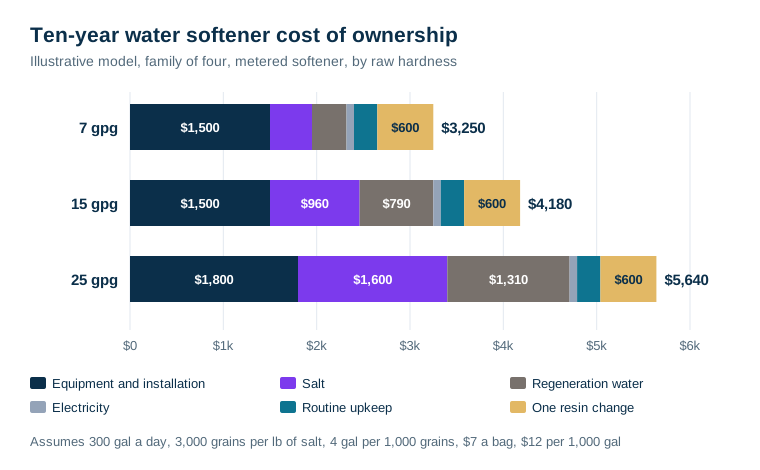
The Ten-Year Water Softener Cost of Ownership at Three Hardness Levels
Find the column nearest your raw water hardness. If you do not know it, a hardness test comes first, because the model is useless without it.
| Ten-year cost line | 7 gpg (hard) | 15 gpg (very hard) | 25 gpg (extremely hard) |
|---|---|---|---|
| Equipment and installation | $1,500 | $1,500 | $1,800 |
| Salt | $450 | $960 | $1,600 |
| Regeneration water and sewer | $370 | $790 | $1,310 |
| Electricity | $80 | $80 | $80 |
| Routine upkeep | $250 | $250 | $250 |
| One resin change | $600 | $600 | $600 |
| Ten-year total | $3,250 | $4,180 | $5,640 |
| Per year | $325 | $418 | $564 |
| Per month | $27 | $35 | $47 |
Three things stand out.
- The purchase price is the smaller part. At 15 gpg, $1,500 of a $4,180 total is equipment and installation. The remaining $2,680 is spread over ten years, which is why the running costs get overlooked.
- Hardness drives the running cost. Salt and water together come to $820 over ten years at 7 gpg and $2,910 at 25 gpg. The equipment line barely moves, apart from a larger softener at 25 gpg.
- Some costs do not change with hardness. Electricity, upkeep and the resin change are the same in every column. That is why softening moderately hard water costs more per grain removed.
The Assumptions Behind Every Line
Every figure above comes from these inputs. Change any of them to match your house, and the arithmetic in the next section shows how.
| Input | Value used | Why |
|---|---|---|
| Household | 4 people, 300 gallons a day softened | A common planning figure for a four-person home that softens everything but outdoor taps |
| Salt efficiency | 3,000 grains removed per pound of salt | A realistic field setting for a metered unit. NSF/ANSI 44 efficiency rating requires at least 3,350 |
| Regeneration water | 4 gallons per 1,000 grains removed | Inside the 5.0 gallon ceiling of the same efficiency rating |
| Salt price | $7 per 40 lb bag of sodium chloride | Typical plain pellet or crystal price. Check your store |
| Water and sewer | $12 per 1,000 gallons combined | Read yours from your bill. Rates vary widely between utilities |
| Electricity | $8 a year | A small plug-in transformer running a control valve all year |
| Softener | Metered (demand-initiated), single tank, 32,000 grain class; 48,000 at 25 gpg | Sized so it regenerates every few days rather than daily |
The two efficiency limits come from the NSF/ANSI 44 efficiency rating. The US Department of Energy's Building America Solution Center summarises it: a rated softener must be demand-initiated, reach at least 3,350 grains per pound of salt, and use no more than 5.0 gallons of water per 1,000 grains removed. Time-clock units cannot be efficiency rated at all.
Line by Line: How Each Cost Is Worked Out
Equipment and installation
The model uses $1,500 for a metered single-tank softener installed on an existing plumbing loop, and $1,800 for the larger unit at 25 gpg. Treat that as a placeholder. A self-installed online unit can come in well under $1,000, and comparing budget softeners on ten-year cost, parts included shows which cheap units stay cheap to own. A dealer-installed premium brand can cost two or three times as much. Kinetico's typical quotes by model, set against how long its efficiency savings take to pay back, show where the top of that range sits. Most of the variation between quotes comes from the drain run, the loop and any electrical work rather than the tank. That breakdown is in how much water softener installation costs.
Salt
Grains removed per year = hardness (gpg) × gallons per day × 365.
Pounds of salt = grains ÷ 3,000.
| Hardness | Grains a year | Salt a year | 40 lb bags | Cost a year |
|---|---|---|---|---|
| 7 gpg | 766,500 | 256 lb | 6.4 | $45 |
| 15 gpg | 1,642,500 | 548 lb | 13.7 | $96 |
| 25 gpg | 2,737,500 | 913 lb | 22.8 | $160 |
Salt is the line most worth checking against your own bills, because a badly set unit can double it. Salt types, bag prices and a worksheet for your own household are in how to estimate annual water softener salt cost.
Regeneration water
Gallons to drain = grains removed ÷ 1,000 × 4.
That is about 3,070 gallons a year at 7 gpg, 6,570 at 15 gpg and 10,950 at 25 gpg. At $12 per 1,000 gallons, it costs $37, $79 and $131 a year. The EPA's WaterSense page on cation exchange water softeners puts regeneration at "25 gallons of water or more per day, or up to 10,000 gallons per year", so the 25 gpg case sits at the top of that range.
If you are on a septic system, this water also goes to the tank. It costs you nothing on the water bill, but it is still load on the system.
Electricity
A modern control valve runs from a low-voltage transformer. The motor turns only during regeneration, and the display draws very little the rest of the time. The model allows $8 a year. Even if yours draws twice that, it is under 5% of the total.
Routine upkeep
The model allows $25 a year for owner-done maintenance. That covers hardness test strips, an occasional resin cleaner, and one seal-and-spacer kit for the valve during the decade. A kit for a common Fleck 5600 valve was listed at $28 by an online parts retailer when this page was written. The time involved is about five minutes a month and an hour a year.
If you pay for an annual professional visit instead, add its price for each year. At $150 a visit, that is another $1,500 over ten years, the same as the equipment line.
One resin change
The model includes one resin change, at $600 installed, somewhere in the decade. Online retailers list one cubic foot of standard softening resin at roughly $150 to $300, and a 32,000 grain softener holds about one cubic foot. The rest is labour, gravel or a new distributor where needed, and disposal.
Whether you will actually pay for this depends on your water. Chlorine and chloramine in city water slowly break down resin, and iron fouls it. On clean, unchlorinated well water, the resin may outlast the ten years. If yours lasts, take the $600 off.
What the model leaves out
- A control valve replacement. A valve can fail inside ten years, but it is not expected to, so it is not in the base model. The repair-cost range for a valve is worth knowing before you buy.
- Plumbing repairs, permits and a drain that has to be built. These belong to the installation quote.
- Financing interest. A $1,500 softener on a dealer finance plan can cost much more than $1,500. Compare the total repayable, not the monthly payment.
What Moves Your Number the Most
Five inputs account for nearly all the difference between one house and another.
- Hardness. Each extra grain per gallon adds about $11.65 a year for a family of four ($6.39 in salt and $5.26 in water), or about $117 over ten years.
- How much water you soften. Two people using 150 gallons a day halve the salt and water lines. Teeing irrigation or an outdoor tap off before the softener keeps it out of the model altogether.
- Timer or metered control. A timer regenerates on a schedule whether or not the resin is used up. The worked example in metered vs timer-based water softeners found metering cut salt and regeneration water by 22% to 42% in the same house. Turned the other way round, a timer unit on the 15 gpg column would add roughly $490 to $1,270 to the salt and water lines over ten years.
- The hardness setting. A unit set to 25 gpg on 15 gpg water regenerates about two-thirds more often than it needs to. Test your raw water once a year and set the valve to the result, plus any allowance for iron that the manual specifies.
- Your water and sewer rate. At $20 per 1,000 gallons instead of $12, the regeneration water line at 15 gpg rises from $790 to about $1,310 over ten years.
Salt type matters too. Potassium chloride costs considerably more per bag than sodium chloride. If you use it, rerun the salt line at its price rather than using the $7 figure.
The Offsetting Side: What Softened Water May Save
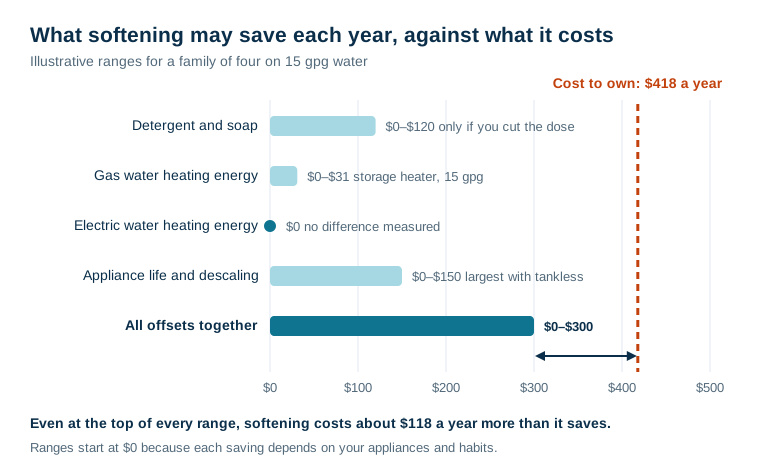
Sales material often claims a softener pays for itself. The research behind those claims is real, but it is narrower than it sounds. Every range in the chart above starts at $0, because each saving depends on something about your house.
Water heating energy
The main source is a 2009 study by Battelle, funded by the Water Quality Research Foundation (WQRF), the research arm of the water treatment industry's trade association. Battelle tested gas, electric and tankless water heaters on softened and unsoftened water under conditions "designed to accelerate the waterside scaling". Its executive summary reports:
| Water heater | Finding |
|---|---|
| Gas storage | Estimated life-cycle energy cost savings of 3.1% at 5 gpg, 10.3% at 15 gpg and 19.0% at 25 gpg |
| Electric storage | "Did not record any difference in the electricity consumption" between softened and unsoftened water, though element life is expected to be shorter on hard water |
| Tankless gas | Without softening, estimated deliming every 2.7 years at 15 gpg and every 1.6 years at 25 gpg |
In money, a household spending $300 a year to heat water with gas saves up to about $31 a year at 15 gpg. With an electric storage heater, the energy saving is $0. The model uses $0 to $31.
Detergent and soap
The same research programme found cold-water laundry in softened water needed far less detergent than hot hard water. Those are laboratory results, and the saving only happens if you actually reduce the dose. Most households do not. For a family spending $300 a year on detergent and soap, the model uses $0 to $120, where $120 is a 40% cut.
Appliance life and descaling
This line includes a storage water heater that lasts longer, showerheads and aerators that do not clog, a kettle and coffee maker that do not need descaling, and, for tankless owners, professional flushes you no longer pay for. It has the widest spread of all. For a house with a tankless heater it can be the biggest saving on the list. For a house with an electric storage heater and no tankless appliances it is small. The model uses $0 to $150.
The honest total
Together, the offsets come to $0 to $300 a year at 15 gpg, against an ownership cost of $418 a year. Even at the top of every range, the softener costs you about $118 a year more than it saves. At the bottom, it costs the full $418.
Two situations close the gap. The first is extremely hard water with a gas heater, where the energy saving grows with hardness. The second is a tankless heater that would otherwise need regular professional descaling. A worksheet that runs this payback for your own household is in do you actually need a whole-house water softener.
What the Ten-Year Figure Does Not Tell You
- It is not a health calculation. A softener removes hardness minerals. It does not remove bacteria, nitrate, lead or arsenic, and softened water adds sodium in proportion to the hardness removed. None of that appears in a cost model.
- It does not include resale value. There is no reliable evidence that a softener raises what buyers pay for a house. In very hard-water areas, it may simply remove one objection.
- It assumes the unit is set up and looked after. An unmaintained softener with a salt bridge costs almost nothing to run and softens nothing. The low cost is not a saving.
- It does not compare against doing nothing. The comparison that matters is the net figure, $118 to $418 a year at 15 gpg, against how much you value soft water, fewer spots and less scale.
How to Run the Model on Your Own House
- Test raw hardness at an untreated tap, in grains per gallon (mg/L ÷ 17.1).
- Take household water use from your water bill, excluding irrigation, and divide by the days in the billing period.
- Work out grains per year: hardness × gallons a day × 365.
- Salt: grains ÷ 3,000 × your price per pound. Use 2,000 grains per pound instead if you have a timer unit.
- Water: grains ÷ 1,000 × 4 × your combined water and sewer rate per gallon.
- Add fixed lines: electricity, upkeep, a resin reserve of $60 a year on chlorinated water, and the installed price from a written quote.
- Subtract only the savings you will really get. Use $0 for detergent unless you will cut the dose, and $0 for water heating energy if your heater is electric.
A water softener's cost of ownership is predictable once hardness and household size are known. Work it out before you compare quotes, and a sales pitch built on "it pays for itself" is easy to check.
Frequently Asked Questions
How much does it cost to own a water softener per year?
In the illustrative model on this page, a family of four with a metered softener spends about $325 a year at 7 gpg, $418 at 15 gpg and $564 at 25 gpg, averaged over ten years. That figure includes the purchase and installation, salt, regeneration water, electricity, routine upkeep and one resin change. Hardness, household size and the softener's efficiency move it the most.
How much does a water softener cost to run each month?
Leaving out the purchase price, salt, regeneration water and electricity come to about $8 a month at 7 gpg, $15 at 15 gpg and $25 at 25 gpg for a family of four in the model. Adding routine upkeep and a reserve for one resin change brings that to about $15, $22 and $32. Electricity is under $1 a month for a typical control valve. An old timer unit, or one set to a higher hardness than your water, can use far more.
Does a water softener pay for itself?
Rarely in cash alone. Even taking the top of every savings range for detergent, water heating and appliance life, a family of four on 15 gpg water recovers about $300 a year against roughly $418 a year of ownership cost. The gap narrows with very hard water, a gas or tankless water heater, and a household that actually cuts its detergent dose. Most people buy one for scale-free fixtures and better lather, not a return.
What is the biggest cost after buying a water softener?
Salt, followed closely by the water used to regenerate. At 15 gpg those two add about $175 a year in the model. The largest single bill is usually a resin change, which on chlorinated city water often falls somewhere around the eight-to-twelve-year mark. A control valve rebuild or replacement is the next biggest risk.
Does a water softener raise your water bill?
Yes, a little. Every regeneration sends water to drain. In the model it is about 3,000 gallons a year at 7 gpg and 11,000 gallons at 25 gpg, which at a combined water and sewer rate of $12 per 1,000 gallons is $37 to $131 a year. The EPA says regeneration can use up to 10,000 gallons a year. A demand-initiated unit set to your real hardness uses the least.
Is a salt-free system cheaper to own than a softener?
Not automatically. A salt-free conditioner has no salt or regeneration water, but its media and prefilters need replacing on a schedule, which in typical worked examples costs a few hundred dollars a year. At moderate hardness that can match or exceed a softener's running cost. It also does not remove hardness, so the soap and spotting benefits of softened water do not apply.
