
7 Water Softener Alternatives Worth Buying, Matched to the Symptom Each Fixes
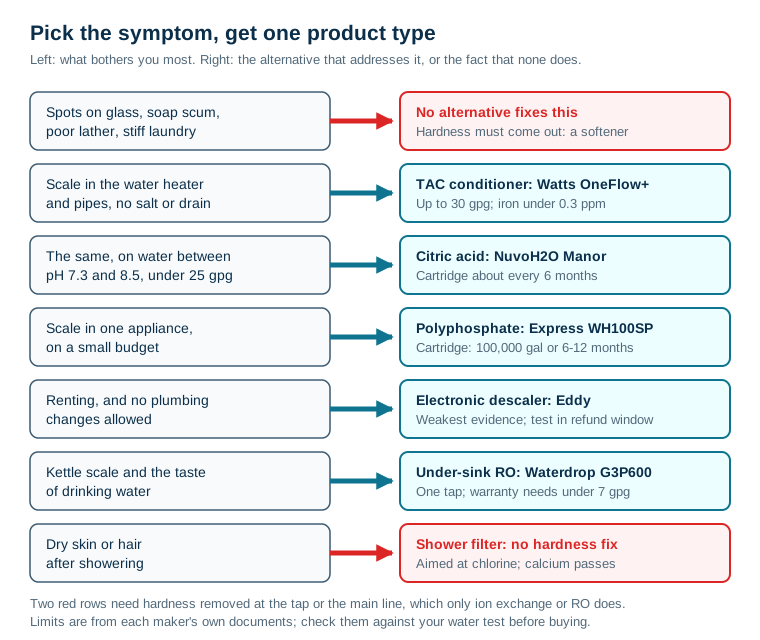
Water softener alternatives each fix one part of the hard-water problem, and none fixes all of it. A salt-free crystal-forming conditioner cuts scale in water heaters and pipes. A citric acid cartridge does a similar job on slightly alkaline water. A polyphosphate cartridge protects one appliance cheaply. An electronic descaler suits a renter who cannot change the plumbing. An under-sink reverse osmosis system fixes drinking water and kettle scale at one tap. Shower filters and magnets fix nothing about hardness. And two of the most common complaints, spotting and soap scum, are fixed by no alternative at all. Find your main symptom below and buy for that one.
Disclosure: Hard Water Solved may earn a commission if you buy through links on this page, at no extra cost to you. It does not change which products we include or how we rank them. Read our disclaimer.
The Symptom-to-Product Matrix
Each column is one alternative; each row is a symptom. "Yes" means independent or maker-published evidence supports it for that symptom. "Partly" means a reduced or unproven effect. "No" means it does not address it.
| Symptom | TAC conditioner | Citric acid | Polyphosphate | Electronic descaler | Under-sink RO | Shower filter | Magnet clamp |
|---|---|---|---|---|---|---|---|
| Scale in the water heater and pipes | Yes | Yes | Partly | Partly | No | No | No |
| Scale in the kettle and coffee maker | Yes | Yes | Partly | Partly | Yes, if filled from the RO tap | No | No |
| Spots on glass, taps and shower doors | No | No | No | No | One tap only | No | No |
| Soap scum and poor lather | No | No | No | No | No | No | No |
| Stiff laundry | No | No | No | No | No | No | No |
| Dry skin or hair after showering | No | No | No | No | No | Only if chlorine is the cause | No |
| Drinking-water taste | Partly (carbon stage on some units) | No | No | No | Yes | No | No |
| Renting, no plumbing changes allowed | No | No | No | Yes | Needs a sink fitting | Yes | Yes |
Read it row by row. If your main complaint sits on a row with no "Yes", no alternative will satisfy you, and the honest answer is a softener. Whether you need one at all is worked through in do you need a whole-house water softener.
How We Chose
Methodology. Nothing on this page was physically tested. The matrix is built from the independent WateReuse study for TAC and electronic devices, the University of Nebraska-Lincoln extension guide, and each maker's own specification sheets, manuals and warranties.
- Included: one product per alternative type, chosen as the best-documented example of that type that is sold on Amazon at a normal price above $100.
- Swapped: SpringWell FutureSoft was the first choice for TAC, but its Amazon listings showed no offer when this site checked on 1 October 2026 and its 95% claim names no test. The Watts OneFlow+ replaces it.
- Not picked: shower filters (most cost under $100, and they target chlorine, not hardness) and magnet clamps (no scientific consensus that they work).
- Prices are not listed here because they change often. Use the buttons to see the current price on Amazon.
7 Water Softener Alternatives and the One Product Worth Buying for Each
1. TAC salt-free conditioner: Watts OneFlow+ OFPSYS
- Fixes: scale in water heaters, pipes and anything fed hot water
- Does not fix: spotting, lather, laundry, skin feel
- Limits: up to 30 gpg; pH 6.5 to 8.5; iron 0.3 ppm and manganese 0.05 ppm maximum; free chlorine under 2 ppm
- Upkeep: scale cartridge every 3 years or 250,000 gallons; carbon block about yearly
- Seller: sold on Amazon by Amazon.com on 1 October 2026
This is the alternative with the strongest independent support. In a heated DVGW W 512 test, crystal-forming media cut scale formation by more than 88 percent. Watts is also blunt about the limits in its OneFlow+ specification sheet: "OneFlow is not a water softener", spotting "may occur", and a point-of-use softener should be used where spot-free results are mandatory. Buy it if your water heater is your main worry. If your water fails any of the checks in when a salt-free conditioner is wrong, do not.
2. Citric acid conditioner: NuvoH2O Manor
- Fixes: scale, on water between pH 7.3 and 8.5 and up to 25 gpg
- Does not fix: the hardness itself; a test strip reads the same afterwards
- Upkeep: a cartridge about every 6 months or 50,000 gallons
- Where to buy: NuvoH2O's own store, other retailers and Amazon; retailer prices have been lower than the brand store's
NuvoH2O doses citric acid, which binds calcium and lowers pH toward neutral. Its evidence is a maker-funded study run with Battelle, in which treated tankless heaters on 15 gpg water collected 0.87 g of scale against 45.6 g untreated. It is a good fit for a city home with slightly alkaline water. On a well near pH 7.3 or in a copper-plumbed house, the pH drop is a reason to choose TAC instead.
3. Polyphosphate cartridge: Express Water WH100SP
- Fixes: some scale, by the maker's claim, in the appliances downstream; no published scale test
- Does not fix: hardness, spotting, total dissolved solids
- Upkeep: the cartridge lasts up to 100,000 gallons or 6 to 12 months; Express Water sells 20-inch polyphosphate replacements, so confirm the size that fits this housing
- Where to buy: Express Water's store and Amazon
A polyphosphate cartridge slowly dissolves into the water and holds hardness minerals in solution so they are less likely to form scale. It is the cheapest way to protect one appliance, such as a washing machine or a single water heater, and the cheapest whole-house option here to buy. The evidence is the thinnest of the tank-or-cartridge options: Express Water's page describes what it does but cites no test. Its own page also notes it will not reduce total dissolved solids.
Do not combine it with TAC. Watts says not to apply any other antiscalant before or after its media, and caps total phosphates at 3.0 ppm.
4. Electronic descaler: Eddy ED6002P-US
- Fixes: possibly some scale, and the scale that forms may be softer
- Does not fix: hardness, spotting, lather
- Strength: clamp-on, no plumbing work; a 12-month money-back window on its retail listings
In the same independent heated test, electronic and electromagnetic devices cut scale by about 50 percent, against more than 88 percent for TAC. That makes a descaler the right alternative only when you cannot plumb anything in, which usually means renting. Buy it as a trial, test it with a kettle during the refund window, and return it if nothing changes. Eddy's terms come from retail listings; we could not reach its own website on 2 October.
5. Under-sink reverse osmosis: Waterdrop G3P600
- Fixes: drinking water, cooking water and kettle scale, at one tap
- Does not fix: anything elsewhere in the house
- Catch: its limited warranty applies only on municipal water under 7 grains per gallon and 750 ppm TDS
RO is the only alternative here that actually removes hardness, and it does it for a few gallons a day at the kitchen sink. That is enough to end scale in the kettle and coffee maker and to make ice and drinking water taste cleaner. The catch is in the manual. On hard, untreated water the membrane works harder and the warranty no longer applies, so on water much over 7 gpg an RO unit is often bought after a softener rather than instead of one.
6. Shower filter: no hardness fix
Shower filters sell hard on "hard water", but the common media (carbon, KDF, vitamin C) are aimed at chlorine. Calcium and magnesium pass through. If your skin or hair complaint is really chlorine, one may help. If it is soap residue left by hard water, it will not. We do not pick one: most cost under $100, and the job they do is not the one this page is about.
7. Magnet clamp: no reliable fix
Permanent-magnet clamps are the cheapest "alternative" and the least supported. The University of Nebraska-Lincoln's extension guide to salt-free water softener alternatives says "there is no scientific consensus as to the effectiveness of magnetic water treatment". It adds that standardised test procedures for these devices have not been developed. Skip it.
Which One for Your Home
Pick from your single worst symptom, not from the longest feature list:
- The water heater, tankless unit or boiler keeps scaling, and you own the house: the Watts OneFlow+, if your water is within its limits.
- The same, but your water is moderately hard and above pH 7.3, and you want the only product-specific study: the NuvoH2O Manor.
- One appliance, a small budget: the Express Water polyphosphate cartridge.
- You rent, or the main line cannot be cut: the Eddy, as a refundable trial.
- Only the kettle, coffee and drinking water bother you, and your water is under about 7 gpg: the Waterdrop G3P600.
- Spotting, soap scum, laundry or skin feel: none of these. You need hardness removed.
The wider choice between keeping hardness in the water and taking it out is set out in salt-based vs salt-free water treatment. It is the decision that sits underneath every row of the matrix.
What Each Alternative Costs Over Five Years
The box price is the smaller part of the bill for most of these. For a family of four using about 102,000 gallons a year, this is what you keep buying over five years:
| Alternative | What you replace over five years |
|---|---|
| Watts OneFlow+ | One scale cartridge at year 3; a carbon block about yearly |
| NuvoH2O Manor | About 2 cartridges a year, so about 10 |
| Express Water WH100SP | A cartridge every 6 to 12 months, so 5 to 10 |
| Eddy descaler | Nothing; a little electricity |
| Waterdrop G3P600 | Filters on the maker's replacement schedule |
Illustrative. Multiply the replacements by current part prices, and add the purchase price, to compare your own five-year totals. Installation is not included.
The cheapest line is the Eddy, and it is also the one with the weakest evidence. The NuvoH2O costs the most over five years because its cartridge is a consumable that dissolves as it works. The Watts sits between them on price and at the top on evidence, which is why it is the default pick for heater scale. And the RO unit's running cost is for a few gallons a day at one tap, not for the house.
Why No Alternative Fixes Spotting or Soap Scum
Spots on glass are the minerals left behind when a drop of water dries. Soap scum is soap reacting with calcium and magnesium. Every alternative on this page except RO leaves those minerals in the water by design. They change how the minerals behave when water is heated or flows through pipes, not whether they are there when water evaporates on a shower door. Watts says as much on its own specification sheet, which is why it recommends a point-of-use softener for spot-free glassware. RO removes the minerals, but only for the water that comes out of its own tap.
A Middle Route for the Red Rows: Soften One Line
If your "No" symptom lives in one place, you do not have to soften the whole house to fix it. Two point-of-use options remove hardness where it matters:
- One tap of drinking and rinse water. The under-sink RO unit above already does this. Glassware given a final rinse in RO water dries with far fewer spots, which is the "one tap only" cell in the matrix.
- One appliance line or one shower. A small portable ion-exchange softener, the kind sold for RVs, can sit on a single line such as a washing machine or a single shower. At 2 to 3 gpm it cannot supply a house, and it needs regenerating with table salt every so often, but it does take the calcium out of that one line. Our separate roundup of the best portable water softeners covers the sizes and how often they need salt.
Both are still softening, not alternatives to it. They are worth knowing about because they solve a red-row symptom for less money and plumbing than a whole-house unit, when the symptom is confined to one spot.
Who Should Buy None of These
- Anyone whose main complaint is spotting, soap scum or stiff laundry. No alternative changes the hardness that causes them.
- Homes with three or more symptoms on the matrix. Stacking alternatives costs more than one softener and still leaves the "No" rows unsolved.
- Wells with iron, manganese or hydrogen sulfide. They foul conditioner media and are ignored by descalers. Filter first.
- Water harder than about 30 gpg. Every alternative here is rated lower or does too little at that level.
- Homes already using one scale treatment. Adding a second can make both work worse, as Watts' antiscalant rule shows.
Match the alternative to the symptom, and buy one product type. If the symptom you care about sits in a row with no "Yes", the alternative you are looking for is a softener.
Frequently Asked Questions
What is the best alternative to a water softener?
It depends on the symptom. For scale in the water heater and pipes, a template-assisted crystallization conditioner such as the Watts OneFlow+ has the strongest independent support. For better drinking water and kettle scale at one tap, an under-sink reverse osmosis system works. For spotting, soap scum and the feel of the water on skin, no alternative works, because only removing the hardness fixes those.
Is there a water softener that does not use salt?
Not one that removes hardness. Salt-free conditioners, citric acid systems, polyphosphate cartridges and electronic descalers all leave calcium and magnesium in the water and aim to stop them forming scale. A potassium chloride softener uses potassium instead of sodium salt, but it is still an ion exchange softener with a brine tank and a drain.
Do shower filters soften hard water?
No. Most shower filters use carbon, KDF or vitamin C media aimed at chlorine. Calcium and magnesium pass through, so the water is as hard after the filter as before it. If dry skin or hair is caused by chlorine, a shower filter can help. If it is caused by hardness and soap residue, only a softener fixes it.
Do magnetic water softeners work?
There is no scientific consensus that they do. The University of Nebraska-Lincoln's extension guide says there is no agreement on the effectiveness of magnetic water treatment or on how it would work. Electronic descalers with powered coils have somewhat better evidence, at about 50 percent scale reduction in one independent heated test.
Is reverse osmosis a good alternative to a water softener?
Only for drinking and cooking water at one tap. An under-sink RO system removes hardness from the water it treats, so kettles and coffee makers filled from it stop scaling. It does nothing for showers, appliances or pipes. RO membranes also suffer on hard water: Waterdrop's G3P600 warranty requires feed water under 7 grains per gallon.
Can you use two water softener alternatives together?
Sometimes, but not every pair. Watts says its OneFlow media must be the last treatment stage and that no other antiscalant should be applied before or after it, which rules out pairing it with a polyphosphate cartridge. An under-sink RO system can sit after a whole-house conditioner, because point-of-use filters are exempt from that rule.
