
When a Salt-Free Conditioner Is the Wrong Choice
Knowing when not to use a salt-free water conditioner comes down to one fact: it leaves the hardness in your water. If you want more lather, spot-free glass, softer laundry or a test that reads near zero, it is the wrong choice. It is also wrong for water above about 30 gpg, for iron or manganese above the media's limits, and for plumbing that pushes more flow than the unit is rated for.
Most pages on this topic set salt-free and salt-based side by side and leave you to weigh them. This one is a disqualification list. Run through the nine checks below. If any answer is yes, stop, because no brand or model fixes that answer. For how the technology works, see does a salt-free system actually soften water. For the full side-by-side comparison, see salt-based vs salt-free water treatment.
When Not to Use a Salt-Free Water Conditioner: The Nine Checks
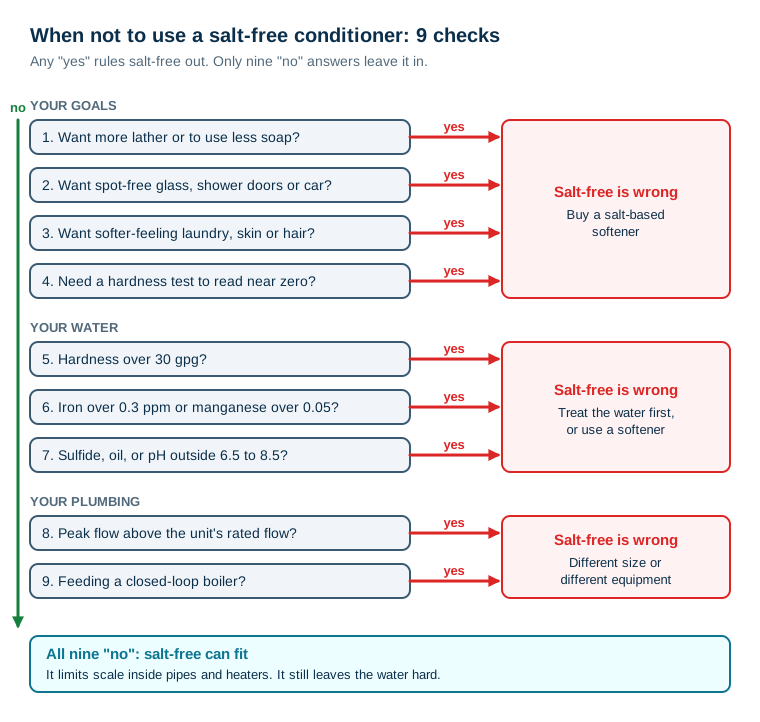
The checks fall into three groups, and each group fails for its own reason.
- Checks 1 to 4 are about what you expect. They fail because the minerals stay in the water. No setting or media upgrade changes that.
- Checks 5 to 7 are about your water. They fail because certain chemistry coats or overwhelms the media. Pretreatment sometimes fixes them.
- Checks 8 and 9 are about your plumbing. They fail because the unit is the wrong size or the wrong type of equipment for the job.
The limits in checks 5 to 9 come from one manufacturer's published specification. The Watts OneFlow engineering specification is one of the few that prints its feed water limits in full, so it is used as the reference here. Other template-assisted crystallization (TAC) products publish similar numbers. Check the sheet for the model you are considering, because its limits are the ones its warranty holds you to.
Goal Disqualifiers: What Salt-Free Structurally Cannot Do
A salt-free conditioner of the TAC type turns dissolved calcium and magnesium into microscopic crystals that stay suspended in the water. The crystals are less inclined to stick to a heating element or a pipe wall. But the calcium and magnesium are still in the water. Watts says so without hedging: the system "is not a water softener" and "does not soften the water."
Four common goals depend on removing that hardness, so a conditioner cannot meet them.
1. Soap savings and lather. Soap reacts with calcium and magnesium to form curd before it lathers. That reaction happens whether the minerals are dissolved or held as tiny crystals, so you use about as much soap and shampoo as before. Watts goes further and warns that laundry and dishwashing chemistry "will likewise require adjustments" after installation. That points away from savings, not toward them.
2. Spot-free glassware, shower glass and cars. A spot is what is left when a drop evaporates. With a conditioner, the drop still carries its minerals, so it still leaves a spot. Watts says "spotting may occur" and recommends a point-of-use softener "on mandatory spot-free applications (e.g. glass stemware, dishware)." If cloudy glasses are your reason for shopping, a conditioner will not help. Check first whether the film is hardness at all, because etched glass looks similar and no water treatment reverses it.
3. Softer laundry, skin and hair. Stiff towels and the tight-skin feeling after a shower both come from soap curd, which is point 1 again. The slippery feel people associate with softened water comes from removing hardness, and a conditioner does not remove it.
4. A hardness test that reads near zero. Test strips and titration kits measure dissolved hardness. After a conditioner, the reading will be about the same as before, because the minerals are still there. If you, a home inspector or a buyer will judge the system by a test kit, it will look as though it is not working.
The honest summary: a salt-free conditioner addresses scale on hot surfaces and in pipes. It does not address the hard-water symptoms you notice every day. If a whole-house softener is also off the table, matching a narrower alternative to the one symptom that bothers you is the better route.
Water Disqualifiers: Chemistry That Defeats the Media
The goals above rule salt-free out for what it cannot do. The next group rules it out for water it cannot handle. These are the published limits from the Watts specification:
| Parameter | Published limit | What happens above it |
|---|---|---|
| Hardness | 30 gpg (513 ppm as CaCO₃) recommended maximum | "Soft scale residue" forms outside the plumbing. Watts asks for testing to confirm the application above 30 gpg |
| Iron | under 0.3 ppm | Coats the active surface of the media and reduces effectiveness over time |
| Manganese | under 0.05 ppm | Same coating effect as iron |
| Hydrogen sulfide and oil | must be removed before the unit | Foul the media |
| pH | 6.5 to 8.5 | Outside the tested range |
| Free chlorine | under 2 ppm | Above normal city levels |
| Copper | under 1.3 ppm, and new copper lines passivated for at least 4 weeks | New copper plumbing can foul the media |
| Silica | 20 ppm | The media does not reduce silica scaling. Above this, spots become hard to wipe off |
| TDS | under 1,500 mg/L | Outside the rated range |
5. Hardness over 30 gpg. Above that level, the crystals can still leave a film on fixtures. The conditioner may still protect the heater, but the house will look no better than it does now.
6. Iron or manganese. This check rules out a large share of wells. City water rarely comes near 0.3 ppm iron, but a well often does. A salt-free unit on an iron-bearing well is a media bed that fouls slowly with no backwash to clean it. The well-specific version of this decision is in salt-free conditioners on city vs well water.
7. Sulfide, oil or pH outside 6.5 to 8.5. Acidic well water is common, and it fails this check before hardness is even considered.
Checks 6 and 7 can sometimes be passed with an iron filter or a neutralizer upstream. By then you are running a backwashing treatment train anyway, and much of the simplicity that made salt-free attractive is gone. Get a lab panel that reports hardness, iron, manganese and pH before you buy anything.
Plumbing Disqualifiers: Flow, Pressure Drop and Position
8. Peak flow above the rated flow. A TAC unit works only if water spends enough time in contact with the media. Each model is rated for a maximum flow. The Watts OneFlow cartridge models are rated at 5, 6 and 10 gpm, and the sheet warns that "exceeding maximum flow can reduce effectiveness and void warranty." A house with two showers, a dishwasher and a washing machine running at once can go past a small unit's rating. When that happens, part of the water passes through without enough contact time, and the unit also becomes a restriction. So size the unit to your peak flow, not your average use. Count the fixtures that can realistically run together and add their flow rates.
Pressure drop is the other half of this check. Any tank or cartridge costs some pressure at high flow. If your supply pressure is already marginal, or a well pump cuts in at 30 to 40 psi, an undersized conditioner makes the upstairs shower noticeably weaker. Ask for the pressure drop at your peak flow in writing before you buy.
9. A closed-loop boiler. The Watts sheet is plain about it: "Not for use on closed loop systems." TAC depends on water passing through once and going to the drain. A sealed heating loop recirculates the same water, so the crystals never leave, and loop water is treated with its own chemistry anyway.
The specification also sets two placement rules that can disqualify an installation even when the water qualifies. The conditioner "must be the last stage in the treatment chain," apart from point-of-use filters. And no other antiscalant may be added before or after it. If your plan puts a whole-house filter after the conditioner, or you already dose a phosphate cartridge, the plan does not meet the spec.
The Buyer Who Regrets a Salt-Free Conditioner
Most regret comes from one type of buyer. Two or more of the following apply to them:
- They bought it to fix what they can see. Spotty shower glass, a ring in the toilet, white film on dark cars. These were the reason they started shopping, and a conditioner does not change them.
- They had very hard water, often above 15 gpg, where the everyday symptoms are strongest and no amount of crystal formation makes glassware look clean.
- They test their water. A strip that still reads hard six months later makes an owner feel cheated, even when the heater is actually being protected.
- They were sold on "no maintenance." Cartridges and media still need replacing. Watts specifies replacing the media every two years. Pre-filters, where fitted, need changing too.
- They are on a well and never tested for iron or manganese before buying.
If you recognize yourself in that list, you need softening, not conditioning. To decide whether you need either one, work through do you actually need a whole-house water softener.
When Salt-Free Is Still the Right Call
A checklist like this can make salt-free sound useless. It is not. It suits a specific buyer:
- Municipal water in the moderate hardness range, with iron, manganese and pH well inside the limits.
- The main goal is protecting equipment, especially a water heater, where scale does expensive damage out of sight.
- A softener is not practical. For example, there is no drain near the supply line, a local rule limits brine discharge, or the owner will not carry salt. The EPA notes that softener regeneration "can use 25 gallons of water or more per day." That is a legitimate reason some households and towns look elsewhere (EPA WaterSense on cation exchange softeners).
- The owner accepts that the water stays hard and will keep using the same soap and cleaners.
If that describes you, the next questions are limits and fit, not category. Start with the spec sheet of the exact model and hold your lab results against every line of it.
What a Salt-Based Softener Will Not Fix Either
Rejecting salt-free does not make a softener the answer to everything. A softener removes hardness and small amounts of dissolved iron. As Penn State Extension puts it, softening "simply removes hardness minerals" and will not necessarily fix more serious drinking water problems. It does not correct pH, remove bacteria, sulfide, lead or nitrate, or make water safer to drink. It adds sodium in proportion to the hardness it removes. It also needs a drain, salt and occasional service.
So the decision works in two steps. First, use the nine checks to rule salt-free in or out. Then confirm from a real water test that a softener, or a softener plus pretreatment, covers everything the test found.
Frequently Asked Questions
When should you not use a salt-free water conditioner?
Do not use one if you want more lather, spot-free glass, softer-feeling laundry or a hardness test that reads near zero, because a salt-free conditioner leaves the hardness in the water. Also rule it out if your hardness is over about 30 gpg, iron is over 0.3 ppm, manganese is over 0.05 ppm, hydrogen sulfide or oil is present, or pH is outside 6.5 to 8.5, which are the limits one major manufacturer publishes for its media.
Do salt-free water conditioners stop water spots?
No. Spots form when water evaporates and leaves its dissolved minerals behind. A salt-free conditioner does not remove those minerals, so they are still there when the droplet dries. Watts states in its OneFlow specification that spotting may occur and recommends a point-of-use softener where spot-free results are mandatory.
Will a salt-free conditioner make my water feel soft?
No. The slippery feel of softened water comes from removing calcium and magnesium so soap does not form curd. A salt-free conditioner changes how hardness behaves on hot surfaces but leaves it dissolved in the water, so soap, skin and laundry behave much as they did before.
Why does my water test hard after installing a salt-free system?
Because it is still hard. Test strips and drop kits measure dissolved calcium and magnesium, and a salt-free conditioner does not remove them. A hard reading after installation is the expected result, not a sign of failure. Judge a salt-free system by scale on heating surfaces, not by a hardness test.
Do salt-free water conditioners work on well water?
Often not without pretreatment. Iron, manganese and hydrogen sulfide coat the media, and wells commonly carry them. Watts asks private-well owners to confirm iron below 0.3 mg/L and manganese below 0.05 mg/L, and says oil and hydrogen sulfide must be removed before the unit.
Is a salt-free conditioner better than a water softener?
Only for a narrow goal: limiting scale in pipes and water heaters without salt, drain water or electricity. For soap savings, spot-free surfaces, softer laundry, very hard water or iron-bearing wells, a salt-based softener is the better tool.
