
Water Softener Financing: What the Same System Really Costs
Water softener financing can cost nothing or nearly double the price, depending on the plan. Take one $3,500 dealer-installed system. Paid in cash, or on a true 0% plan cleared on time, it costs $3,500. On a deferred-interest promotion with $350 left at the deadline, it costs about $4,315. Spread over ten years at 14.99% APR, it costs about $6,770. Renting the same kind of system at $40 a month costs $4,800 over ten years, and you own nothing at the end. Before you compare plans, get the cash price. A comparable online softener plus an independent installer came to about $1,970 in our example.
Disclosure: Hard Water Solved may earn a commission if you buy through links on this page, at no extra cost to you. It does not change which products we include or how we rank them. Read our disclaimer.
How these figures were built. This is a cost model, not a lender survey. The $3,500 system, the APRs and the $40 rent are illustrative inputs; replace them with the numbers on your own offer. Loan payments use the standard amortisation formula. The deferred-interest figure is simple monthly interest on each month's balance, which is close to, but slightly below, what a card charging daily interest would bill. The online cash row uses a brand-store price seen on 2 October 2026. Prices of individual products are not listed here because they change often. Use the buttons to see the current price on Amazon.
Water Softener Financing: Six Ways to Pay for the Same System
| How you pay | Monthly | Paid over 10 years | You own it? |
|---|---|---|---|
| Online softener plus independent installer, cash | — | about $1,970 | Yes |
| Dealer system, cash | — | $3,500 | Yes |
| Dealer system, true 0% APR for 18 months, paid on time | $194.44 | $3,500 | Yes |
| Dealer system, deferred interest for 18 months, $350 left at the end | $175 | about $4,315 | Yes |
| Rental at $40 a month | $40 | $4,800 | No |
| Dealer system, 14.99% APR over 10 years | $56.45 | about $6,770 | Yes |
Illustrative. Online row: an online 48,000-grain-class softener at its brand-store price on 2 October 2026, plus about $600 for a swap into an existing loop. Deferred interest at 26.99% APR. Upkeep, salt and repairs are excluded from every row except that the rental includes service.
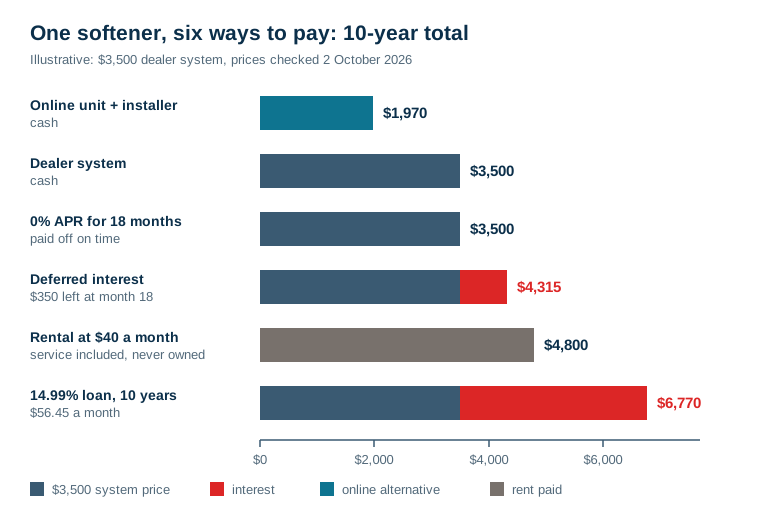
Three things stand out.
The lowest monthly payment is the most expensive plan. $56.45 a month sounds smaller than anything else on the list. Over 120 months it adds up to about $6,770, of which about $3,270 is interest.
A 0% plan is only as good as your last payment. Paid on time, it matches cash. Fall $350 short at the deadline on a deferred-interest plan and the bill jumps by about $815.
The cash price matters more than the plan. Before comparing financing at all, find out whether the system itself is priced fairly. The difference between the top two rows is bigger than the interest on most of the plans.
The Deferred-Interest Trap, Worked Through
The Consumer Financial Protection Bureau describes the mechanism plainly. Under a deferred-interest promotion, you pay no interest if the purchase is paid in full within the period. If a balance remains at the end, or you are more than 60 days late on a minimum payment, interest is charged for each month on the balance you owed in each month of the promotion.
Here is what that does to a softener purchase:
- Purchase: $3,500 on a store card or dealer credit account, "no interest if paid in full in 18 months".
- Deferred APR: 26.99%, about 2.25% a month.
- What the owner pays: $175 a month, a round figure that feels comfortable and is more than the minimum payment.
- What clearing it actually needed: $3,500 ÷ 18 = $194.44 a month.
| Month | Balance that month | Interest building up in the background |
|---|---|---|
| 1 | $3,500 | about $79 |
| 6 | $2,625 | about $59 |
| 12 | $1,575 | about $35 |
| 18 | $525 | about $12 |
| After the payment in month 18 | $350 left | about $815 charged in one go |
Illustrative. Interest is 26.99% ÷ 12 on each month's opening balance; the 18 monthly balances sum to $36,225.
The owner paid $3,150 and owed $350. Because a balance was left, the interest on all 18 months of balances lands on the next statement: about $815, and it will keep accruing at 26.99% on the new balance until paid. Leaving 10% of the price unpaid cost almost a quarter of the price in interest.
How to avoid it:
- Divide the price by the number of months minus one, and pay that. On 18 months, $3,500 ÷ 17 is about $206. You finish a month early with a margin.
- Ignore the minimum payment on the statement. It is set by the card terms, not by the promotion deadline.
- Put the end date in your calendar the day you sign.
- Ask before signing: "Is this 0% APR, or deferred interest?" They are different products.
True 0% or Deferred Interest: Read the Wording
The two offers look the same on a sales sheet. The paperwork tells them apart.
| Wording | What it usually means |
|---|---|
| "0% APR for 18 months" | True 0%. If a balance is left at the end, interest starts from that day on what is left |
| "No interest if paid in full within 18 months" | Deferred interest. If a balance is left, interest is charged back to the purchase date |
| "Same as cash" | Often deferred interest. Ask |
| "Low monthly payments of $X" | A loan with an APR and a term you have not been told yet |
If the agreement uses the words "if paid in full", treat it as deferred interest until the lender says otherwise in writing.
Standard Dealer Loans: Four Numbers to Find
Any consumer loan disclosure gives you four boxes. Find them before you think about the monthly payment.
- Annual percentage rate (APR). The yearly cost of the credit, including some fees.
- Finance charge. The total dollar cost of the credit over the loan.
- Amount financed. What you are borrowing. Check it matches the cash price minus any deposit.
- Total of payments. What you will have paid by the end. This is the number to compare with the cash price.
For our $3,500 system, the same principal behaves very differently by term and rate:
| APR and term | Monthly | Total of payments | Interest |
|---|---|---|---|
| 9.99%, 5 years | $74.35 | about $4,460 | about $960 |
| 12.99%, 7 years | $63.65 | about $5,350 | about $1,850 |
| 14.99%, 10 years | $56.45 | about $6,770 | about $3,270 |
| 17.99%, 10 years | $63.04 | about $7,565 | about $4,065 |
Illustrative, standard amortisation, no fees.
Stretching the term from five years to ten cuts the payment by about $18 a month and more than triples the interest. A softener's valve may need work within that decade, so a ten-year loan can still be running when you are paying for repairs.
Ask about security interests. Some home improvement financing is secured on the equipment or the property. In 2024 the FTC acted against Aqua Finance, a lender to water treatment dealers, saying its dealers frequently misled people about the financing terms and pressured them to sign documents they did not understand. The settlement provided $20 million in refunds and $23.6 million in forgiven debt. The FTC's advice is to get the interest rate, APR, loan length and total interest in writing before signing. Ask directly whether the lender will record any lien or filing against your home, and how it is released when the loan is paid.
Financing vs Renting
Renting is the other monthly-payment option, and it is a different deal. The rent usually includes service and salt checks, and you can often end it when you move. You never own the unit. At $40 a month, ten years of rent is $4,800, which in our example is cheaper than a ten-year loan at 14.99% but more than cash or a 0% plan paid on time.
The break-even point depends on how long you stay and what the rent covers. The site's guide to renting vs buying a water softener works that out for rents of $25 to $60 a month and installed prices of $1,000 to $2,500.
Cash-Price Benchmarks Before You Finance Anything
Financing a fair price is one decision. Financing an inflated price is two mistakes. These whole-house softeners in the 48,000-grain class are sold for cash online, so check their current prices before you look at a dealer's offer:
| Benchmark | What it is | Amazon |
|---|---|---|
| Aquasure Harmony 48,000 (AS-HS48D) | Aquasure's own digital metered head, 10 x 54 in tank; also sold at Aquasure's store | Check price on Amazon |
| SoftPro Elite 48,000 | 10% crosslink resin, upflow brining; also sold at SoftPro's store | Check price on Amazon |
Our original research used an older Amazon listing for the Harmony 48k that is now unavailable; the button links to the current listing for the same model.
Add installation to either. A swap into an existing loop is a short job; a house that needs a new loop, drain and outlet costs more. The line-by-line ranges are in water softener installation cost. If the installed total for a comparable online system is $1,200 to $2,000 and the dealer's cash price is $3,500 or more, ask what the difference buys before you discuss monthly payments.
Cheaper Ways to Spread the Cost
- A credit union or bank personal loan. Compare its APR and total of payments with the dealer's. You can then pay the dealer, or any installer, in cash.
- A card with a true 0% introductory APR on purchases. Only if you can clear it within the intro period, and only if it is 0% APR rather than deferred interest.
- A cheaper system for cash. An online softener installed by a plumber often costs less in total than the interest alone on a long dealer loan.
- A rebate. Some water utilities pay toward replacing an old timer softener with a demand-initiated one. The programs, and what they require, are in water softener rebates and incentives. Apply before you buy; many require pre-approval.
- Waiting a few months. If the old softener still works, saving for the cash price may be the best financing of all.
What to Ask Before You Sign
- What is the cash price, and is it the same price you are financing?
- Who is the lender, and is this application a hard credit check?
- Is this 0% APR or deferred interest? Show me the wording.
- What APR applies after any promotion, and from what date?
- What is the total of payments over the full term?
- Is there a prepayment penalty?
- Does the lender record a lien, fixture filing or other security interest on my home?
- Where is my cancellation form, and what is the last day I can cancel?
If the sale happens at your kitchen table, the FTC's Cooling-Off Rule usually gives you until midnight of the third business day to cancel a purchase of $25 or more for a full refund. Use those days to check the cash price elsewhere.
Who Should Not Finance a Water Softener
- Anyone offered a long loan on a price they have not compared. Get a second quote first.
- Anyone who cannot clear a deferred-interest plan by the deadline with a margin. Choose a true 0% plan or a fixed-rate loan instead.
- Owners likely to move within a few years. A loan, especially one secured on the house, can complicate a sale. Renting or a cheaper cash purchase fits a short stay better.
- Anyone being told the offer ends today. A fair financing offer is still available after you have read it.
The cheapest way to pay for a softener is cash or a true 0% plan cleared early, on a fairly priced system. Every other plan on this page costs more, and the one with the smallest monthly payment costs the most.
Frequently Asked Questions
Is it a good idea to finance a water softener?
Only if the financing costs you little or nothing. A true 0% APR plan that you pay off within the term costs the same as cash. A long dealer loan at a double-digit APR can nearly double the price: in the example on this page, a $3,500 system costs about $6,770 over ten years at 14.99%. If you need to spread the cost, compare the dealer's offer with a credit union personal loan and with a cheaper system bought for cash.
What is deferred interest on a water softener?
A promotion that says no interest if paid in full within a set period, often 12 or 18 months. If any balance is left at the end, or you are more than 60 days late on a minimum payment, interest is charged back to the purchase date on the balance you owed each month. In our worked example, leaving $350 unpaid on a $3,500 purchase triggers about $815 of interest.
What credit score do you need for water softener financing?
It depends on the lender the dealer uses, and lenders do not publish one fixed cutoff. Promotional 0% plans usually go to applicants with stronger credit, and others are offered a standard rate. Ask which lender is behind the offer, whether the application is a hard credit check, and what APR applies if you are not approved for the promotion.
Is it better to finance or rent a water softener?
Financing ends with you owning the softener; renting never does. At $40 a month, ten years of rent is $4,800, which is less than a ten-year loan at 14.99% on a $3,500 system in our example, but more than cash or a 0% plan paid on time. Renting includes service, so it suits short stays. For owners staying put, buying for cash or at 0% is cheapest.
Can I cancel water softener financing after signing?
If the sale was made in your home, the FTC's Cooling-Off Rule usually lets you cancel for a full refund until midnight of the third business day after the sale, for purchases of $25 or more. Send the cancellation notice in writing and keep proof of the date. After that window, cancelling a loan generally means paying it off.
