
Are Water Softener Rebates or Tax Credits Available?

A water softener rebate, where one exists, comes from your local water utility, sewer district or city, not from the federal government. There is no federal energy tax credit for a water softener. The main home efficiency credit never listed softeners, and it closed at the end of 2025. The local programs that do exist pay to tune, replace or remove softeners so less salt reaches the wastewater plant.
That second sentence contradicts a lot of what turns up online, so it gets checked first, against the IRS's own page. After that, the rest of this page covers the money that is real: who pays it, what the new softener usually has to be, and the paperwork that decides whether you actually get paid.
The Federal Tax Credit Claim, Checked Against the IRS
The claim usually goes: "a high-efficiency softener qualifies for the federal energy credit." It does not, for two separate reasons.
Softeners were never qualifying property. The IRS page for the Energy Efficient Home Improvement Credit (section 25C) lists what counted:
- building envelope components: exterior doors, windows, skylights, insulation and air sealing
- home energy audits
- residential energy property: central air conditioners, water heaters, furnaces and boilers
- heat pumps and biomass stoves and boilers
- electrical panel work needed to support that equipment
A water softener is not on the list, and a softener does not become a "water heater" because it protects one.
The credit has ended anyway. The same IRS page limits it to property placed in service before the end of 2025. A softener bought in 2026 would not qualify even if softeners had been eligible.
So if a seller tells you the federal government will pay part of the bill, ask them which IRS form and which line. There isn't one.
What about the "efficiency" label? The EPA's WaterSense program does not label water softeners. EPA says it considered a specification and decided not to go ahead, partly because of stakeholder concerns about softener discharge and wastewater treatment. A "WaterSense softener" does not exist.
Why Local Utilities Pay for Softeners at All
Real rebates come from the people who have to deal with softener salt after it goes down the drain.
Every regeneration flushes the hardness it removed, plus the leftover salt, to the sewer or septic system. Conventional wastewater treatment does not take chloride out. The Minnesota Pollution Control Agency's guide to softener rebate programs states this directly. It also notes that removing chloride with reverse osmosis at the plant is expensive and energy-hungry, and it leaves a concentrated brine that still has to go somewhere. The guide adds that where household water is hard and the utility does not soften it, home softeners may be the main source of chloride reaching the treatment plant.
A city facing a chloride limit on its wastewater permit has a cheaper option than a plant upgrade. It can pay residents to use less salt. That is why rebate programs are:
- local. They depend on one plant's permit and one city's budget.
- concentrated where water is hard and chloride limits are tight. Minnesota, Wisconsin and parts of Southern California are examples.
- temporary. Programs open when grant money arrives and close when it runs out.
The Minnesota results show why cities bother. The MPCA reports that in Marshall and Worthington, a 2022 grant paid for softener replacement, tune-ups and removal. Marshall had nearly 300 participants and cut about 320,000 pounds of salt a year, with salt use falling by as much as 86% in some homes. Worthington replaced or retrofitted more than 200 softeners and saved about 212,000 pounds a year.
The Three Kinds of Water Softener Rebate Program
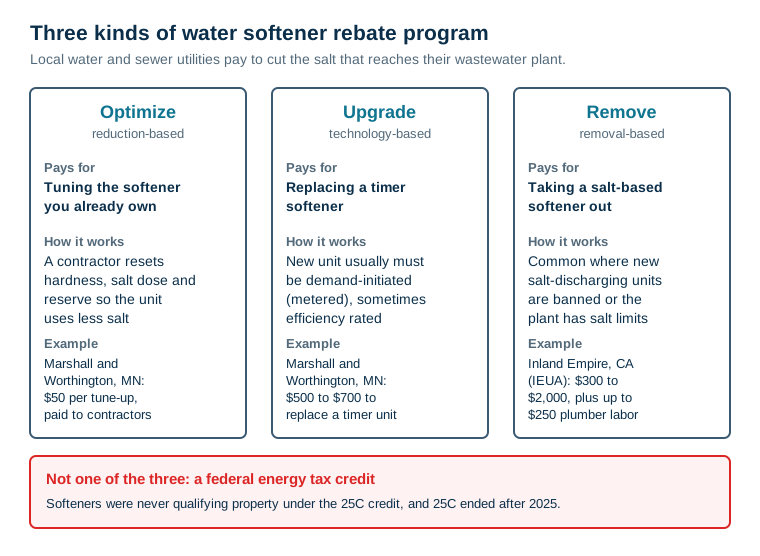
The MPCA guide sorts existing programs into three types, and nearly every program you will find is one of them.
1. Optimize (reduction-based). The program pays to tune the softener you already own. A contractor resets hardness, salt dose and reserve so the unit uses less salt per grain removed. In the Minnesota grant programs, contractors were paid $50 per tune-up. This is the cheapest type for the city and the least disruptive for you. It helps most when a softener was left on factory settings.
2. Upgrade (technology-based). The program pays part of the cost of replacing an old unit, usually a timer softener, with a demand-initiated one. The Marshall and Worthington rebates for replacing timer units ran $500 to $700. Some programs structure this as a bill credit rather than a check.
3. Remove (removal-based). The program pays you to take a salt-based softener out. It is common where new salt-discharging softeners are banned or the plant cannot accept more chloride. The Inland Empire Utilities Agency in Southern California pays $300 to $2,000 to remove a working self-regenerating softener, plus up to $250 toward the plumber. Its service area covers Chino, Chino Hills, Fontana, Montclair, Ontario, Rancho Cucamonga and Upland. The agency's ordinance already bars new or replacement salt-based units there. California's wider rules on softeners that discharge to a sewer are covered in water softener brine restrictions.
The MPCA guide also describes a fourth, less common variation: an incentive for a first-time buyer of a non-salt-based system, used alongside a removal program where salt-based units are prohibited.
What the New Softener Usually Has to Be
Upgrade programs almost always specify the replacement, and the wording tends to use two terms.
Demand-initiated regeneration (DIR). The valve regenerates only after a measured amount of water, or a measured change in hardness, rather than on a calendar. This is the one requirement that shows up nearly everywhere, because a timer regenerates whether the resin needs it or not. How the two controls compare in salt and water is worked through in metered vs timer-based water softeners.
The NSF/ANSI 44 efficiency rating. NSF/ANSI 44 is the certification standard for residential cation exchange softeners, and it includes a voluntary efficiency rating. EPA's WaterSense technical sheet on water softeners summarises it as using 5.0 gallons of water or less per 1,000 grains of hardness removed. It tells builders to specify demand-initiated systems that meet that rating and to pick models with higher salt efficiency. The Department of Energy guidance cited in that metered-versus-timer comparison puts the rating's minimum salt efficiency at 3,350 grains per pound of salt and excludes timer-regenerated units. California's Health and Safety Code sets a higher bar of 4,000 grains per pound for softeners made from 2002 on that discharge to a community sewer. Grains per pound is explained in water softener salt efficiency.
Three practical points follow.
- The rating applies at a stated salt setting. A unit that meets 3,350 grains per pound at a low dose may not meet it at the high dose a dealer programs by default. If the program checks the setting, run the rated one.
- "High efficiency" in an advert is not a rating. Ask for the certification listing or the performance data sheet showing grains per pound and gallons per 1,000 grains.
- Some programs keep an approved-model list or require an approved installer. If yours does, a better unit that is not on the list still will not qualify.
How to Find a Water Softener Rebate in Your Area
Search engines are poor at this, because the programs live on small city and utility pages. Go down this list:
- Your water utility's rebate or conservation page. Search "[your city] water softener rebate" and "[your utility] conservation rebates."
- Your wastewater or sewer district. It is often a different organisation from the water supplier, and it is the one with the chloride problem. Look for "salt reduction," "chloride reduction" or "softener optimization."
- Your city's public works or environmental department.
- Your state pollution control agency. In Minnesota, the MPCA funds local chloride reduction grants. A state agency page can tell you which cities currently have money.
- Watershed districts and regional water agencies. In Southern California, some softener programs are run by regional agencies such as IEUA rather than by individual cities.
- Your softener dealer. Local dealers usually know about a program in town, because it affects their sales. Check the details with the program itself.
If you are on a private well with a septic system, most of these programs will not apply. They are funded to protect a municipal treatment plant you do not discharge to.
Paperwork That Decides Whether You Get Paid
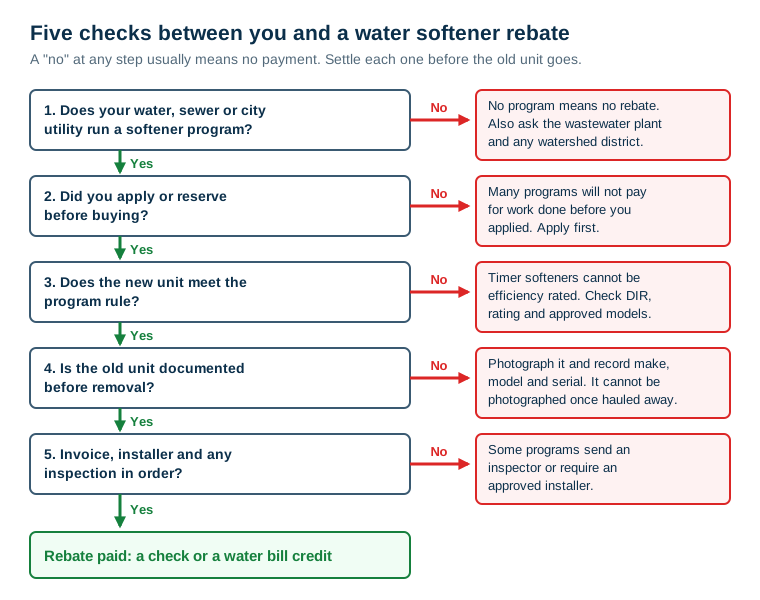
A rebate is usually lost on process, not on the equipment. The MPCA guide lists the documents programs commonly ask for:
- a recent water or sewer bill, to prove you are a customer
- a photograph of the existing salt-using softener
- make, model and serial number of the old and new units
- installation address and date
- the invoice or receipt for the new unit, or a contract with a water treatment dealer
- for salt-reduction programs, salt delivery records, monthly water use and estimated annual salt reduction
The guide also describes rules on timing and verification. One Wisconsin program reimburses only systems that were working when removed. Another pays for salt-reduction projects only on softeners in use and never retroactively. One California city inspects the installation and returns after 12 months to read the softener's performance history.
The sequence that protects you:
- Read the current program rules and apply first. Some programs cap the number of rebates each year.
- Confirm the exact model qualifies before paying a deposit.
- Photograph the old unit and its label while it is still plumbed in.
- Keep the itemised invoice showing the model, the installer and the date.
- Program the rated salt setting, and leave the unit accessible if an inspection is part of the deal.
How the payment arrives matters too. The MPCA guide notes that a cash payout may have tax implications. Paying the rebate as a water bill credit avoids that, which is why some cities pay that way. If you get a check, keep the paperwork with your tax records.
What a Rebate Is Worth Against the Real Cost
A rebate reduces the price, but the purchase has to make sense without it. Two numbers matter more than the rebate itself.
The installed price. A $500 rebate is a large share of a basic metered unit and a small share of a complex installation with new plumbing and a drain run. Typical installed costs and what drives them are in water softener installation cost. If the balance after the rebate still has to be paid over time, compare what cash, 0% and dealer loans add to the total before signing.
The running savings. An upgrade from a timer to a metered valve saves salt every year, not just once. The Marshall figures show how much a badly set timer can waste. The size of the saving in your house depends on how wastefully the old timer was set and how much water you use.
Here is an illustrative comparison, not a quote. Say a household runs an old timer softener and could either tune it or replace it:
| Option | One-time cost to you | Ongoing effect |
|---|---|---|
| Do nothing | $0 | Salt use unchanged |
| Tune-up only (optimize program) | Often little or nothing if the program pays the contractor | Lower salt dose; still regenerates on a timer |
| Replace with a DIR unit, with rebate | Installed price minus rebate | Regenerates only on demand; lowest salt use of the three |
If the timer unit is near the end of its life, the upgrade rebate is worth taking. If it is fairly new and simply set wrong, a tune-up may get most of the saving for much less money.
What a Rebate Does Not Change
A rebate is a discount on equipment. It does not change what the equipment can do.
- It does not make an unnecessary softener worthwhile. EPA's WaterSense sheet says to avoid installing softeners where hardness does not call for one. Test first.
- A removal rebate leaves you with hard water. If you take the payment and do not replace the unit, hardness comes back at every tap. A salt-free conditioner bought afterwards generally reduces scale but does not remove hardness, so soap and spotting behave like hard water.
- Efficiency does not remove other contaminants. A rated softener removes hardness and a little dissolved iron. It does nothing about lead, nitrate, bacteria or PFAS.
- Programs change. Amounts, eligible models and deadlines on this page are examples, drawn from the sources linked. Check the current rules with your own utility before you buy.
Start with your water bill: find out who treats your wastewater, then check that organisation's rebate page. If there is a program, apply before you buy, and make sure the new unit regenerates on demand.
Frequently Asked Questions
Is there a federal tax credit for a water softener?
No. The Energy Efficient Home Improvement Credit (section 25C) covered building envelope items, energy audits, air conditioners, water heaters, furnaces, boilers, heat pumps and related electrical work. Water softeners were never on the list. The IRS also says the credit applies only to property placed in service before the end of 2025, so it is closed for new purchases either way.
How much is a typical water softener rebate?
It depends entirely on the local program. In the MPCA-funded programs in Marshall and Worthington, Minnesota, replacing a timer softener paid $500 to $700 and removing a softener paid $500. The Inland Empire Utilities Agency in California pays $300 to $2,000 to remove a salt-based softener, plus up to $250 toward the plumber. Many areas have no program at all.
Does WaterSense label water softeners?
WaterSense does not. EPA says it decided not to develop a WaterSense label for softeners. What rebate programs usually ask for instead is demand-initiated regeneration and, sometimes, the voluntary efficiency rating in NSF/ANSI 44. Check your program's own wording before you buy.
Can I get a rebate for a salt-free water conditioner?
Some programs pay for one, usually where the aim is to remove salt-based softeners entirely. The Minnesota Pollution Control Agency's guide lists first-time purchase of a non-salt-based unit as one rebate type. Remember that most salt-free conditioners reduce scale but do not remove hardness, so a lower bill is not the same result.
Do I have to apply before I buy the softener?
Usually, yes. Many programs pay only for work done after you applied, and some reserve a limited number of rebates each year. Apply first, confirm the new model qualifies, and photograph the old unit before it is removed.
Is a rebate check taxable?
It can be. The Minnesota Pollution Control Agency's program guide notes that a cash payout may have tax implications for the customer, which is one reason some cities pay the rebate as a water bill credit instead. Ask a tax professional about your own situation.
