
Renting vs Buying a Water Softener

Renting vs buying a water softener comes down to how long you stay. At commonly advertised rents of about $35 to $45 a month, a $1,500 installed softener costs less than renting within about 3.3 to 4.5 years. After that, every rent payment is money an owner would not spend. Renting wins only over a short stay, or when it includes service you would otherwise pay for.
The arithmetic is the easy part. The contract is where renters get caught out, so half of this page is a clause-by-clause checklist.
Renting vs Buying a Water Softener: The Break-Even Table
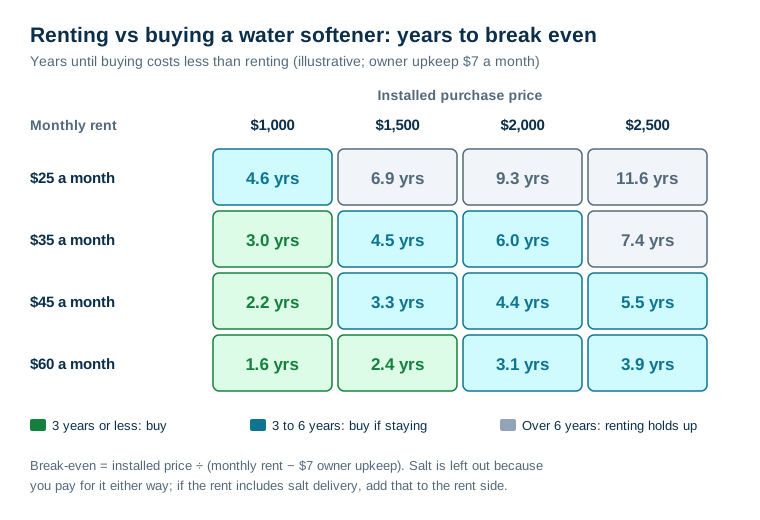
Find the cell nearest your rental quote and your purchase quote. The number is how many years it takes for buying to cost less.
The formula:
Break-even in months = installed purchase price ÷ (monthly rent − owner's monthly upkeep)
- Installed purchase price comes from a written quote for a comparable softener, including installation.
- Monthly rent comes from the rental quote. Add any separate service, delivery or installation fees, spread over the months you expect to rent.
- Owner's monthly upkeep is what an owner pays that a renter does not: routine maintenance supplies and a reserve for repairs. The table uses $7 a month, which is $25 a year for supplies plus $60 a year set aside towards a resin change or valve repair.
- Salt is left out of both sides. An owner buys salt and so does a renter, unless the rent includes it. If yours does, add the value of that salt to the rent.
A worked example. A rental at $40 a month against a $1,500 installed purchase: $1,500 ÷ ($40 − $7) = 45 months, or about 3.8 years. Stay five years and buying saves about $480. Stay ten and it saves about $2,460, before the owner's softener still has years of life left.
The rents in the table span the range typically advertised for standard residential softeners, and they are illustrative, not survey data. Local rents and purchase prices vary widely, which is why the method matters more than any single cell. What goes into an installed price, and why two quotes differ, is covered in how much water softener installation costs. If your rental quote is from Culligan, checking it against typical Culligan rental rates tells you whether the number going into the formula is fair.
What Rent Usually Covers, and What It Leaves to You
A fair comparison counts what each side actually includes.
| Item | Renting (typical) | Owning |
|---|---|---|
| Equipment | Company's choice of unit | Your choice. You can pick a metered valve and a standard brand |
| Installation | Often included or a small fee | Part of the purchase quote |
| Repairs and parts | Included | You pay. Most repairs are a cheap part and an hour of labour |
| Routine service visits | Usually included | You do it, or pay for visits |
| Salt | Sometimes included, often extra | You buy it |
| Upgrades | Company decides | Your decision |
| At the end | Company takes the unit back | You keep a working softener |
The repair line is the renter's strongest argument. Most repairs are inexpensive, though. The two big ones, a control valve and a resin change, typically happen once at most in a decade. What those cost, part by part, is in common water softener repair costs.
The Contract Clauses That Cause Problems
Rental agreements are easy to sign and can be hard to leave. Read these ten clauses before signing, and get anything a salesperson promises written into the agreement.
| # | Clause | What to look for | Why it matters |
|---|---|---|---|
| 1 | Minimum term | The number of months you are committed to | Leaving early usually triggers a fee |
| 2 | Early termination fee | A fixed amount, or all remaining payments | "All remaining payments" can be more than buying a softener outright |
| 3 | Removal or de-installation fee | A charge to take the unit out, in any circumstances | Adds to the cost of leaving, even at the end of the term |
| 4 | Automatic renewal | Whether the term restarts, and the notice needed to stop it | Missing a notice window can lock you in for another term |
| 5 | Price increases | Whether the rent can rise, how often and by how much | A fixed rent in year one is not a fixed rent in year five |
| 6 | What is included | Salt, service visits, repairs, parts, emergency calls | Separate charges for each change the break-even |
| 7 | Home sale | Whether the agreement transfers to a buyer, must be ended, or must be paid off | This is the clause that turns up at closing |
| 8 | Ownership at the end | Rental, lease-to-own, or a financed purchase | Tells you whether you are renting at all |
| 9 | The equipment | Brand, model, grain capacity, and whether it is certified | You should know what you are paying for, and be able to compare it |
| 10 | Damage and leaks | Who pays if the unit floods the basement | Check both the contract and your homeowner's insurance |
Two questions settle most of these at once. What would it cost me, in total, to end this agreement in month 13? And what happens if I sell the house in year two? If the salesperson cannot answer both in writing, do not sign. With franchise dealers, the answers vary from town to town: the Culligan review separates what the brand's own warranty covers from the rental and service terms each local dealer sets.
When a "Rental" Is Really a Loan
Some agreements sold as rentals, or as low monthly payments, are finance agreements for a purchase. That is not a problem in itself, but it is a different product with different risks.
The Federal Trade Commission took action against Aqua Finance, a company financing household water treatment systems sold by door-to-door dealers. In its 2024 consumer alert, the FTC says dealers "pressured people to sign financing documents they didn't understand". The settlement provided $20 million in refunds and $23.6 million in debt forgiveness. The FTC's advice is to "get specific details of the financing in writing" and to treat pressure to sign without a clear explanation as a red flag.
Before signing any monthly-payment agreement, find out:
- Is it a rental or a loan? If ownership passes to you at the end, it is a purchase on credit.
- What is the interest rate and the total repayable? Compare the total with the cash price of the same system.
- Who is the lender? It is often a finance company, not the dealer.
- Will anything be recorded against your home? Ask directly, and ask how it is cleared if you sell.
If you would rather buy on credit openly, comparing cash, 0%, deferred-interest and dealer-loan totals shows what each one adds to the price.
Your Three-Day Right to Cancel an In-Home Sale
Many softener rentals and purchases are sold at the kitchen table. The FTC's Cooling-Off Rule covers most sales of $25 or more made in your home. Your right to cancel for a full refund "lasts until midnight of the third business day after the sale". Saturday counts as a business day, while Sundays and federal holidays do not. You do not have to give a reason. Send a signed cancellation notice by certified mail with a return receipt, postmarked before the deadline, and keep the receipt.
Use those three days. Get a second quote to buy, run the break-even formula, and read the ten clauses above at your own pace.
Red Flags During the Sales Visit
The Minnesota Department of Health publishes a warning about water treatment sales tactics that applies nationally. It lists salespeople who claim to represent a city or state agency, "free" in-home water tests that present naturally occurring minerals as contamination, claims that a unit is maintenance-free, and limited-time deals at inflated prices.
Some practical checks follow from that:
- Test your own water first, with a hardness kit or a certified lab. A softener is sized to hardness, and nothing a salesperson's test kit shows changes that number.
- A softener removes hardness. It does not make unsafe water safe. A pitch that sells a softener for bacteria, nitrate or lead is selling the wrong equipment.
- Nothing is maintenance-free. A rental includes maintenance. It does not remove the need for it.
When Renting Is the Right Call
Renting is a sensible choice in a handful of situations.
- You will move before the break-even. At $40 a month against $1,500, anyone leaving within three years is likely to pay less by renting, provided the exit fees are small.
- You are a tenant. A landlord may allow a rented unit that the company removes at the end, where they would not allow a permanent installation. Get written permission either way.
- You want no involvement at all. If paying someone to handle salt, service and repairs is worth the premium to you, it is a fair choice. Just know what the premium is.
- You want to try soft water before committing. A short rental with a low exit cost is a cheap trial.
- You only need soft water occasionally, or have no drain for a regenerating softener. Then a portable exchange service may beat both options, as compared in portable exchange tank vs installed softener.
Buying clearly wins for everyone else: a household staying five years or more, that can check the salt once a month, and that picks a softener with a standard valve. Many repairs are then within reach of a local plumber. If you buy but want the service element of renting, a maintenance agreement is the halfway option. Whether that is good value is covered in is a water softener service contract worth it.
What Neither Option Changes
Renting or buying changes who pays and who owns. It does not change what a softener does.
- The unit has to be sized to your hardness and household. A rental company's standard unit is not automatically the right size.
- Water chemistry still matters. Iron, chlorine and low pH affect a rented softener exactly as they affect an owned one, and they may need pretreatment either way.
- Health contaminants are outside a softener's job. A softener does not remove bacteria, nitrate, lead or arsenic, whoever owns it.
Run the break-even with real quotes, read the ten clauses, and use the three-day window if the sale happened at your door. Handled that way, renting vs buying a water softener is a simple calculation, not a trap.
Frequently Asked Questions
Is it cheaper to rent or buy a water softener?
Buying is cheaper for anyone staying more than a few years. In the illustrative table on this page, a $1,500 installed softener costs less than renting at $35 to $45 a month within about 3.3 to 4.5 years. Renting only comes out ahead over a short stay, with a low rent or an expensive purchase, or when the rent includes service you would otherwise pay for.
Can you get out of a water softener rental contract?
It depends on what you signed. Many agreements have a minimum term with an early termination fee, and some add a removal charge. If the equipment was sold in your home, the FTC's Cooling-Off Rule usually gives you until midnight of the third business day after the sale to cancel for a full refund. After that, the contract terms decide, so read the termination and removal clauses before signing.
What happens to a rented water softener when you sell your house?
The contract should say. Some rentals transfer to the buyer, some must be ended with a fee and the equipment removed, and financed purchases may need paying off before closing. The FTC has described dealer-arranged water treatment financing that in some cases impaired homeowners' ability to sell. Ask how the agreement is handled on a sale, and whether anything is filed against the property, before you sign.
Does renting a water softener include salt?
Sometimes. Most rentals include the equipment, installation, service and repairs. Salt delivery is often a separate charge or an add-on. When comparing, put salt on both sides of the calculation, because an owner buys salt too. Only a rental that includes salt at no extra charge gains anything from it.
Is rent-to-own a good deal for a water softener?
Compare the total of all payments to the cash price of a similar installed softener. A rent-to-own plan that ends in ownership is a form of financing, and the difference between the total and the cash price is what you pay for the credit. Also check whether ownership passes automatically at the end, whether a final payment is due, and what happens if you move before the term is up.
Why do water treatment companies prefer renting?
A rental produces steady monthly income for as long as it runs, and the company keeps the equipment. That is not wrong in itself, since the company also takes on repairs. It does mean the sales incentive favours renting even when buying would cost you less, so run the break-even figure yourself rather than relying on the salesperson's comparison.
