
Water Softener Noises: Motor, Clicking and Humming
A water softener making noise is usually fine during regeneration and usually a fault between cycles. Regeneration is supposed to be audible: motor whirring, water rushing, a hiss during brine draw. Continuous humming, grinding, rapid clicking or running water when no cycle is scheduled each point to a specific part — a stalled motor, a stripped gear, or an internal leak.
So before you describe the sound to anyone, work out when it happens. That single fact does most of the diagnosis.
First Question: Is It Regenerating Right Now?
Every sound in this article sorts into one of two bins. The first bin is noise during a regeneration, which is almost always normal unless it is violent or never ends. The second bin is noise between regenerations, which is almost never normal.
How to find out whether a regeneration is in progress:
- Read the display. Most digital control heads show the current cycle step — "Backwash", "BW", "Brine", "Rinse", "Fill" — or a countdown while regenerating. If the screen shows the time of day and a capacity figure, the unit is in service.
- Check the programmed regeneration time. It is usually in the basic settings menu. The factory default on many units is around 2 a.m. If the noise wakes you at 2:15 and stops by 4, that is the schedule.
- Feel the drain line. During regeneration water runs to drain for most of the cycle. A drain line that is cold and vibrating tells you water is moving through it.
- Look at the valve. On timer-style heads with a visible dial or cam, the pointer moves off the "service" position during a cycle.
Why timing is the whole game. During regeneration the valve deliberately moves, reverses flow through the resin, draws brine by suction and sends water to drain. All of that makes sound by design. In service, the valve should sit still and the only moving part is the water passing through when a tap is open. Anything that moves, strains or flows while the unit is supposedly idle is doing something it should not.
A complication worth knowing about. Demand-initiated softeners — the kind that meter water and regenerate only when capacity runs out — do not regenerate every night. They are popular because, as the EPA notes in its overview of cation exchange water softeners, regeneration "can use 25 gallons of water or more per day". Some are set to regenerate immediately when capacity runs out rather than waiting for a set time. A regeneration at an odd hour on one of these can be perfectly normal. Check the display before assuming the timing is wrong.
What a Healthy Regeneration Sounds Like
It helps to know the normal soundtrack well enough that anything off-script stands out. The stages below are the typical downflow sequence; exact durations depend on the valve and how it has been programmed.
| Stage | Typical length | What you should hear | What it is doing |
|---|---|---|---|
| Valve moves to backwash | Seconds to a minute | Motor whir or hum from the head, a clunk or click as it stops | Piston travelling to the first position |
| Backwash | About 5–15 minutes | Strong rush of water, like a toilet refilling continuously; drain line vibrates | Water flows up through the resin to lift and flush it |
| Brine draw and slow rinse | Often 45–75 minutes | Quiet hiss or sucking from the head; a faint gurgle from the brine line when the brine tank runs dry and air check closes | Injector pulls brine from the tank, then rinses slowly |
| Fast rinse | About 5–10 minutes | Rushing water again, similar to backwash | Flushes residual brine and packs the resin bed |
| Brine refill | About 5–15 minutes | Gentle trickle or running water inside the brine tank | Refills the tank with water to make the next batch of brine |
| Return to service | Seconds | Motor runs, a final clunk, then silence | Valve returns to its home position |
Three normal sounds that alarm people:
- The brine-draw hiss. It sounds like a leak, and lasts the better part of an hour. It is the injector creating suction to pull brine from the tank. It stops on schedule.
- The clunk at the end of each move. On valves like the Clack WS1, the manufacturer's service manual explains that the circuit board finds the service position by "noting the increase in current delivered to the motor when the mechanical stop at the service position is reached" (Clack WS1 service manual). In plain terms, the motor drives the piston into a stop on purpose. A brief knock at the end of a regeneration is the valve homing, not something breaking.
- Water hammer at stage changes. When the valve switches from a high-flow stage to a closed or low-flow one, the sudden change can make pipes thump once. A single thud at a stage change is common. Repeated banging that shakes pipes is worth dealing with, and the causes are laid out in water hammer after installing a water softener.
When regeneration noise itself is a problem. Normal regeneration sounds become a symptom in two cases: when they never stop, or when the order is wrong. A backwash rush that is still going three hours later, or a regeneration that seems to repeat, is covered step by step in why a water softener is stuck in regeneration.
Water Softener Making Noise Between Cycles: The Sound-to-Cause Reference
This is the table to use when the display says the unit is in service and something is still making a sound. The descriptions are written the way people actually describe these noises, so match on what you hear, then check the timing column.
| What it sounds like | When it happens | Most likely cause | How urgent |
|---|---|---|---|
| Steady electric hum from the control head, nothing moving | At random, or continuously | Motor powered but stalled: stripped drive gear, binding piston, failing motor | Soon — the motor can burn out |
| Grinding, ratcheting or "chewing" noise from the head | When the valve tries to move | Stripped or cracked drive gear teeth skipping | Soon — the valve cannot reach position |
| Click … click … click every few seconds | Continuous or in bursts | Motor repeatedly trying to reach a position, a slipping gear, or a timer/switch fault | Soon |
| Soft hiss or trickle with every tap closed | Constantly, day and night | Internal leak past a piston seal to drain, or brine refill not shutting off | This week — wastes water and salt |
| Gurgling, sputtering, air spitting at taps | For a day after service or a power cut, or recurring on a well | Trapped air in the resin tank and pipes; on wells, a pump or pressure-tank fault | Low if temporary, investigate if recurring |
| Low buzz or whine from the pipes, not the head | Only when water is flowing | High supply pressure, a partly closed valve or a restriction | Medium — check pressure |
| Rattle or vibration | When water flows or the valve moves | Loose brine tank lid, loose bracket, unsupported pipe, drain line slapping | Low, but fix the cause |
Reading the table correctly. A motor hum for thirty seconds at 2 a.m. is the valve moving between stages. The same hum at 4 p.m. with the display in service is a stalled motor. Timing beats description.
Motor and Gear Sounds: Hum, Grind and Click
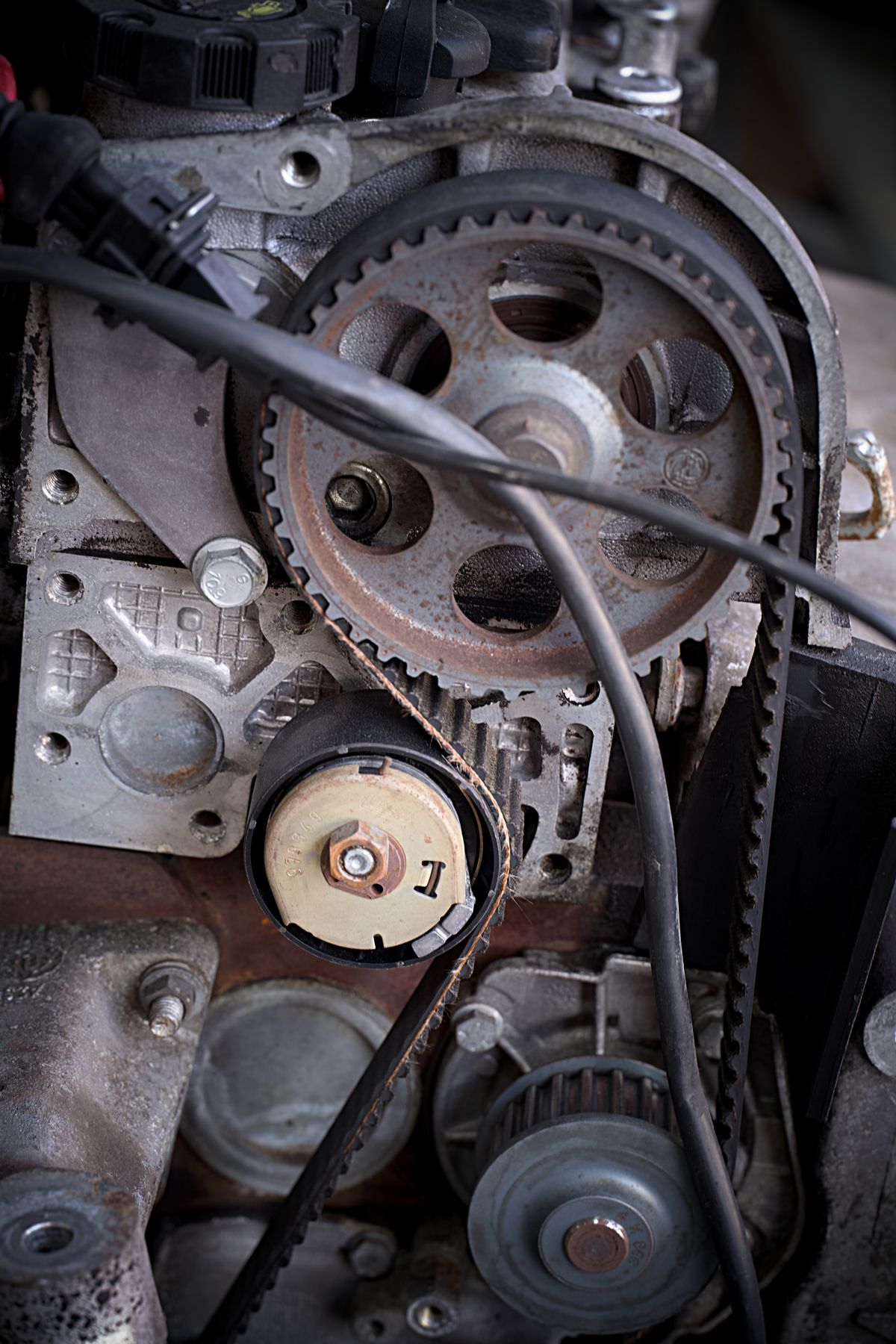
The control head contains a small motor that moves the valve piston through each regeneration position. How it does that depends on the design, and the design changes what failure sounds like.
Two drive designs you will meet:
| Design | How it knows where it is | Typical failure sound |
|---|---|---|
| Timer with cams and microswitches (common on older mechanical and many electronic timer valves) | A rotating cam trips switches at set positions | Hum with no movement, clicking of a switch that is not being released, or a motor that runs and never stops |
| DC motor with optical position sensing (for example the Clack WS1) | Counts light pulses from a coated drive gear; homes against a mechanical stop | Motor running longer than normal then stopping with an error code; grinding if a reduction gear is damaged |
The stalled-motor hum. A motor that is powered but cannot turn makes a steady, slightly strained electrical hum. On cam-timer valves this can go on until the motor overheats. On electronic valves the board usually gives up after a timeout and shows an error. The Clack manual, for instance, lists error E3 as the motor running too long without finding the next position, with causes including "foreign matter built up on piston and stack assemblies creating friction and drag enough to time out motor". Fleck's 5600SXT manual gives a similar cam-sense error when the drive takes more than six minutes to advance, and tells you to "verify that the motor and drive train components are in good condition" (Fleck 5600SXT service manual).
The stripped-gear grind. When a gear tooth breaks or wears smooth, the motor spins but the teeth skip over each other. It sounds like a ratchet or a chewing noise, often rhythmic, and it comes with a valve that never arrives at the next position. On many heads you can see the gears once the cover is off. Look for missing teeth, white plastic dust inside the cover, or a gear that wobbles on its shaft.
The endless click. Clicking that repeats every few seconds usually means one of three things:
- A motor hunting for position — starting, stopping, reversing, trying again. Common after a power cut on valves that have lost track of the piston. Many electronic valves have a resynchronise routine in the manual; running it often stops the clicking.
- A slipping gear — the teeth engage, slip, re-engage. Each slip is a click.
- A relay or switch fault — on timer valves, a microswitch that is chattering because the cam is sitting on its edge.
What to check yourself before calling anyone:
- Unplug the unit for thirty seconds and plug it back in. Note whether the sound returns immediately, only when a regeneration starts, or not at all.
- Look at the display for an error code. An error narrows the fault to a specific subsystem — the codes and what each family means are in water softener error codes and blank displays.
- Remove the front cover (unplugged) and look at the gears. Plastic dust or broken teeth confirm a stripped gear.
- Start a manual regeneration and watch. A valve that moves smoothly from stage to stage is mechanically fine; one that grinds, stalls or hums in place is not.
Hissing and Running Water When Nothing Is On
This is the quietest noise in the table and the most expensive to ignore, because it means water and often salt are leaving the house continuously.
Where the water is going. In a softener with every tap closed and no cycle running, there are only two places water can move to:
| Destination | How to confirm | What is wrong |
|---|---|---|
| The drain | Drain line is cold and vibrates, or you can hear flow at the drain outlet | A worn piston seal or spacer lets water pass internally to drain — Fleck's troubleshooting table lists "internal valve leak" and says to "replace seals and spacers and/or piston" |
| The brine tank | Lift the lid: water level rising above its normal few inches, or a trickle from the brine line | The refill shut-off or the safety float is not closing |
The five-minute test. Close every tap and make sure no appliance is running. Put your ear against the control head and a hand on the drain line. Then mark the water level in the brine tank with a strip of tape. If the drain line stays cold and vibrating, the leak is to drain. If the tape mark is underwater in an hour, the leak is into the brine tank.
A continuously running drain is its own fault with its own repair order, and it is covered properly in why a water softener is constantly draining. A brine tank that keeps filling points at the refill control or safety float instead.
One sound that is not the softener. If the hiss continues with the softener in bypass, look elsewhere — usually a toilet fill valve that never quite shuts.
Gurgling, Spitting and Buzzing: Air and Pressure
Gurgling and sputtering after work on the system. Any time the softener is bypassed, serviced, re-bedded or newly installed, air gets into the resin tank and the pipes downstream. For the first hour or so you get gurgling from the tank, knocking in the pipes and taps that spit. This is normal and it clears by running cold taps one at a time, starting nearest the softener, until each flows smoothly. The full routine is in air in faucets after softener service.
Gurgling that keeps coming back on a well. A softener does not make air. If a well-supplied house gets repeated air noise at the softener and at the taps, the air is coming in upstream. Fleck's troubleshooting table lists "air in water system" as a cause of continuous drain flow and says to make sure the "well system has proper air eliminator control" and to "check for dry well condition". Common upstream causes are a waterlogged pressure tank, a failing check valve that lets the column drain back, or a pump drawing air when the well level drops.
Buzzing or whining in the pipes. A thin, high-pitched whine or buzz that happens only while water flows, and seems to come from the pipes rather than the control head, is usually pressure or restriction. Check:
- Supply pressure. A hose-bib pressure gauge costs little and screws onto an outdoor tap or the washing machine connection. Fleck specifies a minimum of 20 psi for the valve to operate and a maximum of 125 psi; most household plumbing is happiest well below that ceiling. If you read high numbers, the pressure reducing valve (if you have one) may need attention.
- A partly closed valve. A bypass lever or a shut-off valve left half-closed after service creates a restriction that whistles. Open fully.
- Sediment in a prefilter. A clogged cartridge upstream of the softener restricts flow and can whine. It also drops pressure throughout the house, which is often the first thing people notice.
Rattles are almost always something loose — a lid, a bracket, or a drain line slapping the wall during backwash. Clip or secure whatever moves.
A Five-Minute Listening Routine
When you cannot tell which row of the table you are in, this sequence narrows it down without tools.
- Note the time and the display. Is the unit in service or mid-cycle? Write it down along with a short description of the sound in your own words.
- Locate the sound. Stand next to the unit. Is it the control head, the resin tank, the brine tank, the drain line, or the pipes? A phone held close to each part and recording works surprisingly well for comparing.
- Close every tap. Does the sound stop? If yes, it is flow-related: pressure, restriction, air or a loose pipe. If no, something is moving or leaking on its own.
- Put the softener in bypass. Does the sound stop? If no, the source is not the softener at all.
- Unplug the control head for thirty seconds. Does a hum or click stop? If yes, it is electrical or mechanical in the head. Plug it back in and note whether it resumes straight away.
- Start a manual regeneration at a time when you can watch it through. Listen at each stage and compare to the normal soundtrack table above.
Timing, location and trigger together identify the fault, and they are exactly what a technician will ask for on the phone.
What Noise Cannot Tell You
Sound is an excellent early warning and a poor final diagnosis. Be honest about the limits:
- A silent softener is not necessarily a working one. A unit with a salt bridge, a plugged injector or a bypass left open can run silently while delivering hard water. Noise tells you about mechanics; only a hardness test tells you about softening. The method is in how to check if your water softener is working.
- Loudness does not equal severity. A rushing backwash is loud and healthy. A faint hiss at 3 p.m. is quiet and costing you money.
- Some faults are silent until they are not. A cracked distributor tube or fouled resin makes no noise at all.
What to Do Next
- Normal regeneration sounds at the scheduled time: nothing to fix. If the noise bothers you, move the regeneration time to when nobody is sleeping near the unit but water use is still low.
- Hissing or running water between cycles: find out whether it is going to drain or the brine tank, then follow the matching repair.
- Hum, grind or repeated clicking with the unit in service: unplug it if it is straining, look at the gears, note any error code, and plan a motor or gear replacement.
- Gurgling after service: bleed the air from the taps. Recurring on a well: have the well system checked.
- Anything involving opening the valve body on an older unit, or a fault you cannot place: that is the point where a service call is worth the fee.
A water softener making noise is giving you information for free. Most of the parts that make those noises — motors, drive gears, seal kits — are modest repairs when caught early and a whole new valve when ignored until they fail completely. The sound is the cheap stage. Listen to when it happens, and it will usually tell you exactly which part is going.
Frequently Asked Questions
Is it normal for a water softener to make noise?
Yes, during regeneration. A softener regenerates on a schedule, usually in the early hours, and for one to two hours you will hear the motor move the valve, water rushing to the drain, a hissing or sucking sound while brine is drawn, and a trickle while the brine tank refills. Between regenerations a healthy softener is essentially silent apart from the sound of water passing through it when a tap is open. Noise with no regeneration in progress is the part worth investigating.
Why is my water softener making a humming noise?
A hum from the control head while the valve is moving is the motor and is normal. A hum that continues when the valve should be stationary, or a hum with no movement at all, usually means the motor is powered but stalled, either because a drive gear has stripped, the piston is binding in dirty seals, or the motor itself is failing. A low hum or buzz that comes from the pipes rather than the head, and only when water is flowing, is more often high supply pressure or a partly closed valve.
Why does my water softener keep clicking?
A few clicks as the valve starts and stops each regeneration stage are normal, because older timer valves use cams and microswitches and newer valves use a motor that briefly strains against a mechanical stop. Continuous clicking every few seconds, or clicking at random times of day, usually points to a slipping or stripped drive gear, a motor that is trying and failing to reach position, or a timer fault. Unplug the unit briefly and watch whether the clicking returns when power is restored.
Why does my water softener sound like water running all the time?
If you can hear water moving through the softener with every tap closed and no regeneration in progress, water is going somewhere. The two usual destinations are the drain, through a worn piston seal that lets water leak internally, and the brine tank, through a refill valve that is not shutting off. Put a hand on the drain line: if it is cool and vibrating, water is running to drain. Lift the brine tank lid: if the water level is rising, the refill is the leak.
Why does my water softener make noise at night?
Because that is when it is programmed to regenerate. Most units default to a regeneration time around 2 a.m., when nobody is drawing water, so the sounds of backwash, brine draw and rinse often carry through a quiet house. You can change the regeneration time in the programming menu, but choose a time when water use is genuinely low, because drawing water during a regeneration can send untreated water to the taps.
Can air in the lines make a water softener noisy?
Yes. After a softener has been bypassed, serviced or newly installed, trapped air in the resin tank and pipes produces gurgling, knocking and sputtering taps for a short period. That clears by running cold taps until the flow is steady. On private wells, repeated air noise is often a well system problem rather than a softener problem, such as a failing pressure tank bladder, a check valve fault or a low water level in the well.