
Water Softener Replacement Cost: Swap vs Full Reinstall
Water softener replacement cost is about $910 to $1,570 for a professional like-for-like swap when the existing loop, drain line and outlet are reused, and about $660 to $915 if you do the swap yourself. That is far below a first installation. If nothing can be reused, the job becomes a full reinstall at roughly $1,310 to $2,970. Sometimes the whole unit does not need replacing at all. A new control valve is about $580 to $880 installed, and a resin rebed $480 to $930. Price only what is actually changing.
Disclosure: Hard Water Solved may earn a commission if you buy through links on this page, at no extra cost to you. It does not change which products we include or how we rank them. Read our disclaimer.
How these figures were built. Nothing here was physically tested or installed by us. Equipment ranges come from brands' own stores in October 2026; labor uses the site's standard placeholder of a $100 to $150 service call plus $100 an hour, and the plumbing lines use the illustrative ranges in the site's installation cost guide. Replace them with the figures on your own quotes. Prices of individual products are not listed here because they change often. Use the buttons to see the current price on Amazon.
Water Softener Replacement Cost by Scenario
| Scenario | What changes | DIY | Pro |
|---|---|---|---|
| 1. Resin only | Old bed out, new resin in; valve and tanks stay | $180–$330 | $480–$930 |
| 2. Valve only | New control head on the old tank | $290–$400 | $580–$880 |
| 3. Like-for-like swap | New softener into the existing loop, drain and outlet | $660–$915 | $910–$1,570 |
| 4. Full reinstall | New softener plus new loop, drain run and outlet | — | $1,310–$2,970 |
| 5. Upgrade swap | Premium softener plus a carbon prefilter, existing loop | — | $2,070–$3,070 |
Illustrative. Scenarios 1 and 2 are for a 1 to 1.5 cubic foot softener. Scenarios 3 to 5 use a 48,000-grain online system at $630 to $785, or a premium upflow unit in scenario 5.
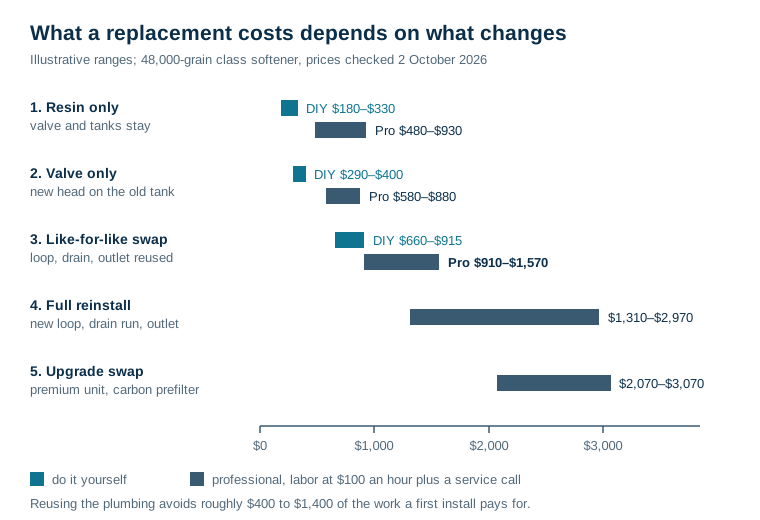
The gap between scenarios 3 and 4 is the plumbing. A swap that reuses the loop, drain and outlet avoids roughly $400 to $1,400 of work that a first install pays for. That is why a replacement quote that looks like a first-install quote deserves a question.
Before pricing a whole unit, make sure it is the whole unit that has failed. The site's guide to signs a water softener needs replacing separates the faults a part can fix from the ones that mean the softener is done.
What a Swap Reuses, and What It Cannot
A like-for-like swap is cheap because most of the first installation is still in the wall. Check each piece before you assume it can stay.
| Part of the old installation | Reusable if… | Cost if it has to be redone |
|---|---|---|
| Loop (the pipe tee-ing off the main to the softener) | It is sound, the right size, and outdoor taps still branch off before it | Illustrative $200–$600 |
| Drain line | It reaches the new valve, has an air gap at the drain and is not kinked | Illustrative $50–$400 |
| Electrical outlet | It is within reach of the new valve's power cord and always on | Illustrative $150–$400 |
| Brine tank overflow | The new brine tank's overflow can reach the drain by gravity | Usually just tubing |
| Bypass valve | Most new softeners include their own bypass; the old one is replaced | Included, or about $60 |
| Brine tank and salt | New systems ship with their own brine tank; leftover salt can be moved across | Included |
Plumbing ranges from the site's guide to water softener installation cost.
Three things catch people out on a swap:
- Connection type and size. The old unit may have a 3/4-inch connection and the new one a 1-inch yoke or bypass. An adapter or a short length of new pipe is a small job, but it should be on the quote.
- Tank height. A taller tank may not fit under a low basement beam or beside a water heater.
- Inlet and outlet sides. If the new valve's inlet sits on the opposite side, the flex connectors may need to cross. That is fine with enough slack, but it needs checking before the old unit is removed.
A Like-for-Like Swap, Priced Line by Line
| Line | DIY | Pro |
|---|---|---|
| New 48,000-grain softener, online | $630–$785 | $630–$785 |
| Fittings, flex connectors, adapters | $30–$80 | $30–$80 |
| Service call and labor (1.5 to 3 hours) | — | $250–$450 |
| Removal and disposal of the old unit | $0–$50 | $0–$100 |
| Permit, where your town requires one for a swap | $0 | $0–$150 |
| Total | $660–$915 | $910–$1,570 |
Illustrative. Many towns do not require a permit for a like-for-like replacement; check yours.
If the installer supplies the softener rather than installing yours, expect the equipment line to be higher than the online price. That is normal, because the installer carries the stock, handles any warranty return and stands behind the unit. Ask for the model and resin volume so you can compare the markup.
The Systems to Price a Swap With
These are the systems behind the model above. All three main units are 1.5 cubic foot class softeners suited to a typical city-water home.
AFWFilters Fleck 5600SXT 48,000: the like-for-like default
- Valve: Fleck 5600SXT digital metered
- Resin: 1.5 cu ft high capacity resin; a 10% crosslink version is also sold
A Fleck valve is the easiest replacement to live with. Parts and service manuals are widely available, and almost any water treatment installer can work on it. If your old unit also had a Fleck valve, the swap is usually the simplest of all.
Watch for: the 10% crosslink version, which costs only a little more. On chlorinated city water, take it.
Aquasure Harmony 48,000 (AS-HS48D): the lowest upfront swap
- Valve: Aquasure's own digital metered head
- Tank: 10 x 54 inch
The cheapest way to put a new metered softener into an existing loop. The trade-off is the valve: it is Aquasure's own design rather than a Fleck or Clack, so parts come through one company. The listing in our original research is unavailable on Amazon; the button goes to the current listing for the same model.
Fleck 5600SXT replacement head: when only the valve has failed
- What it is: a complete digital metered valve head for a standard 2.5-inch tank opening, with transformer and flow controls
- Seller: Aplus Water on Amazon, which describes itself as a Pentair dealer
If the tank and resin are fine and the old valve is the problem, this keeps everything else in service. Confirm the tank opening and distributor tube size match the new head before ordering.
ResinTech CG10 1 cubic foot: when only the resin is spent
- What it is: premium 10% crosslink softening resin, WQA Gold Seal certified per the maker
A rebed suits a softener whose valve is under about 8 years old. Past about 12 years, a new unit usually costs little more and replaces the valve too.
Upgrades Worth Making While the Old Unit Is Out
The cheapest moment to improve a softener is when the old one is already disconnected. These upgrades cost little on top of a swap.
| Upgrade | Extra cost | Worth it when… |
|---|---|---|
| Timer valve to a metered valve | Usually $0; most current online units are metered | Always, if the old unit was a timer |
| Standard to 10% crosslink resin | Small; usually a few dollars to a few tens of dollars | You are on chlorinated city water |
| 48,000 to 64,000 grain | A modest step up in the same model line | Hardness or household size means the old unit regenerated very often |
| Standard to fine mesh resin | A modest step up in the same model line | A well with a little dissolved iron |
| Carbon prefilter | Illustrative $300–$700 plus an hour or two of labor | Chlorine or chloramine shortened the old resin's life |
Metering is the upgrade that pays. An old timer softener regenerates on a schedule whether or not you used the water. The EPA notes that softener regeneration can use 25 gallons of water or more a day, up to 10,000 gallons a year, and its guidance points buyers to demand-initiated models that regenerate only when needed. The site's repair or replace an old water softener works through an example where a new metered unit saves about $130 a year even while you pay for it.
Upgrades that rarely pay on a swap: oversizing far beyond your daily use, which wastes salt on every regeneration of a big bed, and paying extra for app features if you will never open the app.
Removal and Disposal of the Old Softener
Removal is a short job and often free. Many installers include haul-away when they fit the replacement; others charge a small fee. Ask for it as its own line, so it does not appear later as a surprise.
If you remove it yourself:
- Put the old unit in bypass and depressurise it.
- Unplug it and disconnect the drain, overflow and bypass connections.
- Drain the mineral tank, then empty the resin. A full tank is far too heavy to carry.
- Rinse the resin and bag it for household trash, where local rules allow. Resin from water with radium or uranium needs a call to your state first.
- Take the valve to e-waste, brass fittings to scrap, and the tanks to bulky waste.
Replacing a Dealer Softener
Culligan, Kinetico, EcoWater, RainSoft, Hague and Rheem dealer systems are not sold on Amazon, and their replacement price is set by the local dealer. Ask the dealer for an itemized quote for a like-for-like replacement, then price the same swap with an online unit and an independent installer using the tables above. Check two things first:
- Rental or contract terms. If the old unit is rented or under a service contract, the dealer may own it or need to remove it.
- Proprietary connections. Some dealer systems use their own bypass and connectors, so a third-party softener may need new fittings. That is usually a small adapter job, not a new loop.
Who Should Not Replace Yet
- Anyone whose fault is a part, not the unit. A failed motor, seal kit or injector is a repair. Diagnose first.
- Owners of a softener under about 8 years old with spent resin. A rebed is the cheaper fix.
- Homes where the water has changed. If you now have iron, sulfur or much harder water, price the treatment the new water needs before you buy a like-for-like softener.
- Homes in areas with salt-discharge restrictions. Check local rules; a replacement salt-based unit may not be allowed, and a removal rebate may pay more than a new softener saves.
For most owners with a working loop, drain and outlet, the right replacement is a like-for-like metered softener, 10% resin on city water, and a quote that prices only the parts that change.
Frequently Asked Questions
How much does it cost to replace a water softener?
About $910 to $1,570 for a professional like-for-like swap into existing plumbing in our illustrative model, using a 48,000-grain online system at $630 to $785. Doing the swap yourself costs about $660 to $915. If the house needs a new loop, drain run and outlet, the replacement becomes a full installation at roughly $1,310 to $2,970.
Is replacing a water softener cheaper than installing a new one?
Usually, yes. A first installation often pays for a new plumbing loop, a drain line with an air gap and an electrical outlet, which together add roughly $400 to $1,400. A replacement reuses all three when they are in good condition and in the right place, so you pay for the new softener, a few hours of labor, fittings and removal of the old unit.
How much does it cost to remove an old water softener?
Often nothing, because many installers include haul-away when they fit the replacement. Others charge a small fee, roughly $0 to $100 in our model. Ask for it as a line on the quote. If you remove it yourself, the valve goes to e-waste, metal fittings to scrap and the tanks to bulky waste in most areas, once the resin is drained and bagged.
Should I replace the whole water softener or just the valve?
Replace only the valve when the tank is sound, the resin is still doing its job and the valve is the part that failed. A new control valve costs roughly $290 to $400 to fit yourself, or $580 to $880 installed, in our model. If the softener is over about 12 years old, or the resin also needs replacing, a whole new unit usually costs little more and resets everything.
Can I replace a water softener myself?
A like-for-like swap is a reasonable DIY job if the loop, drain and outlet already exist and the new unit's connections match. It involves bypassing and depressurising the old unit, disconnecting it, moving the new tanks into place, connecting the bypass, drain and overflow lines, and programming the valve. Building a new loop or cutting into the main is plumber's work in most homes and may need a permit.
