
Should You Repair or Replace an Old Water Softener?

A repair or replace water softener decision depends on three things: the age of the unit, which part failed, and how efficiently it runs. A sound tank with a failed valve is usually worth repairing, often with a new metered valve. A failed tank, or a big repair on a unit over about ten years old, is not. An old timer unit that wastes salt can be worth replacing even while it still works.
The matrix below combines age and the failed part. The sections after it explain the thresholds and the efficiency test, so you can check the answer against your own quotes.
The Repair or Replace Water Softener Decision Matrix
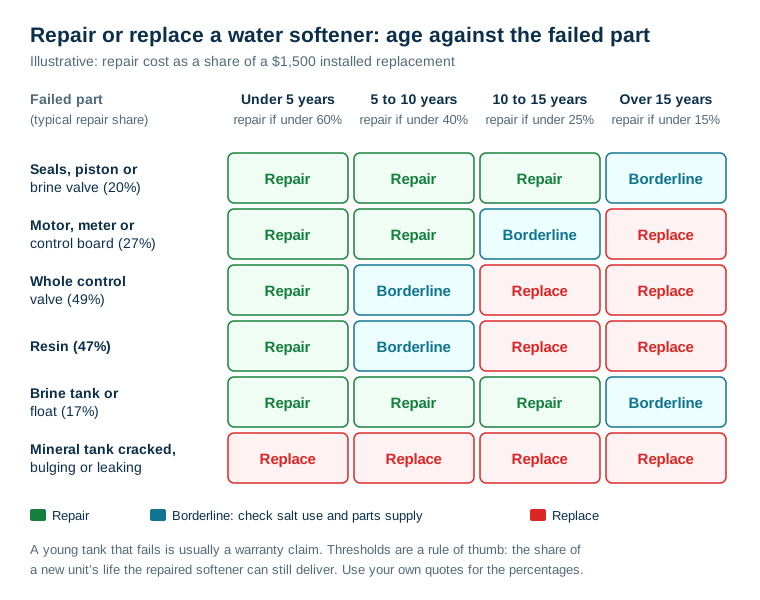
Read across from the part that failed to the column for the softener's age.
- Seals, pistons, brine valves, floats and brine tanks are worth repairing at almost any age. They are cheap, and they do not shorten the life of anything else.
- Motors, meters and control boards are worth repairing until about ten years, then borderline. After fifteen, a board for an old timer valve is often better spent on a new metered valve.
- A whole control valve or a resin change is a clear repair on a young unit, borderline at five to ten years, and a replace after that.
- A failed mineral tank means replacing the softener at any age. On a young unit, it is usually a warranty claim first.
The percentages beside each part are its typical repair cost as a share of a $1,500 installed replacement, using the illustrative installed ranges in common water softener repair costs. The matrix uses about $300 for seals or a rebuild (20%), $400 for a motor, meter or board (27%), $730 for a whole valve (49%), $700 for resin (47%) and $250 for a brine tank or float (17%). Your quotes will differ, so recalculate the share with your own figures before reading the matrix.
Where the Repair-Cost Thresholds Come From
Each age band has a threshold: the most a repair should cost, as a share of a new installed softener. The logic is simple. A repair is worth paying for when it buys a reasonable share of the service life a new unit would give you.
Threshold ≈ years the repaired softener can still give ÷ years a new softener gives
Taking a well-maintained softener's life as roughly 15 years:
| Age of the softener | Years a repaired unit might still give | Threshold, rounded down | On a $1,500 replacement |
|---|---|---|---|
| Under 5 years | About 10 | 60% | Repair if under about $900 |
| 5 to 10 years | About 6 to 7 | 40% | Repair if under about $600 |
| 10 to 15 years | About 3 to 4 | 25% | Repair if under about $375 |
| Over 15 years | About 2 | 15% | Repair if under about $225 |
The thresholds are rounded down on purpose. A repaired old softener still has other old parts waiting to fail, and a new softener comes with a new warranty. "Borderline" in the matrix means a repair falls within ten points above the threshold. There, the next two sections usually settle it: whether parts are still easy to buy, and how much salt the old unit uses. How long softeners typically last, and what shortens their life, is covered in how long a whole-house water softener lasts.
The Failed Part Matters More Than the Age
Sound tank, failed valve: usually repair
The mineral tank is a fibreglass-wrapped pressure vessel. On clean water it often outlasts two control valves. If the tank is dry, straight and firm, a failed valve is a valve problem, not a softener problem.
Start with the cheapest fix. Worn seals, spacers and pistons cause most valve faults, and a rebuild kit costs far less than a new head. If the valve body is cracked, the board is obsolete, or parts are unavailable, a whole new valve head goes onto the old tank. Choose a metered, demand-initiated valve if the old one was a timer, and confirm the tank thread and riser fit before choosing a replacement valve head. That repair also fixes the efficiency problem described below.
Failed tank: replace
A bulge, a crack, or water weeping from the base or neck of the mineral tank cannot be repaired safely. The tank is under full mains pressure. A new tank plus resin, gravel and labour costs most of a new softener, and it leaves you with an old valve on a new tank. Replace the whole unit, and price the replacement for your situation, including removal of the old one, before taking quotes.
Worn-out resin: depends on the valve
Resin wears out, especially on chlorinated city water. On a young softener with a good valve, a rebed restores it to full capacity and is clearly worth doing. On an older unit, look at the valve before paying for resin. If it is a timer valve of the same age, new resin under an old valve buys a few years of an inefficient softener. The signs that point to the resin rather than something cheaper are in signs a water softener needs replacing.
Brine tank, float or safety valve: repair
These are the cheapest parts of a softener and the easiest to replace. A cracked brine tank is not a reason to replace the whole system. Only on a unit past fifteen years does it become borderline, and then mainly because something else is likely to fail soon.
The Efficiency Argument: When a Working Softener Costs Too Much to Run
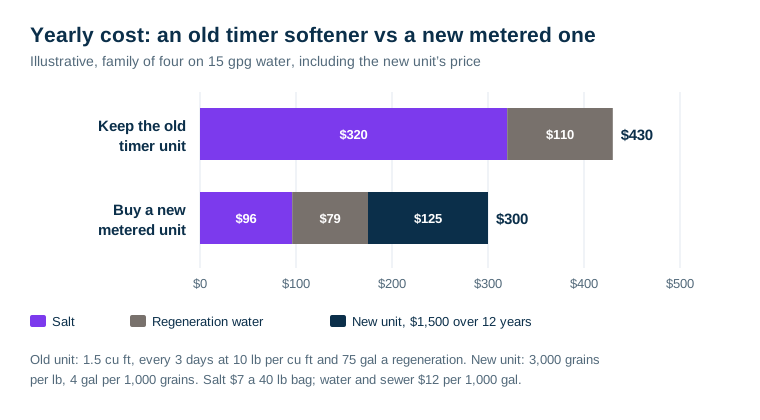
This is the part of the decision most people miss. A fifteen-year-old timer softener that still works can cost more in salt and water each year than a new metered unit costs to run plus its price, spread over its life.
A timer regenerates on a schedule whether the resin is exhausted or not. Many were set up generously, with a large salt dose and short intervals, so the water never ran hard. Efficiency standards reflect this. Under the NSF/ANSI 44 efficiency rating, a softener must be demand-initiated, reach at least 3,350 grains of hardness removed per pound of salt, and use no more than 5.0 gallons of water per 1,000 grains, as summarised by the US Department of Energy's Building America Solution Center. NSF's own explanation of the standard in Water Conditioning and Purification notes that time-clock softeners are "disqualified from being efficiency rated".
A worked example, with illustrative figures. A family of four on 15 gpg water uses about 4,500 grains of softening a day.
| Old timer unit | New metered unit | |
|---|---|---|
| Setup | 1.5 cu ft, regenerates every 3 days at 10 lb of salt per cu ft | 3,000 grains per lb of salt, 4 gal per 1,000 grains |
| Regenerations a year | 122 | Only as needed |
| Salt a year | 15 lb × 122 = 1,830 lb, about 46 bags = $320 | 548 lb, about 14 bags = $96 |
| Regeneration water a year | 122 × about 75 gal = 9,150 gal = $110 | 6,570 gal = $79 |
| Running cost | $430 | $175 |
| New unit's price spread over 12 years | — | $1,500 ÷ 12 = $125 |
| Total a year | $430 | $300 |
Salt at $7 a 40 lb bag, water and sewer at $12 per 1,000 gallons.
In this example, replacing a working softener saves about $130 a year, even while you pay for the new one. When the old unit needs a repair anyway, the case is stronger still.
Try the free fix first. Many timer valves let you set both the salt dose and the days between regenerations. In this example, the household uses about 4,500 grains a day. At 6 lb of salt per cubic foot, standard resin gives roughly 20,000 grains per cubic foot, or about 30,000 for the whole bed. That covers about six days, so a five-day interval leaves a margin. Salt would drop to about 9 lb × 73 regenerations = 657 lb, or roughly $115 a year. Check the capacity table in your valve's manual and test the water on the last day of each cycle. If the settings can be corrected, the efficiency argument for replacing the unit largely disappears. What metering itself saves in the same household is set out in metered vs timer-based water softeners.
To run the test on your own softener:
- Count bags of salt used in a year, from receipts or the monthly log.
- Estimate regeneration water: regenerations a year × gallons per regeneration from the manual.
- Work out what a correctly sized metered unit would use: hardness × gallons a day × 365 ÷ 3,000 for pounds of salt, and ÷ 1,000 × 4 for gallons of water.
- Add the new unit's installed price divided by 12 years.
- If the old unit's salt and water cost more than step 3 plus step 4, replacement pays for itself even before anything breaks.
Five Checks Before You Decide
- Find the real age. Look for a date on the mineral tank label, the valve's serial label or the installation paperwork. Houses are often sold with softeners older than the owners realise.
- Inspect the tank. Check the base and neck for bulges, cracks, damp rings or salt crust. A failed tank ends the discussion.
- Check parts supply. Standard valve brands have parts sold openly. A proprietary valve from a dealer who has closed may be impossible to repair at any price.
- Read the salt log. A unit that uses far more salt than the formula above predicts is either set badly or worn out. Both change the answer.
- Retest and resize. Test raw hardness and count the household again. A softener sized for two people fifteen years ago may be too small for five, and the replacement should be sized for how the house is used now.
When Replacing Will Not Fix the Problem
Replacing a softener is the wrong answer when the fault is not in the softener.
- A salt bridge, blocked injector or wrong setting looks like failure and costs nothing to fix. Rule these out before pricing anything.
- Iron, manganese or chlorine will foul or damage a new softener's resin exactly as it did the old one's. Replace the softener without adding pretreatment and the new resin will fail the same way.
- A plumbing fault, such as a bypass left partly open or a hot-water mixing valve, sends hard water past any softener.
- Health concerns need testing and their own treatment. A new softener removes hardness. It does not remove bacteria, nitrate, lead or arsenic.
The Decision, in Order
- Rule out the free fixes: salt bridge, injector, settings, bypass.
- Identify the failed part and get a written repair quote.
- Check the tank. If it has failed, replace the softener.
- Divide the repair quote by the installed price of a comparable new softener and compare it with the threshold for the unit's age.
- If it falls in the borderline band, run the salt and water test and check parts supply.
- If you replace, choose a demand-initiated, efficiency-rated softener with a standard valve, sized to today's hardness and household. Ranking softener brands by who makes the valve and whether its parts are sold openly narrows the field to units you can still repair in fifteen years.
Worked through in this order, repair or replace water softener decisions are usually clear. A good tank is worth keeping, a failed tank is not, and an old timer that wastes salt is often worth replacing before it breaks.
Frequently Asked Questions
When should I replace my water softener instead of repairing it?
Replace it when the mineral tank is cracked, bulging or leaking at any age, or when a repair costs more than a set share of a new installed softener for its age. This page uses about 60% under five years old, 40% at five to ten, 25% at ten to fifteen and 15% beyond that. Also consider replacing a working old timer unit if its salt and water costs exceed a new metered unit's running cost plus its price spread over its life.
How long does a water softener last?
A well-maintained softener on clean water commonly lasts 10 to 15 years, and many run longer. The mineral tank often outlasts both the control valve and the resin. Chlorine in city water shortens resin life, and iron fouls it. Age alone is not a reason to replace a softener that works well and uses a sensible amount of salt.
Is it worth replacing the resin in an old water softener?
On a unit under about ten years old with a sound tank and valve, usually yes. The resin is the part that wears out, and a rebed restores full capacity. On a unit over ten years old, a resin change costs close to half the price of a new softener in the illustrative figures here, and the valve may be next to fail. Then replacement is usually the better use of the money.
Can you replace just the control valve on a water softener?
Yes. Most residential mineral tanks use a standard threaded top opening, so a new valve head from a common valve family can go on an existing tank and resin. This is often the best repair on a softener with a sound tank, because a new metered valve also cuts salt and water use. Check the tank size and distributor tube against the new valve's specification first.
Is a 20-year-old water softener worth fixing?
Only for cheap repairs such as a seal kit, a brine valve or a float, and only if the tank is sound and the unit's salt use is reasonable. Anything larger, such as a control board, a whole valve or new resin, usually costs more than a 20-year-old unit's remaining life justifies. Older timer units also tend to waste salt, which strengthens the case for replacement.
Can an old softener be made more efficient without replacing it?
Sometimes. Many timer valves let you change the salt dose and the days between regenerations. Setting them to match your hardness and household use can cut salt use sharply at no cost. Check the valve manual's capacity table for the salt dose, and test the water near the end of each cycle to make sure it stays soft. Replacement is worth pricing only once the settings are right.
