
Water Softener Planning for a Home With Septic
A water softener with a septic system is generally safe when the softener is efficient. The research that exists tested brine chemistry and found efficient, demand-initiated units cause no harm and can even improve how a septic tank settles solids. Very inefficient softeners did cause harm in testing. The question still worth asking is hydraulic: how much extra water regeneration sends to the tank. Local rules can also restrict discharge whatever the research says.
This article is about septic tanks and drainfields. Softener drainage in general, including air gaps and drain line problems, is covered in why a water softener drain line leaks.
What the Studies Actually Tested
Three pieces of research sit behind almost every "softeners are fine with septic" claim. Here is what each one tested.
| Study | Who did it | What it tested | What it found |
|---|---|---|---|
| NSF International, 1978 | NSF, Ann Arbor, Michigan | Home aerobic treatment units receiving softener brine | No adverse effects, even at twice the normal softener use (brine for 10 people instead of 5). No difference between days with brine and days without |
| Corey & Tyler, 1978 | University of Wisconsin–Madison, Small Scale Waste Management Project | Whether brine reduces drainfield soil percolation, and its effect on tank bacteria | Brine did not reduce percolation in a normally operating system and may improve it in fine-textured soils. No negative impact on septic tank bacteria |
| Novak & Hogan, 2013 | Virginia Tech | Septic tank effluent quality at different softener salt efficiencies: lab columns of real septic solids, a New York case study, and samples from North Carolina tanks | Efficient softeners improved effluent. Very inefficient ones increased solids, COD and BOD5 in the effluent |
Who paid for it. All three were funded by the water treatment industry's own research body: the Water Quality Research Council for the 1978 studies, and the Water Quality Research Foundation for the 2013 one. The WQA's white paper on softener brine and septic systems summarizes all three. The 2013 study's steering committee included NOWRA (the onsite wastewater industry's association), the State Onsite Regulators Association and NSF. That does not make the findings wrong. It does mean a reader should know the funding source, and the published summaries rarely mention it.
What the studies did not settle:
- Field data is thin. The 2013 study's strongest results came from lab columns. The New York case study supported them. The North Carolina samples showed "no clear relationship" between sodium ratio and effluent quality.
- The aerobic finding is from 1978. Units designed to remove nitrogen are more sensitive. An Ontario onsite industry review (OOWA, 2020) notes that nitrification is affected by chloride.
- Salt still leaves the system. A septic tank is not designed to remove dissolved salt. The chloride in regeneration water goes on to the drainfield and the ground beneath it. That is an environmental question, not a septic performance one, and it is the reason some regulators take a harder line.
Water Softener With Septic System: The Settled Question
The old worry was that salt kills the bacteria in the tank or seals the soil in the drainfield. On that question, the research is consistent: efficient softeners do not harm a conventional septic system.
The 2013 study explains why. Regeneration water carries sodium, but also the calcium and magnesium the resin has just released. Those hardness minerals help solids flocculate and settle, and they keep soil permeable. The problem comes from excess sodium, meaning salt beyond what was needed to strip the hardness off the resin. That depends on how efficiently the softener uses its salt.
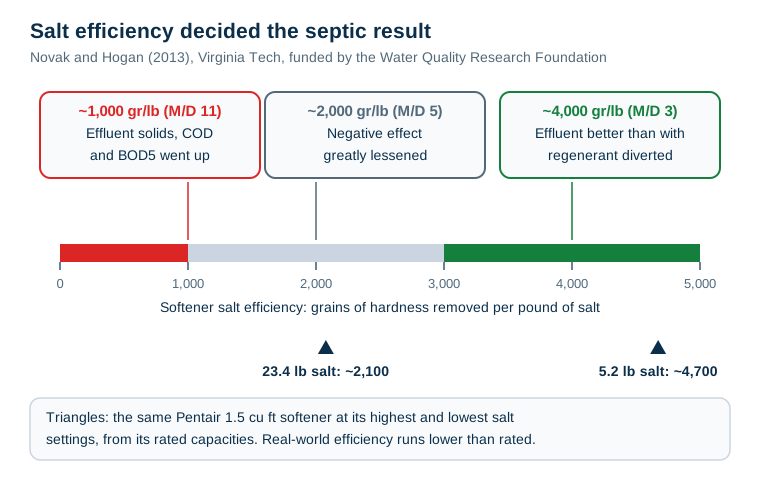
The study expressed this as the monovalent to divalent cation ratio (M/D), roughly sodium divided by calcium plus magnesium:
- About 1,000 grains per pound of salt (M/D 11): effluent solids, COD and BOD5 increased.
- About 2,000 grains per pound (M/D 5): the negative effect was "greatly lessened."
- About 4,000 grains per pound (M/D 3): effluent was better than in tanks where regeneration water was diverted away.
The WQA's summary of the study puts the line at "at or above ~3000 gr/lb" for improved performance. The joint WQA and NOWRA screening guidance asks professionals to keep the predicted ratio at 5 or below.
Your salt setting decides which side of that line you are on. Pentair's specification sheet for a 1.5-cubic-foot softener rates it at 24,300 grains on 5.2 lb of salt and 48,600 grains on 23.4 lb:
- 24,300 ÷ 5.2 ≈ 4,700 grains per pound
- 48,600 ÷ 23.4 ≈ 2,100 grains per pound
Those are rated figures, and real efficiency in a house runs lower. The point is that the same softener, set two different ways, lands at opposite ends of the range the 2013 study tested. The highest salt setting is not the septic-friendly one.
The Real Question: How Much Water Regeneration Adds
Once chemistry is set aside, what is left is volume. Every regeneration sends backwash, brine and rinse water to the tank.
- Per regeneration: the 1978 research summary puts a properly installed softener at "about 50 gallons per regeneration," added slowly and "lower in volume and rate of addition than wastes from many automatic washers."
- Per day and year: EPA's WaterSense page on softeners says regeneration "can use 25 gallons of water or more per day, or up to 10,000 gallons per year." EPA also records that it dropped plans for a WaterSense softener label partly over "concerns raised by some stakeholders in regards to the effect of water softener discharge on wastewater treatment."
- Against the household: EPA puts the average family at more than 300 gallons a day, or about 2,100 a week.
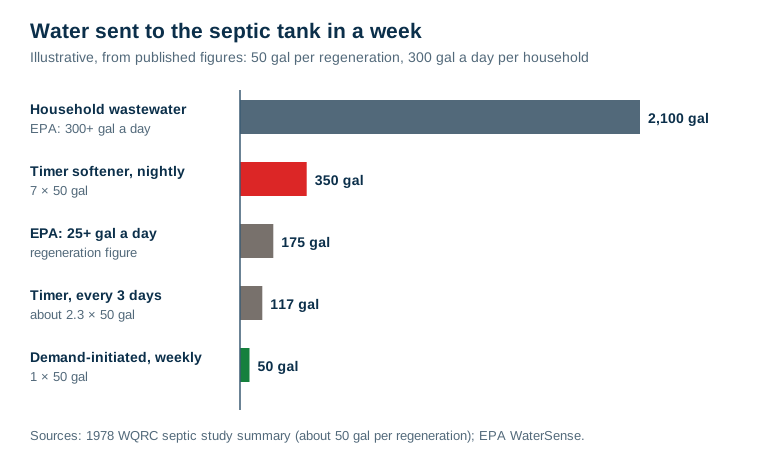
The arithmetic in the chart is illustrative, built from those published figures:
| Softener control | Regenerations a week | Added water a week | Share of a 2,100-gallon week |
|---|---|---|---|
| Timer, every night | 7 | 350 gallons | about 17% |
| Timer, every 3 days | about 2.3 | about 117 gallons | about 6% |
| Demand-initiated, weekly | 1 | 50 gallons | about 2% |
This is why the WQA and NOWRA guidance singles out timer softeners. It says studies "suggest that some septic system / softener issues may be related to the discharge of excess salt from softeners," and advises owners of timer-operated softeners to "seriously consider replacing it" with a demand-initiated unit. Failing that, set the regeneration frequency "not more frequently than needed" and turn the unit off during long absences.
The failure that dwarfs all of these is a valve that never stops draining. A control stuck in backwash at 2 gpm sends 2,880 gallons a day to the tank, more than a family uses in a week. It happens quietly. How to spot it is in why a water softener keeps draining.
How to Set Up a Softener for a Septic Home
- Use demand-initiated regeneration. A meter or sensor triggers regeneration based on what was actually used. This is the first recommendation in the WQA and NOWRA guidance. Softeners ranked on how much water they send to the tank each year compares current units on that measure.
- Program the real hardness. A hardness setting well above your water's actual figure makes the softener regenerate more often than it needs to. Use a lab result, not a guess.
- Choose a salt setting for efficiency. Work out grains per pound from the valve's own capacity table, as in the Pentair example. Aim for the upper part of the range. A salt setting that is far too high is the most common reason a softener uses too much salt.
- Do not oversize the salt dose to make up for iron. If iron is pushing you toward heavy salt and frequent regeneration, pretreatment is usually the better answer for both the resin and the tank.
- Fix leaks. NOWRA's guidance calls excess water "one of the largest issues related to onsite wastewater treatment system failures." A running toilet also makes a metered softener regenerate more often.
- Keep the septic system maintained. Regular inspection and pumping on the schedule your local program recommends. The softener does not change that.
Should you divert the regeneration water instead? Not automatically. In the 2013 New York case study, the tank that did not receive regeneration water showed higher values for most of the measured parameters. The authors suggest that removing the calcium and magnesium without returning them to the tank may cause problems of its own.
Aerobic and Advanced Systems Are a Different Case
The WQA and NOWRA guidance is written for "conventional septic tank and drainfield systems." For advanced treatment systems, it says, "the manufacturer's instructions should be followed."
- Read the unit's manual and warranty before connecting a softener discharge. Some manufacturers restrict it.
- Nitrogen-removal units need extra care. The OOWA review points out that chloride affects nitrification, the step these units rely on.
- The 1978 NSF result covers the aerobic units NSF tested at the time. It is not a statement about every modern design.
Check the Rules Where You Live
The research does not override the local code. Several jurisdictions restrict softener discharge regardless of the science, and the WQA's own white paper acknowledges that agencies "have from time to time proposed restrictions," which it opposes.
Examples of real rules:
- Massachusetts. The state's Title 5 septic code (310 CMR 15.000) states that "Backwash of water purification or filtration devices shall not be discharged to an on-site system." Dry wells used instead must comply with the state's underground injection control regulations.
- Queen Anne's County, Maryland. A 2024 ordinance prohibits water softener brine from being discharged into the county's septic tank effluent pumping (STEP) sewer system in one wastewater subdistrict, with penalties for violations.
- California. Water Code section 13148 lets local sewer and water recycling agencies in specified regions restrict or prohibit self-regenerating residential softeners to control salinity. That applies to homes on community sewers, not septic, but it shows the direction some regulators are taking.
How to find your own rule:
- Start with your county or local health department, which usually issues septic permits and inspects systems.
- Then check the state onsite wastewater program, often in the environment or health department. Search its rules for "water softener," "backwash" and "brine."
- Read your septic permit or as-built drawings. Some permits record what may be connected.
- For an aerobic or advanced unit, read the manufacturer's manual and service contract.
- If discharge to the septic system is not allowed, ask what is. A separate dry well may need its own permit. The OOWA recommends keeping any alternative discharge point at least 30 meters from wells and surface water.
What a Softener Cannot Do for a Septic System
- It cannot fix a failing drainfield. Soft water does not restore a clogged or undersized system. Neither does removing the softener.
- It does not remove the salt it adds. The sodium and chloride from regeneration pass through the septic tank.
- It does not change your drinking water safety. A home on a well and septic needs regular water testing whatever treatment it has. See can a water softener be used on private well water for the full test panel.
The honest verdict on a water softener with a septic system is that the chemistry question has been answered in favor of efficient units, by studies the industry paid for. The water volume question is answered by how often you let it regenerate. And the legal question is answered by your county, not the research.
Frequently Asked Questions
Is it OK to have a water softener with a septic system?
Generally yes, if the softener is efficient. The studies funded through the Water Quality Association's research foundation found no harm from efficient units, and the 2013 Virginia Tech study found that efficient softeners improved septic tank effluent. The same study found that very inefficient units, around 1,000 grains of hardness removed per pound of salt, made effluent worse. Local rules also apply: Massachusetts, for example, does not allow treatment-device backwash into an on-site system.
Will a water softener ruin my septic system?
Not an efficient, demand-initiated one on a conventional septic tank and drainfield. The research does point to two real risks. One is excess sodium from softeners set to use far more salt than they need. The other is extra water from timer units that regenerate on a schedule whether or not the resin needs it. A valve stuck sending water to drain can overload any system.
Does water softener salt kill septic bacteria?
The research says no for normal use. The University of Wisconsin work reported in 1978 found the salt from softener brine had no negative impact on the bacteria in a septic tank, and the NSF study found no adverse effect on aerobic treatment units even at twice the normal brine use. The 2013 Virginia Tech study found anaerobic digestion was not affected by sodium level in its tests.
How much water does a water softener add to a septic system?
The 1978 study summary puts a typical regeneration at about 50 gallons. EPA says regeneration can use 25 gallons or more a day, or up to 10,000 gallons a year. A demand-initiated softener that regenerates weekly adds only a few percent to a household's wastewater. A timer unit regenerating every night can add about a sixth.
Can I drain my water softener somewhere other than the septic tank?
Sometimes, but it needs a permit check first. Separate dry wells are regulated in some states. Massachusetts requires them to comply with its underground injection control rules. The Virginia Tech study also found that diverting regeneration water can remove the calcium and magnesium that help solids settle in the tank. Ask your county health department or state onsite program what is allowed before re-plumbing the drain.
Is a water softener OK with an aerobic septic system?
Check the aerobic unit's manufacturer before anything else. The WQA and NOWRA guidance says that for advanced treatment systems, the manufacturer's instructions should be followed. The 1978 NSF study found no adverse effects on the aerobic units it tested, but an Ontario onsite industry review notes that chloride can affect nitrification, which matters for units designed to remove nitrogen.
