
Best Water Softener for Septic Systems: Picks Ranked on Discharge

The best water softener for septic systems is the one that sends the least water and salt down the drain. On that measure the SoftPro Elite, an upflow softener with variable brining, comes first at about 1,400 gallons a year for a family of four. A metered Fleck 9100SXT twin sends about 3,400 and a metered Fleck 5600SXT about 3,900. A timer softener regenerating every three days sends more than 10,000.
Research funded by the water treatment industry found efficient softeners do not harm a working septic system, and very inefficient ones do. So the choice comes down to efficiency: how often a softener regenerates, how much water each cycle uses, and how much salt it wastes.
Disclosure: Hard Water Solved may earn a commission if you buy through links on this page, at no extra cost to you. It does not change which products we include or how we rank them. Read our disclaimer.
How These Picks Were Ranked
Methodology. Every pick is a demand-initiated, salt-based softener listed on Amazon.com. Picks are ranked on estimated regeneration water sent to the drain each year by a family of four using 300 gallons a day on 15 gpg water. Fleck figures use the per-cycle volumes worked out in our guide to how much water regeneration uses, based on one maker's published cycle times. SoftPro's figure uses the per-cycle volume on SoftPro's own product page. Warranty terms come from the makers' pages. Nothing was physically tested. Excluded: timer-only softeners and units shown as unavailable on Amazon. Prices are not listed here because they change often. Use the buttons to see the current price on Amazon.
Per-cycle water is rarely published as a single number. Where it is not, the estimate is shown as illustrative.
Best Water Softener for Septic Systems: Annual Discharge by Pick
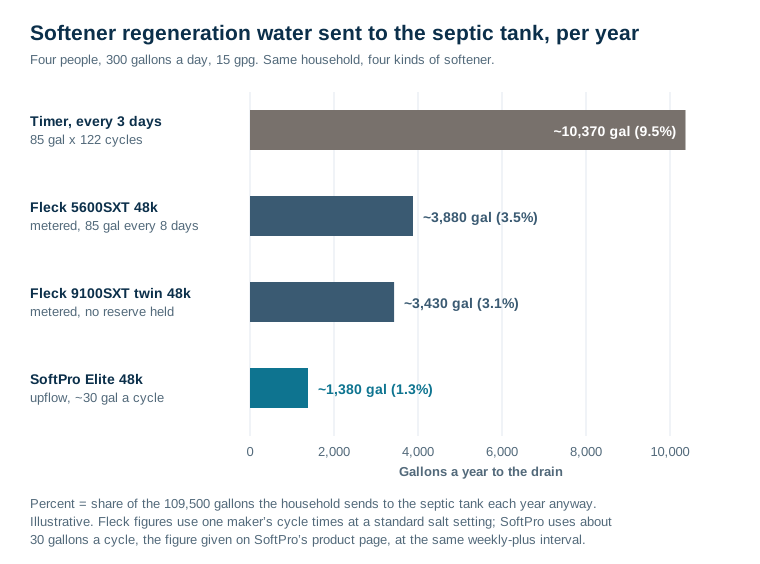
| Per regeneration | Regenerations a year | Gallons a year | Share of household wastewater | |
|---|---|---|---|---|
| Timer, every 3 days (baseline) | ~85 gal | 122 | ~10,370 | ~9.5% |
| Fleck 5600SXT 48k, metered | ~85 gal | ~46 | ~3,880 | ~3.5% |
| Fleck 9100SXT twin 48k, metered | ~85 gal per tank | ~40 | ~3,430 | ~3.1% |
| SoftPro Elite 48k, upflow | ~30 gal (SoftPro) | ~46 | ~1,380 | ~1.3% |
Illustrative. The household sends about 109,500 gallons a year to the septic tank before any softener water is added.
Two things stand out. First, metering does most of the work. Going from a three-day timer to any metered pick cuts regeneration water by about two-thirds. Second, the SoftPro's lower per-cycle volume is what separates it from the Fleck units. That figure comes from SoftPro, not from an independent test, so treat it as the maker's best case.
The Salt That Goes With the Water
Water is half of what a softener sends to the tank. The other half is the salt that was not used to strip hardness off the resin. For the same family of four, removing about 1.64 million grains of hardness a year:
| Salt efficiency | Typical of | Salt a year |
|---|---|---|
| ~2,070 grains per lb | Maximum salt setting, about 15 lb per cu ft | ~795 lb |
| ~3,000 grains per lb | A realistic metered field setting | ~548 lb |
| ~3,500 grains per lb | Economy setting, about 6 lb per cu ft | ~470 lb |
In the drain water, the chloride from the brine leaves paired with the calcium and magnesium the resin released, plus whatever sodium chloride was surplus to the exchange. The research found the first part harmless. The surplus sodium from an over-salted softener is what made effluent worse in testing. So the salt setting is a septic setting as well as a running cost.
SoftPro's comparison page claims the Elite's upflow regeneration cuts salt and water use by up to 75% against a downflow Fleck 5600SXT. That is the maker's best case and we have not verified it, but the direction matches the mechanism: upflow regeneration needs less salt to restore the same capacity.
1. SoftPro Elite 48k: Lowest Discharge
The Elite regenerates upflow: brine enters at the bottom of the bed and pushes the hardness out through resin that is already used up, which SoftPro says saves both salt and the unused part of the bed. On top of that:
- Precision brining. SoftPro says the valve pre-makes only 70% of the brine before regeneration and tops it up to match how much of the resin is actually depleted, which it puts at up to 30% more salt saving.
- A smaller reserve. SoftPro sets a 15% reserve and adds a short "refresh" regeneration if capacity drops below 3%. It says less efficient systems hold back 30% or more.
- Soft-water brine refill, which keeps the brine tank cleaner.
- 10% crosslink resin, more resistant to chlorine than standard resin.
The answer on SoftPro's product page puts regeneration water at around 30 gallons a cycle. If that holds at a weekly-plus interval, the Elite sends about 1,400 gallons a year to the tank, roughly a third of a metered downflow unit. The mechanism is explained in upflow vs downflow regeneration.
Warranty. SoftPro's warranty page lists lifetime cover on the tanks and the control valve body, five years on the piston, seals and spacers on city water, seven years on the circuit board, and ten years prorated on the 10% resin on city water. SoftPro also offers a six-month return window.
Skip it if you are on a tight budget, or your water has iron. SoftPro's resin warranty applies to city water, and the standard Elite is sold as a city-water softener.
2. SoftPro Elite 32k: Best for Smaller Septic Households
Same valve, same upflow regeneration and precision brining, with a smaller bed. For one to three people it regenerates at a sensible interval without leaving resin idle for weeks, and it usually costs a little less than the 48k.
Size it honestly. On a family of four at 15 gpg, a 32,000-grain bed regenerates more often than the 48k. Each cycle is smaller, so the annual water is similar, but the valve cycles more. A family of four is usually better served by the 48k. The sizing method is in how to size a water softener.
3. AFWFilters Fleck 9100SXT Twin 48k: Best for Large Households
A twin-tank softener always has one tank in service while the other regenerates or waits. Because the standby tank is ready, the valve does not need to hold back a reserve. It runs each bed until it is spent and switches. For a family of four at a standard salt setting, that means roughly 40 regenerations a year instead of about 46, and about 3,430 gallons instead of 3,880.
It also regenerates with soft water from the tank in service, and it can regenerate as soon as a tank is exhausted rather than waiting for a set time. For a septic system that spreads the load through the day instead of stacking it at one hour.
The trade-off. It is a lot of hardware: two 10 × 54 in mineral tanks, each with 1.5 cu ft of high-capacity resin, plus a brine tank. AFWFilters gives its service flow as 6.5 gpm and peak flow as 9.8 gpm, which is modest for a big household. Check that against your peak demand.
Skip it if your household is four people or fewer. The saving over a single metered tank is small for the extra cost.
4. AFWFilters Fleck 5600SXT 48k: Best Budget Pick
A metered Fleck 5600SXT on 1.5 cu ft of high-capacity resin. It regenerates downflow with a fixed brine fill, so it uses more water per cycle than the SoftPro. But its meter means it only regenerates when the resin is used up, and that alone puts it at about a third of a timer unit's discharge.
Make it septic-friendly. Set the salt dose to economy, about 6 lb per cubic foot of resin, and the hardness to your actual test result. At economy settings our regeneration guide puts a 1.5 cu ft unit at about 56 gallons a cycle and about 3,410 gallons a year. Pentair's Fleck 5600SXT specification sheet lists the valve as tested and certified by the WQA to NSF/ANSI 44 for softener performance.
Warranty. AFWFilters' standard terms are five years on the Fleck valve and ten years on the tank.
Skip it if the lowest possible salt and water discharge matters more to you than a lower purchase price. It usually costs noticeably less than the SoftPro Elite.
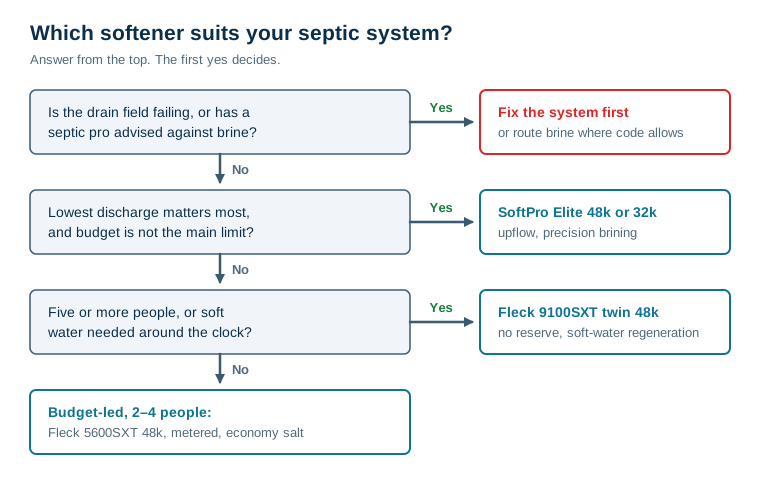
Which Septic Softener Should You Buy?
Settings That Cut Discharge on Any Softener
The softener matters less than how it is set up. These cut regeneration water and salt on every pick here, roughly in order of impact.
- Use the meter. A metered valve with a short day override is a timer again. Set the override to the longest interval the manual allows, or switch it off.
- Set hardness from a test, not a guess. Programming 25 gpg on 15 gpg water makes the softener regenerate about two-thirds more often than it needs to.
- Use the lowest salt dose that keeps the water soft. The first pounds of salt do most of the work. Lower doses mean less salt to the tank and, on most valves, a shorter brine draw.
- Leave outdoor taps on hard water. Lawn and garden water does not need softening and does not go to the septic tank, so softening it only adds regenerations.
- Do not shorten backwash on dirty water. It saves a few gallons and costs resin life. Shorten it only on clean water, within the manual's limits.
Where the regeneration water goes, and why some states restrict sending it to a separate dry well, is set out in where water softener regeneration waste goes.
What the Research Says About Softeners and Septic Tanks
Three studies funded by the water treatment industry's research arm sit behind most claims on this subject. The WQA's white paper on softener brine and septic systems summarises them. Efficient softeners caused no harm to a working tank or drainfield and could improve tank effluent. Very inefficient softeners, using far more salt than needed, made effluent worse. Our full review of the studies, their funding and their limits is in a water softener with a septic system.
The practical reading is that efficiency is what protects the tank. Every pick on this page is demand-initiated. The ranking is about how far beyond that each one goes.
The EPA's WaterSense notes on cation exchange water softeners say regeneration can use 25 gallons or more a day, or up to 10,000 gallons a year. That is the timer end of the chart above. A metered softener, set correctly, sits well below it.
Who Should Buy None of These
- Homes with a failing drainfield. Any extra water hurts. Fix the system, or talk to a septic professional about where regeneration water can go.
- Advanced treatment units designed to remove nitrogen. Follow the unit manufacturer's instructions on softener discharge before buying anything.
- Homes in states that restrict softener discharge to on-site systems. Check the rules first.
- Well owners with iron, manganese or sulfur. Treat those first. A softener fouled by iron regenerates more often and sends more water to the tank.
The best water softener for septic systems is efficient first and clever second. Choose a metered unit, set it from a water test at a low salt dose, and the tank will barely notice it.
Frequently Asked Questions
What type of water softener is best for a septic system?
A demand-initiated, metered softener with an efficient salt setting. It regenerates only when the resin is used up, so it sends the least water and salt to the tank. Upflow designs with variable brining, such as the SoftPro Elite, cut the discharge further. Avoid timer-only softeners, which regenerate on a schedule whether the resin needs it or not.
How much water does a water softener send to a septic tank?
For a family of four on 15 gpg water, a metered 1.5 cubic foot softener sends roughly 3,400 to 3,900 gallons a year, about 3 to 4 percent of the household's water. A timer regenerating every three days sends about 10,400 gallons. An upflow SoftPro Elite, if its regenerations use about 30 gallons as SoftPro's product page states, sends about 1,400.
Will softener salt damage my drain field?
Research on efficient softeners found no harm to a normally working septic tank or drainfield, and found that efficient units can improve tank effluent. The same research found very inefficient softeners, using far more salt than needed, made effluent worse. The fix is efficiency: a metered valve and the lowest salt dose that keeps your water soft.
Can I route softener discharge away from my septic tank?
Only where your state or county allows it. Separate dry wells are regulated in some states, and diverting the water also removes the calcium and magnesium that help solids settle in the tank. Check with your county health department or state onsite program before re-plumbing the drain line.
Is a twin-tank softener better for a septic system?
Slightly. A twin-tank metered softener like the Fleck 9100SXT does not need to hold back a reserve, so it uses more of each bed before regenerating. For a family of four that works out to roughly a tenth fewer regenerations than a single tank of the same size. It suits large households that need soft water at all hours more than it suits septic owners as such.
