
What Does Water Softener Resin Actually Do?
What does water softener resin do? It swaps ions. Every resin bead is covered in fixed, negatively charged exchange sites that hold sodium. When hard water passes, calcium and magnesium take those sites and the sodium goes into the water. Brine reverses the swap during regeneration. A resin bed's capacity is simply how many of those sites it has, and resin wears out only by losing them.
Sites are lost in one of two ways. Blocked sites, coated by iron or other fouling, can often be recovered with a cleaner. Destroyed sites, lost when chlorine breaks down the bead, are gone for good. That one distinction decides whether the right response is a bottle of cleaner or a new bed.
What Water Softener Resin Is Made Of
Household softening resin is a strong acid cation resin in the sodium form. Put plainly:
- The skeleton is polystyrene, cross-linked with divinylbenzene (DVB). The cross-links hold each bead rigid. Standard resin carries about 8 percent DVB; chlorine-resistant grades carry 10 percent.
- The exchange sites are sulfonic acid groups attached throughout the bead, not just on its surface. Each carries a fixed negative charge.
- The loose ions are what those charges hold. Resin ships holding sodium, which is why it is called the sodium form.
Purolite's C100E product data sheet, a widely used softening resin, describes it as a gel polystyrene cation resin with beads of 300 to 1,200 micrometres and a total capacity of 1.9 equivalents per litre. The beads are translucent amber, about the size of coarse sand. A dry one is hard to see individually. A wet bed looks like wet brown sugar.
The resin sits in the mineral tank around a central distributor tube, with empty freeboard above it so the bed can lift and loosen during backwash. The layout, and how each part fails, is in inside a water softener mineral tank.
What Does Water Softener Resin Do at the Bead Level?
Softening happens at a scale far too small to see, and the numbers help explain why a softener works as it does.
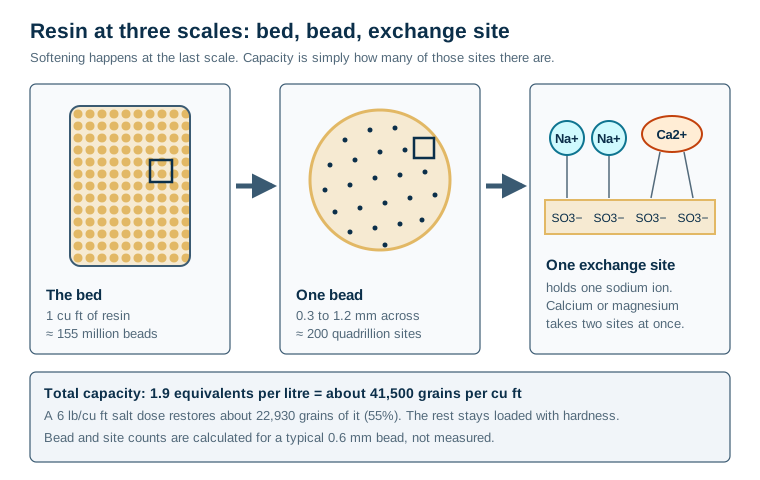
How many sites? Worked from the data sheet's 1.9 equivalents per litre, and assuming a typical bead of about 0.6 mm packed as loose spheres pack:
| Scale | Calculated figure |
|---|---|
| Beads in one cubic foot | About 155 million |
| Exchange sites on one bead | About 200 quadrillion (2 × 10¹⁷) |
| Total capacity of one cubic foot | About 41,500 grains of hardness |
| Hardness one fully loaded bead can remove | About 1 mL of 1 gpg water, or a few hundredths of a mL at 15 gpg |
These are calculations, not measurements, but the total agrees with the published figure. Chubb Michaud's technical review The Capacity of Ion-Exchange Resin gives softening resin a volumetric capacity of 1.9 to 2.0 mEq/mL, which he converts to 41.5 to 43.7 kilograins per cubic foot. It takes hundreds of millions of beads because each one does so little.
Why calcium wins. A sodium ion carries one positive charge and fills one site. Calcium and magnesium carry two charges and take two sites at once. Michaud notes that the resin's selectivity "for the hardness ions is considerably stronger than for sodium". So as hard water passes, the resin lets go of sodium and grabs calcium and magnesium in its place, two sodium ions out for each hardness ion held.
Why regeneration needs so much salt. That same preference works against you during regeneration. To push calcium off, brine has to swamp the sites with sodium at a huge excess. That is why a softener uses far more salt, by weight, than the hardness it removes.
What resin does not touch. Negatively charged ions such as chloride, sulfate, bicarbonate and nitrate pass straight through. Only positive ions trade places, so total dissolved solids stay about the same after softening.
Total Capacity vs the Capacity You Actually Get
A new bed has around 41,500 grains of sites per cubic foot. A softener never uses all of them.
The salt dose decides how many are restored. Hellenbrand's published table for one cubic foot gives about 22,930 grains at 6 lb of salt, 28,060 at 10 lb and 32,310 at 15 lb. At the common 6 lb setting, that is about 55 percent of the total. The rest of the sites stay loaded with calcium and magnesium from one cycle to the next. Michaud puts operating capacity at typically 60 to 70 percent of total.
That held-back share is not a fault. It is the efficiency trade-off built into every salt setting. The first pounds of salt clear sites cheaply, and each extra pound clears fewer. It does explain two things owners see:
- A little hardness leakage is normal, especially at the end of a cycle and at low salt doses. Sites that still hold hardness near the bottom of the bed can release a trace of it.
- Lost sites come straight off the capacity you use. A bed that has lost a tenth of its sites delivers roughly a tenth less at the same salt dose. A metered valve still programmed for new resin then lets the bed run out before it regenerates, and hardness slips through at the end of each cycle.
The Two Ways Resin Loses Sites
Every resin problem comes down to fewer usable sites. What matters is where they went.
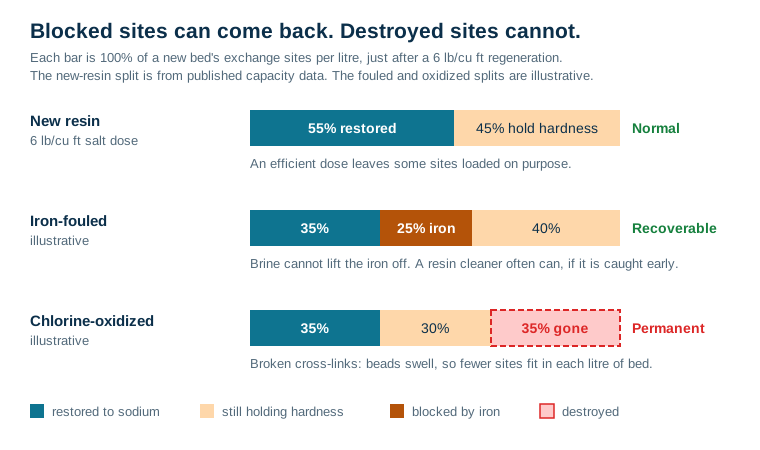
Blocked: the sites are there, but something is in the way
Fouling coats the beads or occupies the sites with something regeneration cannot remove:
- Iron. Dissolved iron is exchanged like hardness, but it oxidizes inside the bed and clings. Purolite's technical note on factors affecting softening resin performance and life explains that softening resin has "a high selectivity for iron", which makes it "impossible for the brine regenerant to obtain a good reversible removal". Salt alone will not clean it off.
- Manganese. Similar, but darker and harder to shift.
- Sediment and silt. Physically buries beads and fills the gaps between them.
- Organic matter. Tannins and humic acids bind to the sites and stain the bed brown.
The beads underneath are intact. Remove the coating with a reducing or acidic resin cleaner, and many of those sites work again, especially with iron caught early. Organic fouling is the hardest to reverse. Which agent leaves which signature is set out in what is water softener resin fouling.
Destroyed: the sites are gone along with the bead's structure
Oxidation attacks the skeleton. Chlorine and chloramine break the DVB cross-links. With fewer cross-links, each bead takes on water and swells, so each litre of bed holds fewer beads and fewer sites. Purolite's note says total capacity falls and moisture content rises, and in severe cases beads become soft and "jelly-like", raising pressure drop. Eventually they crush and break.
The rule of thumb the industry works from, in the same Purolite note, is that "for each 1 mg/l (1 ppm) of chlorine present in the incoming water supply, the life of the resin will be reduced by 50%." Heat speeds it up.
No cleaner rebuilds a broken cross-link. The detection side, from finding your residual to reading the capacity trend, is covered in how chlorine damages water softener resin.
Which One Do You Have? Cleaner or New Resin
Because the fixes are opposite, identify the damage before spending on either. The evidence usually points one way.
| Evidence | Points to blocked sites (fouling) | Points to destroyed sites (oxidation) |
|---|---|---|
| Water source | Well water with iron, manganese or tannins | Chlorinated or chloraminated city water |
| Bead colour in a rinsed sample | Rust orange, grey to black, or deep brown | Normal amber, or paler |
| Bead feel between finger and thumb | Firm, resists pressure | Soft, squashes or smears |
| Broken fragments in the sample | Few | Many, plus fine debris in aerators |
| Brown or orange water after regeneration | Common | Rare |
| Gallons between regenerations after one full cleaner treatment | Clear rise | No change |
The test that settles it. Log the gallons between regenerations for two cycles. Run one full resin cleaner treatment as the product directs, then log two more cycles. A clear rise means the lost capacity was blocked and some has come back. No change after a correctly done treatment means the sites are gone, and more cleaner is money wasted.
If it was blocked: clean the bed, and then deal with the source. Iron water without iron removal ahead of the softener will foul new resin on exactly the same timetable.
If it was destroyed: plan a re-bed or a new softener, and protect the next bed. That means carbon ahead of the softener, 10 percent chlorine-resistant resin, or both. How to weigh a re-bed against replacing the whole unit, and how to read the capacity trend that tells you when, is in water softener resin life and when to replace it.
Both at once is common. An old bed on chlorinated city water, supplied through old galvanized pipe, can be oxidized and iron-fouled together. Cleaning will recover the fouled share and nothing more. If capacity improves a little and then stops, that is what you are seeing.
Looking at Your Own Resin
You do not need a microscope to see which kind of damage you have. A rinsed sample in a white dish, in daylight, shows colour, uniformity and broken beads plainly. A cheap 10x hand lens is enough to see cracks and fragments.
Healthy resin is uniform, translucent amber and spherical. Put the softener in bypass and relieve the pressure before removing the control valve to take a sample. If you would rather not take the valve off, ask a technician to pull a sample at the next service and show you the beads.
What Resin Does Not Do
- It is not a filter. Sediment clogs it rather than being removed by it. A sediment prefilter protects it.
- It does not disinfect. Bacteria pass through, and a bed can harbor them if it sits unused.
- It does not remove chlorine. Chlorine removes resin, slowly. Carbon removes chlorine.
- It does not lower TDS. It trades one dissolved ion for another.
- It does not remove negatively charged contaminants such as nitrate, arsenic in most forms, or fluoride.
- It does not handle oxidized iron well. Rust particles foul it. Iron removal belongs ahead of a softener above modest levels.
- It does not heal. Regeneration restores sites that exist and can be reached. It cannot recover the ones that are gone.
Frequently Asked Questions
What does the resin in a water softener do?
It removes hardness by ion exchange. Each resin bead carries fixed, negatively charged sites that hold sodium ions. As hard water flows past, calcium and magnesium, which the resin holds more strongly, take those sites and the sodium goes into the water. When the sites are mostly full, regeneration floods the bed with strong brine, which pushes the hardness off to drain and reloads the sodium.
What is water softener resin made of?
Standard softening resin is polystyrene cross-linked with divinylbenzene, made into small beads and treated so that each bead carries sulfonic acid groups. Those groups are the exchange sites. Standard resin uses about 8 percent divinylbenzene; chlorine-resistant grades use 10 percent. It is sold in the sodium form, as amber, translucent beads roughly 0.3 to 1.2 mm across.
Can water softener resin be regenerated forever?
Not forever, but the exchange itself does not wear out. A bed on clean, unchlorinated water can run well over ten years. What ends resin life is losing exchange sites: blocked by iron, manganese, sediment or organic matter, or destroyed when chlorine breaks down the bead. Regeneration only restores sites that are still there and still reachable.
How do I know if my softener resin is bad?
The earliest sign is fewer gallons between regenerations with the same settings, followed by rising salt use and hardness appearing near the end of each cycle. To tell which kind of damage it is, look at a bead sample. Discoloured, firm beads point to fouling, which a cleaner may reverse. Normal-coloured beads that are soft, swollen or broken point to oxidation, which needs new resin.
Does resin cleaner fix chlorine-damaged resin?
No. Resin cleaners dissolve coatings such as iron and some manganese from the bead surface. Chlorine damage is to the bead's structure: broken cross-links let it swell and lose capacity per litre. Nothing puts the cross-links back, so the only fix is new resin, ideally with carbon pretreatment or chlorine-resistant resin so the new bed lasts longer.
Does softener resin remove anything besides hardness?
Some other positively charged ions, such as small amounts of dissolved iron and manganese, and radium where it occurs. It does not filter sediment, disinfect water, lower total dissolved solids or remove negatively charged contaminants like nitrate. It is also damaged by chlorine rather than removing it.
