
What Does NSF/ANSI 44 Mean for Water Softeners?
NSF/ANSI 44 is the certification standard for cation exchange water softeners. A full NSF/ANSI 44 water softener listing shows that a softener's materials are safe in drinking water, its tank and valve passed structural testing, and its published hardness capacity was verified. It can also carry optional claims for salt efficiency and for barium and radium reduction. It does not cover iron, bacteria, chlorine, lead or any contaminant that is not on the listing.
The mark is worth something, but only when it is attached to the right thing. The most common trick in softener marketing is not a fake logo. It is a real certification for part of the product, or for a different standard, presented as if it covered the whole softener's performance.
What an NSF/ANSI 44 Water Softener Listing Covers
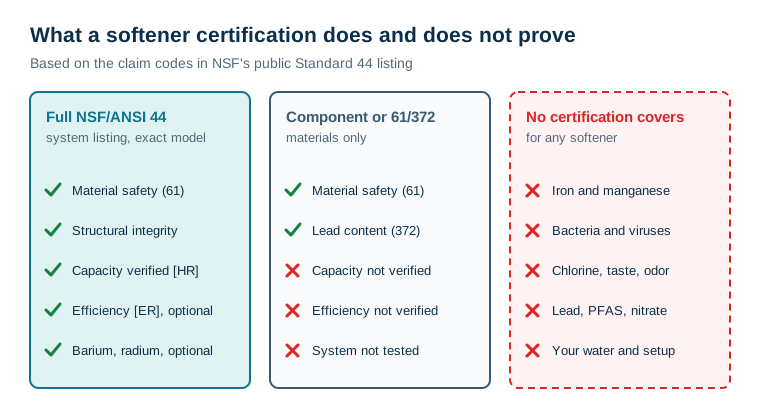
The clearest guide to what the standard covers is NSF's own public listing, which spells out each claim in footnotes. On 26 September 2026, NSF's NSF/ANSI 44 listing for cation exchange water softeners showed 13 manufacturers and 313 products. Across those entries, a certified system can carry these claims:
| What is certified | How it appears on the NSF listing | What it means |
|---|---|---|
| Material safety | [POE] note: "conforms to NSF/ANSI/CAN 61 health effects requirements" | Wetted parts were tested for what they leach into drinking water |
| Structural integrity | Required for certification. One listing notes "material and structural integrity requirements" | The tank, valve and fittings withstood pressure testing |
| Hardness capacity | Hardness Reduction [HR]: "the published capacity ratings for reducing hardness have been verified" | The grain capacity the maker publishes, at its stated salt doses, was confirmed by test |
| Salt and water efficiency (optional) | Efficiency Rated [ER]: at least 3,350 grains per pound of salt and 5 gallons or less of regeneration water per 1,000 grains | The unit meets both efficiency floors at the listed setting |
| Barium and radium (optional) | "Barium Reduction" and "Radium 226/228 Reduction" | Reduction of those two contaminants was tested |
| Low-lead materials (separate) | [Pb] note: weighted average lead content that meets "lead free" plumbing law | Compliance with NSF/ANSI 372 for lead content |
Two details matter. First, the efficiency rating is optional. In the September 2026 listing, 240 model entries carried the Hardness Reduction claim and 234 carried Efficiency Rated. The rest of the 313 products were mostly components such as tanks and resin. So a handful of certified softeners have a verified capacity but no efficiency claim. If a brochure says "high efficiency", check that [ER] sits next to that exact model. Why the capacity figure depends so heavily on the salt setting is explained in advertised vs usable softener capacity.
Second, each claim is tied to a model and a flow rate. The listing shows a rated flow in gallons per minute next to every model. A certification does not tell you the unit will keep up with a flow higher than that.
What No Water Softener Certification Covers
This is the part marketing leaves out. A Standard 44 listing is a narrow, well-defined set of claims. Everything outside it is unverified by the certification, however prominently the brochure prints it.
- Iron and manganese. The listing's reduction claims for softeners are hardness, barium and radium. An "iron removal up to 5 ppm" line on a spec sheet is the maker's own figure, not part of the certification.
- Bacteria, viruses and cysts. Softeners are not disinfection devices. No softener listing covers microbiological reduction.
- Chlorine, taste and odor. Those are NSF/ANSI 42 claims for filters. A softener certified to 44 has not been tested for them.
- Lead, PFAS, arsenic, nitrate. These are NSF/ANSI 53 or 58 claims, for filters and reverse osmosis. A softener's Standard 44 listing says nothing about them. See what a water softener does not remove.
- Your water and your installation. Testing uses standardized water and conditions. It does not predict performance on water with iron fouling, chlorine or high sediment, or with the valve programmed wrongly.
- Salt-free scale prevention. Standard 44 is for ion exchange. A salt-free conditioner cannot be certified to it for softening, because it does not remove hardness.
- Lifespan and service. Certification tests the product as built. It does not rate resin life, valve reliability after ten years, or the dealer who installs it.
Material-Safety Certification vs Full Performance Certification
This is the distinction manufacturers exploit most often, and it is easy to miss because every rung of it involves a real certification.
NSF/ANSI/CAN 61 covers drinking water system components. It tests what leaches out of materials that touch the water. It is an important health standard, and it is required for many plumbing products. What it does not do is measure performance. A tank, a valve or a salt-free conditioner can pass Standard 61 without removing a single grain of hardness.
NSF/ANSI 372 covers lead content. It confirms that the wetted surfaces meet the "lead free" definition in plumbing law. It too says nothing about softening.
Component listings certify a part, not a system. The same NSF Standard 44 listing includes entries such as pressure vessels and ion exchange resin, listed as components, with the claim column reading "N/A". Some carry the note: "These components do not bear the NSF Mark. Evidence of Certification will appear on the manufacturer's literature and packaging." A softener built from a certified tank, certified resin and a certified valve has not been tested as a system. Its capacity rating has not been verified.
That is how a product can truthfully say "made with NSF certified components" or "certified to NSF/ANSI 61" and still leave the impression that its softening performance was checked. Unless Standard 44 is listed against that exact model, the performance claim is still the manufacturer's word. How Aquasana's filter and salt-free conditioner certifications split by stage is a worked example of reading a package that way.
NSF, WQA Gold Seal and IAPMO R&T: Standard vs Certifier
People often say "NSF certified" when they mean "certified to an NSF/ANSI standard". Those are different things. The Water Quality Association states it plainly on its product certification page: people "are often confused into thinking that products then must have 'NSF certification.' This is not correct." NSF/ANSI 44 is a public standard. Several accredited organizations test and certify products to it.
| NSF | WQA Gold Seal | IAPMO R&T | |
|---|---|---|---|
| Certifies softeners to NSF/ANSI 44 | Yes | Yes | Yes |
| Also certifies to 61 and 372 (materials, lead) | Yes | Yes | Yes |
| Accreditation stated | NSF is the standard's developer and a certifier | ANAB and SCC accredited | Accredited certifier. Its water systems certification scope lists NSF/ANSI 44 and 61 |
| Ongoing checks | Listing kept current | WQA states annual facility inspections and regular retesting | Listing kept current |
| Public database | info.nsf.org listings | wqa.org find products | IAPMO R&T product listing directory |
For a softener buyer, the practical rule is simple: the standard and the claims matter, the logo does not. A WQA Gold Seal listing to NSF/ANSI 44 with an efficiency rating proves the same thing as an NSF listing with the same claims. A Gold Seal listing to Standard 61 only proves the same limited thing as an NSF Standard 61 listing: safe materials, not verified softening.
What Each Certification Claim Is Worth
Put the pieces together and you can rank any certification claim you see on a softener's box or website.
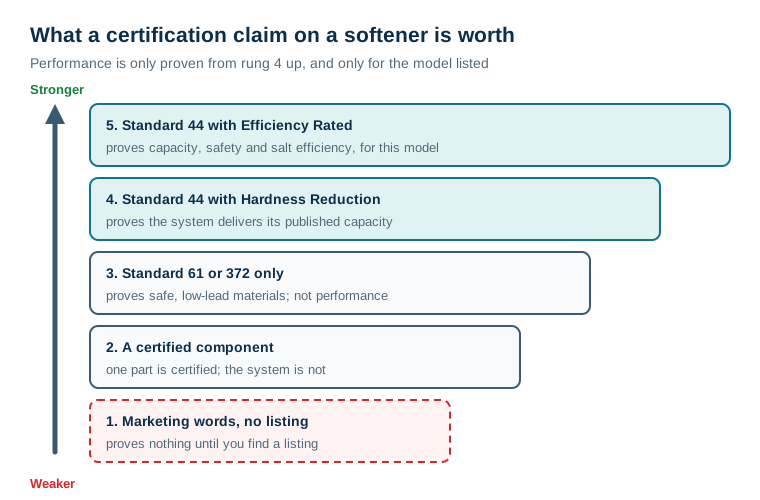
- Marketing wording with no listing. "Meets NSF standards", "tested to industry standards", "certified quality". Worth nothing until you find a listing. Treat it as a claim, not evidence.
- A certified component. "NSF certified resin" or "certified tank". The part is fine. The system's performance is unverified.
- Material safety only (61 or 372). The wetted materials are safe and low-lead. Softening, capacity and efficiency are unverified.
- A full Standard 44 listing with Hardness Reduction. The softener as a system is safe, structurally sound and delivers its published capacity at its stated salt doses.
- Standard 44 with Efficiency Rated. All of the above, plus it meets the 3,350 grains per pound and 5 gallons per 1,000 grains floors at the listed setting.
Most of the value sits in the jump from rung 3 to rung 4. That is where the certification starts telling you about performance rather than materials. How to confirm which rung a specific model is on, using the public databases, is the subject of how to verify a softener certification and performance claim. If you are shortlisting, popular softeners checked model by model against the NSF listing shows which reach rung 4 and which have no listing at all.
Which Claims Matter Most for Your House
Not every claim on a listing is worth paying extra for. Which ones matter depends on your water and where you live.
- On city water with moderate hardness: Hardness Reduction is the claim that matters, because it confirms the capacity you are sizing from. Efficiency Rated is worth having if you want lower salt and water use, since it guarantees the unit meets both floors at the listed setting.
- On a private well: check your lab report for barium and radium. If either is present, a softener listed for Barium Reduction or Radium 226/228 Reduction has had that claim tested. Without the claim on the listing, any reduction is the maker's own figure, and the waste brine may need its own disposal advice from your state.
- In California and other areas with softener rules: look for the numbered footnote stating compliance with California's efficiency rating requirements. Local rules on softener discharge vary, so check them before you buy any softener, certified or not.
- For any home: the [POE] and [Pb] notes confirm the materials and lead content. They are useful, but they are not a reason on their own to pick one softener over another.
If a seller leads with a claim that is not on the listing for your model, ask why. Usually it is because that claim was never tested.
What Certification Cannot Tell You
Even a top-rung listing leaves the most important decisions to you.
- Whether the softener is the right size. A verified 32,000-grain capacity is still wrong for a house that needs 64,000. Size from your hardness, iron and daily use.
- Whether the valve and resin suit your water. Chlorinated city water, iron and sediment affect resin life in ways a certification test does not.
- Whether it will be set up correctly. A certified softener programmed for the wrong hardness or salt dose performs like an uncertified one.
- Whether an uncertified unit is bad. Many softeners are built from the same widely used valves and resins as certified ones and simply were not submitted for system testing. No listing means no independent proof. It does not prove the unit is poor.
Use the listing to verify the claims it covers. Judge everything else on specifications you can compare directly, which is the method in how to compare water softener spec sheets.
Frequently Asked Questions
What does NSF/ANSI 44 certify?
NSF/ANSI 44 is the standard for cation exchange water softeners. A certified softener has been checked for material safety and structural integrity, and its published hardness capacity ratings have been verified. Optional claims can add a salt and water efficiency rating and reduction of barium and radium 226/228. It does not certify iron, manganese, bacteria or chlorine removal.
Is NSF/ANSI 44 certification required for a water softener?
Not nationally in the US. Some states and local jurisdictions require certification for products sold there, and WQA notes that some codes require products to meet NSF/ANSI standards. Many good softeners are certified and many are not. It is a way to verify claims, not a legal minimum everywhere.
Is NSF 61 the same as NSF 44?
No. NSF/ANSI/CAN 61 covers what leaches from materials that touch drinking water. It says nothing about whether a product softens water or how much hardness it removes. A softener with only a Standard 61 or 372 listing has had its materials checked, not its performance. For softening performance, look for Standard 44 against the exact model.
Is WQA Gold Seal as good as NSF certification?
For a softener, a WQA Gold Seal listing to NSF/ANSI 44 is equivalent in what it proves. NSF/ANSI 44 is a public standard, and WQA, IAPMO R&T and NSF are all accredited certifiers that can test to it. What matters is the standard and the claims on the listing, not which organization tested it.
Does NSF/ANSI 44 mean a softener removes iron?
No. The listing's reduction claims for softeners are hardness, and optionally barium and radium 226/228. A manufacturer's iron rating on a brochure is not part of a Standard 44 certification. Check your iron against the manufacturer's own limit and plan an iron filter if you are above it.
What does 'efficiency rated' mean on an NSF listing?
It means the softener achieves at least 3,350 grains of hardness removed per pound of salt and uses 5 gallons or less of regeneration water per 1,000 grains removed, at the salt setting listed. It is optional. A softener can be certified to Standard 44 without it.
