
What Does Grain Capacity Mean on a Water Softener?

Water softener grain capacity is the amount of hardness, counted in grains, that the resin can remove before it has to regenerate. It is not a single fixed number. It depends on how much salt each regeneration uses, and the figure in the model name is usually the capacity at the maximum salt dose. That is the least efficient way to run the softener, and rarely how it will be set up in your house.
One manufacturer's own table shows the spread. The same cubic foot of resin gives 22,930 grains at 6 lb of salt, 28,060 at 10 lb and 32,310 at 15 lb. The unit is sold as a "32." The sections below cover what a grain is, how the number is tested, how to turn it into gallons and days, and how to convert any grain rating back to the one figure that compares fairly across brands.
What a Grain Is, and How Capacity Turns Into Gallons
A grain is an old unit of weight, 1/7,000 of a pound or about 64.8 mg. Water hardness in the US is still quoted in grains per gallon (gpg), and 1 gpg = 17.1 mg/L (ppm) as calcium carbonate.
That makes grain capacity easy to turn into something you can use:
Gallons between regenerations = grain capacity ÷ hardness (gpg) Days between regenerations = gallons ÷ gallons used per day
For example, 1 cubic foot of resin at 6 lb of salt, rated 22,930 grains, on 15 gpg water: 22,930 ÷ 15 = about 1,530 gallons. A household using 230 gallons a day gets about 6.6 days.
A metered control valve does exactly this. You program the hardness and the capacity, it works out the gallons, and it regenerates when the meter gets close, holding back some reserve. If the capacity programmed into the valve is the box rating while the salt is set lower, the valve thinks it has more capacity than it does, and hard water gets through before every regeneration.
Water Softener Grain Capacity Is a Curve, Not a Number
Resin exchanges hardness for sodium until its exchange sites are used up. Regeneration pushes brine back through to drive the hardness off and reload the sites with sodium. A bigger salt dose clears more sites, but with diminishing returns: each extra pound finds fewer hardness ions left to remove.
The Hellenbrand residential softener manual publishes the whole curve for its units:
| Salt setting | Salt per cu ft of resin | Capacity per cu ft | Grains per lb of salt |
|---|---|---|---|
| Efficient | 3.3 lb | 13,952 | 4,228 |
| Low (factory default) | 6 lb | 22,930 | 3,822 |
| Medium | 10 lb | 28,060 | 2,806 |
| High | 15 lb | 32,310 | 2,154 |
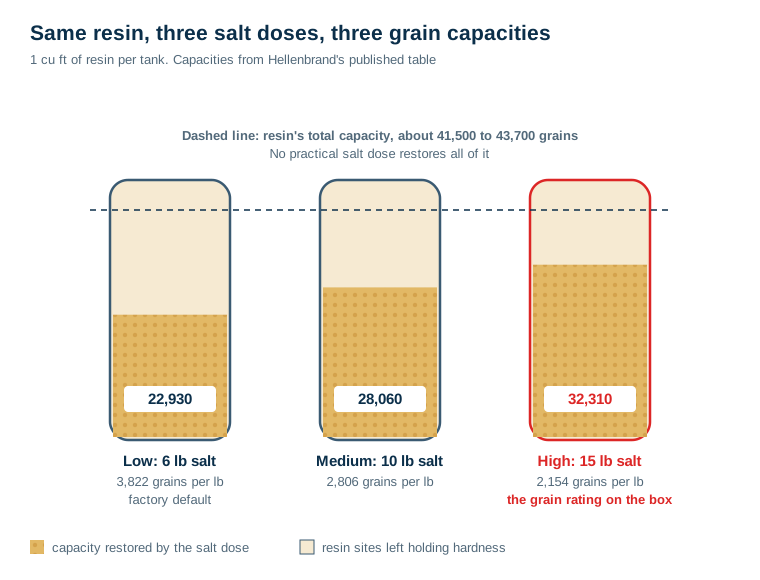
There is also a ceiling above the curve. Chubb Michaud's technical review The Capacity of Ion-Exchange Resin puts the total capacity of standard softening resin at about 41,500 to 43,700 grains per cubic foot. No practical salt dose restores all of it. Even the high setting recovers about three-quarters, and the factory default about half. Pushing closer to the ceiling would take salt doses no household would pay for.
Three things follow from the curve:
- "A 32,000-grain softener" describes one point on it. Change the salt setting and you have, in effect, a different softener.
- Salt efficiency falls as capacity rises. Going from 6 lb to 15 lb adds 41 percent more capacity for 150 percent more salt. The cost side of that is worked through in is a higher grain rating always better.
- Lower doses leak a little more. Michaud notes that more salt leaves the resin cleaner, with higher capacity and less leakage. The trade-off is small at normal settings, but it is real.
Where the Number on the Box Comes From
Certified capacity ratings are measured, not estimated. Under NSF/ANSI 44, capacity is tested with feed water at 20 ± 2 gpg, at half the rated service flow. The run ends when the softened water reaches 1 gpg. Three runs must fall within 10 percent of their average, and that average becomes the official figure. NSF's Rick Andrew sets out the procedure in NSF/ANSI 44 requirements for water softeners.
The standard tests at the lowest, middle and highest salt settings, so a certified spec sheet should list several capacities. Model names still tend to use the highest. In Hellenbrand's range, the PM6-32, PM6-48 and PM6-64 are named for their high-salt capacities of 32,310, 48,460 and 64,620 grains.
Two things about the test conditions matter when you read the number:
- Half flow is gentle. At full flow, especially during peak demand, hardness breaks through a little earlier.
- The test water is clean. Iron, manganese and organic matter all take capacity away in real use. Hellenbrand's own note says operating efficiency "is typically less than the tested efficiency."
The full gap between the rated number and what a household actually gets is covered in advertised vs usable softener capacity.
Converting a Grain Rating Back to Resin Volume
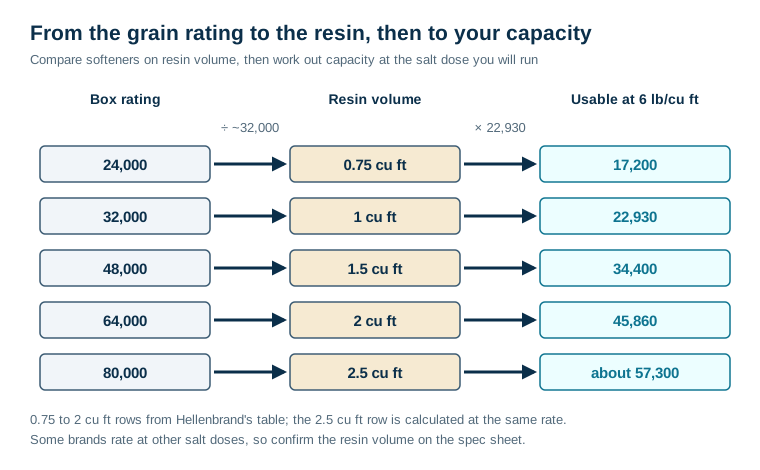
Grain ratings compare poorly across brands, because not every brand rates at the same salt dose. Resin volume is the figure that compares. Most brands follow the same convention: the grain rating is about 32,000 grains per cubic foot, the high-salt figure.
| Box rating | Typical resin volume | Capacity at 6 lb/cu ft | Capacity at 10 lb/cu ft |
|---|---|---|---|
| 24,000 | 0.75 cu ft | 17,200 | 21,040 |
| 32,000 | 1 cu ft | 22,930 | 28,060 |
| 48,000 | 1.5 cu ft | 34,400 | 42,090 |
| 64,000 | 2 cu ft | 45,860 | 56,120 |
| 80,000 | 2.5 cu ft | about 57,300 (calculated) | about 70,150 (calculated) |
Figures for 0.75 to 2 cu ft are from Hellenbrand's published table. The 80,000 row is calculated at the same capacity per cubic foot.
How to use it:
- Find the resin volume on the spec sheet. If it is not listed, ask. A seller who cannot say how much resin is in the tank is selling a label.
- If the only number is a grain rating, divide by about 32,000 as a first guess, then confirm it.
- Compare units at the same salt dose. A "40,000-grain" unit rated at 15 lb and a "40,000-grain" unit rated at a lower dose do not hold the same amount of resin.
- Then work out your own number: resin volume × capacity per cubic foot at the dose you will actually run.
To choose the right volume in the first place, how to size a water softener walks through the calculation from hardness and measured water use. Worked versions for two common cases are sizing for a family of four at three hardness levels and what a 32,000 grain unit really delivers for one to three people.
Reading Grain Capacity on a Spec Sheet
A useful spec sheet shows more than one grain number. Look for:
| Line | Why it matters |
|---|---|
| Resin volume (cu ft) | The only figure that compares across brands |
| Capacity at each salt setting | Shows the curve, and the capacity at the dose you will use |
| Salt per regeneration at each setting | Lets you work out grains per pound |
| Salt efficiency (grains per lb) | NSF/ANSI 44 efficiency rating needs at least 3,350 |
| Service flow rate at a stated pressure drop | Capacity says nothing about flow |
| Iron limit and any limit on the efficient setting | Hellenbrand limits its efficient setting to iron under 0.5 ppm |
| Certification and what it covers | NSF/ANSI 44 or WQA listing, for the specific model |
What Takes Real Capacity Below the Table
The table is a clean-water, half-flow figure for new resin. In a house, these reduce it:
- Iron and manganese. They use up exchange sites and foul the resin. Manuals add 3 to 4 gpg of hardness allowance for each ppm of iron.
- Resin age and chlorine. Chlorinated city water slowly oxidizes resin, and oxidized resin swells and loses capacity.
- Fouling. Organic matter, silt and iron coat the beads and block exchange sites.
- High flow. Heavy peak demand pushes hardness through before the bed is fully used.
- A salt setting that does not match the capacity setting. If the valve thinks it has 32,000 grains and the brine delivers 22,930, nearly a third of each cycle's gallons go through on resin that is already exhausted.
The last one is a programming error, and it is common. Check that the capacity or salt setting in the valve matches the row of the table you are relying on. The salt-dose side of that is covered in how to set the salt dose on a water softener.
What Grain Capacity Does Not Tell You
- Flow. A high grain rating does not mean the unit can supply two showers at once. Check the service flow separately.
- Water quality beyond hardness. Capacity is only about calcium and magnesium exchange. It says nothing about iron beyond the unit's limit, or about bacteria, nitrate, lead or arsenic.
- Running cost. Salt use depends on the dose you set, not the rating.
- How soft the output is. Leakage and blending decide that. A well-sized softener should read zero at the outlet regardless of its grain rating.
Frequently Asked Questions
What does 32,000 grain capacity mean on a water softener?
It usually means the unit's resin, typically 1 cubic foot, can remove 32,000 grains of hardness between regenerations at its highest salt setting, about 15 lb per regeneration. At 15 gpg that is about 2,130 gallons of water. At the more common 6 lb setting, the same resin removes about 23,000 grains, or about 1,530 gallons at 15 gpg.
What is a grain of hardness?
A grain is an old unit of weight: 1/7,000 of a pound, or about 64.8 milligrams. Hardness in grains per gallon (gpg) means how many grains of calcium carbonate equivalent are dissolved in one gallon. One gpg equals 17.1 mg/L or ppm. A softener's grain capacity is the total number of those grains it can remove before it needs regenerating.
How do I calculate how many gallons my softener can treat?
Divide the grain capacity at your salt setting by your hardness in gpg, including any iron allowance. For example, 22,930 grains ÷ 15 gpg = about 1,530 gallons between regenerations. Divide that by your daily water use to get the days between regenerations. Metered control valves do this same calculation from the capacity and hardness you program into them.
Does grain capacity decrease over time?
Yes. Resin loses capacity gradually as it ages, and faster if chlorine oxidizes it or iron and organic matter foul it. A bed that started at 22,930 grains will deliver less each year, and fouling can take capacity away quickly. If hardness starts appearing before the valve regenerates, test for fouling before you replace anything.
Is grain capacity the same as the size of the water softener?
Not directly. The physical size that matters is resin volume in cubic feet, and grain capacity is that volume multiplied by the capacity per cubic foot at a chosen salt dose. Two softeners with the same grain number can hold different amounts of resin if one brand rates capacity at a different salt dose. When comparing brands, compare resin volume and capacity at the same salt setting.
