
What Time Should a Water Softener Regenerate?

What time should a water softener regenerate? At the start of the longest stretch when nobody in the house uses water, finishing at least an hour before the first shower. For most homes that is 2:00 a.m., the usual factory default. Pentair's whole-house softener manual says "2:00 AM is good for most households." The setting fails silently in two cases: when the clock is wrong, and when your household's quiet hours are somewhere else.
A wrong clock is by far the more common one. It is why some houses get hard water at breakfast from a softener that "works fine". This page covers how to choose your time, how to confirm the clock, and when not to use a fixed time at all.
Why the Time Matters at All
A single-tank softener cannot soften while it regenerates. During the cycle it passes untreated water to the house. The same Pentair manual warns that "if any water is drawn during regeneration, some hard water will enter the plumbing system and possibly the hot water tank. Keep in mind that the regeneration cycle can last up to two hours after the starting time."
So the regeneration time is really the choice of which two hours of hard water nobody will notice. Two further reasons to pick those hours carefully:
- Pressure. Backwash and rinse send 2 to 3.5 gpm to the drain on a typical home softener, and heavy use during the brine stage can weaken the brine draw. What reaches the tap at each stage, and why the brine draw is the stage to keep clear, is in can you use water during regeneration.
- Other equipment. An iron filter, a neutralizer or a second softener on the same supply needs its own backwash time. If they all start at 2:00, they compete for flow.
What Time Should a Water Softener Regenerate for Your Household
The right time is found from the household, not the manual. Work backwards from the first water use of the morning.
- Find the first regular use. The earliest shower, coffee maker or dishwasher timer on a normal day.
- Subtract the cycle length plus a margin. Allow 2 hours for the cycle and 1 hour of margin, unless your manual gives a shorter total.
- Check the last use of the night. The start time must be after it.
- Allow for pre-fill. Some valves make the brine before the cycle. Clack's WS1 manual describes a pre-fill that "starts 2 hours before the regeneration time set", during which "treated (softened) water is still available". Pre-fill does not take the water away, so it does not narrow the window.
If the window you end up with is at least 3 hours long, you have a time. If it is not, a fixed time is the wrong tool, and the next section applies.
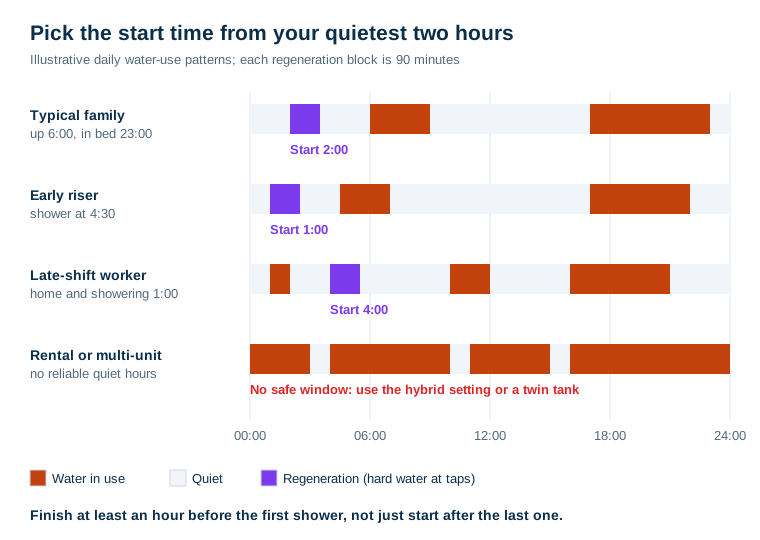
Households where 2 a.m. is wrong
| Household | Why the default fails | Better setting |
|---|---|---|
| Early riser (shower at 4:30 to 5:00) | A 2:00 start can run to 4:00, too close for comfort, and daylight-saving drift can push it later | 12:30 to 1:00 a.m. |
| Late or swing shift (home and showering around 1 to 2 a.m.) | The cycle starts while the shower is running | 3:30 to 4:30 a.m., or late morning if the house is empty then |
| Night-shift worker (sleeps days) | Often fine, since the house is empty at night. Wrong if someone else in the house uses water at night | Set it for the time the whole house is quiet, which may be midday |
| Short-term rental | Guests arrive late, leave early and shower at any hour | Hybrid mode, below. Guests will not tell you about hard water; they will review it |
| Multi-unit building on one softener | Several households mean there is rarely a two-hour gap | Hybrid mode or a twin-tank softener |
| Well with an iron filter | Both units backwash on one pump | Stagger: iron filter first, softener at least an hour later |
The Clock Problem: How This Setting Fails Silently
A regeneration time is only as good as the clock it is measured against. The valve does not know what time it is. It knows what time you told it, and what it has counted since.
Power cuts are the usual cause. Control valves keep their settings through an outage but not always the time. Clack's manual says the valve "remembers all settings for up to 8 hours if the power goes out and the battery is not depleted. After 8 hours, the only item that needs to be reset is the time of day." Fleck's 5600SXT manual says its control keeps track of the time "for a minimum of 8 hours" during a power failure.
Past that, the clock restarts from a default such as 12:00. If power returns at 3:00 p.m. and the display restarts at 12:00 noon, the valve runs three hours behind and its "2 a.m." cycle starts at 5:00 a.m. real time, right into the morning showers. If it restarts at midnight instead, the cycle lands around 5:00 p.m. The next outage moves it again.
Three checks catch it:
- Compare the display with your phone now, and after every outage that lasted more than a few hours. Also check that it shows AM when it should. A clock set to 2:00 PM instead of 2:00 AM regenerates every afternoon.
- Do not trust a steady display. Fleck's manual notes that the time of day flashes after a power failure, and that pressing any button stops it flashing. Someone clearing the flash has not corrected the time.
- If the time flashes after short outages, replace the backup. Clack says that if a power loss lasts less than 8 hours and the time still flashes, the battery should be replaced. The part to change, by valve family, is in why a water softener keeps losing its settings.
Daylight saving time is a smaller version of the same thing. Many basic valves do not adjust for it, so the cycle moves an hour twice a year. That only matters if your window is tight.
The quickest proof of a clock fault is hard water at the same odd time every few days. That is the valve regenerating on schedule, at the wrong real time.
Immediate, Delayed or Both
Most valves offer more than one way to trigger the cycle, and the choice decides whether a fixed time matters.
- Delayed. The valve counts gallons during the day and, at the set time, checks whether the remaining capacity is below the reserve. If it is, it regenerates tonight. This is the normal single-tank setting, and why the time matters.
- Immediate. The valve regenerates as soon as the capacity reaches zero, whatever the hour. Fleck's manual says "meter immediate systems generally do not use a reserve volume" and that on twin-tank systems with soft-water regeneration the reserve should cover the water used during regeneration.
- Hybrid. Clack calls it NORMAL + on 0: regeneration at the set time as usual, but if the capacity reaches zero first, the valve starts "10 minutes after no water usage". It catches the heavy day without regenerating in the middle of a shower.
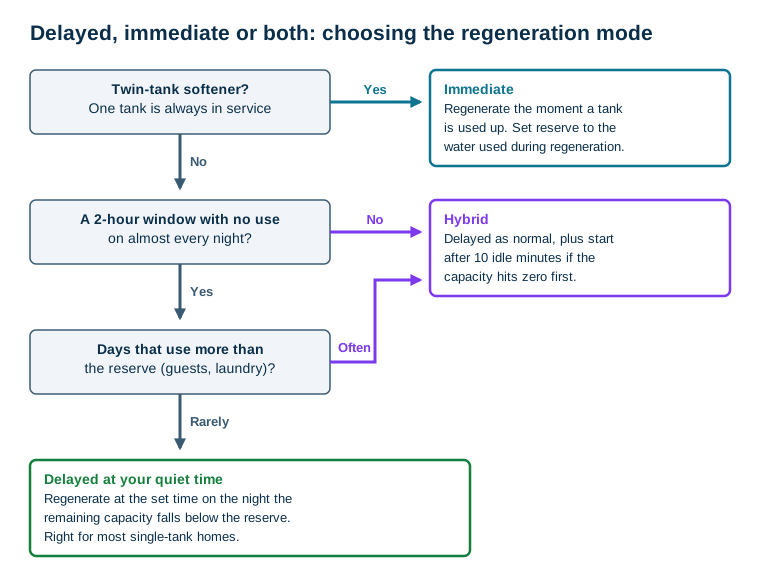
When immediate is genuinely better:
- Twin-tank softeners. One tank is always in service, so there is no hard-water window to protect. Immediate regeneration uses each tank fully and wastes no reserve.
- Houses with no quiet window, where any fixed time lands on someone. Hybrid is usually better than pure immediate on a single tank, because it still prefers the set time.
- Days that often exceed the reserve. A guest weekend or a laundry marathon can empty the capacity before the nightly check. Hybrid regenerates at the first idle moment instead of delivering hard water until 2 a.m.
When immediate is worse: on an ordinary single-tank softener in a house with regular hours. It will sometimes start at 7 p.m. while the dishwasher is running, and the family gets hard water to rinse with. Delayed plus a correct reserve avoids that. Setting the reserve to your heaviest normal day is covered in how much reserve capacity a softener needs.
Setting It on the Valve
The regeneration time is a user-level setting on almost every valve.
- Pentair whole-house systems: in the advanced menu, the TIME OF REGENERATION screen, shown as "Regen @ 2:00 am".
- Fleck 5600SXT: in user programming, the RT (Regeneration Time) display, after the day override.
- Clack WS1: the installer settings include the next regeneration hour and minutes. Clack notes that even when a dealer locks the valve, "hardness, day override, time of regeneration, and time of day" stay adjustable.
Set the time of day first, then the regeneration time, then confirm with a queued manual regeneration if your valve allows one. Clack's "Regen Today" and Fleck's queued regeneration both run the cycle at the set time, which proves the time without waiting days. While you are in the menu, check the hardness entry too. The reason, and the units trap that goes with it, is in how to set hardness on a water softener.
What the Right Time Cannot Fix
- It cannot make the cycle soft. A single tank always supplies hard water while it regenerates. Timing only hides it.
- It cannot fix a short reserve. If the house runs out of soft water before the set time arrives, that is the reserve or capacity setting, not the clock.
- It cannot rescue a missed cycle. Fleck's manual notes that if a power failure makes the valve miss a regeneration, it queues one for the next time the clock reaches the regeneration time, "typically... one day after it was originally scheduled". A day of hard water can follow an outage even with the right time set.
- It cannot fix a softener that is hard all day. That is capacity, programming or resin.
Set 2 a.m. if it suits your household. Move it if it does not. Check the clock after every outage.
Frequently Asked Questions
What is the best time for a water softener to regenerate?
The start of the longest stretch when nobody in the house uses water, with the cycle finished at least an hour before the first shower. For most households that is 2 a.m., which is why it is the usual factory default. Pentair's softener manual says 2:00 AM is good for most households and that the cycle can last up to two hours. A household with different hours should pick its own window.
Why is my water softener regenerating during the day?
Almost always because the clock is wrong. After a power cut long enough to drain the backup, many valves restart at 12:00 and count from there, so a 2 a.m. regeneration can run in the afternoon or evening. An AM and PM mix-up when setting the clock does the same. Check the time on the display against your phone, and set it again after any long outage.
Should a water softener regenerate immediately or at a set time?
A single-tank softener should normally regenerate at a set time, because it sends hard water to the house during the cycle. Immediate regeneration suits twin-tank softeners, which keep one tank in service. A hybrid setting, delayed as normal but regenerating straight away if capacity runs out, suits single-tank homes with irregular heavy days or no dependable quiet hours.
Can I change the regeneration time on my water softener myself?
Yes. It is a user setting on almost every control valve, usually one or two button presses from the main screen. On some Clack valves, the dealer can lock the deeper settings, but hardness, day override, time of regeneration and time of day stay adjustable. Check the manual for your valve's button sequence.
Does a water softener adjust for daylight saving time?
Many basic control valves do not, so the regeneration time shifts by an hour twice a year. For a 2 a.m. setting that rarely matters. If your window is tight, for example an early riser whose first shower is at 4:30, check the clock at each time change and reset it.
Can two water treatment systems regenerate at the same time?
They can, but they should not if they share one supply. Two units backwashing together may ask a well pump, or even a small city service, for more flow than it can deliver, and both backwash poorly. Set them at least an hour apart, with the upstream unit such as an iron filter first and the softener after it.
