
How Much Reserve Capacity Does a Softener Need?

Water softener reserve capacity should equal the most water your household uses in one day, measured from one regeneration time to the next. That is often 15 to 25 percent of the softener's capacity, but not always. A flat 20 to 30 percent rule is too much for small households on large units and too little for big households on very hard water. Measure your heaviest day and set the reserve to that.
The reason is mechanical. A meter-delayed softener decides only once a day, at its regeneration time, whether to regenerate. Once it decides not to, it has to get through the next 24 hours on what is left. The reserve is what guarantees that.
Why a Softener Needs a Reserve at All
Most household softeners are meter-delayed. The meter counts gallons all day, but the valve only regenerates at a set time, usually around 2 a.m., when nobody is drawing water. Pentair's Fleck 5600SXT service manual describes the job of the reserve on this kind of control directly: it "should be set to insure that the system delivers treated water between the time the system capacity is depleted and the actual regeneration time."
Each night the valve compares two numbers:
- Remaining capacity, in gallons, based on the hardness setting and what has been used
- The reserve, in gallons
If the remaining capacity is below the reserve, the valve regenerates tonight. If it is above, the valve waits another 24 hours. The worst case is a night when the remaining capacity is just above the reserve. The valve skips the regeneration, and the house then has only slightly more than the reserve to get through the whole next day.
So the reserve must cover a full day, not just "overnight and breakfast". If it is smaller than your heaviest day, the house will eventually run out before the next regeneration time.
Two kinds of valve do not work this way:
- Meter-immediate valves start regenerating the moment capacity runs out. The Fleck manual notes that they "generally do not use a reserve volume". The exception is a twin-tank unit that regenerates with soft water, where the reserve should cover the water used during regeneration. The Fleck 9100SXT's twin-tank capacity and reserve math works through what that does to usable capacity, and when the twin is worth its price.
- Timer valves regenerate on a fixed schedule and have no reserve setting. They also have no idea how much water you used, which is why they run out whenever the household's use changes.
What Happens When the Reserve Is Too Small
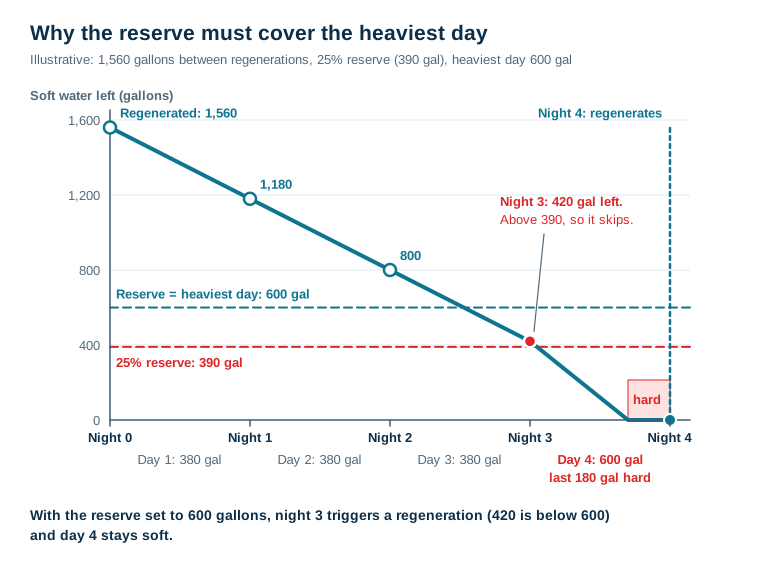
Take a household of five on 25 gpg water with a 1.5 cu ft softener programmed at 9 lb of salt per cubic foot. At about 39,000 grains of capacity, that is roughly 1,560 gallons between regenerations. They use about 380 gallons on an ordinary day and 600 on laundry day. The reserve is set to the "standard" 25 percent, which is 390 gallons.
- Night 1: 1,180 gallons left. More than 390, so no regeneration.
- Night 2: 800 gallons left. No regeneration.
- Night 3: 420 gallons left. Still more than 390, so no regeneration.
- Day 4 is laundry day. The house uses 600 gallons. The softener runs out after 420, and the last 180 gallons of the day are hard.
- Night 4: 0 left. The valve finally regenerates.
With the reserve set to 600 gallons, the heaviest day, the valve would have regenerated on night 3 and nobody would have noticed anything. This is the pattern described as "hard only on the last evening" in why hardness returns before the next regeneration. It is a reserve problem, not a resin problem.
Water Softener Reserve Capacity: Why the 20 to 30 Percent Rule Fails
A percentage reserve scales with the softener's capacity. Your water use does not. The same 25 percent means very different things depending on the size of the unit and the hardness of the water:
| Household | Softener capacity | Heaviest day | Reserve actually needed | Flat 25% gives | Result |
|---|---|---|---|---|---|
| 2 people, 10 gpg, 1.0 cu ft at 9 lb/cu ft | 26,000 grains = 2,600 gal | 180 gal | 7% | 650 gal | Regenerates with 470 gal still usable, every cycle |
| 4 people, 15 gpg, 1.5 cu ft at 9 lb/cu ft | 39,000 grains = 2,600 gal | 450 gal | 17% | 650 gal | Works, with some waste |
| 5 people, 25 gpg, 1.5 cu ft at 9 lb/cu ft | 39,000 grains = 1,560 gal | 600 gal | 38% | 390 gal | Hard water on heavy days |
Capacities use the typical standard-resin figure of about 26,000 grains per cubic foot at 9 lb of salt per cubic foot. Gallons = grains ÷ hardness.
The couple is overpaying. On a valve with a fixed salt dose, every regeneration uses the full dose whether the bed is 70 percent spent or 100 percent spent, so a reserve that is too large turns directly into wasted salt and water. The large household is getting hard water. The rule only suits the middle case, which is the case it was written for.
The third row also shows something else. When the reserve you actually need is over a third of the capacity, the softener is too small for the house. Raising the reserve fixes the hard water, but the unit will regenerate every two or three days. That is a sizing problem. How to calculate the right water softener size covers the fix.
Measure Your Own Reserve: The 14-Day Meter Log
You need your heaviest regeneration-to-regeneration day. The softener's own meter is the best instrument, because it counts exactly the water that passes through the resin.
- Pick a reading time close to the regeneration time, or the last thing at night if 2 a.m. is not practical. The window must be the same every day.
- Record the gallons figure each day for 14 days. Most metered valves can show gallons remaining or total gallons used. If yours shows only remaining capacity, the daily use is the difference between consecutive readings, adding back the full capacity after any regeneration.
- If the valve has no readable display, read the house water meter instead. Put outdoor taps that bypass the softener out of use for the fortnight, or read the meter at times when they are not running.
- Find the largest single day. Make sure the fortnight includes your normal laundry day, a weekend, and any regular heavy days such as a lawn day on a supply that runs through the softener.
- Add a margin for days you know are coming. A household that has visitors every holiday season should plan for that, not for the quiet fortnight it happened to log.
Two weeks is enough to catch a weekly routine. It will not catch seasonal changes, so repeat the log if your pattern shifts, for example when children are home for the summer.
Setting the Number on the Valve
Convert your heaviest day to the form your valve asks for.
Fixed gallons. Enter the heaviest day in gallons. On the Fleck 5600SXT this is the fixed reserve capacity (RC) option. The manual states that it "cannot be set to a value greater than one-half of the calculated system capacity" and that, unlike a percentage, it "does not change if the unit capacity or feedwater hardness are changed". That makes it the better choice once you know your number.
Percentage. If your valve only offers a percentage, often labelled safety factor (SF), divide your heaviest day by the system capacity in gallons. For the five-person household, 600 ÷ 1,560 = 38 percent. Remember that a percentage moves when you change the hardness or capacity setting, so recalculate it after any change to either.
A plain capacity number with no reserve setting. Some valves let you type in the gallons between regenerations directly. Clack's WS1 control valve manual is explicit about what happens then: if a number is entered rather than AUTO, the reserve is "not automatically estimated" and, in normal delayed mode, regeneration happens at the next regeneration time once the volume capacity reaches zero. In other words, there is no reserve unless you build it in. Enter the usable capacity minus your heaviest day.
The menu steps for each common valve are in how to set capacity and reserve on a softener.
Households Where a Fixed Reserve Reliably Fails
Some patterns defeat a fixed reserve almost every time:
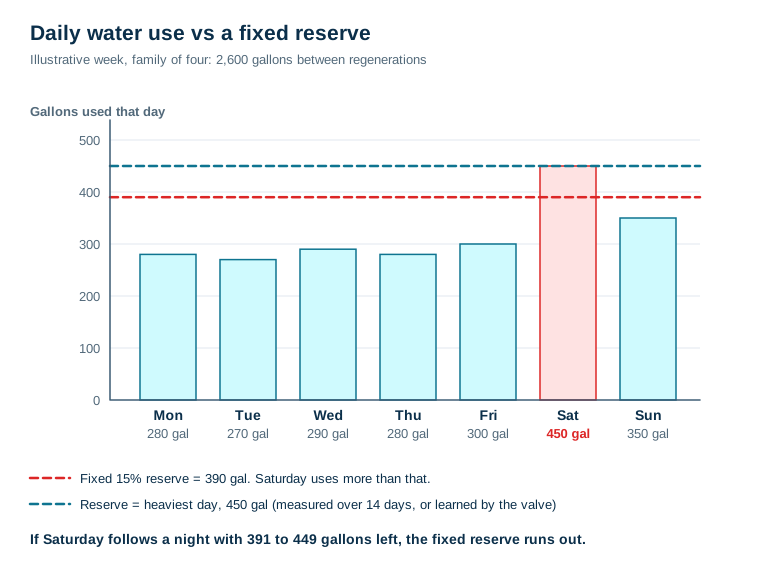
- One big laundry day. Five loads on Saturday can double a normal day's use. A reserve set from the average day fails whenever Saturday follows a skipped regeneration.
- Weekend-heavy households. Everyone at work or school on weekdays, everyone showering at home at weekends. The heaviest days all fall together.
- Regular visitors. Two extra people for a long weekend add a lot of showers. A reserve set in a quiet month will not cover it.
- Very hard water on a mid-sized unit. High hardness shrinks the gallons between regenerations, so each day is a bigger fraction of the capacity. A 25 percent reserve that works at 12 gpg can fail at 25 gpg on the same softener.
- Irrigation or a pool top-up through the softener. A single garden-watering day can exceed a week of household use. Where you can, take outdoor taps off the softened line instead. The reserve is the wrong tool for this job.
The opposite failure is quieter but costs money every week: a small household on a large softener with a default reserve. It never runs out, so nobody notices that a quarter of every regeneration is wasted.
How Variable-Reserve Controls Learn It
Several modern valves can calculate the reserve from recorded use instead of a fixed setting:
- On Clack's WS1 valve, setting the volume capacity to AUTO makes the reserve "automatically estimated", and the manual states the estimate "is based on history of water usage". Each night the valve regenerates only if the remaining capacity has fallen below that estimate.
- The Fleck 5600SXT offers a variable reserve option in master programming. When it is selected, the manual notes, the safety factor shown in user programming "will have no effect".
This is the better arrangement for most households, because it follows the routine automatically, including the laundry day. It has limits worth knowing:
- It needs history. A newly installed or reset valve has nothing to learn from for the first weeks.
- It learns routine, not surprises. A house full of guests over a holiday is heavier than anything in the history.
- It still depends on the hardness setting. A valve that believes the water is 12 gpg when it is 20 gpg calculates its remaining capacity wrongly, and no reserve method corrects that.
If your valve has a variable or automatic reserve, use it, and do a 14-day log only if you still get hard water before regenerations.
What the Reserve Cannot Fix
- An undersized softener. If your heaviest day is more than about a third of the capacity, the correct reserve makes the unit regenerate every two or three days. The reserve is doing its job. The softener is too small.
- A wrong hardness setting. Every gallon figure the valve uses comes from the hardness you entered. Enter your tested hardness, compensated for iron, before touching the reserve.
- Regeneration at the wrong time. If the clock has drifted and the valve regenerates at 7 a.m., the house gets hard water during the cycle however big the reserve is. What time a water softener should regenerate covers the setting.
- Resin problems. Fouled or degraded resin delivers less than the valve assumes. The valve's gallon count is then optimistic, and hardness arrives earlier than the reserve can allow for.
A reserve is a safety margin sized to one day of your own water use. Measure that day, set it in gallons where you can, and let the valve learn it if it can.
Frequently Asked Questions
What should the reserve capacity be on a water softener?
Enough to cover the most water your household uses between one regeneration time and the next, which in practice means your heaviest single day. For a typical family that is somewhere between 15 and 25 percent of the softener's capacity in gallons, but it can be under 10 percent for a couple on a large unit and over 35 percent for a big household on very hard water. Measure your heaviest day from the meter rather than guessing.
Is 30 percent reserve too much for a water softener?
It often is. A reserve is capacity the valve refuses to use, so a softener with a 30 percent reserve regenerates while almost a third of its capacity is still available. On a valve that uses a fixed salt dose, that means paying for a full regeneration each time while using only about 70 percent of it. If your heaviest day is 15 percent of the capacity, a 30 percent reserve wastes the difference on every cycle.
What happens if the reserve on a softener is set to zero?
On a meter-delayed valve that regenerates at night, the unit waits until the capacity has fully run out and then regenerates at the next regeneration time. Whatever water the household uses between running out and that time is hard. The usual result is hard water on the evening or morning before a regeneration, most noticeably after a heavy laundry day.
Do metered water softeners need a reserve?
Meter-delayed softeners do, because they only regenerate at a set time of night. Meter-immediate softeners generally do not, because they start regenerating as soon as the capacity runs out. Pentair's Fleck 5600SXT manual notes one exception: a twin-tank system that regenerates with soft water should hold a reserve equal to the water used during regeneration. Timer softeners do not use a reserve at all, because they regenerate on a schedule.
What is variable reserve on a water softener?
Variable reserve is a setting on some metered control valves that works out the reserve from the household's recorded water use instead of using a fixed percentage or volume. The valve logs daily usage and holds back enough to cover what the household typically uses in a day. It adapts to a routine well, but it needs some weeks of history and cannot anticipate unusual days such as a house full of guests.
Why does my softener give hard water the morning before it regenerates?
Because the reserve is smaller than the water used on the heaviest day of the cycle. The valve checked its remaining capacity the night before, found it slightly above the reserve and skipped the regeneration. The next day used more than was left. Raise the reserve to cover your heaviest day, and check that the hardness setting and regeneration time are correct while you are in the menu.
