
Why Water Hardness Changes by Season and Location
Why does water hardness change? Because the water reaching your tap is not always from the same place. Utilities blend and switch sources through the year, and a private well draws a different mix of recharge and older groundwater as the water table rises and falls. A softener programmed to one reading can run short for months at a time.
That last point explains more "the softener stopped working" calls than most people expect. Nothing is wrong with the equipment. The water got harder, the controller still thinks it is softening the old water, and hard water leaks through for the last part of every cycle. This article covers the five causes of changing hardness and then the part most guides leave out: how much capacity a wrong setting costs, and when to reprogram.
Why Does Water Hardness Change? The Five Causes
Hardness comes from the ground. Rain and snowmelt are close to zero hardness until they soak through soil and rock, dissolving limestone, dolomite and gypsum on the way. Anything that changes which water reaches you, or how long it spent in the rock, changes its hardness.
| Cause | Applies to | Direction | Typical timing |
|---|---|---|---|
| 1. Source blending and switching | City water | Up or down, sometimes sharply | Seasonal demand, drought, plant maintenance |
| 2. Recharge and dilution | Wells, and utilities using wells | Down after heavy rain or snowmelt | Spring, or after wet spells |
| 3. Drought and heavy pumping | Wells, and utilities using wells | Up | Late summer and dry years |
| 4. Distribution zone | City water | Differs by address, not season | Constant, unless the zone's feed changes |
| 5. Your own equipment | Everyone | Looks like a change, isn't one | Any time |
The fifth cause is not a real change in the water. It belongs on the list because it produces exactly the same symptom, and it is the one to rule out first.
City Water: Source Blends and Switches
Many utilities have more than one source. A common pattern is a river or reservoir, usually softer, alongside a set of wells, usually harder. The plant mixes them in proportions that change with:
- Demand. Summer demand can bring extra wells online, pushing the blend harder. In other systems the surface plant takes the peak and the blend gets softer.
- Surface water quality. High turbidity after storms, algae in late summer, or low river flows can make the utility lean on groundwater for a while.
- Drought and allocations. Reduced surface supplies push a system onto its wells, sometimes for a whole season.
- Maintenance. When a treatment plant or a well field is offline, the rest of the system covers for it.
Utilities publish their water quality once a year in a Consumer Confidence Report, which you can find through EPA's CCR page. Hardness is often listed near the back among "other" or unregulated parameters, and usually as a range. That range is the most useful number on the page for a softener owner, because it tells you how far the blend moves. How to find it and convert it is in how to read a water hardness report.
A large system may also serve different pressure zones from different plants or wells. Two neighbors on the same bill are usually on the same zone. A house across town may not be. If your reading does not match a friend's on the same utility, that is often why. It is a location difference, not a seasonal one.
Private Wells: Following the Water Table
A private well draws from whatever water is in the formation around the screen, and that mix changes through the year.
- After heavy rain or snowmelt, young, low-mineral recharge water reaches shallow aquifers and dilutes the older, harder groundwater. Hardness drops, sometimes for weeks.
- Through dry spells, recharge stops and the well draws increasingly from water that has spent longer in contact with the rock. Hardness rises.
- Heavy pumping (irrigation, filling a pool, a neighbor's new well) can pull water in from a different part of the formation, with its own chemistry.
- Work on the well such as deepening it, replacing the pump at a new depth, or a new casing can change where the water comes from overnight.
Shallow wells in fractured rock or sand and gravel swing the most. Deep, confined aquifers can stay nearly constant for years. The full set of causes, including iron and pH changes that travel with hardness, is covered in why private well chemistry changes over time. As EPA's private well guidance puts it, private well owners are responsible for the quality of their own water. Nobody sends you a report when your hardness moves.
What a Wrong Hardness Setting Costs: The Capacity Math
This is the part that turns a water-quality fact into a softener problem.
A metered softener does not measure hardness. It measures gallons, and it works out how many gallons it can soften from two numbers you give it: its grain capacity and your hardness. The calculation is simply:
Gallons between regenerations = usable capacity (grains) ÷ hardness setting (gpg)
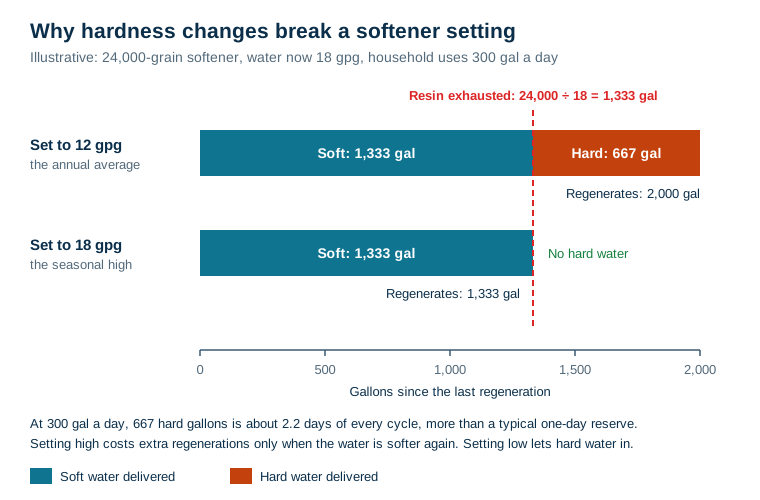
Take a softener with 24,000 grains of usable capacity, in a home using 300 gallons a day.
| Set to 12 gpg (the annual average) | Set to 18 gpg (the seasonal high) | |
|---|---|---|
| Gallons the controller allows per cycle | 24,000 ÷ 12 = 2,000 gal | 24,000 ÷ 18 = 1,333 gal |
| Gallons the resin can soften when the water is really 18 gpg | 1,333 gal | 1,333 gal |
| Hard water delivered per cycle in the hard season | 667 gal, about 2.2 days | None |
| Share of every cycle that is hard | One third | Zero |
| Cost when the water is really 12 gpg | Nothing | About 50% more regenerations than needed |
Three things to notice:
- The failure is intermittent. The softener regenerates on schedule, the water is soft for four or five days, then hardness climbs back until the next regeneration. People describe this as "it works, then it doesn't," and it is the pattern covered in hardness returning before regeneration.
- Reserve capacity does not cover it. Most controllers hold back about one day's water as a reserve. A 667-gallon shortfall is more than two days of use.
- The error is lopsided. Setting too low lets hard water into the water heater. Setting too high only spends some extra salt and water. That asymmetry is why the rule is to program to the seasonal high.
A timer-based softener fails the same way, only the arithmetic is in days rather than gallons. It regenerates on a fixed schedule set for the lower hardness.
Program to the Seasonal High, Not the Average
The practical rule is short: set the hardness to the highest reading you expect in the season, plus any iron compensation. Averages hide exactly the months that cause trouble.
How to find that figure:
- City water: use the top of the CCR hardness range for your zone, not the average. If your own tap test is higher than the CCR maximum, use your own number.
- Private well: test the raw water at least twice in the first year, once in a wet season and once late in a dry one, and use the higher result. Sample from a tap ahead of the softener and any filters so you read the raw water.
- Add iron. Controllers that do not compensate automatically expect you to add a few grains for every part per million of iron. Your valve manual gives the multiplier.
If the salt cost of running at the high setting year-round bothers you, reprogram twice a year instead of once. That only works if you actually do it. A setting left at the low figure is worse than one left at the high figure. The steps for entering the number on common valves are in how to set hardness on a water softener.
Worked example: turning a CCR range into a setting
Say your utility's report lists hardness as 150–290 mg/L, and your own test in spring read 12 gpg.
- Convert the range: 150 ÷ 17.1 = 8.8 gpg, and 290 ÷ 17.1 = 17.0 gpg.
- Compare with your own reading. Twelve gpg sits mid-range, which tells you the spring blend is not the high point.
- Program 17 gpg, plus iron compensation if the report or your test shows iron.
- Check the cost. At 17 gpg instead of 12, the softener regenerates about 40% more often while the water really is at 12 gpg, since 17 ÷ 12 is about 1.4. On a demand-initiated softener that usually means one or two extra regenerations a month. That is the price of never letting hard water through when the blend swings.
- Test again at the other end of the year. If your own reading never gets near 17, drop the setting to your real maximum.
Reprogramming Triggers
Beyond the calendar, these events should prompt a raw-water test and, if the number moved, a new setting:
| Trigger | Why it matters |
|---|---|
| Utility notice of a source change, drought measures or plant work | The blend is about to change, often for weeks or months |
| New CCR published (usually by July 1 each year) | The range may have widened |
| Hard-water spots returning late in each softener cycle | Classic sign the setting is below the real hardness |
| A well pump replaced, well deepened or a new well drilled | The source depth or formation may have changed |
| End of a drought or a very wet spring (wells) | Hardness has probably shifted in the opposite direction |
| Salt use falling while the family's water use is unchanged | On a softener that doses by capacity, often means it is regenerating less than it should |
Is It the Water or the Softener?
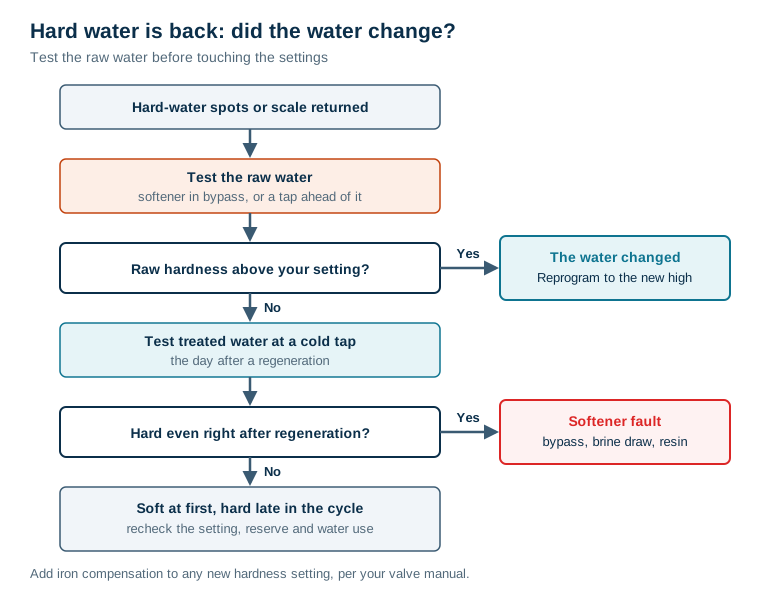
Before you reprogram anything, prove the water changed. A cracked distributor, a stuck bypass or a brine draw problem produces the same hard water at the tap. The check is quick:
- Test the raw water from a tap ahead of the softener, or with the bypass in bypass. This is the only reading that tells you whether the supply changed.
- Test the treated water at a cold tap after the softener, the day after a regeneration.
- Compare. If raw hardness rose and treated water is soft right after regeneration, it is a setting problem. Reprogram. If treated water is hard even straight after regeneration, the softener has a fault regardless of the raw number.
What a Softener Cannot Do About Changing Hardness
- It cannot sense hardness. Standard residential controllers meter flow, not hardness. They rely on the number you enter.
- It cannot keep up with a setting that is too low, however new or well-maintained it is.
- It will not fix other things that change with the season. Iron, manganese, pH, tannins and sulfur on wells, or chlorine and chloramine levels on city water, move on their own schedules and need their own treatment.
- It does not make your raw-water reading steady. A softened supply masks hardness swings at the tap, which is why you have to test ahead of it.
What to Do Next
- Find your spread. Pull the CCR range, or test your well in a wet and a dry season.
- Program to the high end, plus iron compensation.
- Test raw and treated water whenever hard-water spots return, before blaming the equipment.
- Put the triggers on your calendar: the new CCR each summer, and the end of any drought or unusually wet season.
Frequently Asked Questions
Why does my water hardness change?
On city water, the usual cause is a change in the source blend. Many utilities mix surface water and groundwater, or switch wells and reservoirs with demand, drought and maintenance, and each source has its own hardness. On a private well, hardness follows the water table: fresh recharge after rain or snowmelt dilutes it, and long dry spells or heavy pumping concentrate it. Where you are in the distribution system and your own plumbing can change the reading too.
How much can water hardness change in a year?
It depends entirely on the supply. A utility on one deep aquifer may hardly move. A system that blends a soft river with hard wells can swing by several grains per gallon, and a published CCR range is the best guide to your system's spread. Shallow wells vary more than deep ones. The only reliable way to know your spread is to test the same tap several times across a year.
Should I set my water softener to the highest hardness reading?
Yes, set it to the highest hardness you expect in the season, not the annual average. A setting below the real hardness makes a metered softener think it has more capacity than it does, so hard water comes through for the last part of every cycle. Setting it slightly high costs a little extra salt and water but never lets hard water through.
Can water hardness change from day to day?
Day-to-day swings are usually small, but they happen when a utility brings a well on or off line, after main breaks and flushing, or when one pressure zone is fed from a different plant. If readings jump overnight, test the untreated water at the softener inlet before changing anything. A softener fault can look exactly like a hardness change.
Does hardness vary between neighborhoods on the same water system?
It can. Large systems often feed different pressure zones from different plants or wells, so two addresses on the same utility bill can get different water. A CCR usually shows this as a wide range, and some utilities publish hardness by zone or by zip code on request.
Why does my softened water feel hard only some of the time?
The classic pattern is a softener programmed to a hardness below the current raw water. It runs out of capacity before its scheduled regeneration, so the last day or two of each cycle delivers partly hard water, then it regenerates and the problem disappears. Retest the raw water and reprogram to the higher figure before looking for a mechanical fault.
