
What Salt Works Best With Iron in Well Water?

The best water softener salt for iron is a sodium chloride pellet with a citric acid additive, sold as iron-fighting or rust-defense salt. It genuinely helps when your iron is dissolved and low, roughly under the 2 ppm many softeners are rated for. It cannot rescue a softener handling oxidized iron, iron bacteria or iron above its own rating. No salt can.
That makes the salt question smaller than the marketing suggests. The salt does not treat your water. It cleans the resin a little more thoroughly each time the softener regenerates, and that only matters if the softener was the right tool for your iron in the first place. Whether it is the right tool is covered in can a water softener remove iron.
What Is Actually in an Iron-Fighting Salt Bag
The additive is a small fraction of the bag. The manufacturers' own safety and product data sheets show how small:
| Product | What the data sheet says | The iron ingredient |
|---|---|---|
| Diamond Crystal Iron Fighter pellets | 99.62% sodium chloride, 0.35% citric acid, 0.03% sodium hexametaphosphate (Cargill safety data sheet) | Citric acid |
| Morton Clean and Protect Plus Rust Defense pellets | At least 99.65% sodium chloride with "soluble resin cleaning additives" and a separate "rust defense additive" (Morton product data sheet) | Not named on the data sheet |
| Plain pellets, solar crystals, rock salt | Sodium chloride; purity varies by type | None |
Worked from the Diamond Crystal figure: a 40 lb bag at 0.35% citric acid carries about 0.14 lb, roughly 64 grams, of citric acid. At a salt dose of 6 lb per regeneration, each regeneration sends about 9.5 grams of citric acid through the resin. That is a maintenance dose, not a cleaning treatment.
Morton's data sheet says its additive, "in combination with sodium chloride, offers an effective system for minimizing iron and manganese fouling of softener resins." Its product page adds that the salt "removes 10 times more iron than plain salt" per regeneration, based on the company's internal laboratory testing. Read that claim carefully. It describes iron removed from the resin during regeneration. It says nothing about how much iron the softener can take out of your water. Morton's sheet also lists NSF/ANSI/CAN 60 certification, which covers the safety of the salt as a water treatment chemical, not its iron performance.
What the Additive Does During Regeneration
A softener takes up dissolved ferrous iron the same way it takes up calcium: by ion exchange on the resin. During regeneration, strong brine pushes those ions back off. Iron is the troublemaker in that step. Some of it oxidizes inside the bed and turns into rust that brine alone cannot dissolve, and each cycle leaves a little more behind.
The citric acid helps in two ways. It keeps iron that is coming off the resin in a soluble form, and it loosens light deposits that have just started to form. Both go to the drain with the spent brine. Nothing about this reaches your taps: the additive is rinsed out before the valve goes back into service, and Morton's sheet says the cleansing additives "are thoroughly flushed from the system during resin regeneration."
Three things follow from that mechanism:
- The dose is tied to your salt dose, not your iron. A softener set to a lean salt setting delivers less additive per regeneration, just when an iron well needs more.
- It only works on iron that is on the resin. Iron that was already rust when it arrived is a particle problem, and particles lodge in the bed whatever the brine contains.
- It is prevention, not rescue. A bed that is already heavily fouled needs a proper cleaning treatment first. The difference between light and heavy fouling is explained in what is water softener resin fouling.
Best Water Softener Salt for Iron, by Iron Level
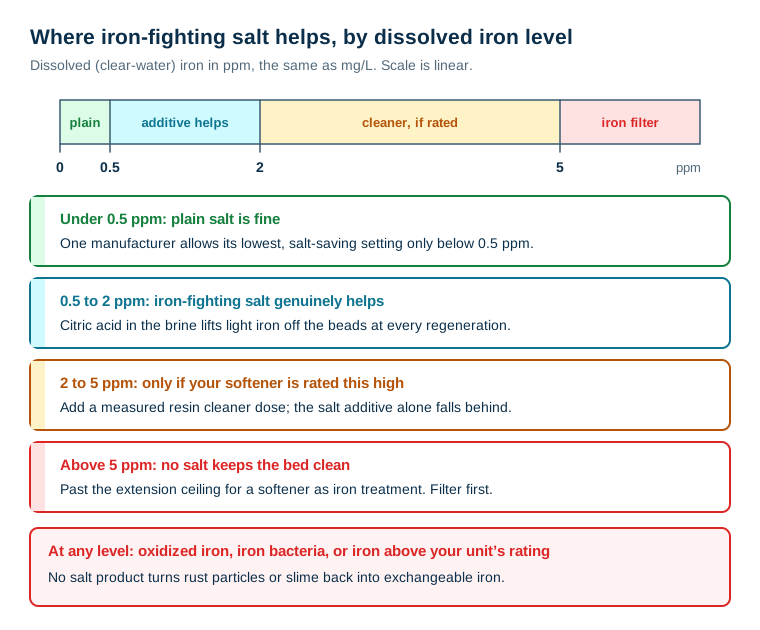
Match the salt to your lab result, not to the bag's claims. These are the breakpoints the sources support:
- Under 0.5 ppm. Plain salt is fine. One residential manufacturer's manual allows its lowest, salt-saving setting only when iron is under 0.5 ppm, which tells you where iron stops being a background issue.
- 0.5 to 2 ppm dissolved iron. This is where iron-fighting salt earns its place. The iron is within the rating of most residential softeners, and a small additive dose at every regeneration keeps the bed from slowly losing capacity.
- 2 to 5 ppm. Only workable if your specific softener is rated this high, and here the additive alone tends to fall behind. Pro Products' label for its Res Care cleaner calls for monthly use on water above 2 ppm of iron, which is a fair signal that a maintenance salt is no longer enough.
- Above 5 ppm. Penn State Extension recommends a softener for iron only below 5 mg/L, with pH above 6.7 and no air or chlorine reaching the water first. Past that, the answer is an iron filter ahead of the softener, not a better salt.
The threshold that matters most is your own softener's rating. If the manual says 2 ppm and your well tests at 3.5 ppm, no salt product changes that. The additive makes regeneration more thorough. It does not add capacity. The extra hardness allowance an iron well needs, typically 3 to 4 grains per gallon for every ppm of iron, is worked through in how iron changes water softener sizing.
Where Additive Salt Is Marketing, Not Chemistry
Iron-fighting salt is a real product doing a real job. The bags, retail listings and "best salt" roundups stretch that job further than the chemistry goes. Here is where the claims break down:
| Claim you will see | What is true |
|---|---|
| "Removes iron" | It removes iron from the resin during regeneration. The softener removes iron from the water, and only dissolved iron within its rating. |
| "Prevents rust stains" | Only indirectly, by keeping a correctly sized softener working. Stains already on fixtures stay there. |
| "For high iron water" | High is relative. Above your unit's rating, or above about 5 ppm, the additive cannot keep up. |
| "Protects your softener" | True for light, dissolved iron. False for oxidized iron, which lodges as particles, and for iron bacteria, which colonize the bed. |
| "Works on manganese too" | Morton's sheet does say iron and manganese. Manganese still has to be dissolved and within the rating, and it is harder to clean off resin than iron. |
Oxidized iron is the big one. If your water leaves the tap orange, or turns orange within seconds, some of the iron has already become rust before it reaches the resin. That rust lodges in the bed as particles. Citric acid in the brine dissolves some of it, but new particles arrive every day and the bed loses ground. That is a pretreatment problem, set out in water softener vs iron filter.
Iron bacteria are the other. Orange slime in the toilet tank means a living colony, not just a mineral. A salt additive neither kills it nor keeps it out of the resin, which is why iron bacteria in well water need well treatment first.
Additive Salt vs a Separate Resin Cleaner: Cost per Year
The alternative to iron-fighting salt is plain salt plus a liquid resin cleaner poured down the brine well. The usual advice is that the cleaner wins on cost. Worked through with real label directions and shelf prices, the two turn out closer than that. The cleaner's real advantage is control.
A worked example, labelled illustrative. Assumptions: a 1 cubic foot softener on an iron well, regenerating every 4 days at 6 lb of salt, which is about 91 regenerations and 548 lb of salt a year, or roughly 14 bags of 40 lb.
| Path | How the annual cost builds up | Illustrative cost per year |
|---|---|---|
| Iron-fighting salt instead of the same brand's plain pellets | 14 bags × a premium of about $0.40 to $1.20 a bag, the gap between Morton's plain and Rust Defense pellets at major US retailers in 2026 | About $6 to $17 |
| Plain salt + cleaner at the maintenance dose | Res Care label: ½ oz per cubic foot before each regeneration. 91 × ½ oz ≈ 46 oz, about a third of a gallon at roughly $34 a gallon | About $12 |
| Plain salt + cleaner used monthly | 4 oz per cubic foot, the label's treatment dose, 12 times a year = 48 oz | About $13 |
Your own numbers will differ with bag prices, cleaner brand, bed size and regeneration frequency, but the conclusion holds: on cost alone, it is close to a draw. The deciding factors are elsewhere:
- The cleaner dose follows the iron. The salt dose follows the salt setting. With a cleaner you can double the dose after a bad month and cut it when iron is low. With additive salt you get whatever the salt setting delivers.
- The cleaner is usually stronger chemistry. It can clean a bed that has started to foul. The salt only helps keep a clean bed clean.
- The cleaner works with any salt, including potassium chloride and the cheapest plain pellets.
- The salt needs no attention. For many households that is worth a few dollars a year, and it is a perfectly good reason to buy it.
When and how to dose a cleaner, and how to tell whether it worked, is covered in resin and iron cleaners: when and how to use them.
Salt Form Matters Less Than the Additive, With Two Exceptions
Most salt guides devote the bulk of their length on pellets versus crystals versus blocks. For iron, the form of the salt matters far less than whether the iron is suitable for a softener in the first place. Two exceptions are worth knowing:
- Insoluble content. Morton's data sheet caps water insolubles in its Rust Defense pellets at 0.10%. Lower-grade rock salt carries more insoluble material, which settles in the brine tank as sludge. On an iron well that sludge mixes with iron residue and can foul the brine well and injector. If your salt tank already looks rust-colored, see why softener salt looks brown or dirty before blaming the salt.
- Potassium chloride. The iron-fighting products named on this page are sodium chloride. Switching to potassium chloride for dietary reasons means giving up the additive, so plan on a cleaner instead.
Pellets that turn to mush at the bottom of the tank are a separate issue, whatever the additive. The diagnosis is in what causes salt mushing in a brine tank.
How to Tell Whether the Salt Is Working
Iron-fighting salt gives no signal of its own. You find out whether it is doing anything by watching the softener, and three checks are enough:
- Gallons between regenerations. On a metered softener, note the capacity or gallons remaining over a few weeks. A bed that is slowly fouling needs regeneration sooner and sooner. A stable number means the bed is staying clean.
- Iron in the softened water late in the cycle. An iron test strip or a lab sample taken just before a scheduled regeneration shows breakthrough when the bed is closest to exhausted. Iron that appears only then is the first sign that the additive is falling behind.
- The color of the first water after regeneration. A burst of brown or orange water right after a regeneration means iron built up in the bed and the backwash is releasing it. What causes it and what to check is in why water turns brown after softener regeneration.
If all three stay steady for a few months, the salt is doing its job. If any of them drifts, switch to a measured cleaner dose or look again at whether the softener should be handling your iron at all.
What No Salt Product Can Do
The limits are worth stating plainly, because they decide whether you are shopping for salt at all:
- It cannot raise your softener's iron rating. The rating comes from the resin volume, the valve and the regeneration settings.
- It cannot treat oxidized iron. Rust particles need filtration, not exchange.
- It cannot control iron bacteria. Biology needs disinfection and, usually, work on the well itself.
- It cannot remove existing stains. The additive never reaches your fixtures.
- It cannot fix a wrong hardness setting. A softener that ignores the iron in its compensated hardness regenerates too late, and iron breaks through whatever salt is in the tank.
- It cannot make a lean salt setting safe on iron. At least one manufacturer restricts the most efficient settings to water with very little iron, whatever the salt.
Choosing, In Order
- Get dissolved and total iron measured separately, plus manganese, pH and hardness. Without that split you cannot tell whether a softener should be handling the iron at all.
- Check the result against your softener's own rating, not the most generous figure you can find.
- Under 0.5 ppm: buy plain salt.
- 0.5 to 2 ppm, all dissolved, within the rating: buy iron-fighting salt, or plain salt with a scheduled resin cleaner if you want to control the dose.
- 2 ppm up to your unit's rating: use a dosed cleaner, check gallons between regenerations every few months, and treat iron-fighting salt as a supplement rather than the plan.
- Above the rating, or any oxidized iron or slime: stop comparing salts and put pretreatment ahead of the softener.
The best water softener salt for iron is the one matched to a softener that should be handling that iron in the first place. On the right well, iron-fighting salt is a low-effort way to keep the bed clean. On the wrong well, no bag on the shelf will save the resin.
Frequently Asked Questions
Does iron-fighting water softener salt actually work?
Yes, within a narrow range. Products such as Diamond Crystal Iron Fighter contain about 0.35% citric acid, which helps lift dissolved iron that the resin picked up and flush it to the drain during regeneration. That keeps a bed cleaner on water with light, clear-water iron, roughly up to the 2 ppm many residential softeners are rated for. It cannot remove oxidized rust particles, iron bacteria or iron above the softener's own rating, and it does not treat the water directly.
Is Rust Defense salt worth it for well water?
It is worth it if your well has dissolved iron that your softener is rated to handle, and you would rather not dose a cleaner yourself. The price premium over the same brand's plain pellets has been small, often around a dollar a bag. It is not worth it if your iron is oxidized before it reaches the softener, above the unit's rating, or accompanied by iron bacteria. In those cases the money belongs in an iron filter or in fixing the well.
Can I mix iron-fighting salt with regular salt in the brine tank?
Yes. The additive is a small fraction of each pellet and simply dilutes when mixed, so a half-and-half tank gives roughly half the dose. That is fine for very light iron. If you are mixing because the iron-fighting salt seems too expensive, a measured resin cleaner poured down the brine well lets you set the dose precisely instead.
Will iron-fighting salt remove rust stains from my toilet and sinks?
No. The additive works inside the softener during regeneration and is rinsed to the drain before the unit returns to service. It keeps the resin able to remove dissolved iron, which prevents new staining if the softener is the right tool for your iron. Stains already on porcelain need a cleaner made for rust stains, and stains that keep coming back mean iron is getting past the softener.
How much iron can a softener handle with iron-fighting salt?
No more than it could handle with plain salt. The salt changes how cleanly iron comes off the resin, not how much the softener is rated for. One residential manufacturer rates its unit at 2 ppm of dissolved iron, and Penn State Extension recommends a softener for iron only below 5 mg/L, with pH above 6.7 and no air or chlorine reaching the water first. Above your unit's rating, no salt product keeps the bed clean.
Can I use potassium chloride if my well water has iron?
You can, but the iron-fighting products on store shelves are sodium chloride with an additive, so switching to potassium chloride means losing the additive. On an iron well that uses potassium chloride, pour a measured resin cleaner down the brine well on a regular schedule to do the same job. Check your softener manual for the higher salt setting potassium chloride usually needs.
