
APEC ROES-50 Review: The Plain RO That Suits a Softened Home
This APEC ROES-50 review comes down to one fit. The ROES-50 is a plain five-stage tank RO system with no mineral stage. APEC's manual says it is certified by WQA to NSF/ANSI 58 for TDS reduction. In a home that already softens, that simplicity is an advantage. The membrane removes most of the sodium the softener added, and softened feed is what APEC's own manual recommends for long membrane life. The trade-offs are real: the "4 gallon" tank holds 2.5 to 3.1 gallons at typical pressures, and under NSF test conditions it sends about 7.5 gallons to drain for every gallon you drink.
Disclosure: Hard Water Solved may earn a commission if you buy through links on this page, at no extra cost to you. It does not change which products we include or how we rank them. Read our disclaimer.
APEC ROES-50 at a Glance
| Item | Figure | Source |
|---|---|---|
| Amazon | Check price on Amazon | Listing opened, live |
| Stages | 5: sediment, two carbon blocks, RO membrane, inline carbon | Manual |
| Output | 50 GPD at 60 psi; 30 GPD at 50 psi and 77°F | Product page |
| Tank | 4 gallon total volume, about 2.5 to 3.1 gallons usable | Manual |
| Feed limits | 40 to 85 psi, 40 to 100°F, TDS up to 2,000 ppm, pH 2 to 11 | Manual, warranty |
| Certification | WQA to NSF/ANSI 58 for TDS | Manual |
| Efficiency rating | 11.8% (recovery rating 25.4% without the tank) | Manual, performance data |
| Space needed | about 17 x 6 x 18 in for the unit, 11 in wide x 18 in tall for the tank | Manual |
| Power | none | Manual |
| Warranty | 1 year | Manual, warranty |
Also sold as a bundle with a 14 gallon storage tank. APEC also sells the 14 gallon tank on its own.
How This Review Was Put Together
Method. No unit was physically tested for this review. Figures come from the APEC ROES-50 installation and owner's manual, including its performance data and warranty, from APEC's product page, and from EPA's WaterSense figures for RO waste water. The sodium example uses 7.9 mg/L of sodium added per grain of hardness removed. The Amazon listings were opened to confirm they are live.
Prices are not listed here because they change often. Use the buttons to see the current price on Amazon.
Why a Plain Five-Stage RO Suits a Home That Already Softens
Many newer RO systems add a sixth "mineral" or "alkaline" stage that puts calcium and magnesium back after the membrane. On the ROES-50 there is none. For a household with a water softener, three things make the plain design a good match.
1. The membrane deals with the softener's sodium. A softener adds about 7.9 mg/L of sodium for every grain of hardness it removes. APEC's manual says a membrane in good condition should leave product water at about 3 to 10 percent of the tap water's TDS. On 15 gpg water, that takes the sodium the softener added from about 119 mg/L to about 12 mg/L. The detail behind the sodium figure is in sodium in softened water.
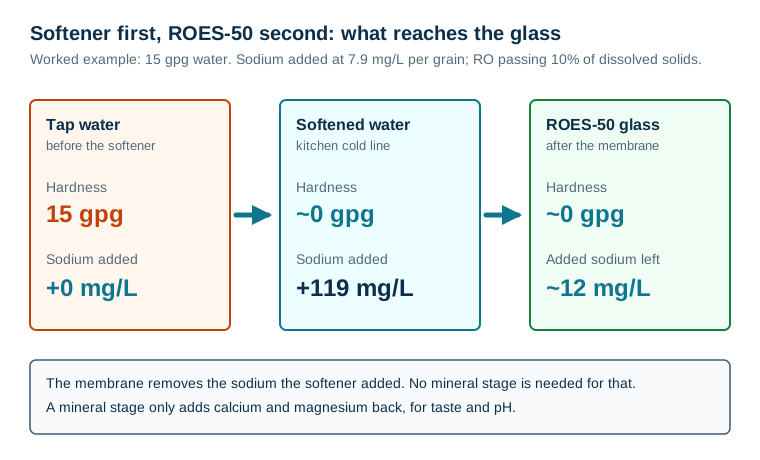
2. Softened feed is easier on the membrane. In its list of the four common causes of premature membrane failure, APEC's manual includes water that is "extremely hard", which "will clog up the membrane with heavy calcification. Adding a water softener will help greatly." Softened feed removes that cause. What is and is not published about membrane life on hard and softened water is collected in reverse osmosis and water softener together.
3. One less cartridge, one less decision. A mineral stage is a taste and pH choice. It adds a filter to replace and puts some hardness back in the glass. If you like the taste of plain RO water, the ROES-50 skips both. If you would rather have the minerals, APEC's ROES-PH75 is the same family with a calcium stage added.
The usual alternative in softened homes is to leave the kitchen cold tap on hard water. That avoids the sodium, but the drinking tap then misses every other treatment in the house. Why RO under the sink usually beats a bypass tap is covered in should a kitchen tap bypass the softener.
Plumbing note: feed the ROES-50 from a softened cold line. If an installer has already left the kitchen cold line on hard water, either run a softened feed to the RO or accept that the membrane is working on hard water.
What the 4 Gallon Tank Means for a Family's Day
The ROES-50 makes water slowly and stores it. So the tank, not the 50 GPD rating, decides how it feels to use.
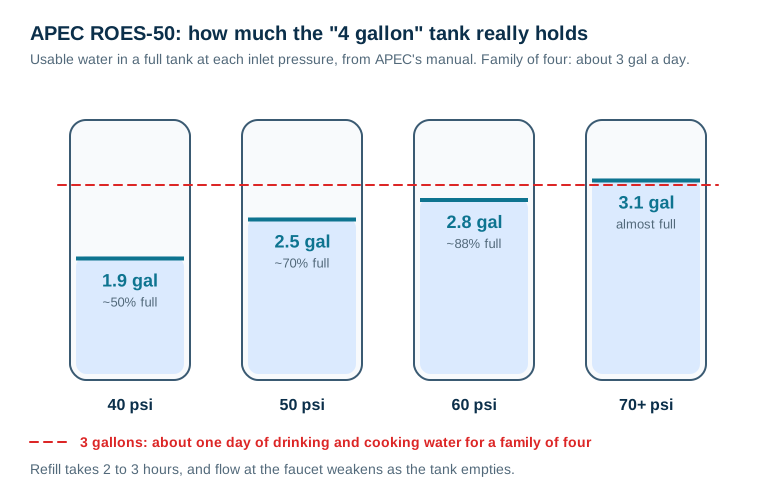
APEC's manual gives two numbers that most product pages leave out. First, "4 gallon" is the tank's total volume, air space included. How full it gets depends on your inlet pressure:
Second, delivery pressure falls as the tank empties. The manual lists about 50 psi at 3.0 gallons, 24 psi at 2.0 gallons, 14 psi at 1.0 gallon and 5 psi when empty. The last gallon comes out noticeably slower than the first.
A family of four, worked through. Assume about 3 gallons a day of drinking and cooking water: four people drinking about half a gallon each, plus a gallon for cooking and coffee.
- At 60 psi (a common city pressure), a full tank holds 2.8 gallons. That covers most of the day. The rest comes from the membrane in real time, at a trickle, unless the tank has had a 2 to 3 hour break to refill.
- At 50 psi, the tank holds 2.5 gallons and APEC rates production at about 30 GPD at 77°F. Use spread across the day still works. Filling a stockpot and several bottles in a row will empty it.
- At 40 psi, the bottom of the warranty range and the low point of many well pressure switches, the tank holds 1.9 gallons. Expect it to run low most evenings. APEC suggests a permeate pump for low-pressure homes, which increases fill and output pressure.
The fix for a big household is not a different RO system. It is a bigger tank, which is why APEC sells the ROES-50 with a 14 gallon tank as a bundle. A larger tank stores more, but it still fills at the same slow rate, so it helps households that use a lot of water at once, not ones that use a lot every hour.
If you plan to feed an ice maker as well, the manual says you need at least 50 psi into the ROES-50 for the 20 to 30 psi most ice makers want.
50 GPD on the Box, and What the NSF Data Says
APEC rates the ROES-50 at 50 GPD at 60 psi, and gives 30 GPD at 50 psi and 77°F. The performance data sheet in the manual, from NSF/ANSI 58 testing, shows:
- TDS challenge: 750 mg/L in, meeting the 75% minimum reduction
- Efficiency rating: 11.8%, the share of water entering the system that ends up as usable RO water with the tank in use
- Recovery rating: 25.4%, the same measure at the membrane with the tank bypassed
- Production rate: listed as 45.3 "L/gpd". The unit is unclear. If it means litres per day, it is about 12 gallons a day under the test conditions.
The efficiency rating is the number to notice. At 11.8%, about 7.5 gallons go to drain for each gallon you drink. EPA's WaterSense page on point-of-use RO says a typical system sends five gallons or more, and WaterSense-labeled systems must stay at 2.3 or less. The ROES-50 is a conventional, non-pumped tank system, and its waste figure shows it.
At 3 gallons a day, that is about 22 gallons a day to drain, roughly 8,200 gallons a year. On a city water bill the cost depends on your local rate, and is usually modest. On a softened supply, the reject water has already been softened, so it carries a small salt cost too. On a low-yield well or metered water, it is worth weighing against a tankless system with a published 2:1 or 3:1 ratio.
Filter Schedule and Running Cost
From the manual's maintenance section:
| Part | Replace every |
|---|---|
| Stages 1 to 3 pre-filter set | 6 to 12 months (sooner on well water) |
| Stage 4 membrane (30 to 50 GPD) | 2 to 4 years on city water; about 2 years on well water |
| Stage 5 inline carbon | 2 to 4 years, ideally with the membrane |
| Complete set, stages 1 to 5 | when the membrane is due |
Yearly running cost, worked out:
- Softened city water, careful use: pre-filters every 12 months, membrane and stage 5 every 4 years. This is the low end.
- Unsoftened or well water: pre-filters every 6 months, membrane and stage 5 every 2 years. That is about twice as many filters a year, and roughly twice the cost.
The difference between the two ends is mostly your water. Softened, chlorinated city water with prefilters changed on time is the cheapest way to run it.
Test TDS once or twice a year, as the manual advises. Product water at 3 to 10 percent of tap water TDS is normal. At 15 to 20 percent, the manual says it is time to change the membrane. A softener does not lower TDS, so measure the softened water feeding the RO, not the raw supply.
Installation Notes
- No power needed. The ROES-50 runs on line pressure alone.
- Cold water only. The manual is explicit.
- The drain line has the flow restrictor inside it. The manual says not to remove the black drain tubing. A blocked or restricted drain is one of the four causes of early membrane failure it lists.
- Drill a 1/4-inch hole for the drain saddle and a 1/2-inch hole for a standard faucet, per the manual's tool list.
- First tank: let it fill for 2 to 3 hours, then drain it completely. Do not drink the first tank.
- Housing O-rings: replace them yearly or with the pre-filters. APEC recommends replacing the stage 1 to 3 housings every 5 years.
Pros and Cons
Pros
- Low running cost, with stage 1 to 3 pre-filters sold as one set
- Certified by WQA to NSF/ANSI 58 for TDS reduction, per the manual
- No mineral stage, which suits softened homes and keeps maintenance simple
- No electricity, standard 10-inch filters, a 2,000 ppm feed TDS limit
- Clear manual, with tank fill, delivery pressure and troubleshooting data
Cons
- 11.8% efficiency rating: about 7.5 gallons to drain per gallon delivered under test conditions
- The "4 gallon" tank holds 1.9 to 3.1 gallons depending on pressure
- Needs 40 psi or more, and 50 psi or more for a good tank fill or an ice maker
- Only a 1-year warranty
- Certified for TDS only, not the wider list of claims some competitors carry
Who Should Not Buy the APEC ROES-50
- Homes on metered water or a low-yield well where 8,000 gallons a year to drain matters.
- Low-pressure homes under about 45 to 50 psi, unless you add a permeate pump.
- Households that draw several gallons at once and will not add the larger tank.
- Anyone who needs certified reduction of lead, fluoride or other specific contaminants. The manual's certification statement covers TDS. Check the WQA listing, or pick a system certified for the claim you need.
- People who prefer mineral-tasting water. Choose a model with a mineral stage.
- Anyone still deciding about whole-house treatment. An RO system treats one tap. Start with salt-based vs salt-free water treatment.
APEC ROES-50 Review: The Verdict
The APEC ROES-50 is a simple, well-documented RO system, and its simplicity is the reason to buy it if you already soften. The membrane removes the sodium your softener adds, softened feed is what APEC itself recommends for membrane life, and there is no mineral cartridge to maintain. Go in with the real numbers: about 2.5 to 2.8 gallons in the tank at normal pressure, a 2 to 3 hour refill, and a waste ratio worse than the industry's typical figure. For a two- to four-person softened home on city water, that is a fair trade for a reliable system that is cheap to run.
Frequently Asked Questions
How much water does the APEC ROES-50 tank hold?
The tank is sold as 4 gallons, but that is its total volume including the air space. APEC's manual says it fills to about 3.1 gallons at 70 psi or more, 2.8 gallons at 60 psi, 2.5 gallons at 50 psi and 1.9 gallons at 40 psi. Refilling takes 2 to 3 hours.
Is the APEC ROES-50 NSF certified?
APEC's manual says the system is certified by WQA to NSF/ANSI 58 for TDS reduction, and APEC describes it as WQA Gold Seal certified. The Amazon listing also mentions NSF/ANSI 372 for lead-free materials. We could not open WQA's listing database to confirm the exact listing on the day we checked, so check it for the model you buy.
Does the APEC ROES-50 work with a water softener?
Yes, and it suits one well. APEC's manual lists extremely hard water as a cause of premature membrane failure and says adding a water softener will help greatly. The RO membrane also removes most of the sodium the softener adds. Feed the ROES-50 from a softened cold line.
How often should I change the APEC ROES-50 filters?
APEC's manual says to change the three pre-filters every 6 to 12 months, the stage 4 membrane every 2 to 4 years on city water or about every 2 years on well water, and the stage 5 carbon filter every 2 to 4 years, ideally with the membrane.
How much water does the APEC ROES-50 waste?
The performance data in APEC's manual gives an efficiency rating of 11.8% under NSF/ANSI 58 test conditions. That means roughly 7.5 gallons go to drain for every gallon of RO water delivered, with the tank in use. That is worse than EPA's typical figure of about 5 gallons. On softened feed, the reject water has already been softened, which adds a small salt cost.
