
Best 64,000 Grain Water Softener, and the Household and Well That Justify One

The best 64,000 grain water softener for most large households is a metered Fleck 5600SXT system with 2 cubic feet of resin from AFWFilters. If your well has dissolved iron, the fine-mesh AFWFilters Iron Pro 2 64k is the better choice. But a 64k only makes sense for the right household. At an efficient salt setting it delivers about 40,000 grains per cycle, so it suits roughly four people on 15 gpg water, three on 20 gpg or more, or six on 10 gpg. Below that it is oversized. On a well it also needs about 3 to 3.5 gpm of backwash flow, held for 20 minutes or more.
Disclosure: Hard Water Solved may earn a commission if you buy through links on this page, at no extra cost to you. It does not change which products we include or how we rank them. Read our disclaimer.
How we chose. Each pick is a complete whole-house system with about 2 cubic feet of resin, metered regeneration and a published warranty, sold on Amazon.com. We compared them at the same efficient salt dose, by tank size, the backwash flow that tank needs, resin type and warranty. Two plan candidates, a Fleck 7000SXT 64k and a Fleck 5800SXT 64k, were dropped because their Amazon listings showed as currently unavailable on 1 October 2026. Evidence comes from listings, brand stores, manuals and warranty terms. Nothing was physically tested.
Prices are not listed here because they change often. Use the buttons to see the current price on Amazon.
Who should buy none of these: households below the thresholds in the next section, wells that cannot hold a 12-inch tank's backwash flow, and water with visible rust or iron above about 6 ppm.
Who Actually Needs 64,000 Grains
A 64k's box rating describes about 2 cubic feet of resin at a heavy salt dose. Programmed for efficiency, at 6 lb of salt per cubic foot, it delivers about 40,000 to 42,000 grains. This page uses 40,000. The reasons the box number overstates capacity are set out in what grain capacity means.
Your daily hardness load is people × 75 gallons × hardness in gpg. A softener is well sized when it regenerates every 3 to 8 days, with one day's load held back as reserve. For a 64k, that means a daily load of about 4,400 to 10,000 grains.
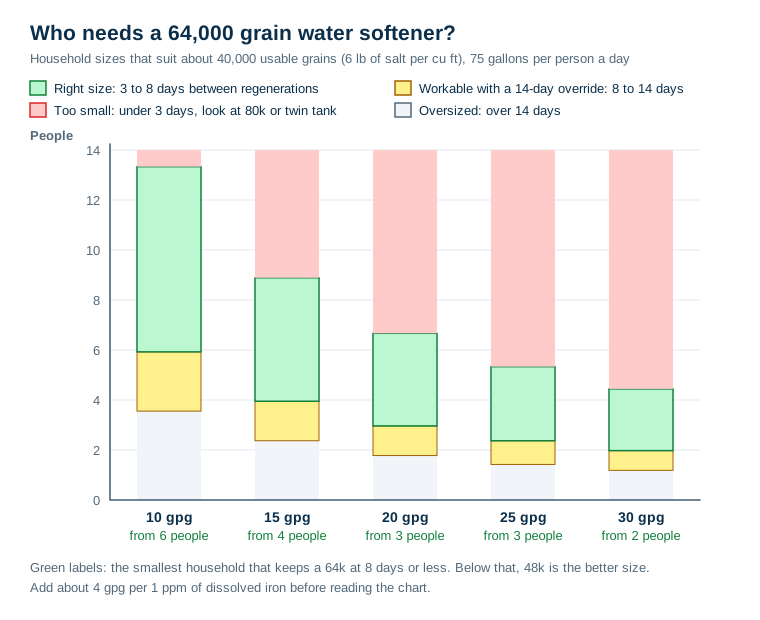
| Hardness | Smallest household for 8 days or less | Workable with a 14-day override | Too small (under 3 days) from |
|---|---|---|---|
| 10 gpg | 6 people | 4 to 5 people | 14 people |
| 15 gpg | 4 people | 3 people | 9 people |
| 20 gpg | 3 people | 2 people | 7 people |
| 25 gpg | 3 people | 2 people | 6 people |
| 30 gpg | 2 people | — | 5 people |
Three things follow:
- A 64k is a hardness purchase as much as a family-size purchase. Two people on 30 gpg water load it as heavily as six people on 10 gpg.
- Below the threshold, 48k is the better size. A 64k that sits for two or three weeks invites stale resin and wastes the salt held in reserve. The oversizing problem is real, and a day override only partly fixes it.
- Above it, you are looking at an 80k or a twin tank. Five or more people on 30 gpg water would regenerate a 64k every couple of days.
If your current softener is running out of soft water before it regenerates, check the symptoms in signs a water softener is undersized before assuming the answer is 64k. Sometimes it is a setting.
The Tank Behind the Number: 12 Inches and More Backwash
Two cubic feet of resin normally ships in a 12-inch diameter tank, 12×48 or 12×52. Some brands use a 13-inch tank. The wider bed is what gives a 64k its two practical advantages, and its one demand.
More flow. Design guidance in Water Conditioning & Purification allows about 10 gpm per square foot of bed continuously and up to 15 in short peaks. A 12-inch bed has about 0.79 square feet, so it handles about 7.9 gpm continuously and 11.8 gpm in peaks. A 9-inch 32k bed manages about 4.4 and 6.6. For a big house running several showers at once, that flow is often the real reason to buy a 64k.
Lower salt per grain. At the same capacity per cycle, a larger bed can run a lower salt dose and regenerate less often. That is where an oversized-but-not-too-oversized unit saves salt.
More backwash flow. Backwash has to lift and expand the bed, and the flow it needs rises with the bed's area, not its grain rating. The WC&P softener design guide says backwash must expand the bed by at least 50 percent:
| Tank | Bed area | Backwash needed, 50°F to 68°F | Published figure |
|---|---|---|---|
| 10-inch (typical 48k) | 0.55 sq ft | 2.3 to 3.0 gpm | 2.5 gpm (Pentair spec sheet) |
| 12-inch (typical 64k) | 0.79 sq ft | 3.3 to 4.3 gpm | 3.5 gpm (Pentair, 12×48); 3 gpm (12×52, distributor catalog) |
| 13-inch (some 64k, most 80k) | 0.92 sq ft | 3.9 to 5.1 gpm | — |
On city water this is a non-issue. On a well, the pump has to deliver it for the whole backwash and rinse, and the well has to keep up. The full method for checking, including the two bucket tests, is in well pump flow for backwashing. If the well cannot hold about 3.5 gpm for 20 minutes or more, a 64k in a 12-inch tank is the wrong purchase however big the family is.
Best 64,000 Grain Water Softener Picks, Matched to Household and Well
1. AFWFilters Fleck 5600SXT 64k: Best Overall
Justified for: four or more people at 15 gpg, or three at 20 gpg. Well must hold: about 3.5 gpm.
The listing pairs the Fleck 5600SXT metered valve with 2 cubic feet of resin in a 12×48 tank, a round 18×33 brine tank and a bypass. Warranty is 5 years on the valve head and 10 on the tank. The 5600SXT is one of the most widely serviced residential valves in the US, which matters over a 15-year life. AFW also sells the same size with 10% crosslink resin, the better choice on chlorinated city water.
- Good: serviceable valve, 12-inch bed for big-house flow, good value for the size.
- Watch: the listing's "up to 16 gpm" is above what design guidance allows for a 12-inch bed continuously. Program capacity from about 40,000 grains, not 64,000.
2. AFWFilters Iron Pro 2 64k: Best for Well Water With Iron
Justified for: the same households as above, after adding about 4 gpg per 1 ppm of iron to your hardness. Well must hold: about 3.5 gpm, and more if an iron filter backwashes on the same night.
The Iron Pro 2 uses fine-mesh resin with the same Fleck 5600SXT valve. The listing rates it for dissolved iron and manganese up to 6 ppm each, and AFW's store gives 2 cubic feet of fine-mesh resin with an 18×33 brine tank. Fine-mesh resin has more surface area, which helps it take up and release ferrous iron during regeneration. Iron counts against capacity, so a family that would be borderline for a 64k on hardness alone often lands squarely in its range once iron is added.
- Good: handles clear-water iron and manganese in one tank, standard valve.
- Watch: iron that has already oxidized, rust you can see, fouls any softener. Above the rating, or with iron bacteria, put an iron filter first.
3. Aquasure Harmony 64k: Best Budget Pick
Justified for: the same thresholds. Well must hold: about 3.5 gpm for a 12-inch tank, or 4 to 5 gpm if yours is 13-inch.
The Harmony uses Aquasure's own metered control head, and the listing sizes it for four or more bathrooms. Check the tank size with the seller. Aquasure's 2019 owner's manual lists a 13×54 tank for the 64k, while its current parts store sells a 12×52 jacket for the same model. The difference matters on a well, because a 13-inch tank needs noticeably more backwash flow.
The warranty is 5 years on the valve, electronics and resin if you register within 60 days, and 2 years without registration. Tanks are covered for 10 years. Resin and internal valve parts are not covered when the softener is used to remove iron or manganese.
- Good: usually the lowest-cost 64k here, metered, 10-year tank warranty.
- Watch: proprietary valve, tank size to confirm, and the full warranty depends on registration.
4. SoftPro Elite 64k: Best for Very Hard Water and Low Salt Use
Justified for: large households on very hard water, where the salt saving is biggest. Well must hold: SoftPro does not publish the tank size or backwash rate, so ask before buying for a weak well.
The Elite brines upflow, which lets it run a lower salt dose without hardness breaking through. It uses 10% crosslink resin and carries the longest warranty here: lifetime on the valve and tanks, 7 years on electronics and a 10-year prorated resin warranty on city water. On a family of five at 25 gpg, an efficient upflow unit saves roughly 330 lb of salt a year against a standard metered softener at 9 lb per cubic foot. That is the household where its price premium over the AFW unit comes closest to paying back.
- Good: best salt efficiency, longest warranty, phone support.
- Watch: price, unpublished tank size, and terms that favour clean city water. Its warranty conditions allow up to 2 ppm of iron, and the resin warranty covers city water only.
Spec Comparison at the Same Salt Dose
| Pick | Resin | Tank | Usable at 6 lb/cu ft | Salt per regeneration at 6 lb/cu ft | Continuous flow the bed handles | Warranty |
|---|---|---|---|---|---|---|
| AFW Fleck 5600SXT 64k | 2 cu ft high-capacity | 12×48 | about 40,000 | about 12 lb | about 7.9 gpm | 5 yr valve, 10 yr tank |
| AFW Iron Pro 2 64k | 2 cu ft fine mesh | not stated on listing | about 40,000, less with iron | about 12 lb | about 7.9 gpm if 12-inch | 5 yr valve (listing) |
| Aquasure Harmony 64k | about 2 cu ft | 12×52 or 13×54 (confirm) | about 40,000 | about 12 lb | about 7.9 to 9.2 gpm | 5 yr with registration, 10 yr tanks |
| SoftPro Elite 64k | 10% crosslink | not published | about 40,000, at lower salt | lower, upflow | not published | Lifetime valve and tanks |
Usable capacity uses about 20,000 to 21,000 grains per cubic foot at 6 lb of salt, from WC&P design tables. Flow uses 10 gpm per square foot of bed.
Should You Buy a 64k? Three Checks
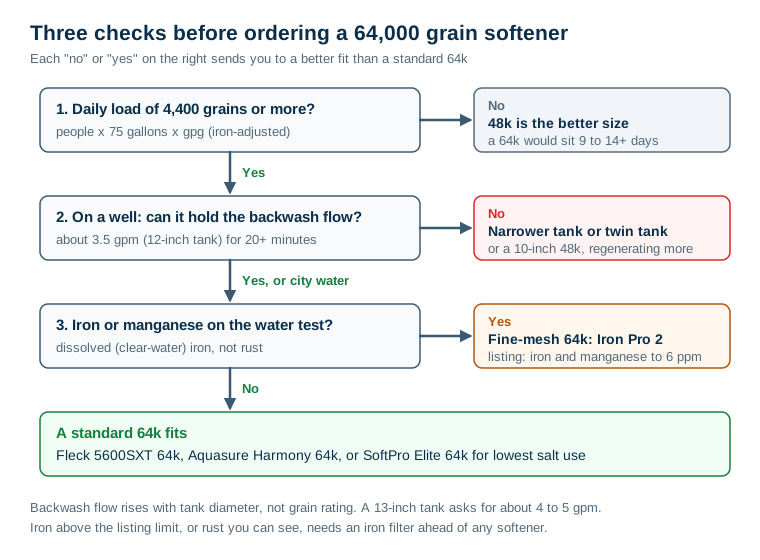
- Load. Multiply people × 75 × gpg, adding 4 gpg per ppm of iron. Under about 4,400 grains a day, buy a 48k.
- Well flow. If you are on a well, run a sustained bucket test at the tank's backwash rate for 20 minutes or more, at the time of day the softener will regenerate. Penn State Extension's guide to low-yielding wells explains why a quick test flatters a weak well: water stored in the casing runs out partway through a long draw.
- Iron. Any dissolved iron or manganese points to the fine-mesh Iron Pro 2. Visible rust or very high levels point to an iron filter first.
When 64k Is Oversized, and What to Do Instead
The commonest 64k mistake is buying "the big one" for a two- or three-person household on moderate water. On 10 gpg, three people use 2,250 grains a day, and a 64k would go about 17 days between regenerations.
If you already own one in that situation:
- Set the day override to 7 to 14 days, so the resin never sits longer than that.
- Lower the salt dose toward 6 lb per cubic foot. The bigger bed then saves salt rather than wasting it.
- Re-enter the true hardness from a test kit. Many oversized units are also programmed with a guessed hardness.
The general method for matching a softener to the house, including peak flow, is in how to size a water softener.
The Bottom Line
A 64,000 grain softener earns its place in households with a daily hardness load of about 4,400 grains or more. That is four people on 15 gpg, three on 20 to 25 gpg, or two on 30 gpg. It also needs a well that can hold a 12-inch tank's backwash flow. For most of those homes the best 64,000 grain water softener is the AFWFilters Fleck 5600SXT 64k, on value. Choose the Iron Pro 2 for clear-water iron, the Aquasure Harmony to save money if you confirm the tank size and register it, and the SoftPro Elite where very hard water makes its salt efficiency worth paying for.
Frequently Asked Questions
How many people is a 64,000 grain water softener good for?
It depends on hardness. At an efficient salt setting a 64,000 grain unit delivers about 40,000 grains per cycle. To keep it regenerating every 8 days or sooner, you need about six people at 10 gpg, four at 15 gpg, three at 20 or 25 gpg, or two at 30 gpg. Smaller households than that are usually better served by a 48,000 grain unit.
What size tank does a 64,000 grain softener use?
Usually a 12-inch diameter tank, such as 12x48 or 12x52, holding about 2 cubic feet of resin. Some brands use a 13-inch tank. Aquasure's 2019 Harmony manual lists a 13x54 tank for its 64k model, while its current parts store sells a 12x52 jacket for the same size, so confirm with the seller.
How much backwash flow does a 64,000 grain softener need?
About 3 to 3.5 gpm for a 12-inch tank on published specification sheets, and roughly 3.3 to 4.3 gpm by design guidance depending on water temperature. A 13-inch tank needs about 3.9 to 5.1 gpm. On a well, the pump and the well have to hold that flow for the whole backwash and rinse, often 20 minutes or more, not just for a quick bucket test.
Is a 64,000 grain water softener too big for my house?
It is if it would go more than about 14 days between regenerations. Two people on 10 gpg water use 1,500 grains a day, so a 64k delivering 40,000 grains would sit for about 26 days. Resin that sits idle that long invites bacterial growth. Either set the valve's day override to 7 to 14 days, or buy a smaller unit.
How much salt does a 64,000 grain softener use?
At an efficient 6 lb per cubic foot, a 2 cubic foot bed uses about 12 lb of salt per regeneration. A family of five on 20 gpg water removes about 2.7 million grains a year, which works out to roughly 780 lb of salt a year at that setting. The full 15 lb per cubic foot dose would use 30 lb per regeneration for only about half again as much capacity.
Can a 64,000 grain softener remove iron?
A fine-mesh model can handle some dissolved, clear-water iron. AFWFilters' Iron Pro 2 64k listing rates it for iron and manganese up to 6 ppm. Standard-resin 64k units are not designed for iron, and some warranties exclude resin damage from iron. Iron you can already see as rust, or levels above the rating, need an iron filter ahead of the softener.
