
Best Budget Water Softeners: Cheapest to Own, Not Just to Buy

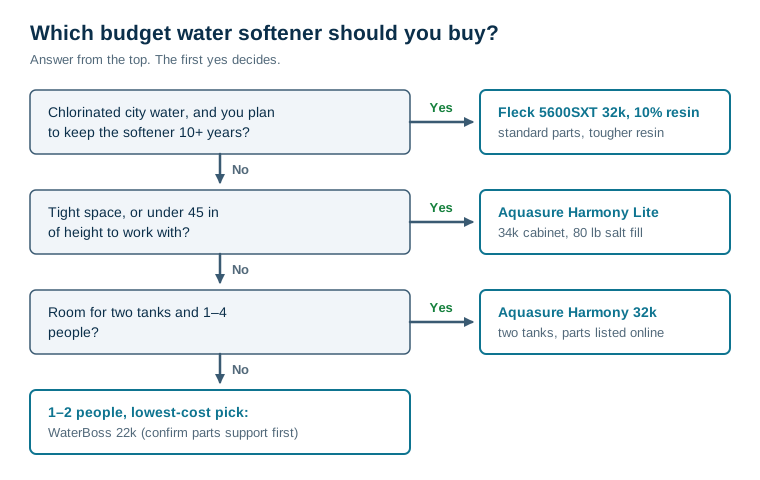
The best budget water softeners are the Aquasure Harmony Lite and Aquasure Harmony 32k, the lowest ten-year cost of the units we could fully cost, with every major part priced. A Fleck 5600SXT 32k costs more to buy but uses standard parts and tougher resin. The WaterBoss 22k is usually the cheapest at the till, but we could not find a published parts price list, so its ten-year cost stays an open question.
That is the point of ranking on ownership cost. Over a decade, salt, regeneration water and power cost a family of four on 15 gpg water about $1,830, far more than the box costs. Two budget softeners with the same resin use the same salt. What separates them is what happens when the warranty ends.
Disclosure: Hard Water Solved may earn a commission if you buy through links on this page, at no extra cost to you. It does not change which products we include or how we rank them. Read our disclaimer.
How the Ten-Year Cost Was Worked Out
Methodology. Every pick is a metered, salt-based softener listed on Amazon.com. Each one is costed for a family of four on 15 gpg chlorinated city water, using the same inputs as our total cost of owning a water softener model: 300 gallons a day, 3,000 grains removed per pound of salt, $7 a bag and $12 per 1,000 gallons of water and sewer. Installation is an illustrative $400 for a plumber fitting the unit into an existing loop. Parts were costed from the brand's own parts store. Nothing was physically tested. Excluded: timer-only units, salt-free conditioners, and units shown as unavailable on Amazon.
Prices are not listed here because they change often. Use the buttons to see the current price on Amazon.
Three cheap units that turn up on other lists did not make it:
- Whirlpool WHES18. It would be the lowest-cost pick, but Amazon shows it as currently unavailable.
- GE GXSF30V. GE lists it as no longer manufactured, and Amazon shows it as unavailable. A discontinued valve is exactly the risk this page is about.
- Tier1 24,000-grain compact. Its ceramic-disc valve, which has no seals to wear, is interesting, and the Amazon listing is live. We could not confirm the valve warranty terms today, so it is not ranked.
The Best Budget Water Softeners, Costed Over Ten Years
| Harmony Lite 34k | Harmony 32k | WaterBoss 22k | Fleck 5600SXT 32k (AFW) | |
|---|---|---|---|---|
| Install (illustrative) | $400 | $400 | $400 | $400 |
| Salt, water and power, 10 years | $1,830 | $1,830 | $1,830 | $1,830 |
| Valve parts after warranty | Seal kit and board, priced by Aquasure | Seal kit and board, priced by Aquasure | Not published | Rebuild kit, priced by AFWFilters |
| One resin change | Resin tank, priced by Aquasure | Resin tank, priced by Aquasure | Not published | 10% refill kit, priced by AFWFilters |
| Amazon | Check price on Amazon | Check price on Amazon | Check price on Amazon | Check price on Amazon |
The salt, water and power line is identical because every unit is metered and the model holds the inputs fixed. When we added each unit's purchase price and parts, the gap between the cheapest and dearest costed pick over ten years was small next to that shared running cost. Every unit's parts line assumes one valve repair after the warranty and one resin change on chlorinated water.
Two things would move the ranking:
- If the Fleck's 10% crosslink resin lasts the decade, which is more likely on chlorinated water, drop its resin line. Its total then comes out level with the Aquasure units.
- If an Aquasure valve fails outright instead of needing a seal kit and board, a complete replacement control valve costs more than those parts, which raises its total.
1. Aquasure Harmony 32k: Best Budget Softener Overall
Also sold at Home Depot and Aquasure's own store.
The Harmony 32k is a conventional two-tank softener: a 1 cu ft resin tank, a separate brine tank, and Aquasure's Aquatrol digital metered valve. Aquasure sizes it for one or two bathrooms.
Why it ranks first. Aquasure lists every major part on its own store, with a price. On 1 October 2026 that included a seal and spacer assembly, the circuit board with display, a complete replacement control valve and a pre-filled 1 cu ft resin tank. That makes it possible to cost the whole decade, which is the test this page sets.
Warranty. The current Harmony owner's manual gives two years without registration and five years on the valve, electronics and resin if you register. The resin tank and brine tank are warranted for ten years. Read the exclusion: resin and internal valve parts are not covered on water with iron, manganese or very high chlorine.
Usable capacity. One cubic foot of resin gives about 21,000 grains at an efficient 6 lb of salt and about 26,000 at 9 lb, not 32,000. For a family of four on 15 gpg, using 4,500 grains a day, that is a regeneration every three and a half to five days after a day of reserve. That is fine, but a household larger than four should move up a size. The full method is in advertised vs usable softener capacity.
Skip it if you want parts you can buy from any supplier. The Aquatrol valve is Aquasure's own, so parts come from Aquasure.
2. Aquasure Harmony Lite 34k: Cheapest for Small Spaces
The standard-resin AS-HL34A is sold at Aquasure. The Amazon listing is the version with a pleated sediment pre-filter, which costs more.
The Harmony Lite is the same Aquatrol valve in a 43 in tall cabinet that holds the resin tank inside the salt bin. It is usually the lowest-cost unit on this page and the easiest to fit. Its parts are listed on the same store, including a replacement Harmony Lite resin tank.
The running-cost catch. The cabinet takes 80 lb of salt, which is about nine weeks for a family of four at an efficient setting. That does not change the ten-year salt bill. It changes how often you refill it.
Warranty. The Harmony Lite manual gives one year on the valve, electronics and resin unregistered, five years if you register within 60 days, and a five-year replacement warranty on the system.
Skip it if your household is more than four people. Aquasure sizes it for up to four.
3. WaterBoss 22k: Lowest Price, Least Certain Decade
The 22,000-grain WaterBoss (item 74011) is also sold at Ace Hardware and Do it Best.
WaterBoss builds compact cabinet softeners in the US. The line is known for small, quick-regenerating beds, and its larger sibling, the Model 900, publishes a flow of 10 gpm at a 15 psi pressure drop, an unusually useful figure. WaterBoss gives the Model 900 five years on all parts and ten years on the media and salt tanks. Confirm that the same terms cover item 74011 before buying.
Why it ranks third. We could not find a published parts price list for this model, so its ten-year cost has a blank where the valve parts and resin should be. That does not mean the parts are expensive. It means you cannot check before you buy, and you depend on WaterBoss or a dealer for every part.
Size it honestly. A 22,000-grain cabinet suits one or two people. For a family of four on 15 gpg it would regenerate about every two days, which is efficient on salt but hard on the valve over a decade.
Skip it if you plan to keep the softener more than five years and want to know what a repair will cost.
4. Fleck 5600SXT 32k with 10% Resin: The Mid-Priced Benchmark
Also sold at AFWFilters.
This is the unit the budget picks have to beat. It is the same 1 cu ft of resin as the Harmony 32k, so its capacity at any salt setting is the same. The differences are in what lasts and what is repairable.
- The valve is a Fleck 5600SXT, one of the most widely installed residential valves. Rebuild parts are sold by many suppliers. AFWFilters lists a full rebuild kit, piston plus seal and spacer kit. Seal kits on their own sell for less at parts retailers.
- The resin is 10% crosslink, which resists chlorine better than standard resin. On city water it is more likely to last ten years. The difference is set out in standard vs chlorine-resistant softener resin. If it does need replacing, AFWFilters sells a 1 cu ft 10% refill kit.
- AFWFilters' standard terms are five years on the Fleck valve and ten on the tank.
It costs more than the Harmony 32k up front. Over ten years the gap shrinks, and almost disappears if the resin outlasts the decade. That is the honest verdict: a mid-priced Fleck is not cheaper to own than a well-supported budget unit, but it is the safer bet if you plan to keep the softener for fifteen years.
Where a Cheap Softener Really Costs More
The running cost hardly varies between metered units, so the extra cost of a cheap softener shows up in four places.
- Parts you cannot buy. A valve whose maker stops selling the board, or never published a parts list, turns a circuit-board repair into a new softener. GE's cabinet softeners are now listed as no longer manufactured. Owners will depend on whatever stock third-party sellers have left.
- A timer instead of a meter. A time-clock valve regenerates on schedule whether the resin needs it or not. That can add hundreds of dollars of salt and water over ten years, more than the saving on the box. None of the picks here is a timer unit.
- Undersizing. A bed too small for the house regenerates every day or two. Salt per grain stays similar, but the valve cycles far more often and wears faster. Size from usable grains with how to size a water softener.
- Paid maintenance. A $150 annual service visit costs $1,500 over ten years, likely more than the softener itself. All four picks are simple enough to look after yourself. A typical owner's maintenance budget is set out in annual water softener maintenance cost.
What Budget Softeners Give Up
Spending less does not mean softer or harder water. Ion exchange works the same in a budget unit as in a dealer system. What you give up is:
- Capacity per dollar on big households. Budget units top out around 32,000 grains. Large homes on hard water outgrow them.
- Iron tolerance. None of these four is sold as an iron filter. Water with significant iron or manganese needs fine-mesh resin or pretreatment.
- Warranty conditions. Most five-year cover depends on registration within a set number of days. Some depends on buying the brand's own cleaner. Register on the day you install.
- Certification. Check whether a unit is certified to NSF/ANSI 44 before you rely on its efficiency claims. The EPA's WaterSense notes on cation exchange water softeners explain why demand-initiated regeneration and rated salt efficiency matter for water use.
Who Should Buy None of These
- Households of five or more on hard water. Buy a larger bed. A budget 32k will regenerate every two or three days and still run short on heavy days.
- Well owners with iron, manganese or sulfur. Fix those first. A cheap softener fed iron fouls quickly and voids the resin warranty.
- Anyone renting. A plumbed-in softener is a poor fit for a rental. A portable or exchange-tank service may cost less overall.
- Anyone not willing to register the unit. The five-year cover on every Aquasure pick depends on registration. Without it, the ten-year cost above is optimistic.
Choose the best budget water softener on its ten-year cost, not its price tag. A well-supported budget unit and a mid-priced Fleck end up close together over ten years. An unsupported cheap unit can end up costing the price of a second softener.
Frequently Asked Questions
What is the cheapest water softener worth buying?
Among units currently listed on Amazon, the Aquasure Harmony Lite cabinet and the Aquasure Harmony 32,000-grain two-tank are the lowest-cost softeners we would buy. Both are metered, both carry five years of valve and resin cover once registered, and Aquasure lists every major replacement part with a price. A cheaper unit is only cheaper if you can still repair it in year six.
Is a cheap water softener a waste of money?
Not usually. Over ten years, salt, regeneration water and power cost a family of four on 15 gpg water about $1,830, far more than a budget softener costs to buy. A cheap metered unit uses about the same salt as an expensive one of the same resin volume. The risk with cheap units is not the running cost. It is a proprietary valve whose parts stop being sold.
How much should I spend on a water softener?
For a family of four on city water, look at a metered single-tank softener with about 1 cubic foot of resin. Its price depends mostly on the valve, the resin grade and whether it comes as a cabinet or two tanks, so check the current price on Amazon or the brand's store. Installation into an existing loop adds a few hundred dollars if you hire a plumber. Spending more buys a stronger resin, a valve with widely sold parts, or more capacity. It does not buy softer water.
Do budget water softeners use more salt?
Not if they are metered and set correctly. Salt use depends mostly on your hardness, your water use and the salt dose per regeneration. A timer-only unit wastes salt by regenerating on a schedule. Every pick on this page regenerates on demand. Set the hardness to your test result and use an efficient salt dose, and a budget unit uses about the same salt as a premium one with the same resin.
How long does a budget water softener last?
Typically eight to fifteen years, depending on chlorine, iron and maintenance. The tanks usually carry ten-year warranties. The valve, electronics and resin are where budget units differ. Aquasure covers them for five years if you register, and AFWFilters covers the Fleck valve for five years. After that, life depends on whether parts are still available at a sensible price.
