
Chlorine-Resistant Softener Resin: Is 10 Percent Worth It?
Chlorine resistant softener resin is ordinary softening resin made with 10 percent divinylbenzene crosslinking instead of the standard 8 percent. The tighter structure lets it last noticeably longer on chlorinated city water. It is usually worth the premium once your tap residual is above a few tenths of a mg/L.
Above roughly 3 mg/L, a carbon filter that removes the chlorine first is the cheaper way to protect the bed.
What Makes Chlorine Resistant Softener Resin Different
Chlorine attacks the crosslinks that hold each resin bead rigid. As they break, the bead takes on water, swells, softens and eventually fractures. How that damage shows up in a working softener is covered in how chlorine damages water softener resin. The point here is that more crosslinks means more structure to lose.
Purolite's data sheets for its standard and 10 percent grades show what the change does to the bead:
| Property | Purolite C100E (8% standard) | Purolite C100x10 (10%) |
|---|---|---|
| Total capacity | 1.9 eq/L | 2.2 eq/L |
| Moisture retention | 46–50% | 40–43% |
| Particle size | 300–1,200 µm | 300–1,200 µm |
| Specific gravity | 1.27 | 1.3 |
| Listed advantage | "Efficient regeneration" | "Superior resistance to oxidation" |
Three things follow from those figures.
It holds less water. Lower moisture retention is the tighter structure showing. That is where the oxidation resistance comes from. Purolite's note on factors affecting softening resin performance and life says it plainly: "The higher the crosslinking (DVB content), the greater the resistance to oxidative attack and the longer the resin life in the duty."
It is not lower in capacity. Total capacity per litre is higher for the 10 percent grade, not lower. The usable capacity at a household salt dose is lower than the total for both. The practical rule is to size the softener the same way for either grade, and not to pay for 10 percent expecting extra grains.
It is heavier. The denser bead needs more backwash flow to reach the same bed expansion. The C100x10 data sheet's expansion curve sits well to the right of the standard grade's. On a well with marginal pump capacity, that is worth checking before a re-bed. On city water it rarely matters.
One check before you buy. Resin for a drinking-water softener should carry a drinking-water certification. Purolite's C100E data sheet lists WQA certification to NSF/ANSI 61. Its C100x10 sheet lists industrial softening as the principal application and no such certification. Potable-grade 10 percent resins are sold, so ask for the data sheet of the exact product and confirm the listing.
The Chlorine Arithmetic
Purolite's note gives the rule of thumb most of the industry works from: "for each 1 mg/l (1 ppm) of chlorine present in the incoming water supply, the life of the resin will be reduced by 50%." It also says a premium resin in a well-designed system "can give reliable operation for over ten years" without that stress.
Build a simple model from those two statements. Assume 12 years of life on chlorine-free water, halving for each 1 mg/L. For the 10 percent grade, use the life multiple resin sellers commonly quote, about twice as long under chlorine. Cap it at the same 12 years, because on clean water something other than oxidation ends a bed's life first.
| Chlorine residual at the tap | 8% resin, expected life | 10% resin, expected life |
|---|---|---|
| None detectable | about 12 years | about 12 years |
| 0.5 mg/L | about 8.5 years | about 12 years |
| 1 mg/L | about 6 years | about 12 years |
| 2 mg/L | about 3 years | about 6 years |
| 3 mg/L | about 1.5 years | about 3 years |
| 4 mg/L | under a year | about 1.5 years |
Two cautions. First, no manufacturer data sheet publishes the "twice as long" figure. It comes from resin sellers, so it is a best case. The sums below also show what happens at one and a half times. Second, the rule of thumb can be optimistic. The same Purolite note warns that 1 mg/L of free chlorine at 15 °C can cut resin life to under two years, and that iron in the water acts as a catalyst for the attack. Treat the table as a planning scale, not a guarantee.
The top of the scale is set by regulation. EPA's national primary drinking water regulations cap both chlorine and chloramines at a maximum residual disinfectant level of 4.0 mg/L. Most taps sit well below that, but homes near a treatment plant, and every home during a utility's seasonal free-chlorine flush, can see the upper end.
Price the Premium Against the Re-Beds It Avoids
A spec comparison asks which resin is better. The useful question is which costs less per year of softened water. That needs two numbers from you: the price of a re-bed with each resin, and your residual.
Worked example, 1.5 cubic foot bed. These prices are placeholders. Substitute your own quotes.
- Re-bed with 8 percent resin: $480 (resin plus labour).
- Re-bed with 10 percent resin: $555 (a $75 premium for the resin).
- Cost per year = re-bed cost ÷ expected life.
| Residual | 8% resin per year | 10% resin per year | Cheaper |
|---|---|---|---|
| None | $40 | $46 | 8% |
| 0.2 mg/L | $46 | $46 | Break-even |
| 0.5 mg/L | $57 | $46 | 10% |
| 1 mg/L | $80 | $46 | 10% |
| 2 mg/L | $160 | $93 | 10% |
| 3 mg/L | $320 | $185 | 10%, but see carbon below |
The premium pays for itself at almost any measurable residual. A $75 difference is recovered as soon as it buys even a couple of extra years. Below about 0.2 mg/L, and on well water with no chlorine at all, it buys nothing.
If the 10 percent grade only lasts one and a half times as long, the break-even barely moves, because both grades hit the same 12-year ceiling at low residuals. The gap narrows higher up: at 1 mg/L it becomes $62 against $80 a year, and at 2 mg/L $123 against $160. The conclusion for typical city water, where residuals usually sit between about 0.5 and 2 mg/L, does not change.
Where Carbon Pretreatment Beats Upgraded Resin
Upgraded resin slows chlorine damage. A carbon filter ahead of the softener stops it, by removing the chlorine before it reaches the bed. The resin then lives as if it were on chlorine-free water. The question is whether that protection costs less per year than the re-beds it saves.
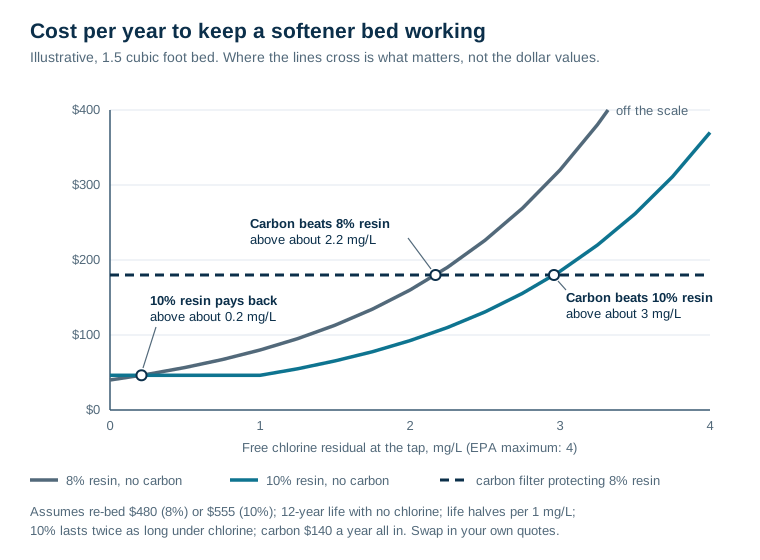
Carbon's annual cost is the installed filter spread over its life, plus media replacement. In the example that comes to $140 a year: a system around $1,200 installed over 15 years, plus media changes of about $240 every four years. Add the protected 8 percent bed at $40 a year and carbon-plus-resin costs about $180 a year, flat, whatever the residual.
Against that flat line:
- Carbon beats unprotected 8 percent resin above about 2.2 mg/L.
- Carbon beats unprotected 10 percent resin above about 3 mg/L.
- Between about 0.2 and 3 mg/L, 10 percent resin with no carbon is the cheapest way to keep a bed working.
The sums move with your assumptions. Try these variations:
| Change | Carbon beats 10% resin above |
|---|---|
| Base case | about 3.0 mg/L |
| 10% resin lasts only 1.5 times as long | about 2.5 mg/L |
| Carbon costs $250 a year, not $140 | about 3.6 mg/L |
Three factors can override the arithmetic.
- Chloramine. It persists longer in the pipes, and removing it needs catalytic carbon with roughly double the contact time. That means a bigger, dearer vessel, which pushes carbon's line up. It also means a steady exposure that 10 percent resin only slows. How chloramine affects a water softener covers the sizing.
- You want chlorine out of the water anyway. Carbon removes chlorine taste and odour at every tap. Resin of any crosslink removes neither. If that matters to you, carbon earns its cost before resin life enters the sum. Placement and sizing are covered in a carbon filter before a water softener.
- Both together. On a high-residual or chloramine supply, 10 percent resin behind carbon is a reasonable belt-and-braces choice. It covers the weeks when a carbon bed nears exhaustion and lets some chlorine through.
Find Your Residual Before You Decide
Every number above depends on one measurement most owners have never taken.
- Read your utility's annual water quality report. It names the disinfectant, chlorine or chloramine, and gives the range of residual measured across the year. Use the top of the range, not the average.
- Test at your own tap with a kit that reads free and total chlorine separately. A large gap between them indicates chloramine. Homes far from the plant often read lower than the report.
- Ask about seasonal flushes. Many chloramine systems switch to free chlorine for a few weeks a year. A bed exposed to that every spring ages faster than the annual figure suggests.
- On a well, the residual is zero except after shock chlorination. Bypass the softener when you shock the well, and 10 percent resin buys you nothing.
Then read the figure against this table:
| Your residual | Sensible choice |
|---|---|
| None detectable (most wells) | Standard 8% resin |
| Up to about 0.2 mg/L | 8% resin; the premium barely pays |
| About 0.2 to 2 mg/L | 10% resin, no carbon needed for resin life |
| About 2 to 3 mg/L | 10% resin, or carbon if you also want chlorine out of the water |
| Above about 3 mg/L | Carbon pretreatment, with either resin behind it |
| Chloramine at any level | Price catalytic carbon; use 10% resin either way |
When the time comes to replace a bed, the timing and the signs are in water softener resin life and when to replace it.
What Chlorine Resistant Resin Cannot Do
- It cannot remove chlorine from your water. Softening resin does not exchange chlorine or chloramine. The water leaves the softener with the same disinfectant it arrived with.
- It cannot stop oxidation. It slows it. At high residuals a 10 percent bed still wears out on a short schedule.
- It cannot resist fouling any better. Iron, manganese, sediment and organics coat 10 percent beads just as they coat 8 percent ones, and iron speeds up chlorine damage on both.
- It cannot make a timer softener efficient. Resin life and salt efficiency are separate problems.
- It cannot rescue a bed that is already damaged. Swollen, soft beads have to be replaced. Choose the upgrade at the next re-bed, and fix the chlorine exposure at the same time.
The decision reduces to two numbers: your tap residual and your re-bed price. For most city water, 10 percent resin is the cheaper bed to own. Above about 3 mg/L, or on chloramine, carbon pretreatment is the part that protects the investment.
Frequently Asked Questions
What is chlorine resistant softener resin?
It is softening resin made with more divinylbenzene crosslinking, usually 10 percent instead of the standard 8 percent. The extra crosslinks give each bead more structure to lose before chlorine breaks it down. Purolite lists 'superior resistance to oxidation' for its 10 percent grade, and states that the higher the crosslinking, the greater the resistance to oxidative attack and the longer the resin life. It still degrades, just more slowly.
Is 10% crosslink resin worth it?
On chlorinated city water, usually yes. In a worked example on a 1.5 cubic foot bed, 10 percent resin became the cheaper option per year at any residual above about 0.2 mg/L, because the extra years of life outweigh the price premium. On a chlorine-free well it buys nothing, since the resin will fail from fouling or wear long before oxidation matters. Check the residual at your tap before deciding.
How long does 10% crosslink resin last compared to 8%?
Resin sellers commonly quote about twice the life on chlorinated water. Resin manufacturers' data sheets do not publish a multiplier, so treat twice as an optimistic planning figure and run the sums at one and a half times as well. The underlying rule of thumb, from Purolite, is that each 1 mg/L of chlorine in the supply cuts resin life by about half.
Is carbon pretreatment better than chlorine resistant resin?
Above a certain residual, yes. Carbon removes the chlorine before it reaches the resin, so the bed lives as if it were on chlorine-free water. Upgraded resin only slows the damage. In the worked example, carbon became cheaper than 8 percent resin at about 2.2 mg/L and cheaper than 10 percent resin at about 3 mg/L. Carbon also removes chlorine taste and odour, which resin never does.
Does 10% crosslink resin have less capacity?
Not on paper. Purolite's data sheets give 2.2 eq/L total capacity for its 10 percent grade against 1.9 for its standard 8 percent resin, because the tighter bead holds less water and more exchange sites per litre. What you use at home is the operating capacity at your salt dose, which is lower than total capacity for both grades. Do not buy 10 percent expecting more grains, and do not reject it expecting fewer.
Does chlorine resistant resin remove chlorine from water?
No. Softening resin exchanges positively charged ions like calcium and magnesium. Chlorine and chloramine are not removed by that process. The water leaving a softener carries the same disinfectant it arrived with. Chlorine-resistant resin only tolerates the chlorine better. If you want chlorine out of the water itself, that is a job for activated carbon, or catalytic carbon for chloramine.
