
Annual Water Softener Maintenance Cost
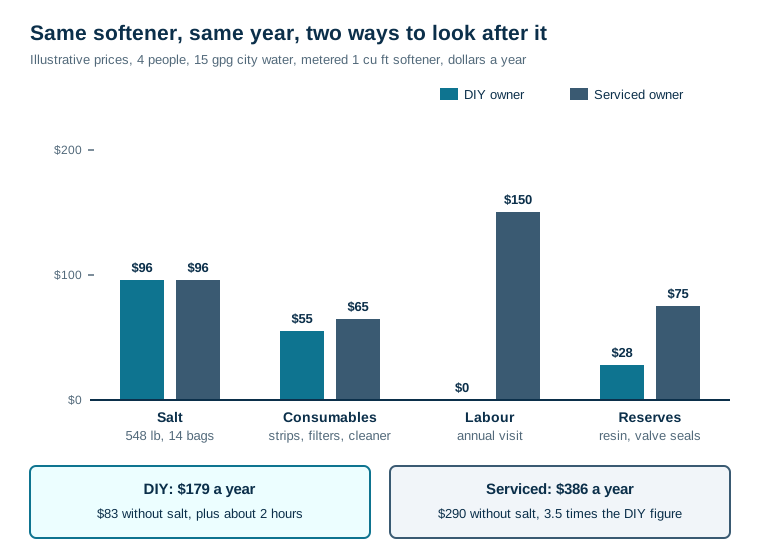
The water softener annual maintenance cost for a typical home is modest if you do the work yourself: about $180 a year including salt, or about $80 without it, in the example below. Paying for an annual professional visit raises that to about $385, and the non-salt part to about $290, three and a half times the DIY figure. Both totals include something most budgets leave out: a yearly reserve for the resin that will one day need replacing.
The figures are a worked example, not a quote. Every price is written out, so you can replace it with your own.
Water Softener Annual Maintenance Cost at a Glance
The example household: four people, 15 gpg city water with chlorine, a metered single-tank softener with about one cubic foot of resin, and a sediment prefilter. The salt line comes from the same assumptions as our total cost of owning a water softener model, so the two pages agree.
| DIY owner | Serviced owner | |
|---|---|---|
| Salt | $96 | $96 |
| Consumables | $55 | $65 |
| Labour | $0, plus about 2 hours of your time | $150 |
| Reserves for resin and valve | $28 | $75 |
| Total a year | $179 | $386 |
| Without salt | $83 | $290 |
The Task List Behind the Numbers
A cost figure is only concrete if you know what it pays for. These prices follow the routine in our water softener maintenance schedule, which comes to about five minutes a month and one hour a year:
- Monthly: check the salt level, probe for a salt bridge, record the gallons since the last regeneration, look for leaks, and test one tap for hardness.
- Every two to three months: check the prefilter's pressure drop and the drain line.
- Annually: clean the brine tank, clean the injector and its screen, test raw against softened water, check the settings, change the prefilter if due, and clean the resin if the water has iron or capacity is falling.
Owner's manuals list the same kind of tasks. The Hellenbrand H125 owner's manual has its own maintenance section covering salt and brine tank cleaning, and its troubleshooting table calls for an "iron reducing resin cleaner to clean resin bed" when iron is fouling the resin. The Fleck 5600SXT manual lists "Clean injector screen" as the remedy when the injector screen is plugged. None of these tasks needs a technician.
The DIY Owner's Year, Line by Line
All prices are illustrative. Check your own store and parts supplier.
| Item | Quantity a year | Price assumed | Cost a year |
|---|---|---|---|
| Sodium chloride salt | 548 lb, about 14 bags of 40 lb | $7 a bag | $96 |
| Hardness test strips | One pack | $15 | $15 |
| Sediment prefilter cartridges | Three, changed on pressure drop | $10 each | $30 |
| Resin cleaner | One bottle on city water | $10 | $10 |
| Valve seal and spacer kit | One per ten years | $28 per kit | $3 |
| Resin reserve, DIY rebed | One per ten years | $250 for resin and parts | $25 |
| Total | $179 |
Salt is half the DIY total and the line that varies most. It follows hardness and household size, and a badly set softener can double it. Work it out from your own hardness and water use rather than copying the $96.
Prefilter cartridges belong here only if a prefilter is fitted. How many you use depends on your water. Change them when the pressure drop across the housing says so, not on a calendar.
Time is the hidden DIY cost: about two hours a year. For most owners that is the whole case for doing it yourself.
The Serviced Owner's Year, Line by Line
| Item | Assumption | Cost a year |
|---|---|---|
| Salt | Same as DIY, added by you or delivered | $96 |
| Annual service visit | One routine visit, $150 | $150 |
| Prefilter cartridges fitted at visits | Supplied at a markup | $45 |
| Resin cleaner applied | At the visit | $20 |
| Valve rebuild reserve | $150 of parts and labour per ten years | $15 |
| Resin reserve, dealer replacement | $600 installed per ten years | $60 |
| Total | $386 |
The $150 visit is a placeholder, matching the ten-year ownership model. Prices vary by region and by what the visit includes.
Salt delivery is not included. Where a dealer delivers and loads salt, the bag price is usually higher than at a store, so add the difference to the salt line if you use one.
What the visit buys is mostly the annual hour, done by someone else, plus a second opinion on the settings. What it does not buy is the monthly check. A single annual visit cannot catch a salt bridge that forms in June or a leak that starts in August. The owner still has to look.
The Line Almost Everyone Leaves Out: Resin
Most "maintenance cost" figures stop at salt and the service visit. They leave out the resin, which wears out, so they undercount the real annual cost.
Resin wears for three main reasons:
- Chlorine and chloramine in city water slowly oxidise the beads. The higher the residual, the shorter the life.
- Iron and manganese foul the beads and cut their capacity, and cleaners only partly reverse it.
- Sediment and fines block the bed and cause channelling.
On clean, unchlorinated well water the resin may outlast the valve. On chlorinated city water, a resin change within a decade is a reasonable planning assumption. How to tell when yours is due, and what a rebed involves, is covered in water softener resin life and replacement.
Counting it annually is simple: divide the replacement cost by the years you expect it to last. A $250 DIY rebed over ten years is $25 a year. A $600 dealer replacement is $60. If your water is chlorine-free and iron-free, stretch the years. If it has iron or a high chlorine residual, shorten them.
Putting that reserve in the annual figure does two things. It stops a four-figure repair from feeling like a surprise, and it makes a DIY-versus-serviced comparison fair, because dealer resin work usually costs more.
When Paying for Service Makes Sense
Paying someone is not always the wrong choice. It is worth it when:
- The water is difficult. Iron, manganese, or a softener in a multi-stage well train benefits from someone who knows the whole system.
- The owner cannot do the monthly check. For an elderly owner, a rental property or a second home, a paid visit may be the only inspection the softener gets.
- The warranty requires it. Some dealer warranties are conditional on dealer servicing. Read the terms before choosing.
- A fault needs inside-the-valve work that the owner is not comfortable with.
What decides whether a contract is good value is what it covers beyond the visit. Parts and repair labour matter far more than an annual check. That comparison is set out in is a water softener service contract worth it.
The Ten-Year View
Annual figures hide how the difference adds up. Over ten years, the example comes to:
| DIY owner | Serviced owner | |
|---|---|---|
| Salt | $960 | $960 |
| Everything else, including reserves | $830 | $2,900 |
| Ten-year maintenance total | $1,790 | $3,860 |
The $2,070 gap is more than the $1,500 installed price used for a softener in our ownership model. That is the real decision behind "DIY or serviced". Over the life of the softener, paying for routine visits can cost as much as a second unit. If you are still choosing that unit, the same arithmetic of salt, parts prices and repairs is how we ranked low-cost softeners on ten-year ownership cost.
The reserves also stop being theoretical in these years. At some point in the decade the resin, a seal kit or both will be spent. An owner who has set aside $28 or $75 a year pays for them from the reserve, not from an emergency.
Where DIY Owners Overspend
The DIY column assumes sensible buying. These are the usual ways it creeps up.
- Premium salt the water does not need. Plain evaporated or solar salt is enough for most softeners. Salt with added iron remover only helps on water with iron, and it costs more per bag.
- Resin cleaner on clean city water. On water with no iron or manganese, routine cleaner does little. Use it when the log shows capacity falling, or when the brine tank residue turns orange.
- Cartridges changed on the calendar. A prefilter changed every month "to be safe" can triple the cartridge line. Change it on pressure drop.
- Topping salt to the brim. A full brine tank does not soften better and encourages salt bridges. Keeping it between a third and two-thirds full uses the same salt with fewer problems.
The reverse also happens. Skipping the annual injector clean or the hardness test saves nothing. Those faults show up later as wasted salt or a service call.
What Moves Your Number Up or Down
| Factor | Effect on the annual cost |
|---|---|
| Harder water | Raises salt roughly in proportion. At 25 gpg the example's salt line rises from $96 to about $160 |
| Iron in the water | Adds resin cleaner, perhaps twice a year, and shortens the resin reserve period |
| High chlorine or chloramine | Shortens the resin reserve period; a carbon prefilter adds its own media cost but protects the resin |
| No prefilter needed | Removes $30 to $45 |
| Potassium chloride instead of salt | Multiplies the salt line, because potassium chloride costs considerably more per bag |
| Timer control instead of metered | More regenerations, so more salt, for the same water |
| Fewer people or softer water | Shrinks the salt line; the fixed items barely change |
The fixed items, test strips, the visit and the seal kit, do not change with hardness. On moderately hard water they make up a larger share of the total.
What Maintenance Money Cannot Buy
- It cannot fix a softener that is the wrong size. An undersized unit regenerates constantly however well it is looked after.
- It cannot make a softener treat other contaminants. Maintenance keeps it removing hardness. It still does not remove bacteria, nitrate, lead or arsenic.
- It cannot make up for a missing pretreatment stage. Iron above the softener's rating, or chlorine with no carbon, wears the resin whatever the cleaning schedule.
- It does not replace testing. A test strip checks hardness at the tap. It says nothing about anything else in the water.
Start from the DIY column. Replace each price with your own, add the resin reserve that suits your water, and then decide whether a paid visit is worth the difference. That gives you a water softener annual maintenance cost you can plan for.
Frequently Asked Questions
How much does it cost to maintain a water softener per year?
In the illustrative example on this page, a four-person home on 15 gpg city water spends about $179 a year maintaining a softener itself, including $96 of salt. The same home paying for an annual professional visit spends about $386. Without salt, the figures are about $83 and $290. Hardness, iron and chlorine move them the most.
How much does a water softener service call cost?
Prices vary widely by region and by what the visit includes. This page uses $150 for a routine annual visit as a placeholder, the same figure used in our ten-year ownership model. Ask for a written list of what the visit covers, because a visit that only adds salt and checks the display does little that an owner cannot do in five minutes.
What is the most expensive part of water softener maintenance?
For a DIY owner it is salt, about half the annual total. For a serviced owner it is the service visit itself. The item most budgets miss is resin: on chlorinated city water a resin change often falls somewhere around the eight-to-twelve-year mark, and setting aside part of that each year is the honest way to count it.
Do I need a professional to maintain my water softener?
Not for routine care. The monthly check takes about five minutes and the annual service about an hour, using a bucket, a test kit and a screwdriver. A technician is worth paying for when the log shows a fault you cannot fix, for internal valve repairs, or when the warranty requires dealer servicing.
How often should water softener resin be replaced?
It depends on the water. On clean, unchlorinated well water resin can last well beyond ten years. Chlorine and chloramine in city water break it down faster, and iron fouls it. For budgeting, the example here spreads one resin change over ten years, which adds $25 a year for a DIY rebed and $60 for a dealer replacement.
Is a water softener service contract worth it?
Only if it covers things you would otherwise pay for, such as parts and repair labour, and you would not do the routine checks yourself. A contract built around one annual visit cannot catch faults that develop between visits. Compare its yearly price with the DIY figures on this page before signing.
