
Best RO Systems to Pair With a Water Softener: 3 NSF/ANSI 58 Picks

The best RO systems to pair with a water softener are the APEC ROES-50 for most homes, the iSpring RCC7AK if you want minerals added back, and the Waterdrop G3P600 if cabinet space is tight and you are on city water. All three are certified to NSF/ANSI 58, the reverse osmosis standard, and we confirmed that before ranking anything else.
The pairing works because each unit covers the other's weakness. The softener keeps calcium and magnesium off the membrane, which is one of the main causes of early membrane failure. The membrane then removes most of the sodium the softener added. On softened 20 gpg water, that takes the added sodium from about 158 mg/L down to about 10 mg/L at the drinking tap.
Disclosure: Hard Water Solved may earn a commission if you buy through links on this page, at no extra cost to you. It does not change which products we include or how we rank them. Read our disclaimer.
How We Chose
Methodology. Nothing on this page was physically tested. Certifications were checked against the certifier's listing or the maker's certification statement on the day of writing. Output, waste ratio, filter life and warranty terms are taken from the manuals and performance data sheets.
- Included: under-sink RO systems sold on Amazon.com, with NSF/ANSI 58 certification of the whole system that we could confirm.
- Compared on: waste ratio, tank vs tankless, mineral stage, filter change intervals, and any hardness or water-source rule in the warranty.
- Excluded: the Home Master TMAFC, because its maker cites NSF-certified components and we found no system listing under NSF/ANSI 58; the Express Water ROALKUV10M, whose listing claims NSF/ANSI 372 for lead-free materials only; and countertop units, which are not plumbed to a softened line.
- Prices are not listed here because they change often. Use the buttons to see the current price on Amazon.
The order of the two units, and why softening first is the rule, is covered in reverse osmosis and a water softener together. This page is about which RO to buy once that decision is made.
Best RO Systems for a Softened Home Compared
| APEC ROES-50 | iSpring RCC7AK | Waterdrop G3P600 | |
|---|---|---|---|
| Best for | Most softened homes, city or well | Mineral taste and higher pH | Tight cabinets, city water |
| NSF/ANSI 58 | WQA, TDS reduction (per manual) | NSF International, 9 claims on the -BN and -BLK models | IAPMO R&T, with 42 and 372 |
| Format | Tank, about 4 gal | Tank | Tankless, needs a power outlet |
| Rated output | 50 GPD at 60 psi | 75 GPD membrane; NSF test 25.41 GPD | 600 GPD |
| Waste ratio | Efficiency 11.8%, about 7.5 gal to drain per gallon | Not published | 2:1 pure to drain |
| Mineral stage | None | Alkaline stage, about 30 to 60 mg/L Ca and Mg | None |
| Hardness rule | Manual: softening helps membranes greatly | Warranty: 7 gpg or less | Warranty: under 7 gpg, municipal water only |
| Warranty | 1 year | 1 year on registration | 1 year |
| Amazon | Check price on Amazon | Check price on Amazon | Check price on Amazon |
Read the hardness row first. Two of the three makers tie the warranty to feed hardness of 7 gpg or less. In a home with a working softener, that condition is met for you. It is one of the less obvious reasons to pair the two.
Sodium on Softened Water: A Worked Example
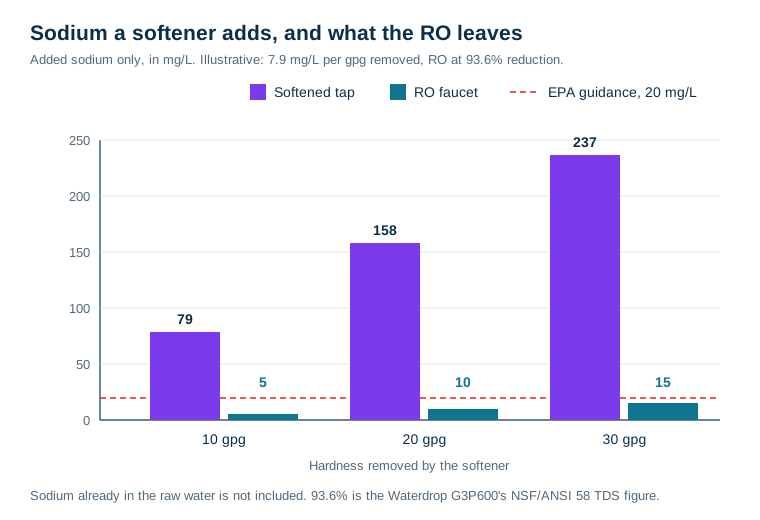
The arithmetic is simple. A softener adds about 7.9 mg/L of sodium for every grain of hardness it removes. The full reasoning, and what it means for diets, is in sodium in softened water. Here is what each step looks like for a 20 gpg home:
- Softened tap: 20 × 7.9 = about 158 mg/L of added sodium. That is about 37 mg in an 8 oz glass.
- After the RO: the Waterdrop G3P600's performance data sheet records 93.59 percent TDS reduction under NSF/ANSI 58. Apply that to the added sodium and about 10 mg/L is left, roughly 2.4 mg in a glass.
- Against the guidance level: EPA's drinking water advisory on sodium sets a 20 mg/L guidance level for people restricted to 500 mg of sodium a day. The RO water sits under it even at 30 gpg, before counting any sodium already in your raw water.
Two cautions. Sodium is a small ion, and membranes reject it a little less well than some other dissolved solids, so treat 93.6 percent as a guide, not a guarantee. And APEC's manual says a good membrane leaves product water at about 3 to 10 percent of the feed TDS. Your result depends on your membrane, pressure and water. An inexpensive TDS meter, used on the softened tap and the RO faucet, tells you your own rejection rate.
1. APEC ROES-50: Best RO for Most Softened Homes
- Stages: three pre-filters, the RO membrane and a carbon post-filter. No mineral stage
- Certification: WQA to NSF/ANSI 58 for TDS reduction, per APEC's manual. The Amazon listing also cites NSF/ANSI 372
- Output: 50 GPD at 60 psi, about 30 GPD at 50 psi
- Feed limits: 40 to 85 psi, 40 to 100°F, TDS up to 2,000 ppm
- Filters: pre-filters every 6 to 12 months; membrane every 2 to 4 years on city water, about every 2 years on well water
Why it ranks first. It is the simplest system here, and in a softened home simplicity pays. APEC's installation and owner's manual lists extremely hard water as a cause of premature membrane failure and says a softener helps greatly. On softened city feed, the pre-filters can run the full 12 months and the membrane the full 4 years. On unsoftened or well water, expect to change them sooner.
Why a plain RO suits softened water. The membrane removes the softener's sodium, and there is no mineral cartridge putting hardness back. If you like the taste of plain RO water, that is one less filter and one less decision.
Watch for: waste. APEC's performance data gives an efficiency rating of 11.8 percent. That is about 7.5 gallons to drain for each gallon you drink. EPA's WaterSense page on point-of-use RO says WaterSense-labelled systems must send 2.3 gallons or less. In a softened home that reject water has already been softened, so it carries a small salt cost (see below).
2. iSpring RCC7AK: Best for Minerals Back and a pH Lift
- Stages: sediment, two carbon stages, RO membrane, post-carbon and an alkaline remineralisation stage
- Certification: NSF International's listing covers the RCC7AK-BN and RCC7AK-BLK under NSF/ANSI 58 for asbestos, barium, cadmium, trivalent chromium, copper, fluoride, lead, selenium and TDS reduction
- Output: 75 GPD membrane rating; the NSF listing gives 25.41 GPD for the whole system under test conditions
- Filters: iSpring's yearly filter set, plus the membrane every 2 to 3 years
- Warranty: 1 year on registration. iSpring's RO manual makes feed hardness of 7 gpg or less a warranty condition
Why it ranks second. It is the only pick with a mineral stage, and its certification covers more than TDS. According to iSpring, the alkaline stage holds calcite, mineral balls and magnesium oxide, and adds back about 30 to 60 mg/L of calcium and magnesium. That raises the pH of RO water, which is usually slightly acidic, and changes the taste.
Check the model. The Amazon listing is the RCC7AK-BN. NSF's listing for the plain RCC7AK, made at iSpring's Taiwan facility, covers TDS reduction only. If the lead and fluoride claims matter to you, buy the -BN or -BLK.
Watch for: the refill wait. A tank system takes 1 to 3 hours to refill once it runs dry. And iSpring publishes no waste ratio, so you cannot cost its drain water in advance.
3. Waterdrop G3P600: Best Tankless RO on Softened City Water
- Format: tankless, with a TDS readout on the faucet. Needs an electrical outlet under the sink
- Certification: certified by IAPMO R&T to NSF/ANSI 42 and 58 for the listed claims, and 372 for lead-free materials, per its performance data sheet
- Output and waste: 600 GPD, 2:1 pure to drain
- Filters: CF prefilter 6 months, carbon block 12 months, RO filter 24 months
- Warranty: 1 year, valid only on municipal tap water under 750 ppm TDS and under 7 gpg
Why it is here. It wastes the least water of the three, fills a glass on demand, and fits a small cabinet. On softened city water its warranty conditions are easy to meet. Without a softener, many hard-water homes would be outside them.
Watch for: the well-water exclusion. Softening fixes the hardness condition but not the municipal one. If you are on a well, buy one of the tank systems above. The G3P600 also needs a power outlet and three cartridges on a fixed schedule.
Which RO for Your Softened Home
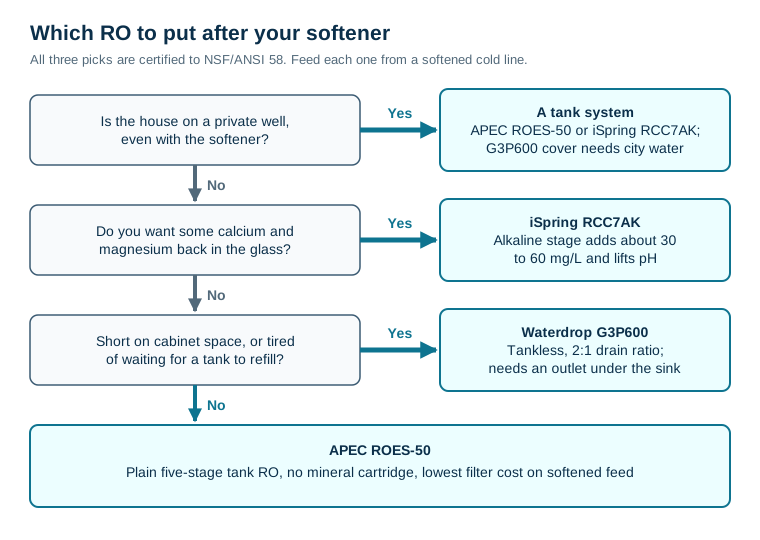
The chart settles most cases. Two things it leaves out:
- Pressure. A tank RO's output and tank fill both fall with pressure. If your house runs near 40 psi after the softener, the APEC tank holds less and a permeate pump helps. The tankless G3P600 has its own pump.
- The tap. Feed the RO from a softened cold line. Some homes leave the kitchen cold tap on hard water instead. That avoids sodium, but that tap then misses every other treatment and shortens the membrane's life. Why RO usually beats a bypass tap is covered in should a kitchen tap bypass the softener.
The Hidden Cost of Waste Water on a Softened Supply
Every gallon an RO sends to drain has already passed through the softener. That costs salt as well as water. The figures below are illustrative. They assume 3 gallons of drinking water a day, 20 gpg hardness, and a softener getting about 3,500 grains per pound of salt, the yield at a 6 lb per cubic foot setting.
| System | Drain water per year | Grains softened for the drain | Salt used |
|---|---|---|---|
| APEC ROES-50 (about 7.5:1) | about 8,200 gal | about 164,000 | about 47 lb |
| Waterdrop G3P600 (2:1 pure to drain) | about 550 gal | about 11,000 | about 3 lb |
| iSpring RCC7AK | not published | not known | not known |
Illustrative. Your hardness, salt setting and use change every figure.
The salt used is small either way, at most about one bag a year. The water cost depends on your rate, and on a low-yield well the drain volume matters more than the money. If water is scarce, the G3P600's 2:1 ratio or a permeate pump on a tank system is worth more than any other spec on this page.
Who Should Buy None of These
- Homes without a softener on very hard water. Two of these warranties need feed at 7 gpg or less. Fix the hardness first. Whether you need both units, or only one, is covered in water softener vs reverse osmosis.
- Anyone who wants whole-house treatment. These are drinking-water systems for one tap. They do nothing for showers, laundry or the water heater.
- Wells that are not microbiologically safe. RO is not a disinfection system. Test for bacteria and treat the well first.
- Renters who cannot drill a countertop or tap a drain line. A countertop RO, filled by hand, is the better fit there.
- Buyers who need a certified claim for one specific contaminant. Check the listing for that exact claim and model. A system certified for TDS reduction is not automatically certified for arsenic or nitrate.
In a softened home the RO's job is small and clear: remove the sodium, plus whatever else the softener cannot. The APEC ROES-50 does that most simply. The iSpring RCC7AK adds minerals back with the broadest certification here. The Waterdrop G3P600 wastes the least water, as long as your supply is municipal.
Frequently Asked Questions
Should I put a reverse osmosis system after a water softener?
Yes. The softener goes at the point of entry and the RO under the kitchen sink, fed from a softened cold line. Hardness is one of the main causes of early membrane failure, and APEC's manual says adding a softener helps greatly. The RO then removes most of the sodium the softener added, so the drinking tap gets low-sodium water while the rest of the house stays soft.
Does reverse osmosis remove sodium from softened water?
Most of it. A softener adds about 7.9 mg/L of sodium for every grain per gallon of hardness it removes. The Waterdrop G3P600's NSF/ANSI 58 test data shows 93.59 percent TDS reduction, and at that rate softened 20 gpg water drops from about 158 mg/L of added sodium to about 10 mg/L. Sodium is a small ion, so check your own result with a TDS meter rather than assuming the exact figure.
What is the best RO system to use with a water softener?
For most softened homes, the APEC ROES-50. It is a plain five-stage tank system certified by WQA to NSF/ANSI 58, with no mineral cartridge to maintain and long filter intervals on softened feed. Choose the iSpring RCC7AK if you want calcium and magnesium added back, or the Waterdrop G3P600 if you have little cabinet space and city water.
Do I need a remineralization stage if I have a softener?
No, it is a taste choice. RO water from softened feed is low in both sodium and minerals, and some people find it flat. A mineral stage, such as the alkaline filter on the iSpring RCC7AK, adds back about 30 to 60 mg/L of calcium and magnesium and raises pH. It does not make the water safer, and it is one more cartridge to replace.
Is a tankless RO system OK on softened well water?
Check the warranty first. The Waterdrop G3P600's manual makes its limited warranty valid only on municipal tap water under 7 gpg of hardness and 750 ppm TDS. Softening fixes the hardness condition but not the well condition. On a well, a tank system such as the APEC ROES-50 or iSpring RCC7AK avoids the problem.
