
Best UV Systems for Well Water, and the Pretreatment Each One Needs
The best UV systems for well water are the VIQUA VH410M, with a UV sensor, and the lower-cost VIQUA VH410 without it. Both treat 14 gpm at the 40 mJ/cm² dose NSF and EPA use. The iSpring UVF55FS, a 12 gpm unit, is a budget option with no published dose. Any of them only works on water that is already clear. VIQUA's manual sets the limits at the UV: iron under 0.3 ppm, manganese under 0.05 ppm, hardness under 7 gpg, turbidity under 1 NTU and UV transmittance above 75%. It also requires a 5 micron filter in front. On most wells that means the UV comes last, after an iron filter, a softener and a sediment filter.
Disclosure: Hard Water Solved may earn a commission if you buy through links on this page, at no extra cost to you. It does not change which products we include or how we rank them. Read our disclaimer.
Best UV Systems for Well Water at a Glance
| Pick | Flow at 40 mJ/cm² | Flow at 30 mJ/cm² | UV sensor | NSF/ANSI 55 listing | Amazon |
|---|---|---|---|---|---|
| VIQUA VH410M | 14 gpm | 18 gpm | Yes | VH410M-V version: Class B | Check price on Amazon |
| VIQUA VH410 | 14 gpm | 18 gpm | No (lamp timer and alarm) | VH410-V version: Class B | Check price on Amazon |
| iSpring UVF55FS | not stated | not stated | No (flow sensor) | Not listed | Check price on Amazon |
VIQUA flows are at 95% UV transmittance at end of lamp life, from the VH410 spec sheet.
How These UV Systems Were Chosen
Method. Nothing on this page was physically tested by us. Each system is compared on its flow at a stated UV dose, the water quality limits in its owner's manual, its standing on NSF's Standard 55 listing, and the replacement parts and power it needs each year.
- Included: whole-house (point-of-entry) UV systems sold on Amazon, with a manual or spec sheet we could read.
- Certification check: we read NSF's Standard 55 listing on 2 October 2026. A dealer's "NSF 55" claim is not enough, because certification often applies only to a variant with a different suffix.
- Excluded: the VIQUA IHS22-D4, discontinued on 30 November 2023, and budget 12 gpm UV units with no published dose and no NSF listing.
- Prices are not listed here because they change often. Use the buttons to see the current price on Amazon.
How UV fits with the rest of a well system, including a softener's role ahead of it, is covered in water softener for well water.
What Must Come First: The Pretreatment Limits
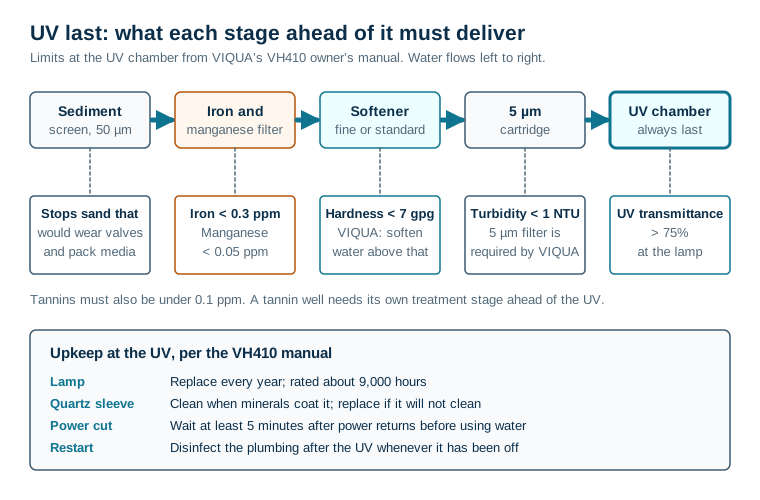
UV light inactivates microorganisms only when it reaches them. Iron, manganese and hardness coat the quartz sleeve around the lamp. Turbidity and tannins shade microbes from the light. The VIQUA VH410 owner's manual lists the water it expects at the chamber:
| Parameter | VIQUA's limit at the UV | Stage that usually meets it |
|---|---|---|
| Iron | under 0.3 ppm | Iron filter, or a fine-mesh softener at low levels |
| Manganese | under 0.05 ppm | Iron and manganese filter |
| Hardness | under 7 gpg; "if total hardness exceeds 7 gpg, the water should be softened" | Softener |
| Turbidity | under 1 NTU | Sediment filtration, ending with 5 µm |
| Tannins | under 0.1 ppm | A dedicated tannin stage |
| UV transmittance | over 75%; "call factory" below that | All of the above |
Two more installation rules come from the same manual. "A 5-micron sediment filter must precede the UV System," and "the UV System should be the final piece of treatment equipment." Where sediment keeps getting through, VIQUA suggests a 20 micron filter followed by a 5 micron filter, then the UV.
Read your lab report against that table before choosing a model. A well with 2 ppm of iron and 15 gpg of hardness needs an iron filter and a softener ahead of any UV on this page. Buying the UV first, and the pretreatment later, means a UV that is not doing its job in the meantime.
iSpring does not publish equivalent limits for the UVF55FS in anything we could open. Treat VIQUA's figures as the minimum for any UV. A sleeve coats the same way whatever brand surrounds it.
Flow Depends on the Dose You Choose
UV systems are sold on a headline flow, and the VH410 is advertised at 18 gpm. VIQUA's spec sheet shows that figure is for one dose:
| VH410 / VH410M flow | UV dose | What the dose is |
|---|---|---|
| 34 gpm | 16 mJ/cm² | US Public Health figure |
| 18 gpm | 30 mJ/cm² | VIQUA Standard |
| 14 gpm | 40 mJ/cm² | NSF/EPA figure |
All at 95% UV transmittance and end of lamp life, per VIQUA.
The higher the flow, the less time water spends in the light, and the lower the dose. For a well, size on the 40 mJ/cm² figure. That is the dose NSF uses for Class A systems, the class certified to treat contaminated water. A home whose busiest moment passes 14 gpm needs a larger chamber, not the 18 gpm label.
Transmittance matters as much as flow. VIQUA's ratings assume 95% UVT, water that lets 95% of UV light through a centimetre. Well water that only reaches 75% delivers a lower dose at the same flow. That is why the pretreatment stages are not optional.
The Certification Check
Several retailers describe the VH410 as NSF 55 certified. NSF's listing, read on 2 October 2026, shows something narrower:
| Model | On NSF/ANSI 55 listing? | Class | Listed flow |
|---|---|---|---|
| VIQUA VH410 and VH410M (standard) | No | n/a | n/a |
| VIQUA VH410-V and VH410M-V | Yes | B | 14 gpm |
| VIQUA PRO10, PRO20, PRO30 | Yes | A | 10, 20 and 30 gpm |
| iSpring UVF55FS | No | n/a | n/a |
VIQUA's own manual agrees. Its VH-series dose charts are marked "Not performance tested or certified by NSF". It also states that Class B systems are "not intended for treatment of contaminated water". The -V versions are certified for Class B at 14 gpm and 16 mJ/cm² at 70% UVT.
What this means for buying:
- If the well has never tested positive for bacteria and you want a safeguard, a VH410 or VH410M is a sound choice. Size it on its 40 mJ/cm² flow.
- If the well has tested positive, the certified choice is a Class A system. VIQUA's PRO series is on the listing as Class A. We could not confirm a PRO model on Amazon, so it is not ranked here. Ask a dealer for the exact model number on NSF's listing.
The Picks
VIQUA VH410M: best UV system for most well homes
- Flow: 14 gpm at 40 mJ/cm², 18 gpm at 30 mJ/cm², 34 gpm at 16 mJ/cm² (95% UVT)
- Monitoring: UV intensity sensor (part 254NM-C1) with a continuous readout; an optional solenoid valve can stop flow when UV output falls below the set level
- Chamber: 304 stainless steel, 23.5 x 3.5 in, ¾-inch FNPT / 1-inch MNPT combination ports, 60 W, 15 to 125 psi
- Warranty (manual): 10 years on the chamber, 3 years on electrical and hardware, 1 year on lamps, sleeves and UV sensors
The sensor is the reason to pay more. A lamp timer tells you when a year has passed. A sensor tells you when the light reaching the water has dropped, which is what happens when a sleeve scales up or iron gets past a filter. On a well, where pretreatment can slip as the water changes, that warning is worth having.
Wrong for: homes that regularly draw more than 14 gpm, and wells with a positive bacteria history where a Class A certified unit is wanted.
VIQUA VH410: best value
- Flow and chamber: the same as the VH410M
- Controller: visual lamp-life countdown, audible lamp failure alarm and replacement reminder; no UV sensor
- Warranty (manual): the same 10, 3 and 1 year terms
It is the same disinfection hardware for less money. You give up the warning when output falls, so the routine matters more: replace the lamp every year, inspect and clean the sleeve, and keep the pretreatment maintained.
Wrong for: owners who will not keep a maintenance calendar. Without a sensor, a coated sleeve gives no sign until a bacteria test comes back positive.
iSpring UVF55FS: budget option, with caveats
- Listed specs: 12 gpm, 55 W lamp, 1-inch MNPT connections, with a flow sensor and automatic on/off switch, per its Amazon listing
- Dose: no UV dose or transmittance basis that we could find
- NSF: not on the Standard 55 listing
It costs far less than the VH410, and for a small household on a well with no bacteria history it may be all that is wanted. The trade is information. Without a stated dose, there is no way to know what 12 gpm delivers, or what it delivers at your water's transmittance.
One question to ask before buying: how long the lamp takes to reach full output after the flow switch turns it on. VIQUA tells owners not to pass water through its systems for at least 5 minutes after power is applied. A lamp that switches on only when water starts to flow may treat the first draw at reduced output. iSpring's answer decides whether the feature suits you.
Wrong for: any well that has tested positive for bacteria.
Installation Details That Decide Whether It Protects the House
A correctly sized UV can still leave water untreated if it is plumbed or wired carelessly. VIQUA's manual sets out the points that matter, and they apply to any brand:
- Cold line, before any branch. The manual says to install the UV "on cold water line only, before any branched lines". An outdoor tap or a water heater feed teed off ahead of it receives water that never passed the lamp.
- Last in the train, after the 5 micron filter. Anything installed after the UV, such as a carbon bed or a softener, can grow bacteria back into treated water.
- A GFCI outlet, and a surge protector. VIQUA requires a ground fault circuit interrupter and strongly recommends a surge protective device for the controller. A tripped GFCI that nobody notices is a UV that is off, which is another argument for a sensor model with an alarm.
- Room to pull the lamp. Leave clearance above or beside the chamber equal to its length, so the lamp and sleeve can be withdrawn without cutting pipe.
- Disinfect at start-up. The whole system after the UV, including the pressure and water heater tanks, should be sterilised with chlorine before start-up, according to VIQUA. Otherwise bacteria already in the plumbing remain there. On a well with high iron or manganese, chlorine in the water heater oxidises what has built up, so expect repeated flushing.
- Hot water at the chamber. During long periods with no flow, VIQUA warns the water in the chamber can reach about 60 °C (140 °F). Run the tap to purge it, or fit a temperature management valve at the outlet.
None of these costs much at installation. Most are expensive to fix afterwards, especially an outdoor line already teed off ahead of the chamber.
Lamp, Sleeve and Power: What Each Year Takes
| Item | VIQUA VH410 or VH410M | iSpring UVF55FS |
|---|---|---|
| Lamp | S410RL-HO, every year | UVB55FS lamp; interval not confirmed |
| Lamp and sleeve together | QL-410 combo | not confirmed |
| Sleeve alone | NP-QSO-410, when it will not clean | not confirmed |
| Power | 60 W continuous, about 526 kWh a year | 55 W lamp; less if the flow switch turns it off between draws |
Multiply the kWh by your own electricity rate. The power figure for VIQUA assumes the controller and lamp run all year, as they should.
The VH410 and VH410M use the same lamp, sleeve and power, so their running costs match year after year. The difference between them is the sensor, bought once.
When UV Is Not the Answer
UV treats water passing through it at that moment. It leaves no disinfectant behind, and it cannot reach anything upstream. That limits it in three situations the site covers in detail:
- A positive coliform test. The first steps are a wellhead inspection and a shock chlorination, then a retest. A softener needs protecting during the shock, as set out in how to protect a softener during well shock chlorination. A UV installed afterwards is a safeguard, not the repair.
- Iron bacteria. They live in slime on the casing, pump and pipes, upstream of any UV, and the iron they carry fouls the sleeve. The sequence that clears them is in why iron bacteria requires more than a softener.
- Power cuts and outages. An unpowered UV passes untreated water. VIQUA's manual says the plumbing after the UV should be disinfected whenever the system has been off. Treat that like a boil-water event, using the flushing order in what to do with a softener during a boil-water notice.

Test again after installation. A bacteria test a few weeks after start-up, and once a year after that, is the only way to know the system is disinfecting.
Who Should Buy None of These
- Wells whose pretreatment is not in place. If iron, hardness or turbidity exceed the limits above, buy those stages first.
- Wells with repeat positive bacteria results after shocking. That points to a defect in the well. Repair it, and use a Class A certified system if treatment is still needed.
- Homes with peak flow above 14 gpm. Choose a larger certified chamber, or split the supply, rather than running a VH410 at its 30 mJ/cm² rating.
- Homes with frequent long power cuts and no backup. Without power, UV does nothing, and every restart calls for disinfecting the plumbing. Chlorination may suit better.
- Wells with high tannins. Above 0.1 ppm they block UV, and they need their own stage ahead of it.
Choose the best UV system for well water by its flow at 40 mJ/cm² and by the pretreatment your test calls for, then install it last. For most homes that is a VIQUA VH410M behind an iron filter, a softener and a 5 micron cartridge, with a new lamp every year.
Frequently Asked Questions
What is the best UV system for well water?
For most homes, the VIQUA VH410M. It treats 14 gpm at 40 mJ/cm² and adds a UV intensity sensor that warns when the sleeve or lamp needs attention. The VH410 is the same chamber and lamp without the sensor, for less money. Either needs prepared water: VIQUA's manual asks for iron under 0.3 ppm, hardness under 7 gpg and turbidity under 1 NTU, with a 5 micron filter ahead of the chamber.
Does a UV system go before or after a water softener?
After. UV should be the last whole-house stage. VIQUA's manual says that if hardness is over 7 gpg the water should be softened, and that the UV should be the final piece of treatment equipment. Scale on the quartz sleeve blocks the light, and media beds after a UV can grow bacteria again.
How often do you replace a UV lamp on a well system?
Every year. VIQUA rates its lamp for about 9,000 hours and tells owners to replace it annually, because output falls with age even while the lamp still glows. The quartz sleeve around it is cleaned when minerals coat it and replaced if it will not come clean.
Is NSF 55 Class A certification important for a UV system?
It matters if your well has tested positive for bacteria. Class A systems are certified to disinfect contaminated water at a dose of 40 mJ/cm². Class B systems are certified only as supplemental treatment for water already judged safe. On NSF's listing, VIQUA's VH410-V and VH410M-V are Class B, the PRO10, PRO20 and PRO30 are Class A, and the standard VH410 and iSpring UVF55FS are not listed.
Will a UV system kill iron bacteria?
Not where it matters. Iron bacteria live in slime on the well casing, pump and pipes, upstream of the UV, and the iron they carry clouds the water and coats the sleeve. Iron bacteria are treated with shock chlorination and removal of the iron. UV can disinfect the water reaching the house once the iron is gone, but it does not clean the well.
What happens to a UV system in a power cut?
It stops disinfecting. Water passing through an unpowered UV is untreated. VIQUA tells owners not to use water for at least 5 minutes after power returns, and to disinfect the plumbing after the UV whenever it has been off. A solenoid valve on a monitored system can stop flow when UV output is too low.
