
Best Water Softener for Tankless Water Heaters: Picks Matched to 5 Warranty Clauses
The best water softener for tankless water heaters is any properly sized salt-based softener that brings your water under the heater maker's warranty limit. That limit is about 12 grains per gallon (200 mg/L) for Navien, Noritz, Rinnai and Rheem, and 7 grains for Takagi. Our picks are the SoftPro Elite 48k if you want the longest valve warranty and upflow efficiency, and the AFWFilters Fleck 5600SXT 48k with 10% resin for the same job at a noticeably lower price. The Express Water WH100SP polyphosphate system is only for water that is already under the limit. Start with the heater's paperwork, because the manufacturer's clause sets the spec.
Disclosure: Hard Water Solved may earn a commission if you buy through links on this page, at no extra cost to you. It does not change which products we include or how we rank them. Read our disclaimer.
What Five Tankless Makers Actually Require
Each line below is quoted from a current manufacturer document, checked on 1 October 2026. Wording changes between models and editions, so the manual and warranty that came with your heater are the ones that count.
| Maker | Document checked | Hardness limit | Treatment wording |
|---|---|---|---|
| Rinnai | N-Series residential condensing installation and operation manual | "Total Hardness Up to 200 mg/L" | Where water is hard, "the water must be treated and may require a more frequent flushing schedule". "Damage caused by lime build-up is not covered by the water heater's warranty" |
| Navien | NPE condensing water heater installation manual | "Total Hardness Up to 200 mg/l (12 grains/gallon)" | "Damage caused by poor water quality is not covered under warranty" |
| Rheem | RTGH condensing tankless use and care manual and residential tankless warranty (AP21265 Rev 04) | "Total Hardness Up to 200 mg/L" | Outside the table, Rheem recommends you "install a water treatment device or water softener at the same time as the original installation". The warranty excludes failures "caused by lime, mineral build-up, or scale" |
| Noritz | Online limited warranty | "hardness levels in excess of 12 grains per gallon (200 mg/L)" excluded | Also excludes "untreated or poorly treated well water" and high pH |
| Takagi | Residential limited gas tankless warranty (100287499 Rev C) | "more than 7 grains per gallon (120 ppm) for single family domestic applications" excluded | Also excludes "pool water, spa water, or any chemically treated water" and "untreated or poorly treated well water" |
Three things follow from the table:
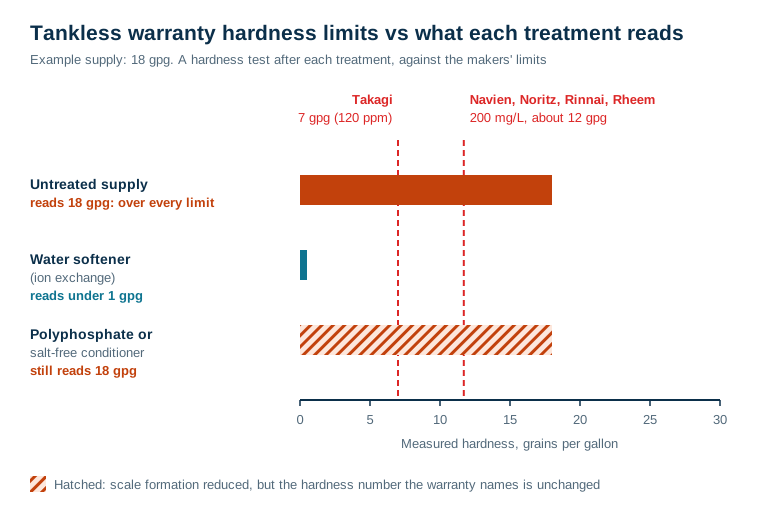
- The limit is a number on a hardness test. Every clause is written as a measured hardness, not as "scale". A treatment that prevents scale but leaves the test reading unchanged does not move you under the line.
- Takagi's line is the strictest. At 7 grains, a lot of water that is merely "moderately hard" is already outside Takagi's residential cover.
- Rheem names the softener outright. Rinnai says "treated". Rheem says "water treatment device or water softener", and asks for it "at the same time as the original installation".
Navien also caps iron at 0.3 mg/L, manganese at 0.05 mg/L, pH at 6.5 to 8.5 and total dissolved solids at 500 mg/L, and Rinnai and Rheem list the same ceilings. A softener does not change pH or TDS. Well owners should test every row, not only hardness. The site's guide to softened water and tankless water heaters explains how softening changes flushing and warranty standing.
How We Chose
Methodology. Nothing on this page was physically tested. Each pick was matched against the clauses above using the makers' published specifications and warranty statements.
- Included: salt-based softeners with a metered valve and chlorine-tolerant 10% crosslink resin, able to take hardness to near zero. One polyphosphate system is included for water already within the limits. All are sold on Amazon.
- Checked: service flow against tankless maximum flows, valve and tank warranty length, and whether the treatment changes measured hardness.
- Excluded: salt-free conditioners for water above the limits (they do not lower measured hardness), and cabinet units with low service flow.
- Prices are not listed here because they change often. Use the buttons to see the current price on Amazon.
The Best Water Softener for Tankless Water Heaters, Matched to the Clause
| Pick | Meets the 200 mg/L (12 gpg) limit | Meets Takagi's 7 gpg limit | Amazon |
|---|---|---|---|
| SoftPro Elite 48k | Yes, softened water reads near zero | Yes | Check price on Amazon |
| AFWFilters Fleck 5600SXT 48k, 10% resin | Yes | Yes | Check price on Amazon |
| Express Water WH100SP polyphosphate | Only if your raw water is already under it | Only if already under 7 gpg, and check the "chemically treated water" clause first | Check price on Amazon |
SoftPro Elite 48k: best overall for a tankless home
- Type: salt-based, demand-initiated, with upflow regeneration
- Resin: 10% crosslink, chosen for chlorine resistance on city water
- Warranty: SoftPro's product page describes a limited lifetime warranty on the control valve. Read the exclusions
A tankless heater is a long-lived purchase with a long heat-exchanger warranty: 15 years on Rheem's residential tankless warranty, and 12 years on Noritz residential models outside its EZ series, which carry 25. A softener with a long valve warranty matches that time frame. Upflow brining tends to restore more capacity per pound of salt (see upflow vs downflow regeneration), which helps on the moderately hard water where many tankless owners first hit the 12-grain line.
Watch for: service flow. SoftPro's page describes 1-inch internal plumbing but does not publish a service flow figure that we could find. If your heater is one of the larger models, ask SoftPro for the rated flow before you order.
AFWFilters Fleck 5600SXT 48k with 10% resin: best value
- Valve: Fleck 5600SXT digital metered
- Resin: 1.5 cu ft of 10% crosslink resin
- Flow: 6.5 gpm service, 9.8 gpm peak
- Warranty: 5 years on the control head, 10 years on the mineral tank, per AFWFilters' product page
This does the same job for the warranty: softened water reads near zero on a hardness test. The Fleck 5600SXT is a widely used residential valve, so parts and service are not hard to find. The 6.5 gpm service figure suits most three- or four-person homes. For a big house running several showers at once through an 11 gpm heater, step up to a larger, higher-flow system.
Watch for: the shorter valve warranty than SoftPro, and the brine tank. You need floor space for a separate brine tank beside the resin tank.
Express Water WH100SP: only for water already under the limit
- Type: single-stage polyphosphate cartridge in a whole-house housing
- Cartridge life: 100,000 gallons or 6 to 12 months, per Express Water
Polyphosphate slows scale by keeping calcium from depositing as hard scale, but the water's hardness reading does not change. So this pick is for one situation only: your water already tests under your heater's limit, say 8 or 9 gpg with a Rinnai, Navien, Noritz or Rheem, and you want fewer flushes between the required services. Rinnai's manual points owners to a phosphate-feed scale system of its own, so it plainly accepts this kind of treatment in principle.
Watch for: Takagi's wording. Its residential warranty excludes "any chemically treated water", next to pool and spa water. Whether a phosphate feeder counts is a question for Takagi, in writing, before you install one. Never run a polyphosphate cartridge ahead of a salt-free TAC conditioner either. The site's guide to salt-free conditioning for tankless heaters and boilers quotes the media makers' "no other antiscalant" rules.
Size the Softener for Flow as Well as Grains
A tank-type water heater buffers demand. A tankless one does not. Every gallon of hot water passes through the softener first, at the moment you use it. Rinnai's condensing manual lists maximum flows of 7 to 11 gpm across its models. A softener whose service flow is well below your heater's working flow will cut pressure at the shower when two fixtures run together.
- Find the heater's maximum flow in its manual, then think about the busiest real moment: two showers and a kitchen tap, for example.
- Compare it with the softener's service flow, not just its peak figure. Peak flows are for short bursts.
- Size grain capacity from your household's daily hardness load. The method, including a day of reserve, is in how to size a water softener.
- Plumb the softener ahead of the heater, with the heater's isolation valves kept in place for flushing. Rinnai "strongly recommends" isolation valves, and Rheem sells them as an accessory.
Who Should Buy None of These
- Owners whose water already tests under 7 gpg. You are under every limit in the table. Flush on the manual's schedule and keep the test result on file.
- Wells with iron, manganese or low pH outside the table. A softener fixes one row. Iron above 0.3 mg/L or pH below 6.5 needs its own treatment first.
- Anyone who will not keep the softener in salt. A softener left empty or in bypass puts the heater straight back on hard water, and the warranty clause does not care why. Scale in a tankless water heater shows how quickly it builds.
- Homes where the heater is the only concern and the water is just over the line, around 12 to 14 gpg. A softener is still the warranty-safe answer. If you choose flushing alone, though, know that it does not change the test result.
Read your heater's water-quality table first, test your water against it, and buy the treatment that moves the measured number under the line. For most tankless homes above 12 grains, that is a metered, salt-based softener sized for flow.
Frequently Asked Questions
Do tankless water heaters need a water softener?
Above the manufacturer's hardness limit, they effectively need treatment that brings the measured hardness down. Navien, Noritz, Rinnai and Rheem set that limit at about 12 grains per gallon (200 mg/L). Takagi's residential warranty excludes water over 7 grains per gallon in single-family homes. Below the limit, regular flushing is usually enough. Above it, a softener is the treatment that reliably gets the number under the line.
What size water softener do I need for a tankless water heater?
Size it for the house, not just the heater, and check flow as well as grains. The grain capacity comes from your daily hardness load. The softener's service flow should also cover your busiest moment, because a tankless heater only makes hot water while water is flowing. Rinnai's manual lists maximum flows of 7 to 11 gpm across its condensing models. A 48,000-grain metered softener with a service flow of about 6.5 gpm and a peak near 10 gpm suits most three- or four-person homes.
Will a polyphosphate filter protect my tankless warranty?
It reduces scale, but it does not lower measured hardness, so it cannot bring water above a hardness limit under it. It suits water that is already under the limit, where it adds protection between flushes. Rinnai offers a phosphate-feed scale system itself, which shows it accepts that kind of treatment in principle. Takagi's residential warranty excludes 'any chemically treated water', so ask Takagi in writing before adding a phosphate feeder to one of its heaters.
Does softened water void a tankless water heater warranty?
Not in any of the five documents quoted on this page. Rheem's manual goes further and tells installers to fit 'a water treatment device or water softener at the same time as the original installation'. The water-quality tables still apply to pH, iron, manganese and total dissolved solids, which softening does not change. Keep a dated hardness test and your flush records in case of a claim.
Is a salt-free conditioner good enough for a tankless water heater?
For scale, often yes. For the warranty, it depends on your water. A salt-free conditioner leaves the hardness reading unchanged. On water under the maker's limit that does not matter. On water over it, a heat exchanger claim could still be refused on the number alone. If your supply tests above about 12 gpg, or above 7 gpg with a Takagi, choose a softener.
