
Salt-Free Conditioning for Tankless Heaters and Boilers
A salt free conditioner protects a tankless water heater well. Scale control in heated equipment is the job template-assisted crystallization (TAC) does best. But check the warranty first. Noritz, Navien and Rinnai write their water limits as a measured hardness of about 12 grains per gallon (200 mg/L). A salt-free system does not change that number, so on harder water it may not satisfy the clause, even while it prevents scale.
That warranty check is the decisive factor, and it is rarely raised at the point of sale. The rest of this page covers why heating equipment is the strongest case for salt-free, what five manufacturers actually write, how to read your own clause, and how to install a conditioner so the heater and the paperwork are both protected.
Why Heating Equipment Is the Best Case for Salt-Free
Scale forms where water gets hot. Heat drives dissolved calcium carbonate out of solution, and it crystallises on the hottest surface available. In a tankless heater, that surface is a heat exchanger with narrow passages. There, even a thin deposit restricts flow and insulates the metal from the water it is meant to heat.
TAC media works upstream of that. Its bead surfaces encourage dissolved hardness to form microscopic crystals in the cold water. When the water heats, the calcium has somewhere to go other than the exchanger wall. The WateReuse Research Foundation study led by Arizona State University (project 08-06, "Evaluation of Alternatives to Domestic Ion Exchange Water Softeners") tested this with the German DVGW W 512 protocol. It found TAC reduced scale formation by more than 88 percent in heated test equipment, the best result of the non-ion-exchange technologies tested.
That is a genuine, independently measured benefit, in exactly the application that matters for a tankless heater. It is also the only benefit. The water still tests hard, soap still behaves as it does in hard water, and fixtures still spot. For a household whose main concern is a costly heat exchanger, that trade can make sense. For how softened water compares on the same heater, the protection is similar and the side effects are different.
The Warranty Check: What Tankless Manufacturers Actually Write
Here is the wording from five major brands. The question in the last column is the one that matters: does a salt-free conditioner, which reduces scale but not measured hardness, satisfy the clause as written?
| Brand | What the document says | Hardness figure | Does salt-free satisfy it as written? |
|---|---|---|---|
| Noritz | Warranty excludes damage from "untreated or poorly treated well water, or water with high PH levels or hardness levels in excess of 12 grains per gallon (200 mg/L)" | 12 gpg | No, if your water tests above 12 gpg. The exclusion is written around the hardness level, which a conditioner does not lower |
| Navien | Installation manual water quality table: "Total Hardness up to 200 mg/l (12 grains/gallon)"; "damage caused by poor water quality is not covered under warranty" | 200 mg/L | No, if above 200 mg/L. Same reason. The table also caps TDS at 500 mg/L and iron at 0.3 mg/L |
| Rinnai | Manual table lists "Total Hardness up to 200 mg/L"; hard water "must be treated"; "damage and repair due to scale in the heat exchanger is not covered by warranty" | 200 mg/L | Unclear. "Treated" is not defined as softened, and Rinnai sells its own non-softening scale control. Ask in writing |
| Rheem | Tankless gas warranty excludes failures "caused by lime, mineral build-up, or scale" and operation outside "recommended water quality levels" | Set in the manual, not the warranty | Partly. Reducing scale reduces the risk of the excluded failure, but the manual's water table still applies |
| A.O. Smith | Tankless warranty excludes damage from "lack of maintenance (e.g. water filter, water treatment system...)", untreated well water, pH outside 6.5–8.5 and iron above 0.3 mg/L | None stated | Yes, in principle. No hardness number to meet. Scale failure is covered on its X3 models |
Three things follow from reading these side by side.
Most clauses are written around a number, not around scale. Noritz, Navien and Rinnai all use roughly 12 grains or 200 mg/L. That figure is exactly what a hardness test measures, and it is where scale inside a tankless heater starts to become a maintenance problem. A salt-free conditioner, by design, leaves the number unchanged. On 15-grain water, your heater could be well protected from scale and still sit outside the written limit.
"Treated" is not the same as "softened", and that cuts both ways. Rinnai does not say softened. It sells a phosphate-feed scale control system, so it plainly accepts non-softening treatment in principle. But that is Rinnai's own product, and its water quality table still lists 200 mg/L. Whether a third-party TAC conditioner counts as "treated" for a heat exchanger claim is a question for Rinnai, in writing, before you buy.
The other rows can disqualify you anyway. Iron, pH, TDS and "poorly treated well water" appear across these documents. A conditioner fixes none of them, and on a well, those rows are often the ones that fail.
Wording changes between models and editions. The manual and warranty that came with your unit are the ones that govern, not this table. How to read a warranty clause covers the general method.
Reading Your Own Clause
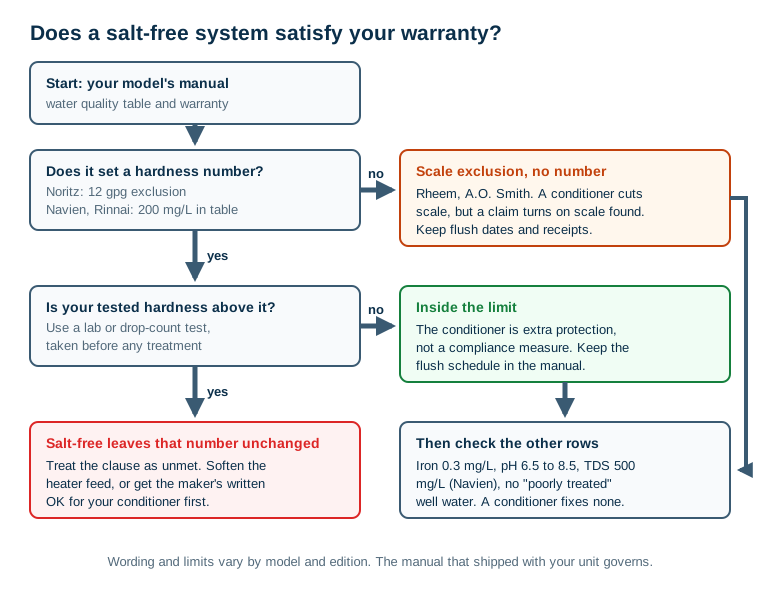
The practical sequence:
- Find the water quality table in the installation or owner's manual, and the exclusions list in the warranty. They are usually separate documents.
- Look for a hardness figure. If there is one, compare it with a proper test of your untreated water: a drop-count kit or a lab panel, not a strip.
- If you are over the figure, a salt-free conditioner alone is a warranty risk, however well it works. Your options are to soften the heater's feed, or to get the manufacturer to confirm in writing that your specific conditioner satisfies the clause.
- If you are under the figure, or there is no figure, a conditioner is sound extra protection. Keep the flush schedule and the receipts anyway, because a scale-damage claim is decided on maintenance records.
- Check every other row — iron, pH, TDS, chloride and well-water treatment — against your test.
Salt Free Conditioner for a Tankless Water Heater: Setting It Up Properly
If your water passes the warranty check, installation details decide whether the conditioner does its job.
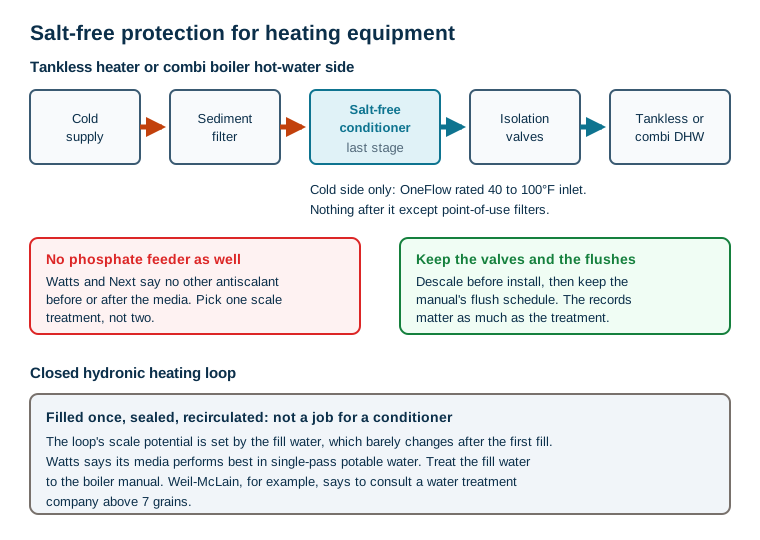
- Cold side only. The media is rated for cold water. OneFlow's limit is 40 to 100°F inlet, and its tankless models are single-cartridge units that go on the cold line immediately before the heater.
- Last stage in the train. Watts and Next both say not to install filters after the media, except point-of-use drinking water filters. A sediment filter goes before it.
- Remove any phosphate feeder. Many tankless installs already have a scale-inhibitor cartridge. Watts says not to apply any other antiscalant before or after OneFlow and caps total phosphates at 3.0 ppm. Next says the same for ScaleStop. Choose one treatment.
- Descale before you start. A conditioner prevents new scale. It will not clear an exchanger that is already coated. Flush it first, so later performance is measured from clean.
- Keep the isolation valves and the flush schedule. The conditioner reduces how often you need to flush. It does not remove the manual's maintenance requirement, and your records are what a warranty claim is judged on.
- Replace the cartridge on schedule. Watts specifies at least every two years for its tankless-heater cartridges. A hardness test will not tell you it is spent.
Boilers: Combi Hot Water vs Closed Heating Loops
"Boiler" covers two very different water circuits, and a salt-free conditioner suits only one of them.
The domestic hot water side of a combi boiler works like a tankless heater. Fresh cold water passes through a heat exchanger once, on its way to a tap. Everything above applies: the conditioner goes on the cold feed as the last stage, the boiler manual's water limits are checked first, and phosphate feeders are removed.
A closed hydronic heating loop is filled once, sealed, and pumped round and round. The scale it can form is set by the minerals in the fill water, and very little fresh water enters afterwards. Watts says its media performs best in single-pass potable water applications, which a closed loop is not. The right approach is to treat the fill water to the boiler manufacturer's specification. Weil-McLain's oil boiler manual, for example, says to consult a local water treatment company where water is above 7 grains of hardness. Many modern condensing boilers publish tighter fill-water limits. Details on softened water in boilers and hydronic systems cover the fill-water side properly.
When to Soften the Heater Feed Instead
A salt-free conditioner is the right tool for tankless and combi protection when three things are true: your tested hardness is under the manual's figure or there is no figure, your water passes the other rows, and you do not need soft water for anything else. When any of those fails, softening is the more reliable route:
- Your water is above the warranty's hardness number. Softening brings the measured figure down. A conditioner does not.
- Your hardness is above about 30 grains. That is past the recommended maximum on most TAC spec sheets, even though scale control is rated higher.
- You want written compliance rather than an argument. A soft-water test result is the simplest evidence you can hand a warranty department.
None of this makes salt-free conditioning a poor technology for heaters. On the right water, it is among the most effective non-salt options measured. It just has to be chosen with the warranty in hand, not after the exchanger fails.
Frequently Asked Questions
Is a salt-free conditioner good for a tankless water heater?
For scale, yes. Protecting heated equipment is where template-assisted crystallization performs best. An Arizona State University study for the WateReuse Research Foundation found it cut water heater scale formation by more than 88 percent. The catch is the warranty. Noritz, Navien and Rinnai set a hardness figure of about 12 grains per gallon (200 mg/L), and a salt-free system does not lower measured hardness. If your water tests above that figure, check with the manufacturer before relying on a conditioner.
Does a salt-free conditioner void a tankless water heater warranty?
Installing one does not void anything. The risk is that it does not satisfy a clause you need it to. Noritz excludes damage from water harder than 12 grains per gallon, and Navien and Rinnai list 200 mg/L as the maximum in their water quality tables. A salt-free conditioner leaves the hardness reading where it was. So on water above those figures, a heat exchanger claim could still be refused on the hardness number alone, whatever scale protection you installed.
Do tankless water heater manufacturers require a water softener?
Most do not name softening specifically. They set water quality limits and exclude scale damage. Rinnai's manual says water in hard-water areas 'must be treated' and sells its own phosphate-feed scale control system. Navien's table limits total hardness to 200 mg/L. Noritz excludes hardness above 12 grains per gallon. Softening is the treatment that reliably brings a measured hardness number under those limits, which is why installers often treat it as the requirement.
Can I use a salt-free conditioner and a phosphate scale inhibitor together?
No. Watts says not to apply any other antiscalant before or after OneFlow media, and caps total phosphates below 3.0 ppm. Next says not to apply phosphate or any other antiscalant before or after ScaleStop. Many tankless installs already have a phosphate feeder cartridge, including the one Rinnai offers. If you add a TAC conditioner, remove the feeder. Two scale treatments on the same line interfere with each other.
Should a salt-free conditioner be used on a boiler?
On the domestic hot water side of a combi boiler, the same logic as a tankless heater applies: cold feed, conditioner last, and check the manual's water limits. On a closed hydronic heating loop, a conditioner does little. The loop is filled once and recirculated, so its scale potential is set by the fill water. Watts says its media performs best in single-pass potable water. Treat the fill water to the boiler manufacturer's specification instead.
What water hardness is safe for a tankless water heater?
Most manufacturers draw the line at about 12 grains per gallon (200 mg/L). Noritz, Navien and Rinnai all use that figure in their warranty or water quality tables. Below it, flushing on the manual's schedule is usually enough, and a salt-free conditioner is extra protection. Above it, treat the water. If warranty coverage of the heat exchanger matters to you, choose a treatment that brings the measured number down.
