
How Softened Water Affects a Tankless Water Heater
A softened water tankless water heater is the combination most manufacturers' water-quality rules are written around. Noritz, Navien and Rinnai set their hardness limit at about 12 grains per gallon (200 mg/L). A working softener brings hardness close to zero, which satisfies that clause and stretches flushing from every few months to about every two years. It does not change pH, iron or dissolved solids, and the yearly inspection stays.
For many homes the tankless heater is the main reason to soften at all. The heat exchanger is the expensive part, it scales faster than anything else in the house, and its warranty coverage depends on the water. This page quotes what three manufacturers require, shows how softening changes both flushing and warranty standing, and works through a ten-year cost comparison for that "the heater justifies the softener" case.
What Tankless Manufacturers Actually Require
The documents are specific, and they are written around a number. Here is what each says, and where softened water leaves you.
| Brand | What the document says | Standing on softened water |
|---|---|---|
| Noritz | The limited warranty excludes "damage as a result of use with non-potable water, untreated or poorly treated well water, or water with high PH levels or hardness levels in excess of 12 grains per gallon (200 mg/L)". Residential heat exchanger cover runs 12 years on standard models | Hardness clause met. pH and well-water treatment still apply |
| Navien | The installation manual lists "Total Hardness up to 200 mg/l (12 grains/gallon)" alongside limits for iron (0.3 mg/L), manganese, chloride, pH 6.5 to 8.5 and TDS up to 500 mg/L, and states "damage caused by poor water quality is not covered under warranty" | Hardness row met. Every other row is unchanged by softening |
| Rinnai | The installation and operation manual lists "Total Hardness Up to 200 mg/L", says that where water is hard "the water must be treated and may require a more frequent flushing schedule", that "damage caused by lime build-up is not covered", and that the heater "must be inspected annually by a licensed professional" | Treatment requirement met. The annual inspection remains |
Three points follow from reading them together.
Softening is the treatment that moves the number. All three set a measured hardness limit. A softener is the one common treatment that lowers measured hardness, so a hardness test at the heater's inlet becomes simple evidence that you are within the clause. Scale-reducing alternatives protect the exchanger but leave the number where it was. Salt-free conditioning for tankless heaters covers that trade-off.
Nobody excludes softened water. None of these documents treats softened water as a problem. The exclusions are for hard water, poorly treated well water, pH, and contaminants such as iron and manganese.
Softening fixes one row of the table, not the table. Iron, manganese, pH and TDS have their own limits. Softening does not raise or lower pH, and it does not remove total dissolved solids. It swaps calcium and magnesium for sodium, so TDS stays roughly where it was. If your raw water is over 500 mg/L TDS or outside pH 6.5 to 8.5, a softener leaves you outside those rows. Well owners should test all of them.
These documents are revised over time and vary by model. The manual and warranty that came with your heater are the ones that govern.
Softened Water Tankless Water Heater Flush Schedule
Scale on a tankless heat exchanger builds inward from the walls of narrow passages. The heater's own manual sets the baseline service, and hardness decides how often descaling is actually needed on top of that.
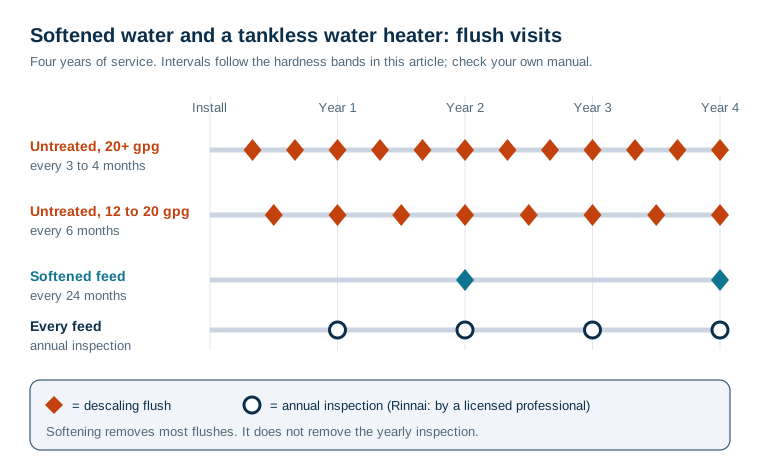
In round terms, based on the hardness bands in signs of scale inside a tankless water heater:
| Water feeding the heater | Realistic descaling interval | Four-year total |
|---|---|---|
| Untreated, above 20 gpg | Every 3 to 4 months, and still losing ground | About 12 flushes |
| Untreated, 12 to 20 gpg | Every 6 months | About 8 flushes |
| Softened feed | About every 24 months | About 2 flushes |
Lab data points the same way. In the Battelle study for the Water Quality Research Foundation, gas tankless heaters on 26-grain water had to be delimed after the equivalent of 1.6 years. Their efficiency had fallen from 80 percent to 72 percent, and recovered only to about 77 percent after deliming. Heaters on softened water held their efficiency through the test (WQA write-up).
What does not change:
- The annual inspection. Rinnai requires one by a licensed professional whatever the water. Burner, venting, condensate and inlet filter checks are not about scale.
- The inlet filter screen. It still catches grit, especially on well water. Clean it at every service.
- The service indicator. Rinnai's manual lets the installer set the Service Soon interval "based on water conditions". Once the feed is softened, ask for it to be lengthened rather than left at a hard-water setting.
Protecting Your Warranty Standing
A heat exchanger claim is decided on two things: whether the water was within the limits, and whether the heater was maintained. Softening handles the first. Records handle the second.
- Test the raw water before the softener goes in. Keep the result. It documents why treatment was needed.
- Descale the heater before, or right after, softening starts. A softener prevents new scale and removes nothing already there. Starting clean means later performance is judged from a known baseline.
- Test the softened water at the heater's cold inlet a few times a year. A drop test kit is enough. Write down the date and result.
- Keep every service record, including flushes, inspections, and softener salt and repairs. A softener that ran out of salt for three months is a period of untreated water.
- Check the other rows once. Iron, manganese, pH and TDS, especially on a well.
How to read a clause like these, and what "treated" or "maintained" tends to mean in practice, is covered in how to read a water softener warranty. The same reading applies to heater warranties.
When the Tankless Heater Is the Whole Case for the Softener
Here is the design question many buyers face. You have, or are about to install, a tankless heater on water around 15 to 25 grains. Nothing else in the house would push you to soften. Does the heater alone justify it?
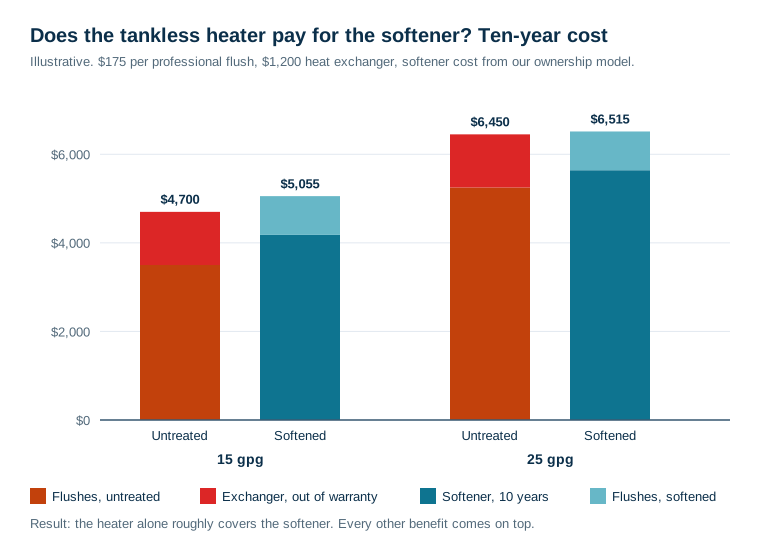
This is an illustrative calculation, not a quote. The assumptions are visible so you can replace them:
- Professional descaling flush: $175 a visit. Prices vary widely by area.
- Heat exchanger replacement outside warranty: $1,200 for parts and labour, counted once in ten years on untreated water. On water above 12 grains, a scale-related exchanger failure is the claim these warranties exclude.
- Softener: ten-year cost of ownership from the model in the total cost of owning a water softener: $4,180 at 15 gpg and $5,640 at 25 gpg, including equipment, salt, water, upkeep and one resin change.
- Flush frequency: twice a year at 15 gpg and three times a year at 25 gpg untreated; once every two years softened.
| Ten-year cost | 15 gpg untreated | 15 gpg softened | 25 gpg untreated | 25 gpg softened |
|---|---|---|---|---|
| Descaling flushes | $3,500 | $875 | $5,250 | $875 |
| Heat exchanger, out of warranty | $1,200 | $0 | $1,200 | $0 |
| Softener ownership | $0 | $4,180 | $0 | $5,640 |
| Total | $4,700 | $5,055 | $6,450 | $6,515 |
What this shows. On these assumptions the tankless heater alone pays for most or all of the softener. Within a few hundred dollars over ten years, you are buying the softener with money you would otherwise have spent on descaling and a heat exchanger. Everything else it does comes on top: fixtures that stop scaling, a dishwasher and washer that stay clean, and much less detergent.
What moves it. The case gets stronger with harder water, a pricier heat exchanger, or a heater still inside a long exchanger warranty that you want to keep. It gets weaker if you descale the heater yourself. A DIY flush with a pump, hoses and vinegar costs far less than a service call, and at 15 grains that can tip the cash comparison against softening. The warranty argument does not change, though. DIY flushing does not bring 18-grain water under a 12-grain clause.
Energy is left out of the table. The Battelle result above, an efficiency drop from 80 to 72 percent before deliming, suggests untreated water also costs gas. Adding it would favour softening further.
Sizing and Plumbing the Softener Around a Tankless Heater
A tankless heater changes how the softener should be chosen and plumbed, because the heater is sensitive to flow and pressure in a way a storage tank is not.
- Size for peak flow, not just grains. A tankless heater makes hot water only while water is flowing through it, often at several gallons per minute during a shower and a running tap together. The softener has to deliver the whole house's peak flow without a large pressure drop. Compare the softener's rated service flow, and the pressure drop at that flow, with your household's busiest moment.
- Watch the combined pressure drop. Every device on the line takes some pressure: the softener, any sediment filter, and the heat exchanger itself. Too much in total, and upstairs fixtures can struggle to draw enough flow to keep the burner lit at low settings. Every tankless model has a minimum flow to fire, listed in its manual.
- The heater must be on the softened side. Outdoor taps may be teed off before the softener. The heater's cold inlet never should be. Check this on existing homes, where a later plumbing change can leave the heater on raw water without anyone noticing.
- Fit isolation valves if they are missing. You will flush less often on softened water, but you will still flush, and the valves make it a simple job.
- Mind recirculation. A recirculation loop runs the heater more often and keeps water hot in the pipes. It raises scaling on hard water and makes softening more valuable. Check your warranty's terms for recirculating installations.
If the softener is being bought mainly for the heater, a demand-initiated (metered) unit sized to your real hardness and peak flow is the usual choice. It regenerates only when needed, which keeps salt and water costs close to the model above. Matching a softener to your heater's warranty hardness clause compares current units against what Navien, Noritz, Rinnai, Rheem and Takagi require.
What a Softener Cannot Do for a Tankless Heater
- It cannot clear existing scale. Descale first.
- It cannot fix other water-quality rows. pH, iron above what the softener can handle, manganese, chloride and TDS need their own treatment, and the manuals list each one.
- It cannot replace the annual inspection or the inlet filter clean.
- It cannot protect the heater while it is out of salt or in bypass. A softener that stops working puts the heater straight back on hard water, and the warranty clause does not care why.
- It cannot cover a heater on a recirculation loop set far above the manual's limits. Runtime and temperature raise scaling on any water, and some warranties limit cover for heavy-use or recirculating applications.
Checklist for a Tankless Owner
- Find your model's water-quality table and warranty exclusions. Note the hardness limit, and every other row.
- Test the raw water for hardness, and for iron, pH and TDS if you are on a well.
- Descale the heater and clean the inlet screen before or as the softener goes in.
- Keep the heater on the softened side. The softener must feed the heater's cold inlet.
- Test at the heater inlet a few times a year and keep the results with your service records.
- Keep the annual inspection, and ask your installer to lengthen the service reminder now that the feed is soft.
Frequently Asked Questions
Is softened water OK for a tankless water heater?
Yes, and it is the treatment most likely to keep the heat exchanger within the manufacturer's water-quality limits. Noritz excludes damage from water harder than 12 grains per gallon, and Navien and Rinnai list total hardness up to 200 mg/L in their manuals. A working softener brings hardness close to zero, well under all three. It does not change pH, iron or total dissolved solids, which have their own limits.
Does a water softener void a tankless water heater warranty?
No. None of the Noritz, Navien or Rinnai documents reviewed here exclude softened water. Their exclusions are for hardness above a limit, poorly treated well water, pH outside 6.5 to 8.5, and other contaminants. Softening addresses the hardness clause. Keep a hardness test result and your service records, because a heat exchanger claim is judged on both.
How often should you flush a tankless water heater with a water softener?
Roughly every two years is common on a softened feed, compared with every six months or more often on untreated water above 12 grains. Your manual still sets the rule. Rinnai, for example, requires the heater to be inspected annually by a licensed professional regardless of water treatment, and its service indicator lets the installer set an interval based on water conditions.
Do tankless water heaters require a water softener?
Not by name. Manufacturers set a maximum hardness and exclude scale damage. Rinnai's manual says water in hard-water areas must be treated and may need more frequent flushing. Navien says damage caused by poor water quality is not covered. If your water is above about 12 grains per gallon, some form of treatment is effectively required to keep heat exchanger coverage, and softening is the one that lowers the measured number.
Is a water softener worth it just for a tankless water heater?
Often it roughly breaks even. In our illustrative ten-year comparison at 15 and 25 grains per gallon, the cost of professional flushes plus one out-of-warranty heat exchanger came close to the full cost of owning a softener. So the heater alone pays for most or all of the softener, and softer fixtures, less detergent and a protected storage tank or dishwasher come on top. If you flush the heater yourself, the case is weaker.
Should I still flush a tankless heater that already has scale before adding a softener?
Yes. A softener prevents new scale but does not remove deposits already inside the heat exchanger. Descale it before or right after the softener goes in, so the heater starts clean and later performance is judged from a known baseline. Clean the inlet filter screen at the same time.
