
Can Household Water Be Too Soft?
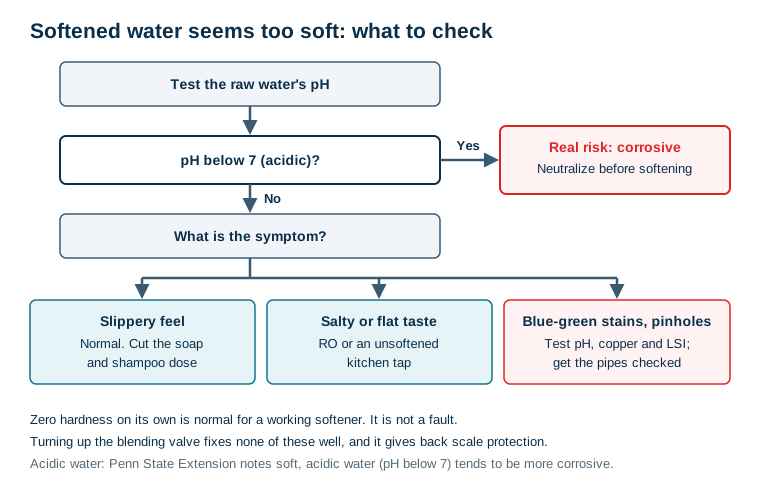
Can water be too soft? Not in the sense most people mean. Zero hardness is exactly what a working softener delivers, and softened water is not harmful in itself. The real problems are narrower: a slippery feel, a flat or salty taste, and one genuine hazard: softening acidic water without neutralizing it, which strips the calcium that helps protect pipes.
Separating those four issues matters, because each has a different fix. The myth leads people to turn their softener's blending valve up until the water "feels normal", which gives back scale protection and does not touch the one problem that damages plumbing.
Can Water Be Too Soft? Myth vs Legitimate Concern
| Concern | Verdict | What is really happening |
|---|---|---|
| "Zero hardness is unnatural and harmful" | Myth | Rain, distilled and reverse osmosis water are all near zero hardness. A softener at 0 gpg is working correctly. Whether softened water should test at zero covers what a normal reading looks like |
| "Soft water feels slimy, so it must be too soft" | Misread | Soap rinses off more slowly without calcium. It is a dose problem, not a hardness problem |
| "Softened water tastes salty or flat" | Real, minor | Sodium replaces the hardness, and some people miss the mineral taste. Fixed at the drinking tap |
| "Softened water corrodes pipes" | Real on acidic water | Softening removes calcium that helps protect metal pipe. Where pH is low, that turns a corrosive supply into a more corrosive one |
| "Softened water is bad for plants" | Real | Sodium builds up in soil. The reason outdoor taps are left hard |
Why Zero Hardness Is Normal
An ion exchange softener swaps calcium and magnesium for sodium (or potassium) until its resin is exhausted. While it has capacity, the output should test at or close to 0 gpg. A reading of 1 gpg or more straight after regeneration usually means something is wrong, such as bypass leakage, a mixing valve left open, or a tired resin bed. It is not a design choice.
Water with no hardness is not unusual. Rainwater is nearly free of calcium and magnesium, and so are the distilled and RO water many people drink every day. The real change softening makes is sodium. Penn State Extension puts it at 7.5 milligrams of sodium per quart for each grain per gallon of hardness removed. On 20 gpg water that is about 150 mg per quart. For most people that is small next to food. For anyone told to limit sodium, it is worth talking to a doctor and drinking from an unsoftened or RO tap.
The One Real Hazard: Softening Acidic Water
This is where "too soft" stops being a myth.
Water becomes corrosive to copper and lead-bearing brass when it is acidic and low in the dissolved calcium and alkalinity that help build a protective film on the pipe. Penn State Extension's guide to corrosive water problems states that "water that is soft and acidic (pH < 7.0) tends to be more corrosive." It explains the Langelier Saturation Index, where negative values indicate corrosive water.
A softener does not change pH. It does remove the calcium, and the calcium is half of what keeps the LSI up. So:
- On acidic water, softening pushes an already negative LSI further negative. Corrosion speeds up, and copper and lead from pipes and fittings can end up in the water.
- On neutral or alkaline water with reasonable alkalinity, the effect is much smaller. This is the common situation for softened homes on city water or limestone wells.
- Minnesota's Department of Health is blunt about the risk: softened water "can corrode your pipes" and "can contribute to elevated lead and copper levels in drinking water." It also advises not running a softener for the first few weeks on new copper plumbing, so the pipe can build a protective layer first.
Signs that it is happening: blue-green stains under faucets and in sinks, a metallic taste, pinhole leaks in copper pipe, and a raw-water pH below 7. The fix is to raise the pH before the softener with an acid neutralizer or a soda ash feed. Softening afterwards is then safe. The full treatment is covered in low-pH well water treatment.
Note what the fix is not. Leaving some hardness in with a blending valve does very little for acidic water. The pH is still low, and a couple of grains of calcium will not rebuild the pipe's protection.
Taste and Feel: Real, but Not Hardness Problems
The slippery feel. Soap reacts with calcium and magnesium in hard water to form curd, and that curd is what makes skin feel "squeaky clean". Without hardness the soap stays soluble and takes longer to rinse off. That leaves the slick feel. Cutting shampoo and soap roughly in half usually fixes it within a couple of weeks. Why soft water feels slippery has the adjustment plan. Turning up the blend helps less than people expect, because the slickness lingers until several grains of hardness are back.
The taste. Some people find softened water flat or faintly salty, especially where the raw water was very hard and a lot of sodium was swapped in. A reverse osmosis unit or an unsoftened cold tap at the kitchen sink solves this for drinking and cooking, without giving up protection for the rest of the house.
The Blending Valve: What It Buys and What It Costs
Many control valves have a mixing or blending adjustment that lets a fixed share of raw water bypass the resin and join the softened water. The result is a residual hardness:
Residual hardness ≈ share of raw water bypassed × raw hardness
On 20 gpg raw water, the cost in scale protection is easy to work out. There are 7,000 grains in a pound.
| Residual target | Raw water blended in | Grains reaching the water heater per 1,000 gal | Scale potential per 1,000 gal | Salt saved |
|---|---|---|---|---|
| 0 gpg | 0% | 0 | None | None |
| 1 gpg | 5% | 1,000 | 0.14 lb | About 5% |
| 2 gpg | 10% | 2,000 | 0.29 lb | About 10% |
| 3 gpg | 15% | 3,000 | 0.43 lb | About 15% |
| 5 gpg | 25% | 5,000 | 0.71 lb | About 25% |
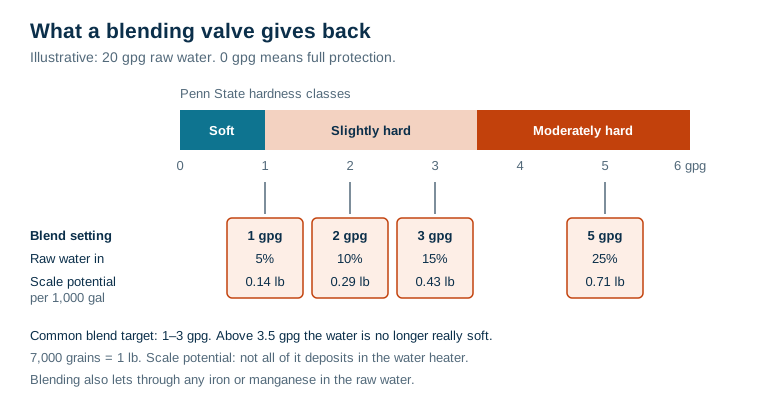
Not all of that potential ends up in the heater, because only part of the temporary hardness drops out at tank temperature. But the direction is clear. Every grain blended back in brings back part of the scale, glass spotting and soap curd the softener was bought to stop. Penn State's scale classes soft water as less than 1 gpg and moderately hard as 3.5 to 7 gpg, so a blend above about 3.5 gpg is no longer really softened water.
Why Blending Valves Usually End Up Set Wrong
Blending is a legitimate choice. It is usually set badly, for four reasons:
- It is set by feel. Someone turns the knob until the shower feels less slippery, often to 5 gpg or more. The residual is never tested, and nobody notices the extra scale until the heater starts to rumble.
- It is set once, on a changing supply. The residual follows the raw hardness. A blend set to 3 gpg when the raw water was 15 gpg gives 4 gpg when the raw water climbs to 20.
- It lets through everything else in the raw water. Blending bypasses all of the resin's work, including any iron and manganese it was removing. On a well with iron, blending brings back orange staining.
- It is checked at the wrong flow. Some mixing valves blend a different share at a trickle than at full flow. A residual measured at one open faucet may not match what the house gets during a shower and a washer fill at once.
To set one properly: test the raw water, pick a target of no more than 1–3 gpg, adjust, then test the softened water at a cold tap with two or three fixtures running. Recheck whenever your raw hardness changes, and leave blending off entirely if the raw water carries iron or manganese.
Who Should Leave Some Hardness In, and Who Shouldn't
Blending is a tool for a few specific situations. Match your house to one of these before touching the valve.
| Your situation | Blend? | Better move |
|---|---|---|
| City water, neutral pH, copper or PEX plumbing, only complaint is the slippery feel | No | Cut the soap dose first. Blend to 1–2 gpg only if it still bothers you after two weeks |
| Acidic well water (pH below 7) | No, it does not fix the problem | Neutralize ahead of the softener, then soften fully |
| New copper plumbing | Don't soften yet | Minnesota's health department advises waiting at least the first few weeks before running a softener on new copper |
| Well with iron or manganese | No | Blending sends iron and manganese straight into the house |
| Very hard water, 20 gpg or more, where the sodium matters to you | Rarely helps | Soften fully and drink from an RO or unsoftened tap. Blending cuts sodium only in proportion to the raw water let through |
| Tankless heater, boiler or espresso machine in the house | No | Any residual hardness scales these fastest. Keep the output near 0 gpg |
How to Check Whether Your Water Is "Too Soft" for Your Pipes
A hardness strip cannot answer this. Four measurements can:
- Raw-water pH. Test it at a tap ahead of the softener, or with the softener in bypass. Below 7 is the warning sign. The lower it is, the more urgent.
- Raw-water alkalinity. Low alkalinity means the water has little buffering and is more likely to be corrosive once softened.
- Softened-water hardness. It should be at or near 0 gpg the day after regeneration. If it is not, look for a fault or a blend setting before worrying about corrosion.
- A first-draw copper or lead test from a certified lab, if you see blue-green staining or your house has lead-bearing brass or older solder. The water that sits overnight in the pipes shows what the plumbing is releasing.
Those numbers go together into the Langelier Saturation Index. Interpreting pH and hardness together works through the calculation, including how far softening moves the index on an acidic supply.
What a Softener Cannot Do Here
- It cannot correct pH. If the raw water is acidic, softening makes corrosion worse, and neutralizing has to come first.
- It cannot make a slippery feel go away. That comes from the soap dose, not the equipment.
- It cannot make water taste of minerals again without giving back scale protection. The drinking-tap fix is cheaper.
- A blending valve cannot give you both. Every grain of comfort costs a grain of protection.
What to Do Next
- Test the raw water's pH. If it is below 7, put neutralizing ahead of the softener before anything else.
- Check for blue-green stains or pinholes if your pipes are copper and your water was softened without neutralizing.
- Cut the soap dose for two weeks before touching the blending valve.
- Fix taste at the kitchen tap, with RO or an unsoftened branch.
- If you do blend, set it with a test kit to 1–3 gpg, and never on water with iron or manganese.
Frequently Asked Questions
Is zero hardness bad for you?
No. A correctly working ion exchange softener is supposed to deliver close to 0 gpg, and softened water is widely used in homes. The health question people usually mean is sodium: softening adds sodium in proportion to the hardness removed, about 7.5 mg per quart for each grain per gallon according to Penn State Extension. Anyone on a sodium-restricted diet should ask their doctor and consider a reverse osmosis or unsoftened tap for drinking.
Can softened water corrode pipes?
It can make corrosion worse where the water is already acidic, because softening removes the calcium that would otherwise help protect the pipe. Minnesota's Department of Health warns that softened water can corrode pipes and raise lead and copper levels. On water with a neutral or higher pH and reasonable alkalinity the effect is much smaller. If your water is acidic, neutralize it before softening.
How do I know if my water is too soft?
Hardness alone will not tell you. Look for the symptoms that matter: blue-green stains under faucets or pinhole leaks in copper pipe, which suggest corrosive water; a salty or flat taste; or a slippery feel that doesn't go away with less soap. Test the pH of the raw water. If it is below 7, the softened water may be corrosive and needs neutralizing.
Should I set my softener to leave some hardness?
Only if you have a reason: the feel in the shower, taste, or a supply that tends to corrode. A blending valve that leaves 1–3 gpg is a common compromise. Every grain you leave in comes back as scale in the water heater and spotting on glass, so set it with a test kit, not by feel, and recheck when your raw hardness changes.
Why does soft water feel slimy?
Soap rinses off more slowly in soft water because there is no calcium or magnesium to react with it and form curd. The slippery feel is soap and your skin's own oils still on the surface. It is not a sign that the water is too soft. Using less soap usually fixes it within a couple of weeks.
Is softened water bad for plants?
Softened water adds sodium, and repeated watering can build sodium up in soil and potted plants. That is why outdoor faucets and irrigation are usually left on hard water. For houseplants, use water from an unsoftened tap, rainwater or reverse osmosis water.
