
Why Soft Water Feels Slippery
Soft water feels slippery because the soap is rinsing off completely instead of leaving a curd on your skin. The sensation is the softener working, not residue left behind. The squeaky feeling you are comparing it to was never a measure of clean — it was the friction of soap scum deposited on your skin by calcium and magnesium.
This is the most common complaint from new softener owners, and it is also the one most often misdiagnosed as a fault. Nothing needs adjusting on the unit. What usually needs adjusting is how much soap you use, because soft water needs dramatically less of it.
Why Soft Water Feels Slippery: What Is Happening on Your Skin
Soap is a salt of a fatty acid — sodium stearate, in a traditional bar. In water, it dissociates and the fatty acid end does the cleaning work.
In hard water, the calcium and magnesium ions in the water grab those fatty acid ions and form calcium and magnesium stearate: insoluble, sticky, and completely useless as a cleaner. That is soap scum. Some of it ends up as the ring around the bath and the film on the shower screen. The rest deposits on your skin and hair as a microscopically thin layer, and it is impossible to rinse off, because it is not soluble in the water you are rinsing with.
That layer has texture. Run a finger across it and it grips. Your brain has been reading that grip as clean for your whole life.
In soft water, there is no calcium to react with. The soap stays soluble, does its job, and rinses away entirely. What is left on your skin is your skin: its own lipid layer, undisturbed, with nothing stuck on top of it. Skin in that condition has very low surface friction — and low friction is what you are interpreting as slippery.
| Hard water | Soft water | |
|---|---|---|
| What soap becomes | Insoluble calcium stearate (scum) | Stays soluble, rinses out |
| What lands on skin | A thin film of curd | Nothing |
| Lather | Poor; suppressed until hardness is consumed | Immediate and abundant |
| Soap actually needed | Large dose; much of it wasted | Roughly a third |
| How it feels | Squeaky, grippy | Slippery, smooth |
| Rinse water | Cloudy, scummy | Clear |
The lather column is worth pausing on. In hard water the first portion of every dose of soap is destroyed producing scum before any lather appears at all — which is exactly why hard water households learn to use so much of it. That mechanism is covered in detail in why soap will not lather in hard water.
The Squeaky Feeling Was the Symptom, Not the Standard
It is worth being blunt about this, because the framing determines whether you adapt in two weeks or fight it for a year.
Soap scum on skin is not desirable. It is a deposit. It is mildly occlusive, it traps residue against the skin surface, and for people with sensitive or eczema-prone skin it is an irritant in its own right — one reason a lot of households notice their skin feeling less tight and itchy after softening, which is the other half of the picture in can hard water make skin feel dry after showering.
The same story plays out in hair. Hard water leaves mineral and scum deposits along the hair shaft that make it feel coarse and look dull; soft water leaves the shaft clean, which reads initially as limp or slippery until the conditioner dose comes down. That is covered in why hair feels waxy or dull in hard water.
So the comparison is not clean versus slippery. It is coated versus not coated.
The Real Fix Is Dose, Not Equipment
Here is the part that actually changes the experience. A significant share of the slippery sensation is not the water at all — it is genuinely too much product, because you are dosing for hardness that is no longer there.
In hard water, a large fraction of every dose is consumed forming scum before any cleaning happens. Remove the hardness and that fraction is suddenly surplus. Surplus surfactant does not vanish on rinse; it lingers, and it is slippery.
Start here and adjust after a week:
| Product | Previous hard water dose | Soft water starting point |
|---|---|---|
| Body wash / shower gel | A full palm | About one third |
| Bar soap | Several passes to lather | One or two passes |
| Shampoo | Coin-sized, often twice | Half that, once |
| Conditioner | Full dose | Half, and further from the roots |
| Hand soap | Full pump | Half a pump |
| Laundry detergent | Label dose | Half the label dose |
| Dishwasher detergent | Full tablet or scoop | Half tablet, or the low-hardness setting |
Two practical notes:
- Dishwashers and washing machines often have a hardness setting of their own. A dishwasher still dosing salt and detergent for 20 gpg water is producing film and residue for no reason. Reset it. The same logic applies to the etching problem discussed in cloudy glasses after dishwashing, where over-dosing detergent in soft water is a genuine cause of damage rather than a cosmetic complaint.
- Reduce one product at a time. If you halve everything at once and something feels wrong, you will not know which change did it.
A Two-Week Adaptation Plan
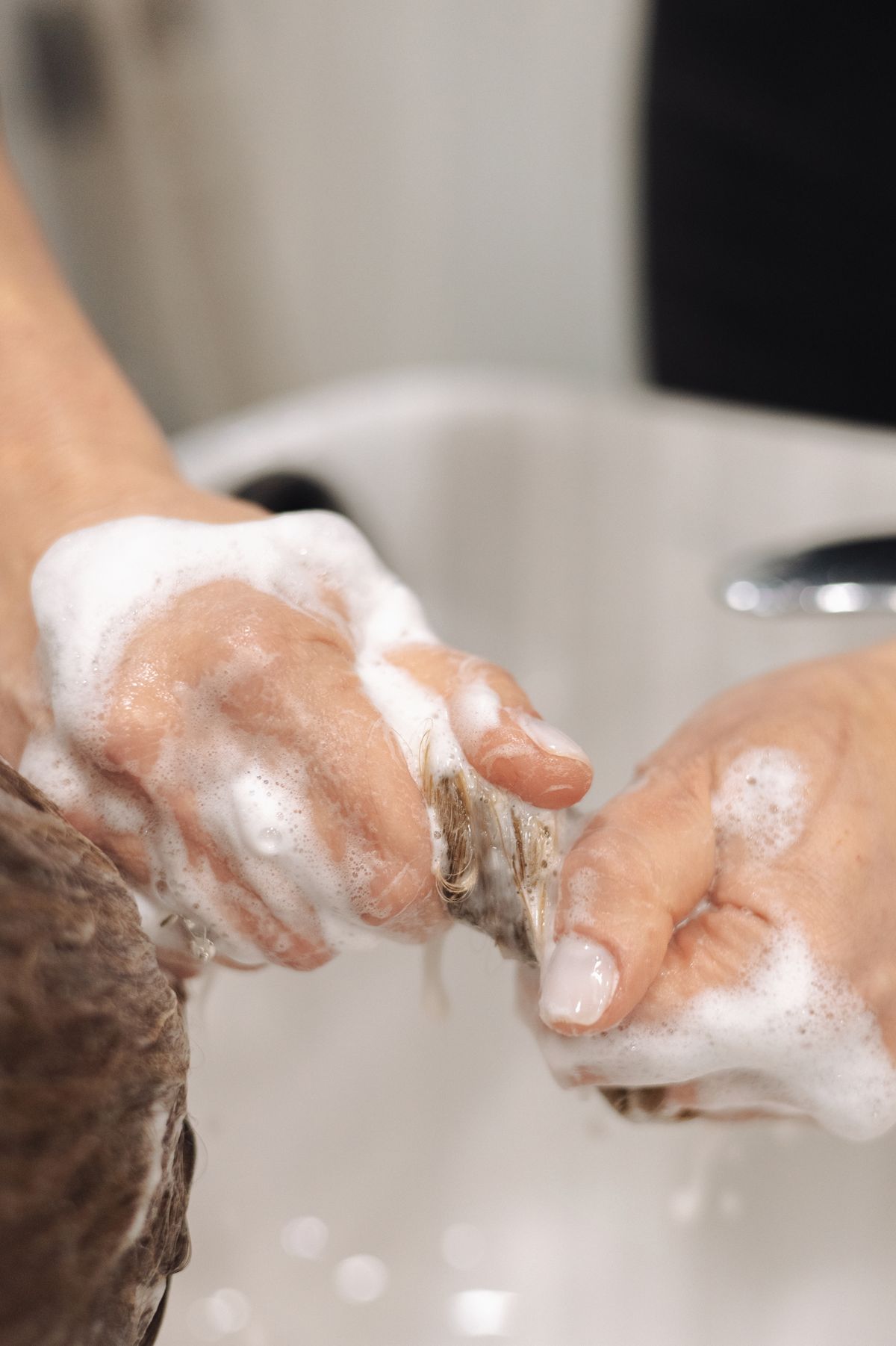
Days 1–3. Change nothing except soap volume. Cut body wash and shampoo to a third. Expect the lather to still be more than you are used to.
Days 4–7. Shorten the rinse. In hard water you rinsed long to shift scum that was never going to shift. In soft water you are rinsing water off water. Cut the rinse time and see whether the sensation changes.
Days 8–10. Adjust products rather than volumes if the feel is still not right. Traditional bar soaps are the worst offenders in soft water because they are formulated to overcome hardness. Syndet bars and low-surfactant washes behave very differently.
Days 11–14. Reset the appliances. Dishwasher hardness setting, washing machine dose, and the rinse aid — which is usually now unnecessary.
Most households are done by the end of the second week. If you are not, the blend valve at the end of this article exists for exactly that reason.
When Slippery Is Actually a Fault
The normal slippery sensation is clean, odourless, and disappears as the skin dries. A small number of complaints are not that, and they are worth separating out.
- Slippery plus a salty taste. Not normal. Brine is reaching the service line — see why softened water tastes salty.
- Slimy with an odour, especially in warm weather. A film that smells musty or sulphurous points at bacterial growth in a bed that is sitting exhausted between infrequent regenerations, or at a brine tank that has never been cleaned. Regenerate more often and sanitise the unit.
- A tacky rather than slippery film that dries dull and visible. That is product residue, and it means the dose is still too high. Tacky and slippery are genuinely different sensations once you pay attention.
- The feeling appeared suddenly on a system that had been fine for years. Normal softening does not change. A sudden change means something mechanical did — the starting point for that is why water is still hard after installing a softener, which works through post-installation faults in order of cost.
There is one thing that is not a fault, and it is worth saying plainly: a softener cannot over-soften. Ion exchange runs to zero hardness and stops. There is no setting that makes water "more soft than zero", so a slippery feeling is never evidence of a unit that is overdoing it.
What Will Not Reduce the Slippery Feel
Save your money on these:
- Rinsing longer. There is nothing to rinse off. Longer rinsing does not change the sensation and wastes water.
- Switching from sodium chloride to potassium chloride. Potassium changes the sodium content of the water, which is a reasonable thing to want for dietary reasons, but the slippery feel comes from the absence of calcium, not the presence of sodium. It will feel identical.
- Adding a "conditioner" or descaler downstream. Template-assisted crystallisation and similar technologies do not remove hardness at all; they change how it precipitates. Fitting one after a softener does nothing to the feel.
- Turning down the salt dose. This reduces regeneration efficiency and will eventually give you hard water breaking through mid-cycle, which is a real fault with its own diagnosis in why hardness returns before the next regeneration.
If You Genuinely Cannot Get Used To It
A blend valve is the legitimate answer, and most control valves have one built in.
It mixes a small, adjustable amount of untreated water back into the softened output, typically leaving 1 to 3 grains per gallon of residual hardness. That is enough for soap to behave a little more like it used to, while staying far below the level at which scale becomes a problem — well inside the range discussed in what water hardness level is considered too hard.
The trade is real but small: a little residual hardness means a little scale over time, and slightly more soap. Set it, live with it for two weeks, and adjust. Do this after cutting the soap dose, not instead of it — a surprising number of people who ask about blending discover they were simply using three times as much shower gel as they needed.
For the underlying chemistry of what ion exchange does and does not change, the EPA's WaterSense guidance on cation exchange water softeners is a good neutral primer, and Penn State Extension's overview of water softening covers the sodium and blending trade-offs without a product to sell.
Frequently Asked Questions
Why does soft water feel slippery or slimy?
Because nothing is left on your skin. In hard water, soap reacts with calcium and magnesium to form an insoluble curd that deposits on skin as a fine film — that film is what produces the familiar squeaky, grippy feeling. Remove the calcium and the soap stays soluble and rinses away completely, leaving your skin's own lipid layer intact and unobstructed. Skin with nothing stuck to it has low friction, and low friction is what you are interpreting as slippery.
Is the slippery feeling leftover soap on my skin?
No — it is the reverse. Soap that has not rinsed off is sticky and tacky, not slippery, and it dries to a dull matte finish. The slippery sensation in soft water comes from soap having rinsed away more thoroughly than it ever did in hard water. The persistent myth here is understandable, because people have used the squeaky feeling as a proxy for clean their entire lives. That proxy was always measuring soap scum, not cleanliness.
How much less soap should I use with soft water?
Start by cutting body wash, shampoo and hand soap to about a third of what you used before, and detergents to roughly half the label dose. Soft water needs far less surfactant because none of it is being consumed reacting with hardness minerals. Most people find the slippery sensation drops sharply once the dose is right, because a large part of what they feel is genuinely excess product that has nothing to bind to. Reduce, use the product for a week, and adjust from there.
Is it safe to shower in softened water?
Yes. Softening exchanges calcium and magnesium for a small amount of sodium and changes nothing else about the water. Many people with dry skin or eczema report that softened water is more comfortable, because the soap curd that hard water deposits is itself an irritant and because they end up using far less product. The one situation worth a second look is a salty taste or a genuine slimy film with an odour — those are faults with specific mechanical causes, not the normal slippery sensation.
Does the slippery feeling of soft water go away?
The water does not change, but your reading of it does, usually within two to four weeks. Two things happen: you recalibrate what clean feels like, and you cut your product dose down to what soft water actually needs. The second matters more than people expect — a large share of the sensation is simply too much soap for the water. Households that reduce dose deliberately adapt much faster than households that wait it out.
Can I make soft water less slippery without removing the softener?
Yes, with a blend valve. Most control valves can be set to blend a small amount of untreated water back in, leaving roughly 1 to 3 grains per gallon of residual hardness. That is enough to restore some of the familiar feel while keeping the great majority of the scale and soap benefits. It is a legitimate setting rather than a compromise on function, though it does mean a little scale returns. Cut the soap dose first — most people find they do not need the blend.