
Should Softened Water Always Test at Zero Hardness?

Should softened water test zero? At the softener outlet, yes. A working softener should read 0 on a home hardness kit. The certification standard allows up to 1 grain per gallon (gpg), and working resin lets through only a fraction of that. A reading above 1 gpg at the outlet means one of three things: a deliberate blend, a bed that is running out before it regenerates, or a fault.
Those three causes leave different patterns, so sampling at two points in the cycle tells them apart. That matters because a lot of "my softener is broken" conclusions turn out to be a blend setting someone chose on purpose.
Should Softened Water Test Zero? The Standard, in Numbers
The industry has written the benchmark down. NSF/ANSI 44 is the certification standard for residential softeners, and NSF's Rick Andrew describes its tests in NSF/ANSI 44 requirements for water softeners:
- Performance test. The softener is regenerated at its lowest salt setting and run at its full rated service flow. Samples are taken every minute for 10 minutes, and none may exceed 1 gpg.
- Capacity test. Feed water at 20 ± 2 gpg runs at half the rated flow until the output reaches 1 gpg. That breakthrough point defines the rated capacity.
So 1 gpg is the pass line in both tests. In the performance test it is the most the softener may leak. In the capacity test it marks exhaustion.
Normal leakage in practice is well below that line. Chubb Michaud's review of resin capacity in The Capacity of Ion-Exchange Resin puts hardness removal at about 98 to 99 percent at moderate salt settings of 6 to 10 lb per cubic foot. On 20 gpg water that leaves 0.2 to 0.4 gpg.
| Reading at the softener outlet | What it means |
|---|---|
| 0 on a drop kit | Working normally. Real leakage is below what the kit can show |
| Under 1 gpg on a lab test or meter | Normal leakage. Nothing to fix |
| 1 gpg | At the certification limit. Fine right before a regeneration, suspicious right after one |
| 2 to 3 gpg, steady all cycle | Almost always a blend setting |
| Climbing through the cycle | The bed runs out before it regenerates |
| High even right after regenerating | A fault: brine, bypass, valve or resin |
Why "Zero" Really Means "Below What Your Kit Can Read"
No softener delivers absolute zero, and no home kit could confirm it if one did. Both ends of the test have limits.
Drop kits count drops of titrant until the sample turns from red to blue. On the common kits one drop equals 1 gpg. If the first drop turns the sample blue, the water is under 1 gpg, and the kit reports it as zero. That is precise enough for this job, because 1 gpg is the line that matters.
Test strips read in color bands. At the low end the bands are often several grains apart, so "zero" on a strip means "below the first band." A strip cannot tell a clean 0.3 gpg from a leaky 2 gpg on some brands. How the two methods compare is set out in hardness test strips vs drop test kits.
What this means in practice: use a drop kit to check a softener. When the question is "zero or not," a strip that reads 0 has not proved anything.
How Leakage Changes Over One Cycle
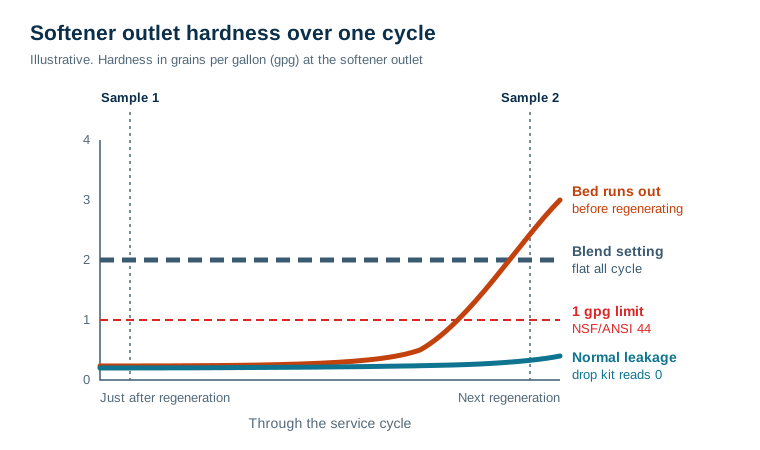
Outlet hardness is not constant between regenerations. It follows a predictable pattern:
Just after regeneration. The bed is as clean as the salt dose made it. Leakage is at its lowest, and a drop kit reads zero. The first few gallons may taste slightly salty if the rinse was short, but they should not be hard.
Most of the cycle. Leakage stays low and fairly steady. The softening is happening in a band that moves down through the bed while clean resin below it polishes the water.
Near exhaustion. Once that band reaches the bottom of the bed, hardness rises fast. A metered valve is supposed to regenerate before this, keeping a reserve so the house never sees it. A reading of 1 gpg or more that appears only on the last evening of a cycle is a reserve or capacity-setting problem. The four timing patterns are worked through in why hardness returns before the next regeneration.
Three settings move the whole curve up or down:
- Salt dose. Michaud's data shows a lower dose leaves the resin less fully regenerated, so leakage goes up. High-efficiency settings give up a little outlet quality to save salt.
- Flow rate. Hellenbrand's manual includes a footnote: if an application "demands 1 gpg or less in service flow at peak flows," the installer may need a safety factor when programming capacity. Heavy simultaneous demand pushes more hardness through. See the Hellenbrand residential softener manual.
- Regeneration direction. Counter-current (upflow) brining regenerates the resin at the outlet end best, so it usually leaks less than co-current (downflow) brining at the same dose.
Blend Setting or Fault? Reading the Pattern
A blend mixes a little raw water into the softened water on purpose. Some control valves have a mixing screw on the valve. On others the blend comes from a bypass valve that is partly open. Blending is common. Installers use it to cut the slippery feel, to reduce the sodium added, or because a customer asked for it. It is also the most common reason a working softener gets called broken.
The two cases leave different patterns:
| Clue | Blend setting | Softener fault |
|---|---|---|
| Reading right after regeneration | Same as later in the cycle, often 2 to 3 gpg | High, when it should be lowest |
| Reading across the cycle | Flat | Rising, or high throughout |
| Salt use | Normal | Often stopped or erratic |
| Every tap in the house | Same number | Same number, so tap-to-tap checks cannot separate the two |
| Changes when the bypass or mixing screw is fully closed | Drops to zero | Does not change |
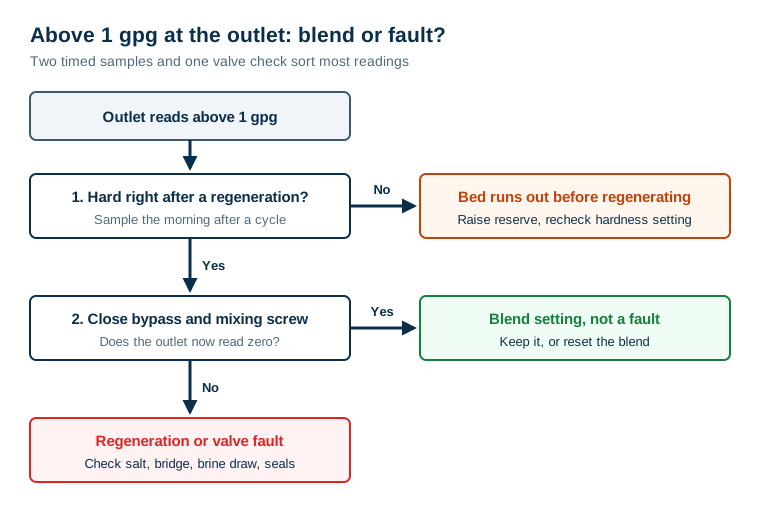
The deciding test is the reading taken right after a regeneration. A softener in good order is at its best then. If it still reads hard, either raw water is getting past the resin or the resin was not regenerated. Close the bypass and any mixing screw fully and test again. If the reading drops to zero, you found a blend. If it does not, the softener has a fault. Check the brine draw, the bypass seals and the valve before you blame the resin.
Where to Take the Sample
The number only means something if the sample comes from the right place at the right time:
- Sample at the softener outlet, or at the first tap downstream of it, not at a far bathroom. That rules out branches that were never softened.
- Run cold water for 30 seconds or more. Water that has sat in the line overnight is not what the softener is producing now.
- Take two samples: one the morning after a regeneration, and one the evening before the next. Most metered valves show days or gallons since the last cycle.
- Use the same kit both times.
The full procedure, including the inlet-versus-outlet comparison, is in how to check if a water softener is working.
When a Non-Zero Target Is the Right Choice
Zero is the benchmark for judging whether the softener works. It does not have to be what comes out of the taps.
Reasons to blend that hold up:
- Feel. Some people dislike the slick feel of fully softened water on skin, and 2 to 3 gpg reduces it. The feel comes from soap rinsing off more slowly, not from anything left on the skin.
- Sodium. A softener adds sodium in proportion to the hardness it removes. Blending back leaves less of it in the water.
- Taste. Some people prefer a little mineral in drinking water.
Reasons that do not hold up as well: a thin "protective" scale layer on water heater elements, or hardness "protecting" pipes. Scale is not reliable corrosion control. The longer argument is in can household water be too soft.
If you blend, write the target down and set it at the softener. Then test the outlet with the blend closed once a year, so you know the softener itself still reads zero.
What a Zero Reading Does Not Tell You
- It does not prove the capacity setting is right. A softener can read zero every morning and still go hard every Friday night. Only the second sample catches that.
- It says nothing about iron, manganese, silica or anything else. A hardness kit measures calcium and magnesium. White residue on a zero reading usually comes from something else.
- It does not mean the water is safe to drink. A softener is not a treatment for bacteria, nitrate, lead or arsenic.
- It does not describe the taps. A branch installed before the softener, such as an outside tap, a kitchen cold line or a hot water heater plumbed in the wrong order, can read hard while the outlet reads zero.
What to Do With Your Reading
- Zero at the outlet at both points in the cycle: the softener meets the standard. If a tap somewhere still reads hard, look at the plumbing, not the softener.
- Steady 2 to 3 gpg: close the bypass and any mixing screw fully, then retest. If it drops to zero, decide whether you want the blend.
- Zero in the morning, hard in the evening: raise the reserve or recheck the hardness setting against a fresh raw-water test.
- Hard right after a regeneration: check the salt level, look for a salt bridge, and confirm the unit is actually drawing brine before blaming the resin.
Frequently Asked Questions
Is it normal for softened water to have some hardness?
A trace, yes. Softener resin removes around 98 to 99 percent of the hardness at typical salt settings, so a little always leaks through. On 20 gpg water that is a few tenths of a grain, which a home drop kit reads as zero. A reading of 1 gpg or more at the softener outlet is not normal leakage. It means a blend is set, the bed is near exhaustion, or something is wrong.
What should my water hardness be after a softener?
At the softener outlet, zero on a home test kit. NSF/ANSI 44 certification allows up to 1 grain per gallon during its performance test, and treats 1 gpg as the point where the resin is exhausted. Some households deliberately blend back to 2 to 3 gpg for feel. That is a preference, not a requirement. Unless you or an installer chose a blend, expect zero.
Why does my softened water test at 3 gpg?
Test once right after a regeneration and again just before the next one. If both read about 3 gpg, and every tap in the house reads the same, a blend is set. Look for a mixing screw on the control valve or a partly open bypass. If the reading starts near zero and climbs to 3 by the end of the cycle, the bed is running out before it regenerates, which is a capacity or hardness-setting problem. If it reads 3 even right after a regeneration, the softener is not regenerating properly.
Should I set my softener hardness higher than my water tests?
Set the valve to your measured raw hardness, plus any iron allowance your manual gives. Setting it higher makes the softener regenerate earlier than it needs to, which wastes salt. Setting it lower lets hardness through toward the end of every cycle. The hardness setting controls when the softener regenerates. It does not control how soft the output is. A blend valve does that.
Can test strips tell if softened water is really zero?
Only roughly. Strips read in color bands, often in steps of several grains at the low end, so a strip showing zero means under the first band, not zero. A drop titration kit where one drop equals 1 gpg is better for this check. The first drop turning the sample blue means under 1 gpg. For readings below 1 gpg you need a lab or a low-range meter, and no household decision needs that precision.
