
Why a Dishwasher Leaves a White Film on Dishes
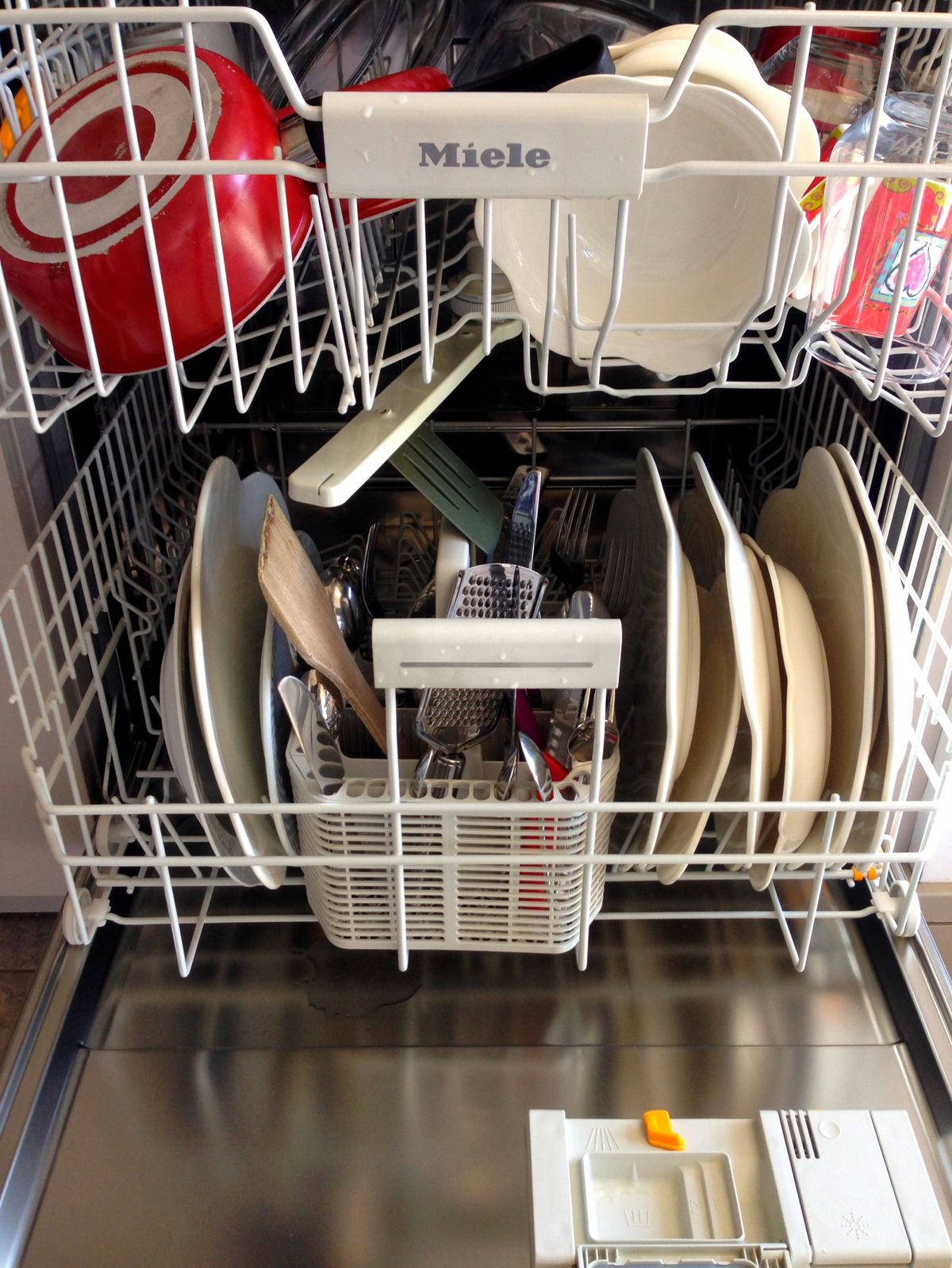
A dishwasher white film on dishes has three realistic causes: hard water minerals, undissolved or overdosed detergent, and a rinse aid failure that lets water dry in place instead of sheeting off. They look similar and they need different fixes, so guessing wastes both money and loads. One citric acid cycle run alongside a deliberate control load separates them in a single evening.
Most advice online tells you to try everything at once — more rinse aid, less detergent, a vinegar cycle, a filter clean. Do that and you will never know which one worked, or whether the problem is coming back next month.
The One-Cycle Diagnostic: Citric Acid Plus a Control Load
This is the whole test. It takes one cycle and about two dollars of citric acid powder.
Step 1 — Build the control load. Take four items you know are filmed: two glasses, one dark plate (film shows best on dark glaze), and one piece of stainless cutlery. Wash all four by hand in warm water with a little dish soap, dry them, and confirm they are clean. Set them aside.
Step 2 — Run a citric acid cycle on the machine, empty. Put two tablespoons of citric acid powder in the main detergent dispenser, close it, add nothing else, and run the hottest normal cycle with the machine completely empty. No detergent, no rinse aid top-up, no dishes. This strips accumulated mineral scale from the tub, the spray arms and the heating element.
Step 3 — Load the control items and run once, with detergent as usual. Add nothing else to the machine. Four items in an otherwise empty dishwasher, your normal detergent at your normal dose, your normal cycle.
Step 4 — Read the four items when the cycle ends, before they are touched.
| Result on the control items | Cause | Why the test proves it |
|---|---|---|
| All four come out clean and clear | Scale in the machine, now removed | The residue was building up in the tub and redepositing. Repeat the citric cycle monthly |
| All four filmed again, evenly, chalky white | Water hardness | An empty machine with four items cannot over-soil or under-rinse. Only the water is left |
| Glasses filmed, plate and cutlery clean | Detergent dose too high | Glass shows alkaline residue first. Cut the dose by half and repeat |
| Drip marks and drying trails, not uniform film | Rinse aid failure | Water is sitting and evaporating rather than sheeting off. Fill the reservoir |
| Gritty specks rather than film | Filter or drain problem | Soil is being redeposited. Clean the filter and check the drain hose |
The control load is what makes this work. A normal load has too many variables — overloading, soil level, item placement, plastic versus ceramic. Four hand-washed items in an empty machine remove all of them, so whatever appears came from the water or the chemistry, nothing else.
The Built-In Softener Almost No US Guide Mentions
If your dishwasher is a Bosch, Miele, Siemens, Asko, Thermador, Beko or Gaggenau, there is a good chance it contains its own miniature water softener, and it will not work unless you feed it.
Open the door, take out the lower rack, and look at the floor of the tub. A large screw cap, usually 40 to 50 mm across and often blue or grey, sits in one corner. That is a salt reservoir feeding an ion exchange cartridge built into the machine. If the cap is there, the machine has a softener; if the tub floor is flat and featureless, it does not.
Three things go wrong with it, and all three produce white film:
- The reservoir is empty and always has been. These machines ship dry. New owners who never read the manual run for years without adding salt, and the machine films every load. There is usually a small indicator light for salt, but it is easily missed among the cycle lights.
- The wrong salt went in. It takes coarse dishwasher salt only. Table salt and softener pellets both contain additives that foul the resin, and once fouled the cartridge does not recover.
- The hardness setting was never changed. These machines have a programmable hardness value, set from the control panel, that determines how often the internal softener regenerates. The factory default assumes moderate hardness. On 15 grain water, a machine left at the default is regenerating far too rarely to keep up.
To set it correctly you need your actual hardness number in the units the manual asks for — usually grains per gallon in US manuals, sometimes German degrees. If you do not have one, measuring it at home takes a few minutes and it is the single input the machine most needs.
This matters even in a softened house. If your whole-house softener is bypassed, in regeneration, or undersized, the machine's internal softener is the last line of defence, and it can only do that job with salt in it.
Fixing Each Cause of Dishwasher White Film on Dishes
Hardness. Raise the detergent dose first, but understand the ceiling — GE's guidance on white film notes that phosphate-free detergents in hard water regions leave film on glassware and on the tub itself, and no dose fully compensates. Phosphates were removed from consumer dishwasher detergent across the US in 2010, which is precisely why this complaint became common that year. Add a rinse aid, run hotter, and treat a monthly citric acid cycle as maintenance rather than a repair.
Detergent overdose. Cut to half the mark and run a week of loads. Powder lets you dose precisely; pods do not, which is why pods are the wrong choice on soft or moderately soft water. If you are on softened water and glasses are involved, act quickly — the same alkaline overdose that leaves film will go on to etch the glass permanently, and that damage does not wash off.
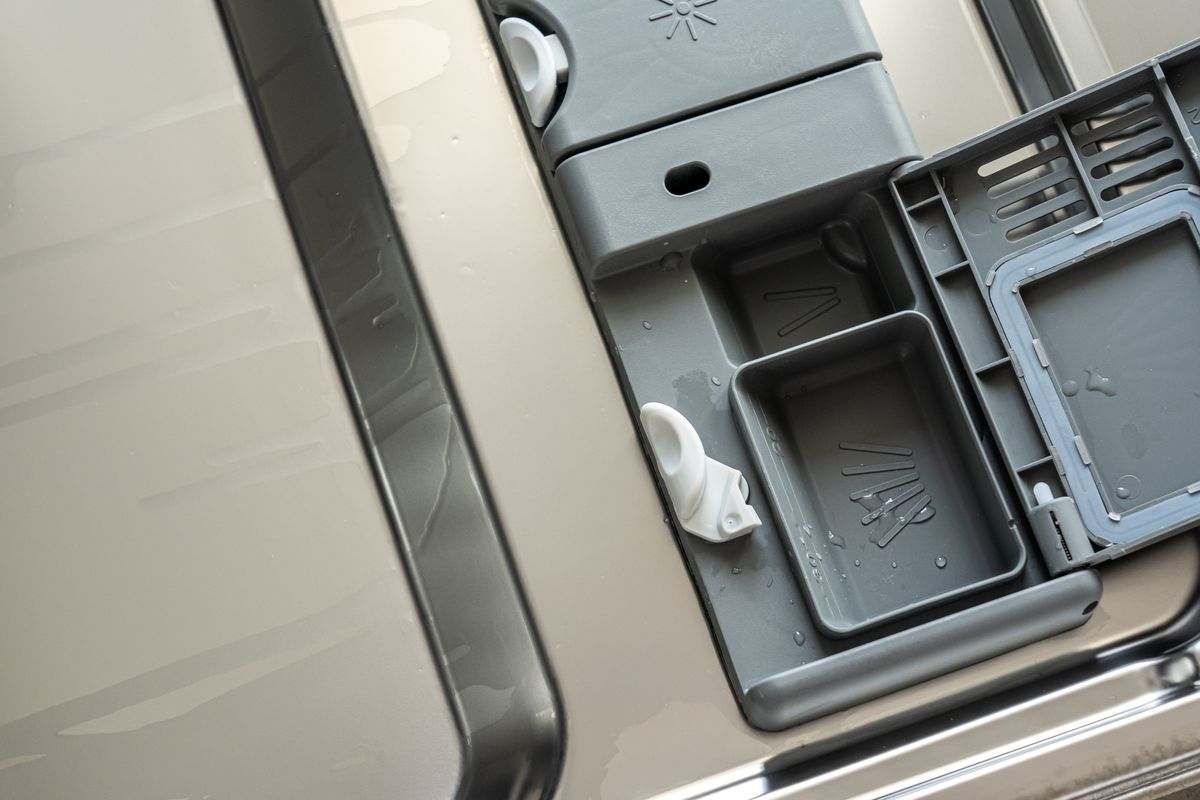
Rinse aid. Fill it and turn the setting up one notch. Rinse aid is a surfactant that lowers water's surface tension so it drains as a sheet instead of beading and drying in place. On hard water it is not optional; every droplet that dries where it sits leaves its whole mineral load behind. Reservoirs typically hold enough for 30 to 60 cycles and give no warning when empty.
Filter and spray arms. Twist out the filter under the lower rack, rinse it under warm water with a soft brush, and check every hole in both spray arms with a toothpick. A blocked arm hole leaves an entire sector of the rack unrinsed, which reads as film on some items and not others — a pattern that maps to rack position rather than to item type.
When the Dishwasher Is Not the Problem
Two situations look like a dishwasher fault and are not.
The film is on everything in the house, not just the dishes. If faucets are spotting and shower doors are hazing at the same time, the appliance is a bystander. That is a whole-house water problem, and no dishwasher setting resolves it.
The residue does not dissolve in acid. Run one filmed item through the vinegar rub described in the glassware test. If a 30-second acid rub changes nothing, it is not calcium — it is either silica, which passes straight through ion exchange, or etching, which is permanent. Treating either one as hardness leads to an expensive disappointment.
Worth knowing before you go further: a softener removes calcium and magnesium, and the EPA's description of cation exchange is clear about the boundary of what that process does. It is not a general-purpose residue remover.
What to Do Next
- Check the tub floor for a salt cap tonight. If your machine has one and it is empty, that is your answer and it costs a few dollars to fix.
- Run the citric acid cycle empty, then the four-item control load. Read the table above against what comes out.
- Change one variable at a time afterwards. Rinse aid, then dose, then temperature — never all three together.
- If the control load films evenly on an empty machine, the water is the cause, and whether your hardness number justifies treatment is the next question rather than another detergent.
Frequently Asked Questions
Why is my dishwasher suddenly leaving a white residue on everything?
Sudden onset points at a change rather than a slow build-up. The usual four are an empty rinse aid reservoir, a switch to a different detergent, a clogged filter after a greasy load, and a change in the incoming water. Rinse aid is the one to check first because it is free to rule out and it fails silently — most machines do not warn you when the reservoir empties. If nothing changed on your end, your utility may have switched source water, which can move hardness by several grains overnight.
Does vinegar in the dishwasher get rid of white film?
Yes for mineral film, and it does nothing for detergent residue. A cup of white vinegar in an upright bowl on the top rack during a hot cycle dissolves calcium and magnesium deposits from both the dishes and the tub. Citric acid powder in the detergent dispenser is more effective and less corrosive to door gaskets over the long term. Do not put vinegar in the machine at the same time as detergent — the acid neutralises the alkaline detergent and you get neither effect.
Should I use more or less dishwasher detergent with hard water?
More, up to a point. Hardness consumes detergent before it can work on food soil, so under-dosing on hard water leaves both film and poor cleaning. Above roughly 10 grains per gallon, however, no realistic dose keeps up, and adding more simply leaves undissolved detergent as its own white residue. If you are on softened water the direction reverses entirely — cut the dose to a third or half, or you risk etching glassware permanently.
Do Bosch and Miele dishwashers need special salt?
Yes, if the model has a built-in softener, and most European-built machines sold in the US do. The salt reservoir sits in the floor of the tub under a screw cap, and it takes coarse dishwasher salt only — never table salt, which contains anti-caking agents that clog the resin. You also have to set the machine's hardness value to match your actual water. A machine left on its factory hardness setting with an empty salt reservoir films dishes no matter what detergent you buy.
Is the white film in my dishwasher harmful?
Mineral film is not a health risk — it is calcium and magnesium, the same minerals dissolved in the water you drink. Detergent residue is worth taking more seriously, mostly because it indicates the machine is not rinsing properly, which also means food soil is not clearing. Run one rinse-only cycle with an empty machine and no detergent. If the tub interior comes out with fresh film, the cause is minerals in the water rather than anything you are adding.