
Why Hard Water Clogs Showerheads
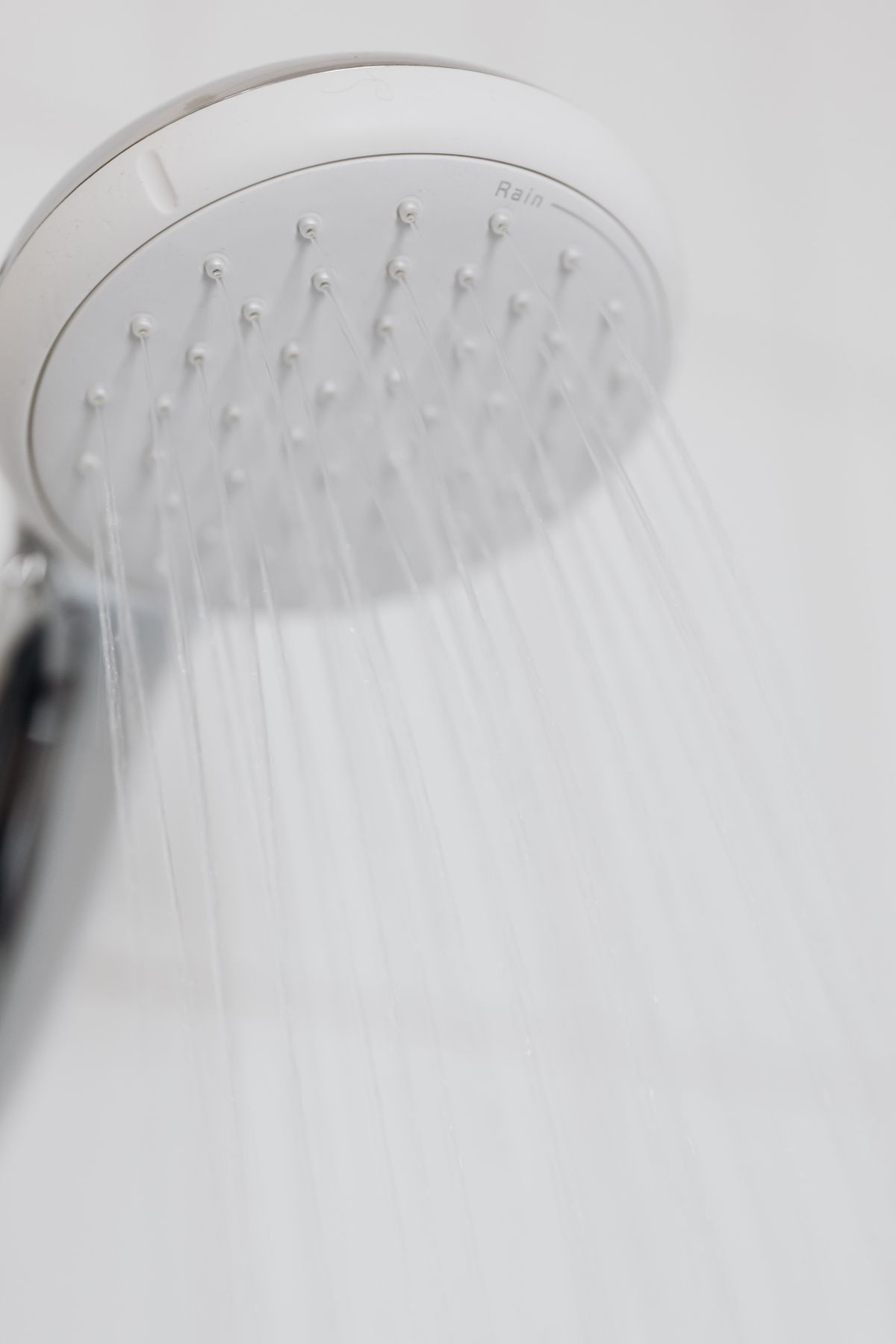
A hard water clogged showerhead is scale — calcium and magnesium carbonate — narrowing the nozzles until the spray splits, sprays sideways, or drops to a dribble. Half an hour in undiluted white vinegar removes it. The part worth doing properly is measuring the flow with a bucket and a stopwatch before and after, because that number, repeated monthly, tells you how fast your water is depositing scale everywhere else in the house.
Cleaning the head fixes today's shower. The measurement is what tells you whether you have a maintenance chore or an equipment problem.
Measure First: The Bucket-and-Stopwatch Baseline
This takes two minutes and it is the entire point of the exercise. Do it before you touch the head.
- Get a bucket with a known volume and mark a one-gallon line on it, or use a one-gallon jug. A two-gallon mark gives a more accurate reading if the bucket fits under the head.
- Run the shower on full hot and cold together, at the setting you actually use, and let it stabilise for 15 seconds.
- Start the timer as you slide the bucket in, and stop it the moment the water reaches your mark.
- Divide 60 by the seconds it took, for a one-gallon fill. Twenty-four seconds means 2.5 gallons per minute; 40 seconds means 1.5 gpm.
- Run it three times and average. Single readings vary by a surprising amount depending on how cleanly you catch the start.
Now compare that against what the head is rated for. Under US federal rules, showerheads may use no more than 2.5 gallons per minute, and a WaterSense-labelled head is capped at 2.0 gpm. The rating is normally moulded into the back of the head or printed on the box.
| Measured flow vs rating | What it means |
|---|---|
| Within 10% of rated | The head is clear. Any complaint is about spray pattern, not blockage |
| 10–25% below rated | Early scale. A soak restores it and the head is not damaged |
| 25–50% below rated | Established scale. Remove the head and soak it properly |
| More than 50% below rated | Either heavy scale or an upstream restriction. Measure the bare arm too |
| At or above rated | Flow restrictor is missing or removed — not a scale problem at all |
Write the number and the date somewhere you will find again. A note on your phone is enough. That single habit converts every future clean into a data point.

Descaling a Hard Water Clogged Showerhead Properly
Removal beats the bag method, because scale builds inside the head's internal passages as well as on the visible face.
Take it off. Most heads unscrew anticlockwise by hand from the shower arm. If it resists, wrap the connector in a cloth before applying an adjustable wrench, and hold the shower arm still with your other hand so you do not twist it in the wall fitting. Chrome marks permanently under bare jaws.
Strip it as far as it goes. Many heads have a removable face plate, a rubber washer, a filter screen at the inlet, and on multi-function models a rotating selector disc. Photograph the order as you separate them. The inlet screen is the most commonly overlooked part and often the most blocked, because it catches everything the pipework sheds.
Soak in undiluted white vinegar. Full strength, not a dilution, in a container deep enough to submerge everything. Thirty minutes for light haze, two to four hours for a normal clog, overnight for a head that sprays sideways. You will see the fizzing slow and stop when the acid has done its work.
Work the nozzles from the outside in. An old toothbrush across the face, then a pin or a paperclip through individual blocked holes, pushing debris back out the way it came rather than deeper in. On rubber-nub heads, rub the nubs with a thumb — that is what they are designed for.
Rinse, reassemble in the photographed order, refit hand-tight. A quarter turn past finger-tight on the thread tape is plenty; overtightening splits plastic connectors.
Two cautions worth repeating. Keep coloured, matte and plated finishes out of long soaks — 30 minutes maximum, then rinse thoroughly. And never combine vinegar with any bleach or chlorine-based bathroom cleaner, in the soak or in the same session.

Measure Again — and Keep the Log
Repeat the bucket test immediately after refitting. Two things come out of that second number.
First, a sanity check: if the flow did not recover to within 10% of the rating, the restriction was never entirely in the head, and the next section covers where to look.
Second, and more useful, you now have a starting point. Measure again once a month, at the same setting, and record the percentage drop from the post-clean number.
| Flow loss per month | Implied scaling rate | What follows from it |
|---|---|---|
| Under 2% | Slight hardness, roughly under 5 gpg | Annual clean. Nothing else needed |
| 2–5% | Moderate, roughly 5–10 gpg | Clean two or three times a year; watch the water heater |
| 5–10% | Hard, roughly 10–15 gpg | Scale is accumulating in every appliance at the same rate |
| Over 10% | Very hard, 15 gpg and up | Treatment pays back on appliance life, not just on showers |
| Flow drops but vinegar does not dissolve the deposit | Silica or sediment | Ion exchange will not help. Different problem entirely |
Two things distort the log, and both are easy to control. Run the test at the same temperature mix each time, because hot and cold sides can have different restrictions. And ignore the first month after any plumbing work or after a softener is installed, since loosened debris from the pipes inflates the rate temporarily.
This is the same reasoning applied elsewhere in the house. The regrowth interval on a faucet aerator gives a comparable reading, and if the two disagree sharply, the difference points at the hot water side rather than at the supply.
Why Silicone Nubs Hide the Problem Rather Than Solve It
Almost every showerhead sold now has flexible silicone or rubber nozzles that you can rub clean with a thumb. They are genuinely convenient, and they are also the reason a lot of households never realise how hard their water is.
The nubs work because scale does not bond well to flexible silicone — flexing the surface cracks the deposit off. What that does is keep the visible face clear while scale continues to build in the internal manifold, the flow passages and the inlet screen, none of which flex. So the spray pattern stays acceptable long after the flow rate has fallen substantially.
The practical consequence: on a nub head, spray appearance is a useless indicator and the bucket test is the only reliable one. Households often report that their old metal-faced head clogged constantly while the new one "never does" — the new one is simply hiding it. Meanwhile the same water is depositing scale in a water heater at exactly the same rate.
The same masking applies to handheld heads with a self-cleaning face and to heads with a built-in filter cartridge. A filter cartridge that removes chlorine does not remove hardness; those are different processes with different media, and the EPA's outline of cation exchange describes what is actually required to take calcium and magnesium out of water.
When It Is Not the Showerhead
Before spending money, rule out three things that look identical from inside the shower.
Remove the head and measure the bare arm. If a bare shower arm gives you 4 gpm or more, the head was the restriction. If the bare arm gives you 2 gpm, the head was never the problem and everything you do to it is wasted effort.
Check the valve cartridge. Mixing valves have their own screens and their own scale. A shower where hot runs strong but the mix is weak, or where flow changes when a tap elsewhere is opened, points at the cartridge rather than the head.
Check the whole house. If flow is poor at several fixtures at once, the shower is a symptom. That belongs in a pressure-versus-flow diagnosis at the hose bib, which separates a genuine pressure problem from a flow restriction — two things that feel the same and have completely different fixes.
What to Do Next
- Measure the flow today, before cleaning anything. Sixty divided by the seconds to fill a gallon. Write it down with the date.
- Remove, strip and soak the head in undiluted vinegar for as long as the buildup warrants, then reassemble in the photographed order.
- Measure again and log it monthly. Three months of readings tell you your scaling rate more honestly than any single water test does.
- If the monthly loss is above 5%, the shower is the visible end of something happening in every appliance you own. Work out whether your hardness number justifies treatment before getting quotes.
Frequently Asked Questions
How long should you soak a showerhead in vinegar?
Thirty minutes clears a light haze, two to four hours handles a typical clog, and overnight is right for a head that sprays sideways. Use undiluted white vinegar rather than a 50/50 mix for anything beyond light buildup — the dilution halves the acid strength and roughly doubles the time needed. The one exception is finish: brass-plated, oil-rubbed bronze, matte black and coloured coatings should not sit in acid for more than about 30 minutes, because prolonged contact strips the coating and the damage is permanent.
Can you clean a showerhead without removing it?
Yes. Fill a sturdy plastic bag with white vinegar, raise it so the whole spray face is submerged, and secure it around the neck with a rubber band or cable tie. It works, and it is the right approach for a head you cannot easily unscrew or one on a fixed arm. It is less effective than removal, because it only treats the face and not the internal passages where scale also builds, so expect the clog to return sooner.
Does a water softener stop showerheads clogging?
It stops new calcium and magnesium scale forming, which is the cause in most homes. Two caveats worth knowing: deposits already inside the pipework keep shedding downstream for several weeks after installation, so plan to clean the head again at the one-month mark, and silica haze passes straight through ion exchange unaffected. If the deposit on your head does not dissolve in vinegar, a softener will not change it.
Why is my shower pressure still low after cleaning the showerhead?
Then the showerhead was not the restriction. Remove it entirely and measure the flow from the bare arm with a bucket. If flow is strong there, the head is at fault after all and needs replacing. If flow is weak from the bare arm too, the problem is upstream — the shower valve cartridge, a partly closed supply valve, scaled pipework, or a whole-house pressure issue. That is a different diagnosis, and it starts with a pressure gauge on an outside hose bib.
How often should a showerhead be descaled in hard water?
Let the flow measurement decide rather than the calendar. In water above 10 grains per gallon, most heads need attention every four to eight weeks; between 5 and 10 grains, every three to six months; below 5 grains, once or twice a year. If you are descaling monthly and the flow still drops between cleanings, the head is not the problem — the water is, and the same rate of deposition is happening inside your water heater where you cannot reach it.