
GE Water Softener Review: Leftover Models, the 2025 Smart Range and What Still Has Support
This GE water softener review has two answers, because there are now two GE ranges. The softeners most reviews describe, the GXSF30V, GXSH40V, GXSH45V, GXSHC40N and GXMH31H, are flagged as obsolete in GE's own product data, and none had an active Amazon offer on 1 October 2026. GE replaced them in October 2025 with a Wi-Fi range: the GXSH35W, GXSH45W and GXMD30W. The old and new units are close relatives. Both are NSF/ANSI 44 certified cabinet softeners with very high salt efficiency and GE's one-year full warranty. If you find leftover stock, the new model is the benchmark its clearance price has to beat.
Disclosure: Hard Water Solved may earn a commission if you buy through links on this page, at no extra cost to you. It does not change which products we include or how we rank them. Read our disclaimer.
GE Water Softener Review: Which Models Are Current
| Model | Type | GE status | First sold | Amazon |
|---|---|---|---|---|
| GXSF30V | 30,400-grain softener | Obsolete | 2012 | Unavailable |
| GXSH40V | 40,000-grain softener | Obsolete | 2012 | Unavailable |
| GXSH45V | 45,100-grain softener | Obsolete | 2012 | Not checked |
| GXSHC40N | 40,000-grain, Wi-Fi | Obsolete | 2019 | Unavailable |
| GXMH31H | 31,100-grain softener + filter | Obsolete | 2015 | Unavailable |
| GXSH35W | 35,000-grain, Wi-Fi | Current | Oct 2025 | Check price on Amazon |
| GXSH45W | 45,000-grain, Wi-Fi | Current | Oct 2025 | No listing found |
| GXMD30W | 30,000-grain, Wi-Fi, carbon filter | Current | Oct 2025 | Check price on Amazon |
The status column comes from the IS_OBSOLETE flag in GE's own product data, which is true for every older model and false for the three 2025 models. GE's store pages still show prices for the obsolete units but no add-to-cart button. Treat those prices as a reference for judging a clearance offer, not as stock you can order.
How this review was built. It is built from documents: GE's product data and specification pages, the GXSH40V/GXSH45V and GXSH35W/GXMD30W owner's manuals, GE's US limited warranty, NSF's public listings and the Amazon listings. Nothing here comes from a unit on our bench. Prices are not listed here because they change often. Use the buttons to see the current price on Amazon.
Who Makes GE Water Softeners
GE softeners carry the GE trademark under licence: the manuals say "GE is a trademark of the General Electric Company. Manufactured under trademark license." The warrantor named in the manual is GE Appliances, a Haier company, of Louisville, Kentucky. NSF lists the older models under GE Appliances, made at a facility in Ripley, Mississippi. The 2025 models are certified to NSF/ANSI 44 by IAPMO R&T rather than NSF, according to their manual. The GXMD30W is also certified to NSF/ANSI 42 for chlorine taste and odour.
Warranty service runs through GE Appliances' factory service network, which is the practical difference from Whirlpool, whose softeners are made and warranted by a separate licensee.
Grain Rating Converted to Real Capacity
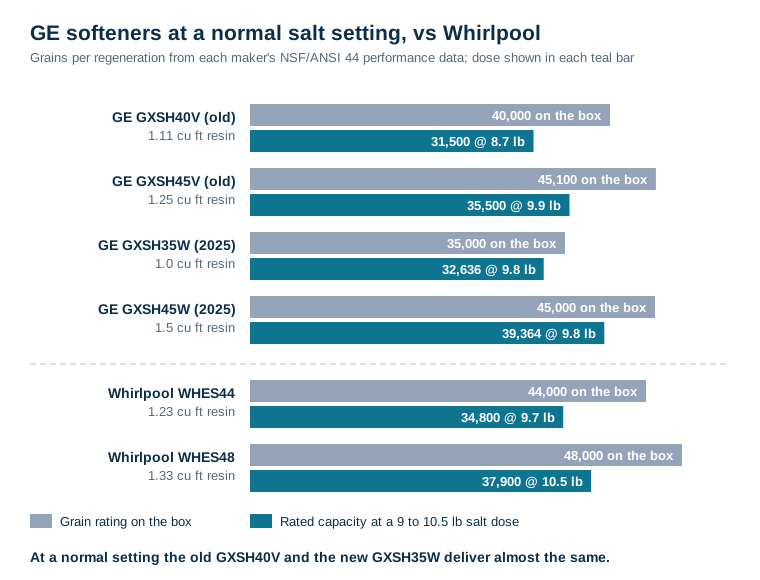
GE publishes NSF/ANSI 44 performance data with capacity at three salt doses for every model. The model name is always the capacity at the highest dose. At a normal 9 to 10 lb setting, every unit delivers less.
| Model | Resin | Minimum dose | Middle dose | Maximum dose | Efficiency at minimum |
|---|---|---|---|---|---|
| GXSH40V (old) | 1.11 cu ft | 11,700 @ 2.3 lb | 31,500 @ 8.7 lb | 40,000 @ 15.1 lb | 5,090 grains/lb |
| GXSH45V (old) | 1.25 cu ft | 13,200 @ 2.6 lb | 35,500 @ 9.9 lb | 45,100 @ 17.0 lb | 5,050 grains/lb |
| GXSH35W (2025) | 1.0 cu ft | 13,311 @ 2.6 lb | 32,636 @ 9.8 lb | 37,065 @ 17.1 lb | 5,120 grains/lb |
| GXMD30W (2025) | 0.9 cu ft + carbon | 11,097 @ 2.34 lb | 27,207 @ 8.8 lb | 30,899 @ 15.3 lb | 4,742 grains/lb |
| GXSH45W (2025) | 1.5 cu ft | 19,904 @ 3.89 lb | 39,364 @ 9.8 lb | 55,424 @ 25.42 lb | 5,120 grains/lb |
From GE's owner's manuals. The GXSF30V and GXMH31H are rated at 4,800 and 4,230 grains per pound of salt; their full dose tables are in their own manuals.
Three conclusions follow:
- The new GXSH35W is not a downgrade from the GXSH40V. Its lower number reflects a lower maximum dose. At a normal setting it delivers 32,636 grains against 31,500.
- GE's resin is rated hard. The GXSH35W claims 32,636 grains from 1 cubic foot at 9.8 lb. Standard resin in industry design tables gives about 26,000 at 9 lb, as our guide to advertised vs usable softener capacity explains. GE's figures are certified, so they are not invented, but they are top-of-the-range claims. A margin for resin ageing is sensible.
- Against Whirlpool's closest equivalents, the GE units are similar. The Whirlpool WHES44 gives 34,800 grains at 9.7 lb and the WHES48 37,900 at 10.5 lb. Morton's MSD34C, the other big-box name, showed as unavailable on Amazon on the same day, so we could not compare a current Morton listing.
The GXSH45W's 55,424-grain maximum needs more than 25 lb of salt per regeneration. That is a salt-hungry setting few households should use. Size it from the 39,364 figure.
The App Features, Old and New
Two GE generations have Wi-Fi.
GXSHC40N (2019, now obsolete): SmartHQ app with leak and running-faucet alerts, remote water shut-off with GE's valve, low-salt alerts, vacation mode and usage monitoring. It needs a Wi-Fi signal at the softener.
GXSH35W, GXSH45W and GXMD30W (2025): built-in Wi-Fi with alerts for low, medium or high continuous flow, low-salt reminders and vacation mode in the SmartHQ app. Leak detection with whole-house shut-off works only with the separately sold RMVALVESFT valve. They also have a blending valve for setting partial softness, and they accept 3/4 to 1-1/4 inch plumbing through the included connectors.
The flow alerts are the useful part. A continuous-flow alert at 3 a.m. usually means a running toilet or a leak, and catching that early saves both water and softener capacity. The shut-off only works if you buy and install the valve, so budget for it if leak protection is the reason you want a smart softener.
The Failure Points GE's Own Manual Expects
GE's troubleshooting table for the GXSH40V and GXSH45V is unusually candid about what goes wrong. For "no soft water", it lists the simple causes before the mechanical ones, and that order is worth following.
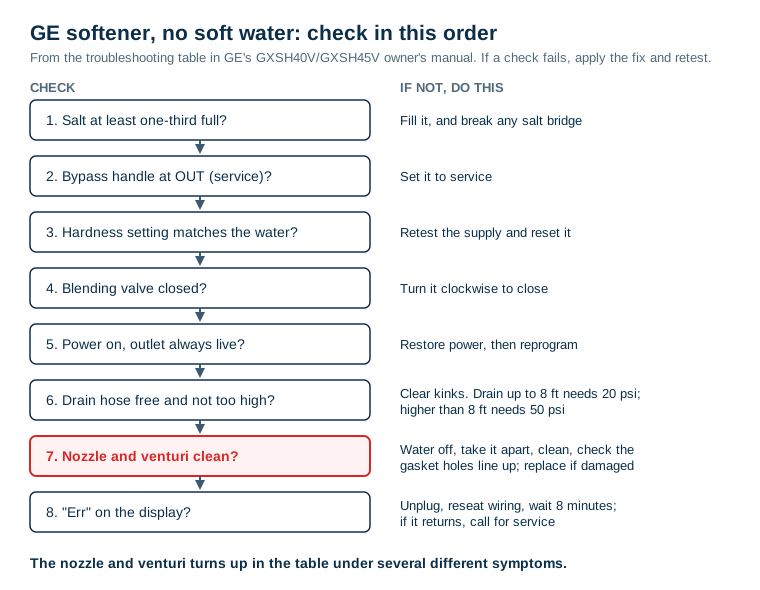
Nozzle and venturi. This is the part the table names most often. A dirty, damaged or badly reassembled nozzle and venturi stops the softener drawing brine, so the resin never regenerates. It turns up under no soft water, a softener that uses no salt and too much water in the brine tank. The manual asks you to turn the water off, take the assembly apart, clean it, and make sure the holes in the gasket line up with the holes in the housing. Our guide to cleaning a softener injector covers the same job on other brands.
Drain hose. A pinched, plugged or raised drain line also stops brine draw. GE's rule: a drain up to 8 feet high needs at least 20 psi of supply pressure, and one higher than 8 feet needs 50 psi.
Electronics. An "Err" code usually means wiring has worked loose inside the control. The manual's fix is to unplug, reseat the connections, plug back in and wait eight minutes. If the code returns, call for service. A blank display or lost settings is a separate set of checks, covered in our guide to a water softener error code or blank display.
Things that are not faults. A demand softener that uses little salt is working as designed. Slippery-feeling water is soft water. Blue water in copper plumbing points to acidic water, which needs testing, not a softener repair.
Warranty and Lifespan
GE's US limited warranty, from the current owner's manual:
| Period from purchase | What GE replaces | Labor |
|---|---|---|
| 1 year | Any part that fails from a defect | Included, through GE factory service |
| 3 years | The electronic monitor | You pay |
| 10 years | The resin tank | You pay |
There is no cleanser condition and no extension scheme, unlike Whirlpool's. The cover starts from the date of original purchase, so a new leftover unit bought today gets the full term from today. Commercial or non-family use cuts all of it to 90 days.
GE publishes no service life. The warranty suggests the same pattern as other softeners: the tank outlasts the electronics, and the nozzle, venturi and valve seals are the routine maintenance items. Our guide to how long a water softener lasts shows how water quality moves that estimate.
Buying Leftover GE Stock: A Checklist
A clearance GE softener can be a good buy. Check four things first:
- Price against the current equivalent. GE listed the GXSH40V below the GXSH35W, which delivers slightly more capacity at a normal salt dose and adds Wi-Fi. A leftover GXSH40V is worth it only if it costs well below a new GXSH35W. A leftover GXMH31H against the GXMD30W can be a bigger saving, if you do not need the newer unit's carbon stage certification. Check the current prices of both before you decide.
- A new-product warranty. Confirm the seller is authorised and that the unit is new, not returned or open-box, so GE's one-year full warranty applies from your purchase date.
- Parts. GE's manuals list part numbers for the nozzle and venturi, seals and control parts. Ask GE Appliances whether those are still stocked for your model. Third-party kits sold online as fitting GE, Whirlpool, Kenmore and Morton units exist, but they are not GE parts.
- Iron and hardness limits. The old models are rated for 3 to 12 ppm of clear-water iron depending on model; the 2025 models are rated at 3 to 5 ppm (GE's specification page and manual differ). On a well with iron, the older GXSH45V's 12 ppm rating may matter more than Wi-Fi. Test first: our guide to testing iron and manganese before sizing explains how.
You can confirm any GE model's certification on NSF's listing for GE Appliances, and read the full performance tables in the GXSH35W and GXMD30W owner's manual.
Three Current Picks on Amazon
-
GE Smart Water Softener GXSH35W. The direct replacement for the GXSH40V and GXSHC40N: 1 cubic foot of resin, 32,636 grains at 9.8 lb, Wi-Fi alerts, up to 165 gpg hardness.
-
GE Smart Water Softener with Integrated Filtration GXMD30W. The replacement for the GXMH31H, adding a carbon stage certified to NSF/ANSI 42 for chlorine taste and odour.
-
EcoPure EPH130 softener and filtration system. A non-GE alternative made by Water Channel Partners, the company that also makes Whirlpool's softeners. It carries a 1-year parts and labor warranty.
Who a GE Softener Is Wrong For
- Wells with more than 5 ppm of iron, for the 2025 models. Pretreat, or look for an iron-rated unit.
- Buyers who want leak protection without extra cost. The remote shut-off needs a separate valve.
- Large households with heavy simultaneous use. The cabinet models are rated at 7.5 to 9.6 gpm.
- Anyone offered an obsolete model near the price of its replacement.
- Rental or small-business use, where the warranty falls to 90 days.
For a typical household on city water, the current GE range is a certified, efficient cabinet softener with genuinely useful flow alerts. If you have not yet decided between softening and a salt-free approach, read salt-based vs salt-free water treatment first.
Frequently Asked Questions
Are GE water softeners discontinued?
The older ones are. GE's product data flags the GXSF30V, GXSH40V, GXSH45V, GXSHC40N and GXMH31H as obsolete, and their Amazon listings showed as currently unavailable on 1 October 2026. GE released a new range on 6 October 2025: the GXSH35W and GXSH45W smart softeners and the GXMD30W softener with integrated filtration. Those are current models.
What is the real capacity of a GE 40,000-grain softener?
GE's own performance data for the GXSH40V gives 40,000 grains only at 15.1 lb of salt per regeneration. At 8.7 lb it is rated at 31,500 grains, and at its minimum 2.3 lb dose, 11,700 grains. For sizing, use the figure at the salt dose you will actually run. At a normal setting the old GXSH40V and the new GXSH35W deliver almost the same capacity.
What does the GE SmartHQ app do on a water softener?
On the Wi-Fi models it sends low-salt reminders, alerts you to low, medium or high continuous water flow, and lets you set vacation mode. Paired with GE's separately sold shutoff valve, it can shut off water to the house remotely when a leak is detected. The softener needs a Wi-Fi signal where it is installed.
What usually goes wrong with a GE water softener?
GE's own troubleshooting table points first to simple causes: low salt or a salt bridge, the bypass left in bypass, a wrong hardness setting, an open blending valve and lost power. The most frequently named mechanical cause is a dirty, damaged or badly assembled nozzle and venturi, which stops the softener drawing brine. A restricted or too-high drain hose and loose control wiring follow.
What warranty do GE water softeners have?
In the US, GE gives one year on any part including labor from its factory service, three years on the electronic monitor, and ten years on the resin tank, all from the date of original purchase. After the first year you pay the labor. If the softener is used for anything other than private family use, the cover drops to 90 days.
Should I buy a leftover GE softener on clearance?
Only if the price is clearly below the current model that does the same job, you get a full new-product warranty from your purchase date, and you can confirm that the parts you are likely to need, such as the nozzle and venturi and the seal kit, are still available. GE listed the GXSH40V below the new GXSH35W, which delivers almost the same capacity at a normal salt setting, so compare the clearance price with the GXSH35W's current price.