
How Long Does a Whole-House Water Softener Last?
How long does a water softener last? Most whole-house units last 10 to 15 years, and Culligan's own guidance on when to replace a water softener gives the same range, "maybe more" with maintenance. That single figure hides the part that matters. The control valve, the resin and the tanks wear out on separate schedules, and each one can usually be replaced on its own.
So the useful question is not "how old is it?" but "which of its three clocks is running out, and how fast is my water winding it?"
How Long Does a Water Softener Last? Three Clocks, Not One
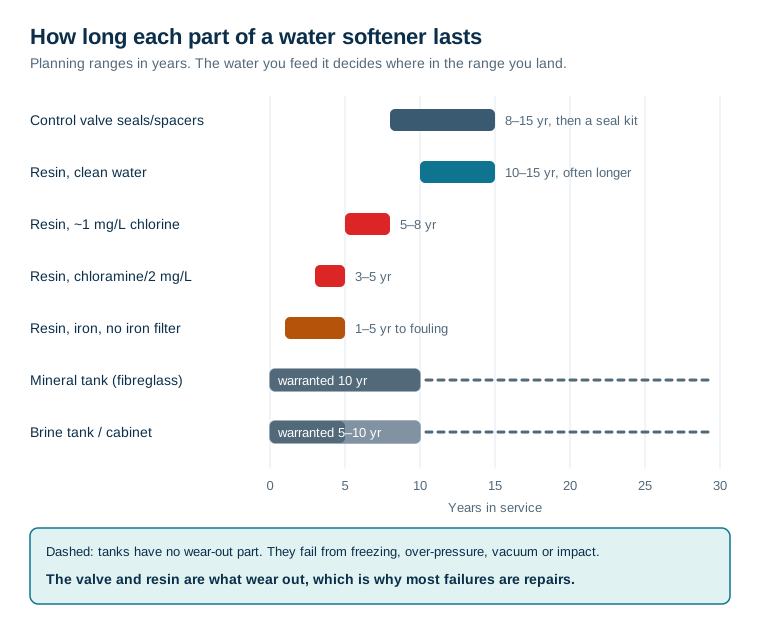
Each major component fails for a different reason, so each has its own lifespan.
| Component | What wears it out | Typical life | Replaceable on its own? |
|---|---|---|---|
| Control valve | Regeneration cycles moving the piston through its seals. Electronics also fail from power surges and damp | Seals and spacers 8–15 years; valve bodies often longer | Yes: seal kit, piston, motor, circuit board, or the whole head |
| Resin | Chlorine and chloramine oxidising the beads; iron, manganese and sediment fouling them | 10–15+ years on clean water; 3–8 on chlorinated water; 1–5 on untreated iron water | Yes: a re-bed |
| Mineral tank | Very little in normal indoor service. Freezing, over-pressure, vacuum and impact | Commonly outlives the valve and resin | Yes, though rarely needed |
| Brine tank | Cracking in cold rooms, physical damage, a failed float | Long; the float and brine valve are the usual failures | Yes |
That is why a failure is so often a repair. A softener whose valve has died usually still has a sound tank, and a softener whose resin has worn out usually still has a working valve. The whole unit only reaches the end of its life when two clocks run out at once, or when the parts to reset one are no longer sold.
The Control Valve Wears by Cycles, Not Years
The valve is the only part with moving parts. Each regeneration drives a piston through its stages, and every stroke slides rubber seals and plastic spacers past each other. That wear is counted in cycles, not in years.
This is the adjustment almost nobody makes. Two identical softeners installed on the same day wear their valves at very different rates if one regenerates weekly and the other every other day.
| Regeneration interval | Cycles per year | Valve wear compared with weekly |
|---|---|---|
| Every 7 days | 52 | 1× |
| Every 4 days | 91 | 1.75× |
| Every 3 days | 122 | 2.3× |
| Every 2 days | 183 | 3.5× |
| Every day | 365 | 7× |
These are calculated from the calendar, not measured valve lives. But the ratio holds. If a valve on a weekly cycle typically needs its first seal kit at around twelve years, one cycling every two days should be expected to need it much sooner. Hard water, a large household and an undersized unit all push the interval shorter, and they all spend valve life. The same thing happens when the hardness setting is left far higher than the water needs.
What else shortens valve life:
- Chlorinated water. Rubber seals harden and crack faster, and on chlorinated supplies they can shed black flakes into the water.
- Sediment and iron. Grit scores the seals and lodges in the injector.
- Power surges and damp. They kill circuit boards and motors more often than wear does.
- Obsolescence. A valve is only as repairable as its parts supply. Widely used valve makers sell seal kits and pistons openly for years. Proprietary heads may be serviceable only through one dealer network.
What it looks like when the valve is due: water running to the drain when it should not, salt use drifting upward, hardness slipping through, noises during regeneration, or leaks at the head. None of these means the softener is finished. They mean the valve needs attention.
The Resin: The Part Your Water Decides
Resin has no moving parts and no fixed lifespan. It fails when something in the water damages or clogs it, so its life depends almost entirely on the supply. The planning figures below match our longer guide to water softener resin life and when to replace it:
| Your supply | What attacks the resin | Realistic resin life |
|---|---|---|
| Private well, no disinfection, low iron | Slow physical attrition | 12–20 years |
| City water with a carbon prefilter | Slow attrition | 10–15 years |
| City water, free chlorine around 1 mg/L, no carbon | Oxidation | 5–8 years |
| City water, chlorine around 2 mg/L or chloramine | Oxidation | 3–5 years |
| Well with iron above about 3 mg/L, no iron filter | Fouling | 1–5 years to visible failure |
Oxidation and fouling are different kinds of damage. Chlorine breaks the cross-links that hold each bead rigid. The beads swell, soften and lose capacity for good, a process described in detail in how chlorine damages softener resin. Iron and sediment coat the beads without destroying them, and some of that capacity can be recovered with cleaning. Penn State Extension's guide to water softening warns that iron already oxidised by air or chlorine "will clog the resin," and recommends filtering it out before the softener.
The signal that resin is ending is not its age. It is a sustained fall in the gallons the unit treats between regenerations, logged month by month. A bed that treated 2,000 gallons per cycle and now manages 1,200 has lost about 40% of its working capacity, whatever its age.
The Tanks Are Usually the Last Thing to Fail
Fibreglass-wrapped mineral tanks and polyethylene brine tanks have no wear-out mechanism in a heated indoor room. They fail from events: a freeze, a pressure spike, a vacuum that collapses a liner, a knock from a lawn mower in a garage, or years of sun on an outdoor unit.
The warranty documents show how confident makers are about this. A.O. Smith's softener manual covers mechanical and electronic parts for five years but the media tank and brine cabinet for ten, and excludes the media altogether. Other published terms follow the same pattern, as the component-by-component warranty terms in the EcoPure review show for one retail range. Tanks carry the longest coverage, and the resin gets the least, either a short "all other parts" term or none at all.
The exclusions in those same documents list what actually kills tanks:
- Freezing. Water-Right, A.O. Smith and WaterBoss all exclude freeze damage.
- Over-pressure. Morton's warranty excludes operation above 125 psi. Water-Right's ten-year tank term excludes damage from 120 psi and above, and from a vacuum on the system.
- Heat. Water-Right's tank term excludes damage from 100°F and above, and Morton's warranty excludes operation above 120°F. A softener that takes back-fed hot water from a heater is outside those terms.
- Outdoor exposure. Some makers exclude unprotected outdoor installations entirely.
A bulging, cracked or weeping mineral tank is the one finding that ends the discussion. It is a replace-now condition, and it is covered in signs a water softener needs replacing.
Adjust the Estimate to Your Own Water
Start from the typical figures and move them for your conditions. This is a planning tool, not a prediction.
| Your situation | Valve | Resin | Tanks |
|---|---|---|---|
| Clean well water, no iron, sized to regenerate about weekly | 12–15 yr to first rebuild | 12–20 yr | Long |
| City water with a carbon prefilter | 10–15 yr | 10–15 yr | Long |
| City water, no carbon filter | Shorter; chlorine hardens seals | 3–8 yr | Long |
| Well water with iron, no iron filter | Shorter; grit and iron in the valve | 1–5 yr | Long |
| Hard water or undersized unit regenerating every 1–2 days | Much shorter; see the cycle table | Unchanged by hardness alone | Long |
| Unheated garage, crawl space or outdoors | Electronics exposed | Freeze risk | Freeze and UV risk |
| House pressure above about 100 psi, no pressure-reducing valve | Seal stress | Unchanged | Pressure-spike risk |
Worked example. Two houses each install the same 32,000-grain demand-initiated softener.
- House A is on a private well at 12 gpg with no iron. It regenerates about every six days, around 60 cycles a year. Its resin faces no oxidant. A reasonable expectation is a valve rebuild in its early teens and resin that outlasts that.
- House B is on city water with chloramine and no carbon filter, at 22 gpg with a larger family. It regenerates every two to three days, 120 to 180 cycles a year. Expect resin trouble within about five years and a valve rebuild well before ten.
Same box, same install date, and a decade apart in life. The difference is the water and the sizing.
What Actually Ends a Softener's Life
Because each part can be replaced, a softener rarely dies outright. People replace the whole unit when one of these is true:
- Two clocks run out together. The resin is spent and the valve needs a rebuild in the same year. Paying for both often costs close to a new unit.
- The parts are gone. An obsolete or proprietary valve with no seal kits available turns a routine repair into a replacement. Before buying a retail cabinet unit, check who supplies its parts; the Whirlpool review traces who makes and warrants those softeners, and comparing Whirlpool and GE on parts availability and warranty shows how far two similar-looking cabinets can differ.
- It is a timer model. Older clock-based units regenerate on a schedule whether or not the resin is used up. A modern demand-initiated unit regenerates only when needed. Over years, the salt and water saved can change the arithmetic, which is the subject of whether to repair or replace an old water softener.
- The household or the water changed. A unit sized for two people on 10 gpg water is wrong for five people on 25 gpg, however healthy it is.
- A tank failed. A bulging or cracked mineral tank is replaced, and at that point the valve and resin usually go with it.
What a Lifespan Figure Cannot Tell You
- It cannot tell you about your unit. A range describes many softeners. Your own gallons-per-regeneration log describes yours, and it is far more useful.
- A softener cannot protect itself. It does not remove chlorine or chloramine, and it is not built for oxidised iron. Those have to be treated before the softener, or they shorten its life.
- "Lifetime" marketing is not a lifespan. Penn State Extension advises being wary of salespeople who claim their product will "outlast" others. Read what the warranty actually covers, part by part. For most units that is years on the tanks, fewer on the valve, and little or nothing on the resin.
- Longevity is not performance. A 20-year-old softener that still regenerates is not necessarily still softening. Test the water the day before a regeneration, when a tired bed shows it first.
How to Stretch Each Clock
The valve:
- Size the unit so it regenerates every three to seven days, not daily.
- Set hardness to the measured raw water figure, not a guess on the high side.
- Plug it into a surge-protected outlet in a dry spot.
- Rebuild it with a seal kit at the first sign of drain flow or drift, before a worn seal scores the valve body.
The resin:
- Fit a carbon prefilter on chlorinated or chloraminated city water.
- Fit an iron filter ahead of the softener on iron-bearing well water, and use a resin cleaner if some iron still reaches it.
- Log gallons between regenerations monthly so you catch a decline while cleaning can still fix it.
The tanks:
- Keep the unit above freezing.
- Fit a pressure-reducing valve if the house pressure runs high.
- Never let hot water back-feed into the softener.
- Keep it out of direct sun.
A water softener lasts as long as its most exposed part, and you can influence which part that is. Treat the water that attacks the resin, size the unit so the valve is not cycling daily, and keep the tanks warm and within pressure. Do that and the 10-to-15-year figure becomes the starting point rather than the ceiling.
Frequently Asked Questions
How long does a water softener last on average?
Most whole-house softeners last 10 to 15 years, and well-kept units on clean water often run longer. That average blends three parts with very different lives. The control valve usually needs its first seal rebuild somewhere between 8 and 15 years. The resin lasts 10 to 15 years or more on clean water, but only 3 to 8 years on chlorinated water with no carbon filter. The mineral and brine tanks usually outlast both, so an old softener is often worth repairing rather than replacing.
What part of a water softener wears out first?
It depends on the water. On clean well water with no iron, the control valve's seals and spacers are usually first, because they wear with every regeneration. On chlorinated city water without a carbon prefilter, the resin often goes first, sometimes within five years. On well water carrying iron with no iron filter, resin fouling can show up in one to three years. The tanks are rarely the first part to fail unless they freeze or see pressure spikes.
Can a 20-year-old water softener still work?
Yes, if its water was kind to it and its valve has been rebuilt or never needed to be. Plenty of softeners on clean, unchlorinated well water still soften at 20 years. The questions to ask are practical. Does it still deliver soft water right up to the next regeneration? Can you still buy seals and a piston for its valve? And is it a timer model using far more salt than a modern demand-initiated unit would?
Does hard water shorten a water softener's life?
Harder water does not damage the resin, but it makes the softener regenerate more often, and every regeneration moves the valve's piston through its seals. A unit regenerating every two days runs about three and a half times as many cycles a year as one regenerating weekly, so its valve wears correspondingly sooner. Correct sizing, so the unit regenerates every few days rather than daily, is the best protection for the valve.
Is it worth replacing the resin in an old water softener?
Often, yes, when the tank is sound and the valve is either young or freshly rebuilt. Resin is the part that wears on chlorinated or iron-bearing water, and replacing it restores capacity for far less than a new unit. It makes less sense when the valve is also near the end of its life, parts are hard to find, or the unit is an inefficient timer model. In that case two repairs in a row can cost close to a new softener.
Do salt-free conditioners last longer than water softeners?
They have fewer moving parts, since most have no control valve and no regeneration, but the media still has a service life that the maker states, often a few years for whole-house tanks and less for cartridges. Iron, manganese and chlorine shorten it. They also do a different job, reducing scale rather than removing hardness, so their lifespan is not a like-for-like comparison with an ion-exchange softener.
