
Hard Water vs TDS, Alkalinity and Mineral Water
Hard water vs TDS is the difference between one ingredient and the whole recipe. Hardness measures only the calcium and magnesium in water. Total dissolved solids (TDS) measures everything dissolved, and a cheap TDS pen cannot tell those ingredients apart, so a TDS reading cannot tell you whether water is hard. Alkalinity is a third measurement again. High TDS, high hardness and high alkalinity are three different findings, and each points to a different treatment.
The single most common consumer testing error is buying a TDS pen, getting a reading of 400 or 600, and concluding the water is hard. Sometimes it is. Sometimes it is soft water full of sodium, or water that has already been through a softener. The four example waters below show why.
Hard Water vs TDS vs Alkalinity: What Each Number Measures
| Hardness | Total dissolved solids (TDS) | Alkalinity | |
|---|---|---|---|
| What it counts | Calcium and magnesium only | Everything dissolved: all minerals, salts and dissolved organics | The water's ability to neutralize acid, mostly bicarbonate and carbonate |
| Charge | Positive ions | Positive and negative ions together | Mostly negative ions |
| Usual units | gpg, or mg/L as CaCO₃ | mg/L or ppm | mg/L as CaCO₃ |
| How to test at home | Drop titration kit or test strips | TDS pen (conductivity), as an estimate | Test strips or a drop kit |
| Federal guidance | None | EPA secondary guideline: 500 mg/L | None |
| What it causes | Scale, spots, poor soap lather | Taste, and deposits if it is mostly hardness | pH stability; low alkalinity means corrosive water |
| What treats it | Water softener | Reverse osmosis or distillation | Depends on the direction: neutralizer or acid feed, rarely needed |
EPA's secondary drinking water standards list TDS at 500 mg/L, with effects that include "hardness; deposits; colored water; staining; salty taste." Hardness itself has no standard. It appears only as one possible effect of high TDS, which is part of why the two get confused.
The units trap sits on top of this. Hardness and alkalinity are both usually reported "as CaCO₃" in mg/L, which is the same unit TDS uses, so three unrelated numbers look directly comparable on one report. If your report mixes grains per gallon and mg/L, water hardness units: gpg, ppm and mg/L has the conversions. The key one: divide mg/L as CaCO₃ by 17.1 to get grains per gallon.
The TDS Pen Mistake, Shown in Two Glasses
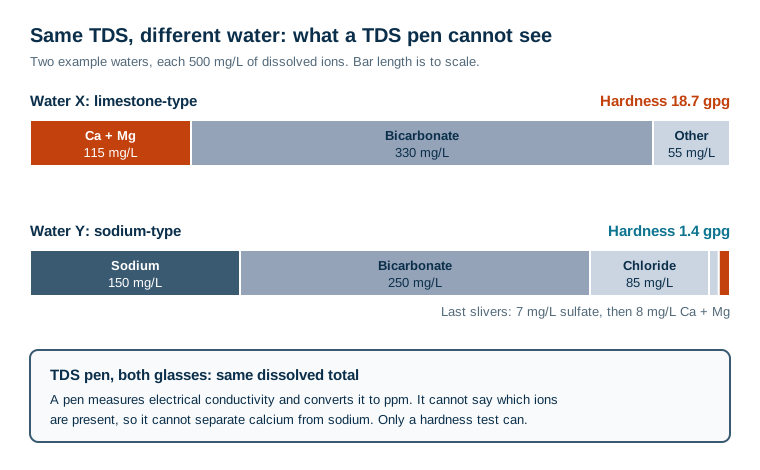
A TDS pen is a conductivity meter. It measures how well the water conducts electricity, which rises with the amount of dissolved ions, and multiplies that by a fixed factor to display ppm. It has no way to know which ions are there.
The diagram shows two example waters, each with exactly 500 mg/L of dissolved ions:
- Water X, limestone-type: 95 mg/L calcium, 20 magnesium, 330 bicarbonate, and 55 of sodium, sulfate and chloride. Hardness: about 320 mg/L as CaCO₃, or 18.7 gpg.
- Water Y, sodium-type: 150 mg/L sodium, 250 bicarbonate, 85 chloride, 7 sulfate, and only 6 calcium and 2 magnesium. Hardness: about 23 mg/L as CaCO₃, or 1.4 gpg.
Same dissolved total, and a thirteenfold difference in hardness. A pen cannot separate them. It can even read them differently from each other, because sodium chloride and calcium bicarbonate conduct electricity differently per milligram. That is fine for tracking one water over time, which is what TDS pens do well, such as watching an RO membrane. It is useless for identifying what is in an unknown water.
The softener version of the same mistake. Owners test softened water with a TDS pen, see no drop, and decide the softener has failed. A softener swaps calcium and magnesium for sodium, so TDS does not fall. It often rises slightly. The only test that checks a softener is a hardness test.
Four Waters, Three Numbers That Move Independently
This is the core of the page: four example waters, each measured three ways. The compositions are realistic examples, not samples from a particular well, and every number is worked from their ion content.
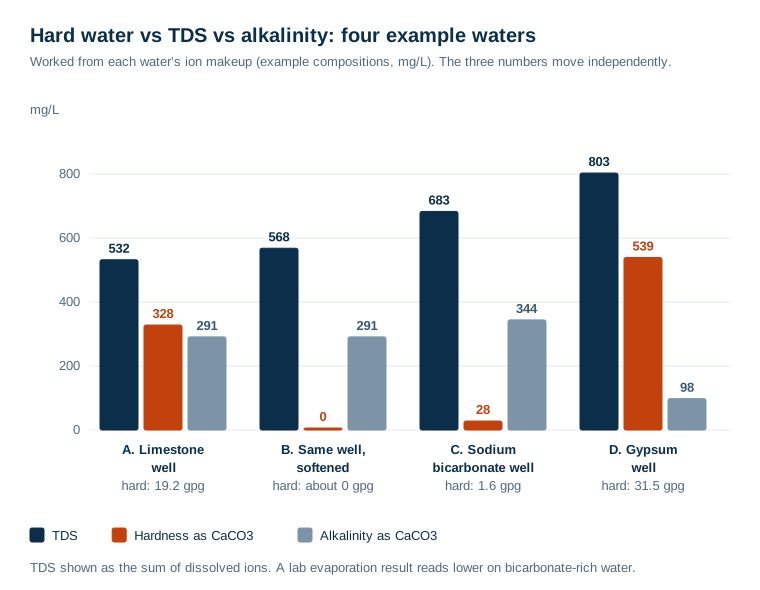
| Example water | Main ions (mg/L) | TDS | Hardness | Alkalinity | What it needs |
|---|---|---|---|---|---|
| A. Limestone well | Ca 90, Mg 25, HCO₃ 355 | 532 | 328 (19.2 gpg) | 291 | A softener. Hardness is the problem |
| B. Same well, softened | Na 161, HCO₃ 355 | 568 | about 0 | 291 | Nothing more for scale. TDS rose; if taste matters, RO at the tap |
| C. Sodium bicarbonate well | Na 180, HCO₃ 420, Ca 8 | 683 | 28 (1.6 gpg) | 344 | No softener. High TDS and alkalinity, almost no hardness. RO at the tap for taste |
| D. Gypsum well | Ca 150, Mg 40, SO₄ 430 | 803 | 539 (31.5 gpg) | 98 | A softener sized for very hard water, plus RO at the tap for the sulfate taste |
Every sample also contains minor sodium, potassium, chloride and sulfate not listed here. TDS is the sum of all ions; a laboratory's evaporation method reports lower on bicarbonate-rich water because part of the bicarbonate leaves as carbon dioxide when the sample is dried.
Read across the rows and each number tells you something the others cannot:
- A to B: softening takes hardness from 328 to zero, while TDS goes up, from 532 to 568. Alkalinity does not change, because a softener does not touch bicarbonate.
- C: a TDS of 683, well above the limestone well, and yet it is soft. Someone with a TDS pen would buy a softener for this well, and it would do nothing useful except add more sodium.
- D: the hardest water by far has the lowest alkalinity. Its hardness comes with sulfate, not bicarbonate. Its sulfate, at 430 mg/L, is also above EPA's 250 mg/L secondary guideline for taste, which a softener will not change.
What Alkalinity Adds to the Picture
Alkalinity is the most misunderstood of the three. It is not the same as pH, and it is not hardness.
Alkalinity vs pH. pH is how acidic or basic the water is right now. Alkalinity is how much acid the water can absorb before its pH falls, its buffering capacity. Water with low alkalinity swings in pH easily and tends to be corrosive to copper. Water with high alkalinity resists change. How pH and hardness combine to predict scale or corrosion is worked through in how to interpret pH and hardness together.
Alkalinity vs hardness. In most well water, alkalinity is mainly bicarbonate. When calcium and bicarbonate come in together, as in limestone water, hardness and alkalinity are close in value. Comparing them tells you what kind of hardness you have:
- Alkalinity about equal to hardness (sample A): mostly carbonate hardness. This is the hardness that forms scale when heated, in water heaters and kettles.
- Hardness well above alkalinity (sample D): much of the hardness is paired with sulfate or chloride instead. It forms less scale on heating and does not go away with boiling, but it still spots fixtures and kills soap lather. A softener removes it the same way.
- Alkalinity well above hardness (sample C): the extra alkalinity is paired with sodium, usually as sodium bicarbonate. This water is soft, often slightly high in pH, and a softener has nothing to do.
Mineral Water: A Label, Not a Hardness Level
"Mineral water" on a bottle is a regulatory term for dissolved solids, not a statement about hardness. Under the FDA's bottled water rule, 21 CFR 165.110, mineral water must contain not less than 250 ppm total dissolved solids from a protected underground source. It must be labeled "low mineral content" if TDS is below 500 ppm, and "high mineral content" if it is above 1,500 ppm.
Those solids can be almost anything. Some mineral waters are mostly calcium and magnesium bicarbonate, and would scale a kettle as fast as a limestone well. Others are mostly sodium bicarbonate, high in minerals and soft, much like sample C. The label's calcium and magnesium figures tell you the hardness. The word "mineral" does not.
The same logic runs the other way. Hard tap water is sometimes described as "mineral-rich" in a way that sounds like a benefit. Whether calcium and magnesium in water matter nutritionally is a separate question. For scale and soap, they are the whole problem.
Which Treatment Each Number Points To
| Finding | What it means | Treatment | What will not help |
|---|---|---|---|
| High hardness (above about 7 gpg) | Calcium and magnesium causing scale and poor lather | Water softener | A TDS pen, RO alone for the whole house |
| High TDS, low hardness | Sodium, chloride, sulfate or bicarbonate dominate | RO at the drinking tap if taste is the complaint | A softener, which adds sodium |
| High TDS and high hardness | Hard water with other dissolved salts on top | Softener for the house, RO at the tap | Either one alone |
| Low alkalinity and low pH | Corrosive water, blue-green stains, pinhole leaks | Acid neutralizer, placed before any softener | A softener, which does not raise pH |
| High alkalinity, soft water | Sodium bicarbonate water, often high pH | Usually nothing; RO for taste if needed | A softener |
If you are weighing a softener against RO because of a TDS reading, water softener vs reverse osmosis compares the two by what they actually change.
How to Get All Three Numbers Right
- Measure hardness directly. A drop titration kit counts drops to a color change and reads in grains per gallon. Strips are quicker and less precise. Either one measures calcium and magnesium, which a TDS pen cannot. How to test water hardness at home covers the methods and their accuracy.
- Get alkalinity and pH together. Pool-style strips give a rough alkalinity figure. A lab gives a real one, and pH should be measured at the same time.
- Treat a TDS pen reading as a rough total only. It is useful for comparing before and after an RO system, or tracking one supply over time. It does not identify anything.
- For a well, get a lab panel. EPA recommends testing a private well every year for total coliform bacteria, nitrates, total dissolved solids and pH. Add hardness, alkalinity, iron and manganese when you are choosing treatment equipment.
What These Three Numbers Cannot Tell You
Hardness, TDS and alkalinity describe how water behaves: whether it scales, tastes of salt or corrodes pipes. None of them is a safety test.
- Water with a TDS of 150 can carry lead, arsenic or nitrate above health limits.
- Water with zero hardness can carry bacteria.
- A high reading on any of the three does not mean the water is unsafe to drink.
Use the three numbers to choose between a softener, a neutralizer and an RO system. Use a certified lab test for contaminants to decide whether the water is safe.
Frequently Asked Questions
Can a TDS meter measure water hardness?
No. A TDS meter measures electrical conductivity and converts it to an estimate of total dissolved solids. It cannot tell calcium and magnesium, which make water hard, from sodium, chloride or anything else dissolved. Two waters with the same TDS reading can differ in hardness by more than ten times. Use a hardness drop test, test strips or a lab test for hardness.
Is high TDS the same as hard water?
No. Hardness is only the calcium and magnesium part of the dissolved solids. Water can have high TDS and almost no hardness, as in sodium bicarbonate wells or softened water, or moderate TDS with most of it as hardness, as in limestone aquifers. EPA's secondary guideline for TDS is 500 mg/L, based on taste and staining. Hardness has no federal standard.
What is the difference between alkalinity and hardness?
Hardness measures calcium and magnesium, which are positive ions. Alkalinity measures the water's capacity to neutralize acid, which in most well water is bicarbonate and carbonate, negative ions. Both are often reported as mg/L of calcium carbonate, which makes them look related. In limestone water they are similar. In gypsum water hardness is far higher, and in sodium bicarbonate water alkalinity is far higher.
Does a water softener lower TDS?
No. A softener swaps calcium and magnesium for sodium, so total dissolved solids stay about the same or rise slightly. For each grain per gallon of hardness removed, about 7.9 mg/L of sodium is added. Lowering TDS takes reverse osmosis or distillation, usually at a drinking-water tap.
What is a good TDS level for drinking water?
EPA's secondary standard is 500 mg/L, a non-enforceable guideline for taste, color and staining rather than health. Below that, TDS alone says nothing about safety. Lead, arsenic, nitrate and bacteria can be present at dangerous levels in water with low TDS, so a lab test for specific contaminants is what answers safety questions.
Is mineral water the same as hard water?
Not necessarily. Under FDA rules, mineral water is bottled water with at least 250 ppm total dissolved solids from a protected underground source. Those solids can be mostly calcium and magnesium, which makes it hard, or mostly sodium bicarbonate, which makes it high in minerals but soft. Check the label's calcium and magnesium figures, not the word mineral.
