
How Hard Can Water Be for Salt-Free Conditioning?
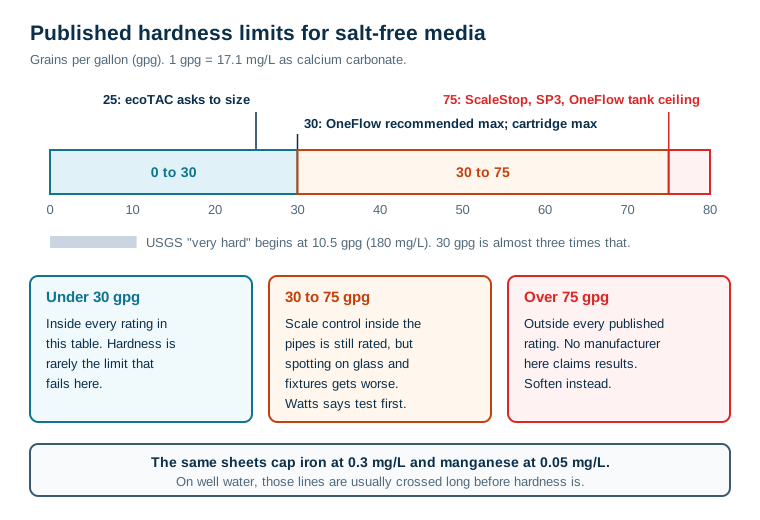
The salt free conditioner hardness limit on most spec sheets is 30 grains per gallon (513 mg/L). The strongest media is rated to 75 grains (about 1,280 mg/L) for scale control inside the plumbing. Hardness is rarely what disqualifies a water supply, though. Iron above 0.3 mg/L, manganese above 0.05 mg/L, copper, chlorine and hydrogen sulfide all foul the media first.
That is the whole answer in one paragraph. The rest of this page is the evidence. It collects the numbers the main template-assisted crystallization (TAC) and nucleation-assisted crystallization (NAC) media makers actually publish, and explains why two hardness figures appear on the same sheet. It then shows how to hold your own lab panel up against them before a sales conversation tells you your water is "perfect for salt-free".
The Salt-Free Conditioner Hardness Limit, Spec Sheet by Spec Sheet
Marketing pages tend to say "works on any hardness". Engineering specifications do not. Here is what four products put in writing. Each covers a different media or format that dominates the U.S. residential market.
| Product (media) | Hardness limit | Iron / manganese max | Copper max | Chlorine | Other named limits |
|---|---|---|---|---|---|
| Watts OneFlow tank systems (TAC) | Scale control to 75 gpg; 30 gpg recommended maximum | 0.3 / 0.05 mg/L | 1.3 mg/L | Free chlorine < 2 ppm | Oil and H₂S removed; phosphates < 3.0 ppm; silica 20 ppm; TDS < 1,500 mg/L; pH 6.5–8.5; 40–100°F |
| Watts OneFlow cartridges (TAC) | 30 gpg maximum | 0.3 / 0.05 mg/L | 1.3 mg/L | Free chlorine < 2 ppm | Same table as the tank systems |
| Next ScaleStop (TAC) | 75 gpg (1,300 ppm) | 0.3 / 0.05 mg/L | 1.3 mg/L | Warranty requires ≤ 0.5 ppm, pretreat above | pH 6.5–8.5; 40–110°F; no phosphate or other antiscalant before or after |
| Watch Water Filtersorb SP3 (NAC) | 75 gpg (1,340 mg/L) | Must be "clean of" iron and manganese | Must be free of copper | Tolerates up to 3 ppm | Must be free of oil, H₂S and phosphates |
The Watts figures come from the OneFlow whole-house engineering specification, which prints the chemistry table and the footnote explaining the two hardness numbers. The ScaleStop limits and the 0.5 ppm chlorine condition are in Next's residential ScaleStop installation and maintenance manual, in its specifications and warranty pages. Watch Water's cartridge literature gives the 75-grain figure and the contaminant list.
Three things stand out once the numbers sit side by side.
Nobody rates beyond 75 grains. Water that hard is uncommon, but it exists, particularly from some private wells. If your report shows more than about 1,280 mg/L total hardness as calcium carbonate, no media on this list claims to handle it.
The iron and manganese limits are identical everywhere. All three TAC products use 0.3 mg/L iron and 0.05 mg/L manganese, with the same footnote telling well owners to confirm both before installing. Watch Water goes further and asks for water "clean of" both.
Chlorine tolerance varies by a factor of six. That spread matters more to city-water buyers than anything in the hardness column.
Why a 75-Grain Media Comes With a 30-Grain Recommendation
The Watts sheet explains its own two numbers. The media is "effective at controlling lime-scale formation inside the plumbing system" up to 75 gpg. But 30 gpg is the "recommended hardness maximum due to potential aesthetic issues related to soft scale residue formation outside of the plumbing system."
The mechanism behind that sentence matters. A salt-free conditioner does not take calcium out of the water. It encourages dissolved calcium carbonate to form microscopic seed crystals, which are carried along rather than growing on pipe walls and heating surfaces. When treated water evaporates on a shower door, the calcium still has to go somewhere. At 12 grains you get a faint film that wipes off. At 45 grains there is nearly four times as much mineral in every drop that dries.
So the two numbers describe two different jobs:
- Protecting what is inside the plumbing (heater elements, tankless heat exchangers, pipe walls) still works at high hardness, within the rating.
- Keeping what you can see clean (glassware, fixtures, tile) gets steadily harder above about 30 grains. Watts says outright that a point-of-use softener should be used where spot-free results are mandatory.
Silica makes this worse. The Watts sheet notes that OneFlow "does not reduce silica scaling" and that silica "can act as a binder that makes water spots and scale residue outside the plumbing system difficult to remove". That is why silica appears as a 20 ppm aesthetic limit. If your report shows high silica and hardness in the 20s, expect spotting that a damp cloth will not shift.
The Limits That Fail Before Hardness Does
On most water, you will clear the hardness line easily and trip over something else. These are the contaminants that disqualify a supply most often, in rough order of how often they catch people.
Iron and manganese. Both oxidise and coat the media surface. A coated bead cannot seed crystals, so hardness passes straight through and scale resumes. Well water frequently exceeds 0.3 mg/L iron, often by a wide margin. The fouling mechanism and the pretreatment that fixes it get their own treatment in salt-free conditioners on city vs well water. Testing iron and manganese before you size anything is the single most useful test to order.
Copper from new plumbing. New copper lines release copper until an oxide layer forms. Watts asks for new copper to be passivated for at least four weeks before the conditioner goes into service, and advises installers to go easy on flux. A house with a fresh repipe can fail this limit for a month and then pass it.
Chlorine and chloramine. Oxidisers attack the media over time. The ScaleStop warranty excludes "damage to the media due to chlorine, other oxidizers or fouling". A city supply running 1 ppm free chlorine is inside the Watts and Watch Water limits but outside Next's, and would need a carbon prefilter in front of a ScaleStop system.
Hydrogen sulfide and oil. Every sheet says remove them first. There is no tolerance figure, because there is no acceptable level.
Phosphates. This limit catches people who already treat their water. Polyphosphate feeders, sold as scale inhibitors and bundled with some tankless heaters, interfere with crystal formation. Watts caps total phosphates below 3.0 ppm and says not to apply any other antiscalant before or after the media. Next says the same. Stacking two scale treatments makes both worse.
pH outside 6.5 to 8.5. Acidic well water needs neutralising regardless. Very alkaline water pushes calcium carbonate towards precipitating so hard that the media's influence matters less.
Temperature. The media belongs on the cold line. OneFlow is rated 40 to 100°F, ScaleStop to 110°F. Neither goes on a hot-water return loop.
How to Check Your Own Test Panel Against These Limits
A hardness strip alone cannot answer the question this page asks. You need a panel that covers the columns in the table above. Here is the order to work through it.
- Get the full panel. Ask a certified lab for total hardness, iron, manganese, copper, pH, TDS, silica and, on city water, free and total chlorine. Many basic panels include hardness, iron and pH but not manganese or silica, so tick those boxes deliberately. On city water, your utility's annual water quality report will give chlorine or chloramine and often hardness. Check whether it reports hardness in mg/L or grains before you compare.
- Convert hardness to grains. Divide mg/L as CaCO₃ by 17.1. A reading of 380 mg/L is 22 gpg.
- Pick the strictest sheet for the product you are pricing. A OneFlow cartridge in front of a tankless heater lives by the 30-grain cartridge limit, not the 75-grain tank figure. A ScaleStop buyer on city water lives by the 0.5 ppm chlorine condition. If you are still choosing a product, comparing salt-free conditioners on the water limits and scale evidence each publishes lets you start from the strictest column on your panel.
- Mark every column where you exceed the limit. One red column is enough to stop.
- For each red column, price the fix. An iron filter, a carbon tank or a polyphosphate feeder removal each change the cost, and sometimes the answer.
Two worked panels show how this usually plays out.
| Reading | Example city supply | Example private well |
|---|---|---|
| Total hardness | 240 mg/L (14 gpg) ✅ | 380 mg/L (22 gpg) ✅ |
| Iron | 0.02 mg/L ✅ | 1.4 mg/L ❌ (4.7× the limit) |
| Manganese | < 0.01 mg/L ✅ | 0.18 mg/L ❌ (3.6× the limit) |
| Copper | 0.1 mg/L ✅ | 0.05 mg/L ✅ |
| Free chlorine | 1.2 ppm (OK for OneFlow and SP3; ❌ for ScaleStop) | None ✅ |
| pH | 7.6 ✅ | 6.9 ✅ |
| Verdict | Suitable with the right media, or with carbon ahead of ScaleStop | Hardness passes; iron and manganese fail. Needs an iron filter first |
These example numbers are illustrative, not from a specific address. The pattern is typical, though. Both homes would pass a hardness-only check. The well home would ruin its media within months if it relied on that check.
What No Hardness Number Changes
Being inside the limits makes a salt-free conditioner suitable. It does not make it a softener, and that is where most disappointment comes from. At any hardness:
- Your hardness test will read about the same after installation. The minerals are still in the water, just in crystal form. That is expected, not a fault.
- Soap and detergent behave the same. There is no slippery feel and no reduction in how much detergent you need.
- Spotting continues, more so the harder the water, as the Watts footnote says plainly.
- Nothing is removed. A conditioner is not a filter for iron, lead, nitrate or anything else. It will not lower a hardness number that is already too high for comfort.
- Existing scale is a separate question. Crystal-seeding media is built to prevent new deposits, and heavily scaled equipment needs descaling on its own schedule.
Scale reduction itself is real, and it has been measured independently. A study by Arizona State University with the WateReuse Research Foundation tested alternatives to ion exchange using the German DVGW W 512 protocol. It found template-assisted crystallization cut water heater scale formation by more than 88 percent. That is a strong result. It is also a result about scale in heated equipment, which is exactly the job the 75-grain rating describes, and nothing else.
When the Numbers Say No
If your panel shows hardness above 75 grains, you have your answer: soften. Between 30 and 75 grains, the pipes will be protected but the bathroom will not look it. Decide whether that trade is acceptable before you spend money. If a contaminant column is red, the question becomes whether pretreatment plus a conditioner still costs less than a softener. On a well with significant iron, it often does not.
The broader case for ruling the category out, including households where soap performance or spot-free glass is the actual goal, is covered in when a salt-free conditioner is the wrong choice. Whatever you decide, the decision should rest on the spec sheet of the specific media you are being quoted, compared against your own lab numbers.
Frequently Asked Questions
What is the maximum hardness for a salt-free water conditioner?
It depends on the media, and most manufacturers publish two figures. Watts rates its OneFlow tank systems for scale control inside the plumbing up to 75 grains per gallon but recommends 30 grains as the working maximum, and its cartridge models are capped at 30. Next ScaleStop and Watch Water's Filtersorb SP3 list 75 grains. The practical line for most homes is 30 grains. Above that the media still limits scale inside pipes, but spotting on glass and fixtures gets noticeably worse.
Does a salt-free conditioner work on very hard water?
Up to a point. USGS classes water above 180 mg/L (about 10.5 grains per gallon) as very hard, and every major template-assisted crystallization media is rated well beyond that. The problem at high hardness is appearance, not the pipes. The conditioner leaves the calcium in the water, so more of it dries as white residue on glass, tile and fixtures. Above 30 grains, test before you buy. Above 75 grains, no manufacturer in this comparison claims results, so the answer is a softener.
Why does my water test the same after installing a salt-free system?
Because it is supposed to. Template-assisted crystallization turns dissolved hardness into microscopic crystals that stay in the water. A drop kit or test strip still counts that calcium and magnesium, so the reading barely moves. That is normal, and it is why you judge a salt-free system by scale on heating surfaces and by the manufacturer's contaminant limits, never by a hardness test after installation.
Can iron ruin salt-free conditioner media?
Yes. Every spec sheet reviewed here caps iron at 0.3 mg/L and manganese at 0.05 mg/L, because both oxidise onto the media surface and cover the sites where crystals form. Once they are coated, the media stops converting hardness and scale comes back. This is the most common reason salt-free systems fail on well water. The fix is an iron and manganese filter upstream, not more media.
Does chlorine damage salt-free conditioner media?
It can, and the published limits are far apart. Watts OneFlow allows free chlorine below 2 ppm, and Watch Water says its SP3 cartridge tolerates up to 3 ppm. Next's residential ScaleStop warranty requires the supply not to exceed 0.5 ppm chlorine, with pretreatment above that. Check the chlorine residual in your utility's annual report against the media you are being quoted before assuming city water is automatically fine.
Is 20 grains too hard for a salt-free conditioner?
No. At 20 grains per gallon you are inside every published hardness limit, including the stricter 30-grain line Watts recommends. Whether a salt-free system suits your house at 20 grains depends on the rest of your test: iron, manganese, copper, chlorine, hydrogen sulfide, phosphates and pH. Also on whether you can live with hard-water spotting and soap behaviour, which a conditioner does not change.
