
Grain Capacity vs Peak Flow Rate
Water softener flow rate sizing means making sure the softener can pass your house's peak demand, the most water drawn at one moment, without a large pressure drop. Grain capacity decides how many days a softener lasts between regenerations. Flow rate decides whether the shower still works while the dishwasher and washing machine run. They are unrelated, and a softener has to pass both tests.
Most sizing advice stops at grains per day. That is how people end up with a softener that regenerates exactly on schedule and still makes the upstairs shower weak whenever someone starts the laundry.
Water Softener Flow Rate Sizing vs Grain Capacity
| Grain capacity | Service flow rate | |
|---|---|---|
| Unit | Grains of hardness per regeneration | Gallons per minute |
| Decided by | Resin volume and salt dose | Control valve ports and resin bed cross-section |
| Sized from | Daily water use × hardness | Fixtures that can run at the same time |
| Too small means | Frequent regenerations, hard water before the cycle ends | Pressure drop at busy times, some hardness slipping through at high flow |
| Changed by programming? | Yes, partly, through the salt dose | No |
A larger grain rating usually means a larger tank, which helps flow, but not reliably. A 48,000-grain unit in a narrow tank on a small valve can pass less water than a 40,000-grain unit in a wider tank on a larger valve. You have to check both numbers.
Step 1: Count Your Water Supply Fixture Units
Plumbing codes size pipes with water supply fixture units (WSFU). Each fixture gets a load value that reflects how much water it uses and how often. The values below are the private-dwelling totals from the International Plumbing Code, Appendix E, Table E103.3(2). Check which code your state adopted before relying on it for anything other than softener sizing.
| Fixture (private dwelling) | WSFU |
|---|---|
| Bathroom group: toilet, lavatory, and tub or shower | 3.6 |
| Toilet (flush tank) alone | 2.2 |
| Lavatory alone | 0.7 |
| Bathtub or shower alone | 1.4 |
| Kitchen sink | 1.4 |
| Dishwasher | 1.4 |
| Clothes washer | 1.4 |
| Hose bibb | 2.5 |
Count only the fixtures the softener feeds. If outdoor taps bypass the softener, leave them out.
Worksheet, a 2.5-bathroom house:
| Fixture | Count | WSFU each | Total |
|---|---|---|---|
| Full bathroom group | 2 | 3.6 | 7.2 |
| Half bath: toilet + lavatory | 1 | 2.9 | 2.9 |
| Kitchen sink | 1 | 1.4 | 1.4 |
| Dishwasher | 1 | 1.4 | 1.4 |
| Clothes washer | 1 | 1.4 | 1.4 |
| Total | 14.3 WSFU |
Step 2: Convert Fixture Units to Peak Flow
Fixture units do not add up as gallons, because not everything runs at once. The code's demand table, IPC Table E103.3(3), converts the total into a probable peak flow. For systems with flush-tank toilets, which covers almost every house:
| Total WSFU | 1 | 3 | 5 | 8 | 10 | 12 | 15 | 20 | 25 | 30 |
|---|---|---|---|---|---|---|---|---|---|---|
| Peak demand, gpm | 3.0 | 6.5 | 9.4 | 12.8 | 14.6 | 16.0 | 17.5 | 19.6 | 21.5 | 23.3 |
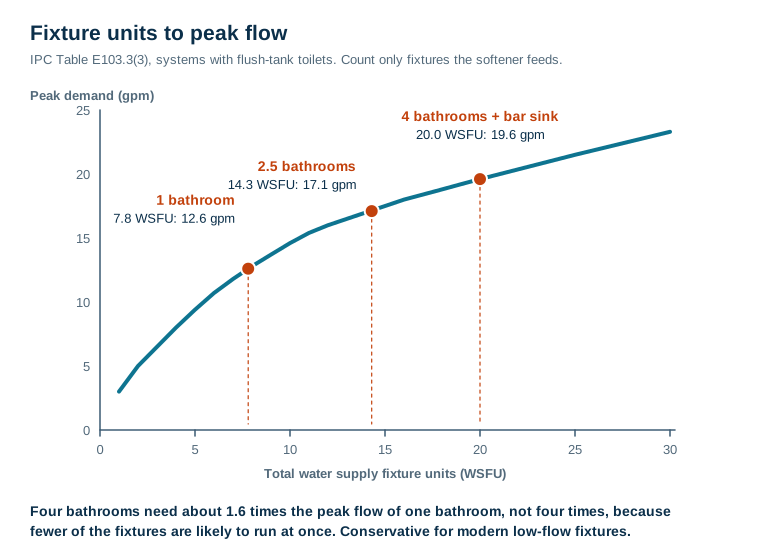
Interpolating between rows gives:
- One-bathroom house (bathroom group, kitchen sink, dishwasher, washer): 7.8 WSFU, about 12.6 gpm
- The 2.5-bathroom house above: 14.3 WSFU, about 17.1 gpm
- Four full bathrooms plus a bar sink: 20.0 WSFU, about 19.6 gpm
The curve flattens, which is the point of the method. Adding a bathroom to a large house adds less peak demand than adding one to a small house, because the more fixtures there are, the less likely they are all to run together.
Step 3: Check It Against the Fixtures You Actually Have
The fixture-unit method dates from the 1940s and was built around the fixtures of its time. With modern low-flow fixtures it is generally regarded as conservative. Treat its answer as an upper bound and do a second, practical check.
List what really runs at the same time in your house at its busiest, for example two showers, the washing machine filling and someone at the kitchen sink. Then use real flows:
- Showers. The EPA notes that standard showerheads use 2.5 gallons per minute and WaterSense-labelled ones no more than 2.0 gpm. Multi-head showers use the sum of their heads.
- Everything else, measure. Time how long a fixture takes to fill a 1-gallon container at full flow. 20 seconds is 3 gpm. 30 seconds is 2 gpm.
Add them up. For example, two WaterSense showers (4.0 gpm), a washing machine you timed at 3 gpm and a kitchen tap you timed at 1.5 gpm make 8.5 gpm, about half the code figure for the same 2.5-bathroom house. Your own numbers will differ. Size the softener so that:
- the practical figure sits comfortably inside the rating, with a small pressure loss, and
- the fixture-unit figure is still within the rated service flow, so a genuinely busy moment costs pressure but does not choke the house.
Step 4: Map Peak Flow to Valve and Tank Size
Two parts of a softener limit flow: the resin bed and the control valve.
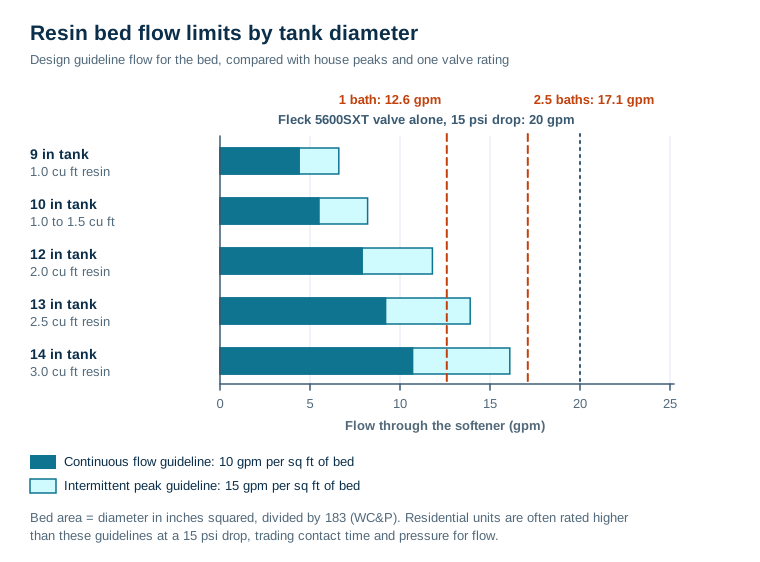
The resin bed. What matters is the bed's cross-section, not its volume. Water spread over a wider bed moves through it more slowly, which means less pressure loss and more contact time with the resin. Water Conditioning & Purification's guidance on surface loading in softener design gives a maximum of 10 gpm per square foot of bed for continuous flow, with intermittent peaks up to 15 gpm per square foot, and a quick way to get the area: tank diameter in inches, squared, divided by 183.
| Tank | Typical resin | Bed area | 10 gpm/sq ft | 15 gpm/sq ft |
|---|---|---|---|---|
| 9 in | 1.0 cu ft | 0.44 sq ft | 4.4 gpm | 6.6 gpm |
| 10 in | 1.0 to 1.5 cu ft | 0.55 sq ft | 5.5 gpm | 8.2 gpm |
| 12 in | 2.0 cu ft | 0.79 sq ft | 7.9 gpm | 11.8 gpm |
| 13 in | 2.5 cu ft | 0.92 sq ft | 9.2 gpm | 13.9 gpm |
| 14 in | 3.0 cu ft | 1.07 sq ft | 10.7 gpm | 16.1 gpm |
These are conservative design figures for sustained flow. Household peaks last minutes, not hours, so residential softeners are routinely rated well above them. The same WC&P article gives the example of a one-cubic-foot softener in a 10-inch tank certified at 14.5 gpm at a 15 psi drop. That is nearly 30 gpm per square foot. The softener can pass that flow, but only by spending the full 15 psi, and the further past the design range you go, the less contact time each gallon gets.
The control valve. The valve body has its own ceiling. Pentair's data sheets put the valve alone at 20 gpm at a 15 psi drop for the Fleck 5600SXT and at 28 gpm at 15 psi for the Fleck 7000. The resin bed, distributor and fittings add their own loss on top, so the whole system always passes less than the valve alone.
Putting it together:
| Realistic peak | Typical choice |
|---|---|
| Up to about 8 gpm | 9 or 10 in tank on a standard 3/4 in or 1 in residential valve |
| About 8 to 12 gpm | 10 or 12 in tank, 1 in valve |
| About 12 to 16 gpm | 12 to 14 in tank, 1 in high-flow valve |
| Above about 16 gpm | 14 in tank or larger on a high-flow valve, or two tanks in parallel |
A useful rule when reading ratings: choose a system whose rated service flow is at least 1.3 times your realistic peak. Because pressure loss rises with roughly the square of flow, that keeps the loss at your peak to about 9 psi or less instead of the full 15.
The 1-Inch Plumbing Case
Many houses have a 1-inch service line, and many softeners are sold with 3/4-inch connections. On a small house that rarely matters. On a large one it can.
- Match the loop to the main. If the house has a 1-inch main, plumb the softener loop, the bypass and the connectors in 1-inch. A loop necked down to 3/4-inch or run through long, narrow flexible connectors can lose more pressure than the softener.
- Pick a valve with 1-inch ports when the fixture-unit peak is in the high teens. The difference between a 5600SXT-class valve and a 7000-class valve in the figures above is about 8 gpm at the same pressure drop, and deciding whether your peak justifies a 7000SXT over a 5600SXT turns on that gap. Comparing large-home softeners on tank diameter and valve size starts from this same peak-flow figure.
- Check the bypass. The bypass valve sits in the same flow path. A restrictive bypass costs pressure in service and in bypass alike, which makes it easy to miss.
High-Flow Fixture Cases
Fixture-unit tables assume ordinary fixtures. Add the actual flow of anything unusual:
- Multi-head and rain showers. A shower with a rain head and body sprays uses the sum of every outlet running together. One such shower can equal two or three ordinary ones.
- Large soaking tubs. A tub filler runs at a high flow for several minutes, often while other fixtures are in use.
- Irrigation and hose bibbs on the softened line. At 2.5 WSFU each, hose bibbs are the biggest single item in the table. Taking outdoor taps off the softened supply removes them from the peak and saves capacity too.
- Two water heaters or a large tankless unit. These do not add demand by themselves, but they let more hot fixtures run at once.
Each of these pushes you up a row in the table above.
How to Read a Flow-Rate Spec Critically
Flow ratings are real numbers, but they are chosen to look good. Read every one with these questions:
- At what pressure drop? Most ratings are quoted at 15 psi, the maximum NSF/ANSI 44 allows at rated flow. Some brochures show a "peak" figure at 25 psi. Losing a quarter of a 60 psi supply inside the softener is not a flow you want to run at.
- Valve alone or complete system? Valve data sheets quote the valve alone. The system rating, with the resin bed, is always lower. Compare system ratings with system ratings.
- Is there a curve? Softeners certified to NSF/ANSI 44 are tested for pressure drop across a range of flows, from 20 to 140 percent of the rated service flow, according to WC&P's summary of the test method. Ask for the curve and read off the loss at your peak flow.
- Is the rating for this tank size? A valve's rating is often printed on the spec sheet for a whole family of tank sizes. The smallest tank in that family will not reach it.
The method for turning one rated point into the loss at your own peak is set out in how pressure drop affects softener sizing, and the wider checklist is in how to compare water softener spec sheets.
What Flow Sizing Cannot Fix
- A supply that cannot deliver the flow. A softener rated at 20 gpm does not help if the well pump delivers 10 gpm or the street service is undersized. Measure the supply first.
- Low static pressure. Sizing for flow keeps the softener's loss small. It cannot raise a 35 psi supply to 60.
- Backwash on a weak well. A bigger tank needs a bigger backwash flow to lift and clean its bed. On a low-yield well, the tank that is right for peak flow can be too large for the pump to backwash, which is covered in well pump flow and softener backwashing.
- Existing pressure problems. If the house already has weak pressure, find the cause before adding a softener. Why water pressure drops after a softener has the two-gauge test that separates the softener from everything else.
Size the grains from your daily use and the flow from your busiest moment, and check that the unit you choose passes both.
Frequently Asked Questions
What flow rate do I need for a whole-house water softener?
Enough to cover the most water your house draws at one moment, not in a day. Add up the water supply fixture units for the fixtures the softener feeds and convert them to gallons per minute using the plumbing code's demand table. A one-bathroom home typically works out around 12 to 13 gpm by that method, and a two-and-a-half-bathroom home around 17 gpm. Then choose a system whose rated service flow comfortably exceeds your peak, so the pressure loss at that peak stays well under the rating.
Does a bigger grain capacity mean a higher flow rate?
Not necessarily. Grain capacity depends on how much resin is in the tank. Flow rate depends mainly on the control valve's internal ports and on the cross-section of the resin bed. Two softeners with the same grain rating can have very different flow ratings if one uses a narrower tank or a smaller valve. Larger resin volumes usually come in wider tanks, which helps, but you have to check the flow rating separately.
What happens if a water softener is too small for the flow rate?
Two things. Pressure at the fixtures drops noticeably when several are running, because pressure loss through a softener rises roughly with the square of the flow. And at very high flow the water spends less time in contact with the resin, so a little hardness can slip through. The softener may still have plenty of grain capacity. It simply cannot pass the flow cleanly.
Is a 1-inch valve better than a 3/4-inch valve on a softener?
For a house with a 1-inch service and a peak demand in the high teens of gallons per minute, usually yes. A larger valve body loses less pressure at the same flow. Pentair's published figures put the Fleck 5600SXT at 20 gpm at a 15 psi drop for the valve alone, and the larger Fleck 7000 at 28 gpm at the same drop. Plumbing the softener loop in pipe smaller than the main throws away that advantage.
What does service flow rate at 15 psi drop mean?
It is the flow at which the softener costs you 15 psi of pressure. NSF/ANSI 44 requires that a softener's pressure drop not exceed 15 psi at its rated service flow, so manufacturers quote the flow that reaches that limit. It is a ceiling, not a comfortable operating point. Because loss rises roughly with the square of flow, a unit running at 70 percent of its rated flow loses about half that, around 7 psi.
Should outdoor faucets go through the water softener?
Usually not, and flow sizing is one reason. A hose bibb carries 2.5 water supply fixture units on its own in the code demand tables, and garden hoses and irrigation can run for long periods at high flow. Leaving outdoor taps on hard water keeps them out of the softener's peak flow and out of its capacity, and avoids softening water that goes on the lawn.
