
How Long Does Water Softener Regeneration Take?
How long does water softener regeneration take? For most residential single-tank softeners, somewhere between about an hour and a half and two hours. Clack's WS1 downflow table gives 57, 80 or 99 minutes before refill, depending on the salt dose, and the refill adds a few minutes more. The time is split very unevenly across five stages, and the longest one is the one that does the actual work.
That uneven split is why owners who try to shorten a cycle usually adjust the wrong step. Below is where the minutes go, which ones are settings and which are fixed by the valve's hardware, and how to tell when a long regeneration is a fault rather than a setting.
How Long Does Water Softener Regeneration Take, Stage by Stage?
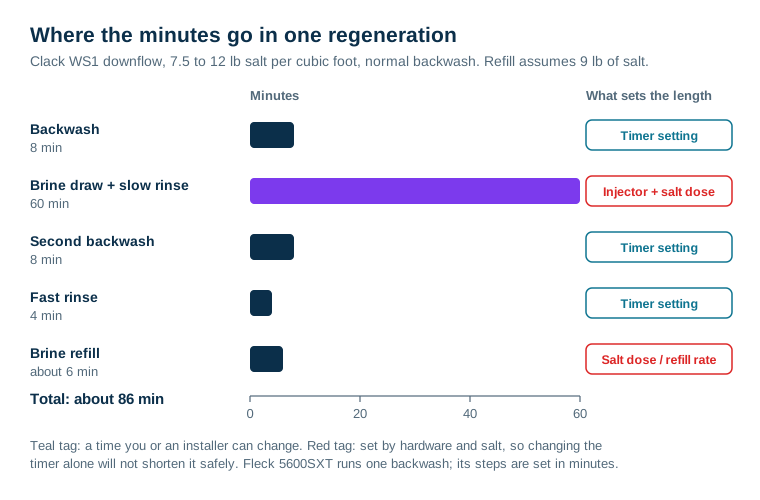
Clack publishes cycle times for its WS1 valve in its control valve manual. They scale with the salt dose, so the table below reproduces the three downflow tiers with the normal backwash setting.
| Salt dose (lb per cubic foot of resin) | Backwash | Brine draw + slow rinse | Second backwash | Fast rinse | Total before refill |
|---|---|---|---|---|---|
| Under 7.5 | 6 min | 45 min | 3 min | 3 min | 57 min |
| 7.5 to 12 | 8 min | 60 min | 8 min | 4 min | 80 min |
| Over 12 | 8 min | 75 min | 10 min | 6 min | 99 min |
Clack's upflow totals are shorter, at 54, 74 and 93 minutes, because upflow runs a single backwash. Selecting the longer backwash option adds time: the downflow totals become 65, 86 and 107 minutes.
The refill is not in those totals. Clack's footnote explains why: fill time "is dependent upon the amount of salt needed," and during fill the system is providing treated water. On a Clack valve the refill control delivers a steady 0.5 gallons per minute, so a 9 lb salt dose, about 3 gallons of water, takes roughly six minutes.
Other manufacturers land in the same range. GE's description of its recharge stages gives fill as a few minutes to about 20, brining as 30 to 100 minutes and backwash as generally 3 to 10 minutes, and notes that its stage lengths vary from one recharge to the next. What happens in each of those stages is explained in how water softener regeneration works.
Which Stages You Can Change and Which the Valve Fixes
This is the part most guides skip. Some of the minutes are timer settings; others are the result of how fast the hardware can move water.
| Stage | What sets its length | Can you change it? |
|---|---|---|
| Backwash | A programmed time | Yes, on valves that expose step times. Shortening it is risky |
| Brine draw | How fast the injector can empty the brine made at the last refill | Not directly. The injector size and the salt dose decide it |
| Slow rinse | The rest of the timed brine/rinse step after the brine runs out | Yes, as part of that step's time, but the brine draw eats into it first |
| Fast rinse | A programmed time | Yes. Too short leaves salty water |
| Refill | Salt dose divided by the refill flow control's rate | Only by changing the salt dose |
Fleck exposes every step. The Fleck 5600SXT manual lets each regeneration step be set from 0 to 199 minutes, and setting a step to 0 skips it. Its refill step is set in minutes, and the brine line flow control fixes how much salt those minutes dissolve: Fleck's parts list rates the 0.25 gpm control at 0.75 lb of salt per minute, so a 9 lb dose needs 12 minutes of refill.
Clack ties the times to the salt dose. On the WS1, the backwash, brine and rinse times shown above follow automatically from the salt setting and the normal or longer backwash choice. The way to change the cycle length is to change the salt dose.
The injector is the fixed point. Brine can only be drawn as fast as the injector pulls it. If the brine step is programmed shorter than the injector needs to empty the salt tank, some brine is simply left behind.
Working Out Your Own Unit's Cycle Length
- Find the programmed step times. On a Fleck SXT they are in the master programming menu under the step abbreviations: BW backwash, BD brine draw, RR rapid rinse, BF brine fill. On a Clack, look up the salt setting in the table above. Cabinet units often show them in the service or diagnostics menu.
- Add them up. That is the time the valve spends in each position.
- Add a little for valve travel. The motor needs a few seconds to a couple of minutes to move between positions, depending on the design.
- Add the refill if your valve does it separately. Salt dose in pounds, divided by about 3 pounds per gallon, divided by the refill rate in gallons per minute.
- Time one. Start a manual regeneration, note the time at each change of sound or display, and compare. A cycle that matches the programmed total is running normally.
A worked example on a timed valve
Suppose a Fleck-style valve is programmed with these step times, which you would read from its master programming menu:
| Step | Programmed time | What decides whether it is enough |
|---|---|---|
| Backwash (BW) | 10 min | Drain flow control rating and how dirty the bed gets |
| Brine draw and slow rinse (BD) | 60 min | Whether the injector empties the salt tank well within it |
| Rapid rinse (RR) | 10 min | Whether the drain water runs clear and the first tap is not salty |
| Brine fill (BF) | 12 min | Salt dose: with a 0.25 gpm control, 12 min at 0.75 lb per minute is 9 lb of salt |
| Valve travel between steps | A few minutes in total | Motor and drive design |
That adds up to a little over an hour and a half. The figures in the table are an example, not defaults; your own valve's programming holds the real ones. Notice that none of these steps can be shortened without changing what the regeneration achieves. Brine fill is tied to the salt dose, the brine step to the injector, and the backwash and rinse to cleaning and flushing the bed. The cycle is as long as the chemistry and hydraulics need, which is the point of the next section.
Why Shortening the Wrong Stage Backfires
Owners usually want a shorter cycle for one of three reasons: water running to the drain at night bothers them, they want less water wasted, or they need soft water sooner. Cutting step times fixes none of those well.
- Cutting the brine draw and slow rinse leaves brine in the salt tank or leaves it only half pushed through the bed. The resin comes back partly regenerated, capacity drops, and the softener regenerates more often, using more water, not less.
- Cutting the backwash leaves sediment and iron in the bed and lets channels form, so water finds paths around the resin. The damage is slow and shows up as early hardness weeks later.
- Cutting the fast rinse can leave salty water in the tank to be sent to the first tap in the morning.
- Skipping a second backwash on a valve designed for one changes what the manufacturer tested, for a saving of a few minutes.
What actually shortens the cycle safely: a lower salt dose where the resulting capacity still covers your use, which cuts both the brine step and the refill. What actually reduces water use: fewer regenerations, from correct hardness and capacity settings and a metered control. What actually solves the timing complaint: scheduling the cycle for a time nobody is using water, covered in what time a water softener should regenerate.
When a Long Cycle Means a Fault, Not a Setting
A regeneration that runs far longer than its programmed total is almost never a setting problem. Read the display before touching anything.
| What you see | What it usually means |
|---|---|
| The same step number for hours, or a step number that flashes and never settles | The valve has stopped moving. A motor, gear or position sensor fault |
| An error code | The control has detected a drive fault. Fleck's code 0 means the valve took more than six minutes to reach the next position |
| Steps advancing normally, but a second regeneration starts afterwards | A queued regeneration, or a day override and a meter trigger falling together |
| A cycle that resumed after a power cut | Normal. The Fleck SXT saves its position and finishes the cycle when power returns |
| Strong flow to drain for more than about 15 to 20 minutes | A valve held in backwash or rinse, or a seal leaking to drain |
| Flow to the drain after the display shows service | A worn seal stack or piston, or debris holding the valve partly open |
A stalled valve is diagnosed step by step in why a water softener is stuck in regeneration. Put the softener in bypass before investigating, because Fleck's manual notes that a valve losing power mid-cycle stays in its current position, which may be a drain position.
Planning Around the Cycle
For most households the length only matters because of what happens to the water supply while it runs.
- On most single-tank softeners, untreated water reaches the house during the cycle. Clack offers a no-hard-water-bypass option as an extra, a sign that its standard valves send untreated water to service during regeneration.
- Heavy use during regeneration competes with it for pressure. A shower or a washing machine during brine draw can weaken the draw on a marginal supply.
- Pre-fill valves shift the timetable. Clack's pre-fill option starts the refill two hours before the regeneration time, with treated water still available during those two hours.
- Twin-tank units avoid the problem. One tank stays in service while the other regenerates.
Whether showering, laundry or the dishwasher during a cycle does any harm is covered in can you use water while a softener regenerates.
What the Duration Does Not Tell You
A regeneration that takes exactly its programmed time has only proved that the valve moved on schedule. It has not proved that brine was drawn, that the bed was rinsed, or that the water is soft. Mark the water level in the salt tank before a cycle; it should fall during the brine step and rise again during refill. Then test a cold tap the next morning.
Expect roughly an hour and a half to two hours, most of it in the quiet brine and slow rinse step. Leave that step alone, change the salt dose rather than the timer if you need a shorter cycle, and treat a cycle that runs hours over its programmed total as a fault to diagnose.
Frequently Asked Questions
How long does a water softener take to regenerate?
Usually between about an hour and a half and two hours for a residential single-tank unit. Clack's WS1 downflow table gives 57, 80 or 99 minutes before refill depending on the salt dose, and the refill adds a few minutes more. GE lists brining alone at 30 to 100 minutes. Your own control's programmed step times give the exact figure for your unit.
Which stage of regeneration takes the longest?
The brine draw and slow rinse, which most valves run as a single timed step. On Clack's downflow table it is 45 to 75 minutes of a 57 to 99 minute cycle. It takes that long because the injector draws brine slowly so it has time to contact every part of the resin bed, then keeps rinsing at the same slow rate to push the brine all the way through.
Can I make my water softener regenerate faster?
Only by changing what the cycle has to do, not by cutting step times at random. Lowering the salt dose, where your capacity allows it, shortens both the brine step and the refill. Cutting the brine draw or slow rinse time leaves hardness on the resin, cutting backwash leaves sediment in the bed, and cutting the fast rinse can leave salty water in the pipes. Scheduling the cycle overnight usually solves the real problem.
Why is my water softener regenerating for so long?
Check the display first. If the same step number has been showing for hours, or the step number keeps flashing, the valve has stopped moving and that is a drive fault, not a long cycle. If steps are advancing but the total is far longer than the programmed times add up to, look for a queued second regeneration, a power cut mid-cycle, or step times programmed longer than intended.
Is it normal for water to run to the drain for two hours?
Some flow for most of the cycle is normal, but not strong flow the whole time. Backwash and fast rinse send a strong flow for a few minutes each. The long brine draw and slow rinse step sends only a small, steady trickle. Strong flow for more than about 15 to 20 minutes, or any flow once the display says the unit is back in service, points to a fault.
What time of day should a softener regenerate?
When nobody needs water, which is why most valves default to the early morning, commonly around 2 a.m. On most single-tank softeners, untreated water passes to the house during the cycle, and heavy water use can also rob the regeneration of pressure. A cycle that starts at 2 a.m. and runs under two hours is finished well before most households are up.
