
How Much Salt Does a Water Softener Use?

How much salt does a water softener use? Most homes use between about 10 and 80 pounds a month, which is anywhere from a quarter of a bag to two 40 lb bags. A family of four on moderately hard water, with the softener at an efficient setting, typically lands near 30 to 35 lb a month. Your own figure depends on three numbers: water use, hardness and salt dose.
Work those out and you get more than a shopping estimate. Compared against what you actually pour in, the expected figure is one of the quickest ways to spot a softener that is mis-set or failing.
The Three Numbers That Set Salt Use
A softener uses salt to put back the capacity that hardness used up. So salt use follows the hardness removed:
Pounds of salt a month = gallons a day × hardness (gpg) × 30 ÷ grains per pound of salt
- Gallons a day through the softener. The EPA's WaterSense figures on household water use put the average family at more than 300 gallons a day at home, with about 70 percent of it used indoors. For softener arithmetic, 70 gallons per person per day is a sound starting point if outside taps bypass the softener, as they usually should. Better still, read your water bill or the softener's meter.
- Hardness in grains per gallon, from a recent test. If your report gives mg/L or ppm, divide by 17.1. Add any iron allowance your manual asks for.
- Grains per pound of salt at your salt dose. This is the one most estimates skip, and it swings the answer by nearly half.
That third number comes from the manufacturer's capacity table. The Hellenbrand ProMate 6.0 manual prints capacity at four doses, and dividing capacity by salt gives:
| Salt dose (per cu ft of resin) | Grains removed per lb of salt | Salt use relative to the 6 lb setting |
|---|---|---|
| 3.3 lb (efficient) | 4,228 | 0.90× |
| 6 lb (low, factory setting) | 3,822 | 1.00× |
| 10 lb (medium) | 2,806 | 1.36× |
| 15 lb (high, the "grain rating") | 2,154 | 1.77× |
The same house on the same water uses 77 percent more salt at the high setting than at the low one. Why the box rating sits at the least efficient dose is covered in how to set the salt dose on a water softener.
How Much Salt Does a Water Softener Use? The Calculator
Worked at 70 gallons per person per day and the 6 lb factory dose (3,822 grains per pound):
Pounds of salt a month
| People | 5 gpg | 10 gpg | 15 gpg | 20 gpg | 25 gpg |
|---|---|---|---|---|---|
| 1 | 3 | 5 | 8 | 11 | 14 |
| 2 | 5 | 11 | 16 | 22 | 27 |
| 3 | 8 | 16 | 25 | 33 | 41 |
| 4 | 11 | 22 | 33 | 44 | 55 |
| 5 | 14 | 27 | 41 | 55 | 69 |
| 6 | 16 | 33 | 49 | 66 | 82 |
Adjust for your valve:
- Medium dose (10 lb per cu ft): multiply by 1.36.
- High dose (15 lb per cu ft): multiply by 1.77.
- Timer valve: the table does not apply. A timer uses its dose on every scheduled regeneration, so monthly salt = regenerations a month × pounds per regeneration.
- Potassium chloride: add 12 to 20 percent (see the FAQ below).
Treat the result as a floor, not a target. A metered valve regenerates with some capacity still unused, the reserve it holds back so you never run hard. Worked through Hellenbrand's table for a 1 cubic foot unit holding back one day's water, real use came out about 11 percent above the simple estimate. Manufacturers also note that efficiency in a home is typically lower than the laboratory figure.
A check against the manufacturer's rule of thumb. Hellenbrand's manual says a family of four uses about 60 lb a month. The calculator gives 33 lb at 15 gpg on the factory dose, and 58 lb at the high dose. The manual's figure is what the high setting uses.
A second route: from the valve itself
If your valve shows a regeneration count or history, you can skip the household arithmetic:
Salt a month = regenerations a month × salt dose per regeneration
A 1 cubic foot bed set to 6 lb that regenerates five times a month should use about 30 lb. This route is useful because it checks the brine side directly. If you are pouring in far more than regenerations × dose, the valve is making more brine than it was told to.
Turning Your Figure Into a Refill Schedule
| Expected use a month | A year | 40 lb bags a year | Typical routine |
|---|---|---|---|
| 10 lb | 120 lb | 3 | Check monthly, add a bag every 3 to 4 months |
| 20 lb | 240 lb | 6 | A bag about every 2 months |
| 30 lb | 360 lb | 9 | A bag about every 6 weeks |
| 40 lb | 480 lb | 12 | A bag a month |
| 60 lb | 720 lb | 18 | A bag every 3 weeks, check every 2 |
| 80 lb | 960 lb | 24 | A bag every 2 weeks, or two at a time |
Manufacturers phrase the fill level differently. Morton's potassium chloride directions, for example, say keep the tank at least half full. Hellenbrand says fill to about three-quarters with a minimum of 12 inches of salt. Neither means "fill to the rim." A tank kept brim-full makes bridging more likely and hides changes in how fast the salt is going down. The working band and how to read it are in how much salt should be in a brine tank.
Log it. Write the date and number of bags on a card taped to the lid. After three or four refills you have your household's real monthly figure, and that is the number to compare against.
To put a price on the annual figure, see how to estimate annual water softener salt cost.
Three Homes, Worked Through
The calculator is simple. Real valves add a few wrinkles, and these three examples show the ones that matter most. All are calculated from Hellenbrand's capacity table, not measured.
1. One person on city water at 8 gpg, 1 cubic foot softener at the 6 lb setting. The arithmetic says 1 × 70 × 8 × 30 ÷ 3,822 = about 4.4 lb a month. The softener, though, can soften 22,930 ÷ 8 = 2,866 gallons between regenerations, which is about 41 days of use. Most valves will not wait that long. A day override of 14 days forces a regeneration every two weeks, about 2.1 a month at 6 lb each, so about 13 lb a month. For small households, the override setting, not the water, sets salt use. Lowering the dose, or accepting the override, are both reasonable. Just expect the higher figure.
2. Four people on well water at 18 gpg, 1.5 cubic foot softener at 9 lb per regeneration (6 lb per cubic foot). Hardness removed is 4 × 70 × 18 = 5,040 grains a day, so the calculator gives about 40 lb a month. The bed holds 34,400 grains, a little under seven days of use. Holding back a day's reserve, it regenerates about every six days: 5 regenerations × 9 lb = about 45 lb a month, 14 percent over the simple figure. That is well inside the normal band.
3. Two people at 12 gpg with a timer valve set to every fourth night at 10 lb. The calculator says about 13 lb a month is all the hardness needs. The timer does not know that. It regenerates 7.5 times a month at 10 lb: 75 lb a month, almost six times the expected figure. Nothing is broken. The valve is doing what it was told. This household would save more than 700 lb of salt a year by recalculating the interval, or by moving to a metered control. How much more an efficiency-rated unit saves on top of that is smaller than it sounds: the Morton review puts it at about 100 lb a year against a well-set metered softener.
Using the Expected Figure as a Fault Detector
Divide your logged monthly use by the expected figure. The ratio tells you where to look.
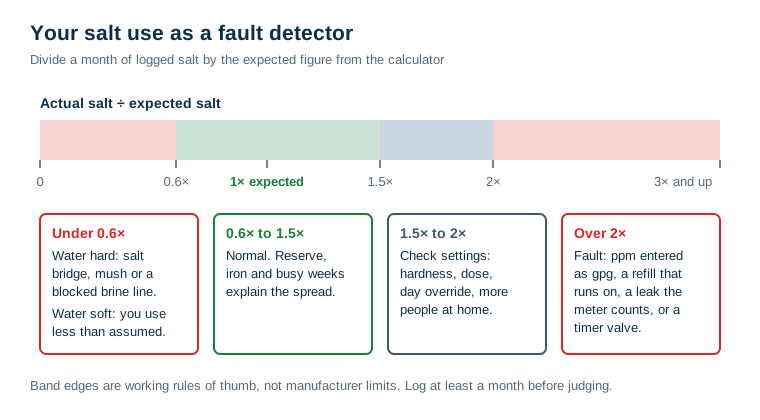
Under about 0.6 times expected. First, test the softened water.
- Water hard: the salt is not getting used. A salt bridge, mushy salt blocking the brine well, a blocked injector or brine line, or a valve left in bypass. Start with why a water softener is not using salt.
- Water soft: the estimate was high. You use less water than 70 gallons per person, someone is away, or more taps bypass the softener than you thought. Nothing is wrong.
About 0.6 to 1.5 times expected: normal. Reserve losses, iron, laundry weeks and guests all live in this band.
About 1.5 to 2 times expected: check the settings. Hardness entered higher than the test result, a dose set to maximum, a day override forcing regeneration every few days, or simply more people at home than there were.
Over about 2 times expected: something is wrong. The usual causes, roughly in order of how often they turn up:
- Hardness entered in ppm on a valve that expects gpg. It tells the softener the water is about 17 times harder than it is.
- A brine tank that keeps filling, from a sticking brine valve or a failed float. Look for water high in the salt or trickling from the overflow.
- A leak the meter counts, such as a running toilet. With every tap off, the softener's flow indicator should be still.
- A timer valve regenerating on a schedule set for a busier house than yours.
These band edges are working rules of thumb, not manufacturer limits. The full diagnosis for the top band is in why a water softener uses too much salt.
What Changes Salt Use Over Time
- Seasons. Summer showers, laundry and guests raise use. If irrigation or a pool top-up runs through the softener, summer use can double.
- Hardness drift. Well water hardness can move with the seasons and over years. Re-test annually and update the setting.
- Iron. Dissolved iron uses resin capacity just as hardness does. If iron appears or rises, salt use goes up with it once the setting is corrected.
- Resin aging. Older resin holds less capacity, so a metered unit regenerates more often. Slowly rising salt use over several years, with nothing else changed, is one sign.
- Settings reset. A power cut or a service visit can put a valve back to factory settings. A sudden change in salt use deserves a look at the screen.
What Salt Use Cannot Tell You
- Whether the water is soft. A softener can use salt normally and still leak hardness through a fouled bed or a bad valve seal. Only a hardness test on softened water answers that.
- Anything within a few weeks. One or two refills are too few. Brine tanks have no gauge, and the level depends on how the salt has settled. Judge on a month or more.
- Anything about sodium in your drinking water. That depends on how much hardness is removed, not on how much salt you buy. A leaner salt setting does not reduce it.
- Anything about a salt-free conditioner. Those use no salt, and they do not remove hardness either.
Frequently Asked Questions
How many bags of salt does a water softener use per month?
Most households use somewhere between a quarter of a bag and two 40 lb bags a month. A family of four on 15 gpg water at the common 6 lb factory setting uses about 33 lb, a little under one bag. The same family at the maximum salt setting uses closer to 58 lb. Hellenbrand's own manual uses 60 lb a month for a family of four as its rule of thumb.
How often should I add salt to my water softener?
Check it monthly, and add salt when it falls to about a third full. Morton's directions are to keep the tank at least half full, and Hellenbrand recommends keeping at least 12 inches of salt in the tank. In practice most households add a bag every two to six weeks. Adding a little often is better than filling to the rim, which makes bridging more likely and hides changes in how fast salt is going.
Why is my water softener using so little salt?
If the water is still soft, you may simply use less water than a typical estimate assumes. People away, a small household, or outdoor taps that bypass the softener all lower it. If the water is hard, the salt is not being used at all: a salt bridge, mushy salt blocking the brine well, a blocked brine line or injector, or the softener sitting in bypass are the usual causes.
Does a water softener use more salt with harder water?
Yes, in direct proportion. Salt use scales with grains of hardness removed, so water at 20 gpg uses twice the salt of water at 10 gpg for the same household and the same salt dose. Iron adds to it, because the resin removes dissolved iron as well and many manuals tell you to raise the hardness setting to cover it.
Is it normal for a water softener to use 40 lb of salt a week?
Only for a large household on very hard water, or a unit set to its maximum dose with a timer. For most homes 160 lb a month is several times the expected figure and points to a fault. Check the hardness setting for a ppm number entered as gpg, then look for a brine tank that keeps filling, a leak the meter is counting, or a day override set to a few days.
Does potassium chloride use more than salt?
Yes. Potassium chloride regenerates resin less efficiently than sodium chloride, so manufacturers tell you to raise the hardness setting to compensate. WaterBoss says multiply the hardness by 1.12. GE says set it 20 percent higher. Expect to use roughly 10 to 25 percent more product by weight, at several times the price per bag.
