
Morton Water Softener Review: Do the Salt Savings Add Up?

A Morton water softener review comes down to one question: does the salt saving hold up? Partly. The Morton System Saver softeners are NSF/ANSI 44 efficiency-rated demand units, and the M34's manual rates it at 5,060 grains per pound of salt at its minimum dose. Against a timer softener or a conventional unit on a heavy salt dose, that saves several hundred pounds of salt a year. Against a well-set conventional metered softener, the gap is about 100 lb a year at best, roughly two and a half bags.
The bigger problem is availability. The Morton MSD34C shows as currently unavailable on Amazon, so this review also covers two in-stock alternatives from the same maker.
Disclosure: Hard Water Solved may earn a commission if you buy through links on this page, at no extra cost to you. It does not change which products we include or how we rank them. Read our disclaimer.
Morton Water Softener Review: The Short Verdict
- Salt efficiency: genuinely good on paper. The lab rating sits well above the 3,350 grains-per-pound floor that NSF/ANSI 44 sets for an efficiency-rated softener.
- Salt savings in practice: large against timers and heavy doses, small against a modern metered softener set to an efficient dose.
- Build and support: NSF-certified for hardness reduction and efficiency. Parts are shipped to your home, but non-tank parts carry only a one-year warranty on the standard models.
- Iron: the M34 is rated for up to 9 ppm of clear-water iron, backed by WQA test data. Red-water and bacterial iron are out of scope.
- Availability: the MSD34C is listed on Amazon as unavailable. Buy only from stock you can see, and check that the seller still supports parts.
How this review was put together. No softener was physically tested. The review uses the Morton System Saver manual for models M20 to M34, the M45C manual, the current NSF certification listing, and the salt-use formula from this site's guide to how much salt a water softener uses. The conventional reference figures come from the Hellenbrand ProMate 6.0 capacity table used in that guide. Each Amazon listing was opened to confirm the page exists.
Prices are not listed here because they change often. Use the buttons to see the current price on Amazon.
What Morton Sells, and What You Can Still Buy
Morton is a salt company. Its softeners are made for it, and NSF's current NSF/ANSI 44 listing for Morton softeners names Water Channel Partners of Eagan, Minnesota as the company behind them. That listing covers eight models:
| Model | NSF rated service flow | Notes |
|---|---|---|
| M20, M27 | 6.5 gpm | Small-household units |
| M30, MC30 | 7 gpm | Mid-size units |
| M34 | 7.8 gpm | 34,000 grains, the same size as the MSD34C on Amazon |
| M45, M45C | 10 gpm | M45C adds Wi-Fi |
| MHY | 6.5 gpm | Also certified for barium and radium reduction |
The same company is listed behind Whirlpool and EcoPure softeners on NSF's register. That is useful when you shop: the alternatives below are close relatives, not strangers.
The Amazon listing for the Morton MSD34C showed "currently unavailable" when the products for this review were researched, and again on 1 October 2026. Treat any remaining stock as clearance, and check the parts situation before buying.
The M34 Spec Sheet, Normalised
A grain rating means nothing without the salt dose behind it, a point covered in detail in advertised vs usable softener capacity. Morton's manual is unusually complete here. It gives capacity at three salt doses, so the salt efficiency at each one can be worked out:
| Morton M34 | Minimum dose | Middle dose | Maximum dose |
|---|---|---|---|
| Salt per regeneration | 2.7 lb | 8.6 lb | 14.5 lb |
| Capacity | 13,700 grains | 29,200 grains | 34,900 grains |
| Grains removed per lb of salt | 5,060 (rated) | about 3,400 | about 2,400 |
Other figures from the same manual: 0.91 cubic feet of resin, a rated service flow of 7.8 gpm at a 14.7 psi pressure drop, up to 110 gpg of hardness, up to 9 ppm of clear-water iron, and 20 to 125 psi operating pressure.
Two things stand out. First, the "34" in the name is the maximum-dose capacity, so it is only reached at the least efficient setting. Second, the minimum dose is very small, 2.7 lb, so the softener regenerates often with little salt. That is where the efficiency rating comes from.
The Salt-Savings Claim: A Worked Calculation
Morton markets its demand control, which it calls Look Ahead, as using salt and water only when needed. The honest way to test that is to compare annual salt use against the alternatives, at the same household and water. The formula is the one from the salt-use guide:
Pounds of salt a year = gallons a day × hardness (gpg) × 365 ÷ grains removed per pound of salt
Worked for a family of four at 70 gallons per person per day (280 gallons a day) on 15 gpg water, the house needs 1,533,000 grains of hardness removed a year.
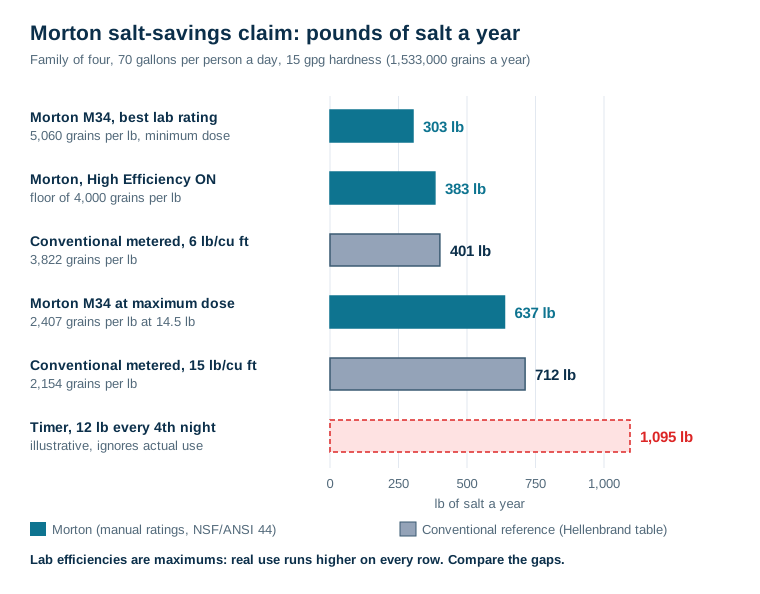
What the chart shows:
- Against a timer softener, the saving is the biggest, because a timer regenerates on schedule whether hardness has been used or not. An illustrative timer set to 12 lb every fourth night burns about 1,095 lb a year, more than three times the M34's figure. Moving from a timer to any demand softener is the main win, and Morton's claim is fair on that comparison. The background is in metered vs timer-based water softeners.
- Against a conventional metered softener at a heavy dose, the M34 at its rated efficiency uses about 409 lb less a year. That is around ten 40 lb bags.
- Against a conventional metered softener set to an efficient 6 lb per cubic foot, the gap falls to about 98 lb a year with the M34 at its best, and to about 18 lb with only the High Efficiency floor guaranteed.
The same comparison at your hardness
Pounds of salt a year, family of four, 280 gallons a day:
| Hardness | Morton M34, 5,060 gr/lb | Morton HE floor, 4,000 gr/lb | Conventional, 6 lb/cu ft | Conventional, 15 lb/cu ft | Morton saving vs efficient conventional |
|---|---|---|---|---|---|
| 5 gpg | 101 | 128 | 134 | 237 | 33 lb |
| 10 gpg | 202 | 256 | 267 | 474 | 65 lb |
| 15 gpg | 303 | 383 | 401 | 712 | 98 lb |
| 20 gpg | 404 | 511 | 535 | 949 | 131 lb |
| 25 gpg | 505 | 639 | 668 | 1,186 | 163 lb |
Calculated from lab efficiencies, not measured. Scale the rows by your household size: two people use about half these figures.
If you have iron, add it before you calculate. Morton's manual asks you to add 5 to the hardness setting for every 1 ppm of clear-water iron, slightly more than the common rule of 4, and the reasoning is set out in how iron changes water softener sizing.
Why Your Real Salt Use Will Be Higher
The manual is candid about this. Rated efficiency is measured in the lab and represents "the maximum possible efficiency that the system can achieve". Operational efficiency, it says, is typically lower because of hardness, water use and other contaminants. Three things push your real figure up:
- The shipping setting. The High Efficiency feature ships switched off. In that mode the softener uses its full rated capacity, and Morton describes it only as "most often" achieving maximum efficiency. Turn it on if salt cost is your priority. In California it must be on.
- The reserve. A demand softener regenerates with some capacity still unused, so it does not hit the lab figure every cycle. The salt-use guide puts that overhead at around 11 percent in a worked example.
- Small households. With little water use, a day override can force regenerations the hardness did not need. Salt use then follows the calendar, not the water.
The point of the chart is the gaps between rows, not the absolute numbers. Why some valves reach better grains-per-pound figures than others is explained in what water softener salt efficiency means.
What Morton Owners Replace First
The manual's troubleshooting section lists the causes of a softener that will not draw brine, from most to least likely. That list is a good guide to which parts wear first, because poor brine draw is the fault that turns soft water hard.
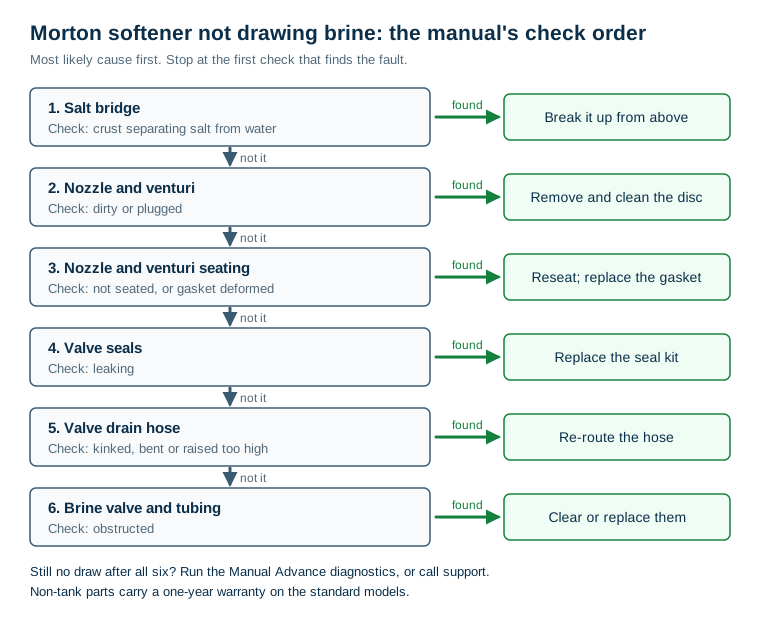
- Salt bridges are not a part failure, but the manual flags them first. High humidity or the wrong salt forms a crust, and the resin never gets brine. The fix is in water softener salt bridge.
- The nozzle and venturi disc is the most likely part to need attention. It is cheap and cleanable, and the manual gives a step-by-step cleaning procedure.
- The gasket under the nozzle and venturi deforms over time, so a cleaned disc may still leak air.
- Valve seals follow. Once they leak, brine draw and regeneration flows both suffer.
Warranty. The M20 to M34 manual covers the salt tank and fibreglass mineral tank for 10 years against rust, corrosion, leaks and bursting, and all other parts for one year. Parts are shipped free, but labour is not covered. On the M45C, Morton offers an extended warranty if you use its MWSC cleanser, and using any other softener additive voids that extension.
In-Stock Alternatives on Amazon
Because the MSD34C is unavailable, the realistic choice is a close relative. Both of these come from the same company that makes Morton's softeners.
EcoPure EPH130: the in-stock cabinet from Morton's maker. It is not a like-for-like M34: the listing describes a 2-in-1 cabinet that combines softening resin with filtration media for better-tasting water, AutoSense demand regeneration with up to 40% less salt than traditional systems, and sizing for households of up to five people. The listing title does not give a grain rating, and we could not confirm a grains-per-pound figure, so read the spec label and the manual before you compare it with the M34's 5,060 grains per pound.
EcoPure EP42: for bigger households. Retailer listings give 42,000 grains, up to 110 gpg of hardness and up to 11 ppm of iron, and the NSF listing rates it at 8.2 gpm. We could not confirm its grains-per-pound figure from a current manual, so compare it on the spec label before you buy.
Who Should Not Buy a Morton Softener
- Anyone with red water, iron bacteria or more than about 9 ppm of iron. The iron rating covers clear-water ferrous iron only. Wisconsin requires extra treatment above 5 ppm.
- Households with high peak flow. The M34's 7.8 gpm rating suits a modest home; several bathrooms in use at once call for a larger valve.
- Buyers who want long parts cover. One year on non-tank parts is short next to rivals that offer five years on the valve.
- Anyone who wants to avoid salt. None of these units remove the need for it. The trade-offs are covered in salt-based vs salt-free water treatment.
The Morton salt claim is true where it matters most: a demand softener with a small minimum dose beats a timer or a heavy dose by a wide margin. Just do not expect it to halve the salt use of a conventional metered softener that is already set up well.
Frequently Asked Questions
Is a Morton water softener any good?
On paper, yes. The Morton System Saver models are certified by NSF International against NSF/ANSI 44 for hardness reduction and efficiency, and the M34 manual rates it at 5,060 grains of hardness per pound of salt at its minimum dose. The weak points are a one-year warranty on non-tank parts for the standard models, and availability: the MSD34C currently shows as unavailable on Amazon.
How much salt does a Morton water softener use?
For a family of four on 15 gpg water, the M34's best lab rating works out to about 303 lb of salt a year. With the High Efficiency setting on, Morton guarantees at least 4,000 grains per pound, or about 383 lb a year. Real use runs higher than lab figures, because of the reserve and partial regenerations, so log what you actually pour in.
Who makes Morton water softeners?
Morton sells the salt and the brand; the softeners are made for Morton. The manual says the unit is manufactured for Morton, with an address in Woodbury, Minnesota, and NSF's current listing names Water Channel Partners of Eagan, Minnesota as the company behind the certified Morton models. The same company appears on the NSF listings for Whirlpool and EcoPure softeners.
Does a Morton softener need Morton salt?
No. Any clean grade of softener salt works, and the manual simply says to use clean grades for best results. Morton's warranty extension on the M45C does require its MWSC softener cleanser to be used, and using another additive voids the extended coverage, so read the warranty before switching cleaners.
What should I buy if the Morton softener is out of stock?
Look for another NSF/ANSI 44 efficiency-rated demand softener in the same size range. The EcoPure EP42 is a larger efficiency-rated option for bigger households, and the EcoPure EPH130 is a current softener-and-filter cabinet from the same maker as Morton's units. Compare them on grains per pound at the minimum salt dose, not on the grain number in the model name.
Should I turn the Morton High Efficiency setting on?
If salt cost matters more to you than regeneration frequency, yes. It ships turned off. With it on, the softener uses smaller salt doses and regenerates more often, and Morton states it will run at 4,000 grains per pound of salt or better. California installations must have it switched on.
